
How Italy's 'Scattered Hotels' Are Saving Forgotten Villages
The 'albergo diffuso' model transforms entire historic hamlets into decentralized hotels, reversing rural depopulation without constructing a single new building.
By Factlen Editorial Team
- Sustainable Tourism Advocates
- Focus on the environmental benefits of the model, praising its zero land consumption and circular economy approach.
- Local Economic Planners
- View the scattered hotel as a vital economic engine capable of reversing rural brain drain and funding local businesses.
- Cultural Preservationists
- Support the model but warn that it must be carefully managed to prevent the 'Disneyfication' of historic towns.
What's not represented
- · Traditional Hotel Developers
- · Displaced Rural Youth
Why this matters
As overtourism plagues major cities and rural areas face economic decline, this hospitality model offers a blueprint for sustainable travel that preserves local heritage, creates jobs, and allows visitors to authentically integrate into a community.
Key points
- The 'albergo diffuso' is a decentralized hotel model where rooms are scattered across existing historic buildings in a village.
- The concept requires zero new land consumption, relying entirely on the restoration of abandoned architectural heritage.
- Guests receive standard hotel services (reception, housekeeping) while living alongside local residents as 'temporary citizens.'
- The model creates a circular economy that provides jobs, funds local shops, and helps reverse rural depopulation.
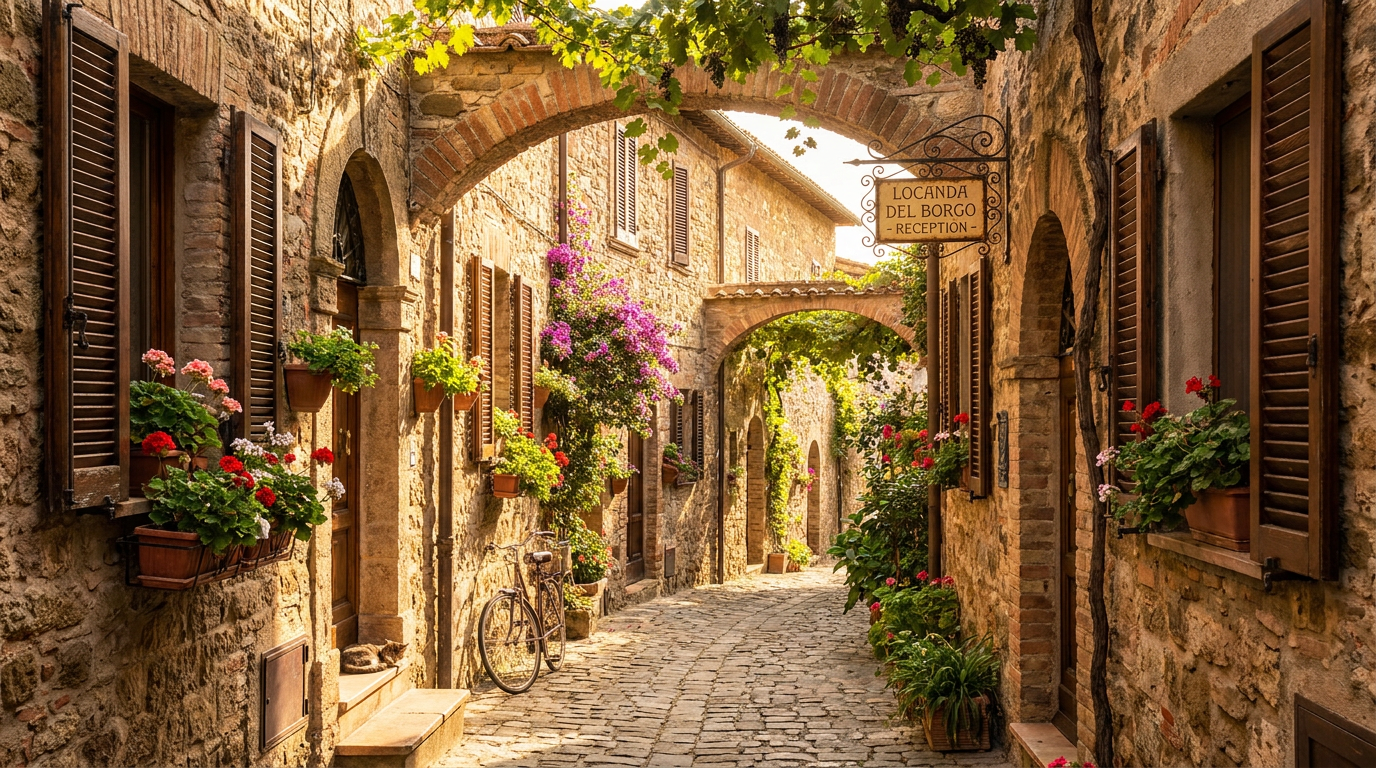
For decades, the story of rural Italy has been one of quiet attrition. As younger generations migrated to Milan, Rome, and beyond in search of economic opportunity, thousands of historic hamlets—known as borghi—were left to slowly hollow out. Cobblestone streets emptied, local bakeries shuttered, and centuries-old stone houses fell into disrepair. Yet, a uniquely Italian innovation is reversing this tide, transforming the very concept of hospitality while breathing life back into forgotten towns. It is called the albergo diffuso, or 'scattered hotel'.[1][3]
Unlike a traditional hotel, which builds vertically and consolidates guests into a single enclosed structure, an albergo diffuso expands horizontally across an existing, inhabited village. There are no new concrete foundations poured, no sprawling resort campuses, and no artificial tourist bubbles. Instead, the village itself becomes the hotel. The reception desk might be located in a former storefront on the main piazza, the dining room in a restored medieval cellar, and the guest suites scattered across various historic homes, all within a short walking distance of one another.[1][2]
The model was pioneered in the early 1980s by Italian tourism marketing professor Giancarlo Dall'Ara. Following a devastating 1976 earthquake in the northern Friuli-Venezia Giulia region, Dall'Ara was consulting on the reconstruction of the village of Carnia. Recognizing that the town needed an economic engine to survive, he proposed a radical idea: rather than building a new hotel on the outskirts to attract visitors, why not network the newly restored, empty houses into a single hospitality entity?[1][5]
The genius of the albergo diffuso lies in its strict operational criteria. To qualify, the property must be managed as a single professional enterprise, offering standard hotel amenities like daily housekeeping, room service, and a central reception. However, the rooms must be integrated into a living community. Guests are not isolated tourists; they are 'temporary residents' who walk the same narrow alleys—the hotel's 'corridors'—as the locals, smelling the morning espresso and hearing the church bells just as their neighbors do.[5][6]

From an environmental perspective, the scattered hotel is a masterclass in sustainable urban planning. It operates on the principle of 'zero land consumption.' Because the model strictly utilizes existing architectural heritage, it requires no new construction sites and does not disrupt the surrounding hydrogeological balance. Restoration efforts typically employ local artisans and adhere to green building practices, preserving the historical aesthetic—from timeworn wooden beams to uneven stone floors—while outfitting the interiors with modern comforts.[1][6]
This architectural conservation is paired with profound economic revitalization. Traditional mass tourism often extracts wealth from a destination, funneling profits to multinational resort chains while overwhelming local infrastructure. The albergo diffuso, by contrast, operates as a circular economy. By employing local residents as staff, sourcing food from nearby farmers, and encouraging guests to patronize village shops, the economic benefits are distributed directly into the community's fabric.[1][5]
This architectural conservation is paired with profound economic revitalization.
Consider the village of Golferenzo in the Oltrepò Pavese hills. With only a few dozen permanent residents, its historic center was nearly deserted until the launch of Borgo dei Gatti, an albergo diffuso occupying restored rural homes. The influx of guests provided the economic baseline needed to reopen a local shop that had been closed for 40 years, alongside a historic pizzeria and a contemporary restaurant. The hotel did not just bring tourists; it rebuilt the town's commercial ecosystem.[2]
Perhaps the most famous example is Sextantio in Santo Stefano di Sessanio, a fortified medieval village high in the Apennine Mountains of Abruzzo. Here, 27 guest rooms are dispersed across restored barns, stables, and shepherds' dwellings. The restoration was painstakingly authentic, utilizing handwoven textiles and handmade olive oil soaps. Of the roughly 100 people who live in the village, a significant portion now work either directly for the hotel or operate adjacent businesses that rely on its guests.[3]

While the model is highly celebrated, it is not without its logistical and financial hurdles. Restoring scattered, centuries-old buildings to modern safety and comfort standards requires a massive initial capital investment, often significantly higher than constructing a conventional hotel from scratch. Furthermore, managing a decentralized property—delivering room service across a rainy piazza, or maintaining consistent Wi-Fi in thick-walled medieval stone houses—presents daily operational challenges that traditional hoteliers never face.[6][7]
There is also the delicate balance of community integration. For an albergo diffuso to succeed, the village must retain a genuine, living population. If a town becomes entirely composed of hotel rooms and holiday rentals, it risks falling into 'Disneyfication'—becoming a hollow museum rather than a living community. The model's founders strictly emphasize that the scattered hotel must complement the local population, not replace it.[2][7]
This requirement sharply distinguishes the albergo diffuso from the proliferation of short-term rental platforms like Airbnb. While short-term rentals often drive up local housing costs and push residents out of historic centers, the scattered hotel is centrally managed, legally regulated, and explicitly designed to generate local employment and preserve the social fabric. It is a collective enterprise rather than a fragmented real estate speculation.[4][7]

The success of the Italian experiment has not gone unnoticed globally. What began as a localized response to an earthquake has evolved into an internationally recognized framework for sustainable tourism. The Global Forum on Human Settlements and the World Travel Market have both lauded the model, and it is now being adapted in countries facing similar rural depopulation crises, including Japan, Germany, and Switzerland.[5][7]
As global travel rebounds and evolves in the mid-2020s, consumer preferences are shifting. Increasingly, travelers are rejecting the sterile uniformity of chain hotels in favor of authentic, immersive experiences. The albergo diffuso meets this demand perfectly, offering the comfort and reliability of a luxury stay combined with the profound intimacy of village life.[4][6]
Ultimately, the scattered hotel represents a paradigm shift in how we value heritage. It proves that preservation and economic development do not have to be mutually exclusive. By treating historic architecture not as a relic to be cordoned off, but as a living space to be shared, the albergo diffuso is ensuring that Italy's most beautiful, forgotten corners will continue to write new chapters for generations to come.[1][7]
How we got here
1976
A devastating earthquake strikes the Friuli region of Italy, leaving many historic villages damaged and abandoned.
1982
Marketing professor Giancarlo Dall'Ara pilots the first 'scattered hotel' concept to revitalize the village of Carnia.
2010
The Italian National Association of Alberghi Diffusi wins the World Travel Market Global Award for sustainable tourism.
2020s
The model expands internationally, with scattered hotels opening in Japan, Germany, and Switzerland to combat rural depopulation.
Viewpoints in depth
Sustainable Tourism Advocates
Focus on the environmental benefits of the model, praising its zero land consumption and circular economy approach.
Environmental planners and sustainable tourism advocates champion the albergo diffuso as the ultimate antidote to the extractive nature of mass tourism. They point out that traditional vertical hotels destroy the hydrogeological balance and aesthetic of rural areas, requiring massive concrete pours and new infrastructure. By contrast, the scattered hotel model operates on a principle of zero land consumption. Because it strictly utilizes existing architectural heritage, its environmental footprint is minimal. Furthermore, advocates highlight the circular economy it creates: by employing local artisans for restoration and sourcing food from nearby farmers, the model ensures that the economic benefits of tourism remain within the community rather than being siphoned off by multinational corporations.
Local Economic Planners
View the scattered hotel as a vital economic engine capable of reversing rural brain drain and funding local businesses.
For municipal leaders and economic planners in rural Italy, the primary value of the albergo diffuso is its ability to reverse decades of depopulation. As younger generations migrate to urban centers, historic villages lose the tax base required to maintain basic services. Economic planners argue that the scattered hotel provides the necessary financial baseline to keep a town alive. The steady influx of guests justifies the reopening of local bakeries, pharmacies, and artisan shops that would otherwise shutter. By creating direct employment in hospitality and indirect employment in adjacent services, the model offers rural youth a viable economic reason to stay in their hometowns.
Cultural Preservationists
Support the model but warn that it must be carefully managed to prevent the 'Disneyfication' of historic towns.
Cultural preservationists generally support the albergo diffuso model but offer a note of caution regarding its implementation. They argue that the success of the model hinges entirely on the presence of a genuine, living local population. If a village becomes too successful as a tourist destination, there is a risk that property values will rise, pushing out the remaining locals and turning the town into a hollow, open-air museum—a phenomenon often referred to as 'Disneyfication.' Preservationists insist that strict regulations must be maintained to ensure that scattered hotels complement the local community rather than consume it, preserving the authentic social fabric that makes the destination appealing in the first place.
What we don't know
- Whether the model can scale effectively in countries without Italy's specific density of historic, medieval architecture.
- How the rising costs of conservative architectural restoration will impact the financial viability of future scattered hotel projects.
Key terms
- Albergo Diffuso
- Literally 'scattered hotel,' a hospitality model where rooms and services are distributed across existing buildings in a historic village.
- Borgo
- An Italian term for a historic village or hamlet, often dating back to the Middle Ages or Renaissance.
- Circular Economy
- An economic system aimed at eliminating waste and the continual use of resources, applied here by repurposing abandoned buildings and sourcing locally.
- Zero Land Consumption
- An urban planning principle that avoids developing new natural land, focusing instead on the regeneration of existing structures.
Frequently asked
What is the difference between an Albergo Diffuso and an Airbnb?
An Albergo Diffuso is a single, professionally managed hotel with a central reception, daily housekeeping, and standard amenities. Airbnb typically consists of unmanaged, decentralized private rentals.
Does an Albergo Diffuso require new construction?
No. The core philosophy of the model is 'zero land consumption,' meaning all rooms and facilities must be housed within restored, pre-existing historic buildings.
Can this model be implemented in an abandoned ghost town?
Generally, no. The model relies on integrating guests into a living community. If there are no permanent residents left, the project functions more like a resort than a true Albergo Diffuso.
Sources
Source coverage
7 outlets
3 viewpoints surfaced







[1]Smart Green PostSustainable Tourism Advocates
Scattered Hotels: Tourism Regenerating Historic Villages
Read on Smart Green Post →[2]Gambero RossoLocal Economic Planners
The tourism that saves forgotten villages: Italy's hamlets are reborn through Alberghi Diffusi
Read on Gambero Rosso →[3]South China Morning PostSustainable Tourism Advocates
Albergo diffuso, or 'scattered hotel', is a concept offering a different kind of sustainable hospitality experience
Read on South China Morning Post →[4]ExploreCultural Preservationists
The Unique Italian Hotel Concept That's Spreading Around The World
Read on Explore →[5]Global Forum on Human SettlementsLocal Economic Planners
Albergo Diffuso: The Italian model for rural revitalization and sustainable tourism development
Read on Global Forum on Human Settlements →[6]Journal of Place Management and DevelopmentCultural Preservationists
Sustainable tourism and development: the model of the Albergo Diffuso
Read on Journal of Place Management and Development →[7]Factlen Editorial TeamCultural Preservationists
Synthesis by Factlen editorial team
Read on Factlen Editorial Team →



Every angle. Every day.
Get travel stories with full source coverage and perspective breakdowns delivered to your inbox.