
Solar Power Eclipses Coal in the US for the First Time, Powered by a Battery Storage Boom
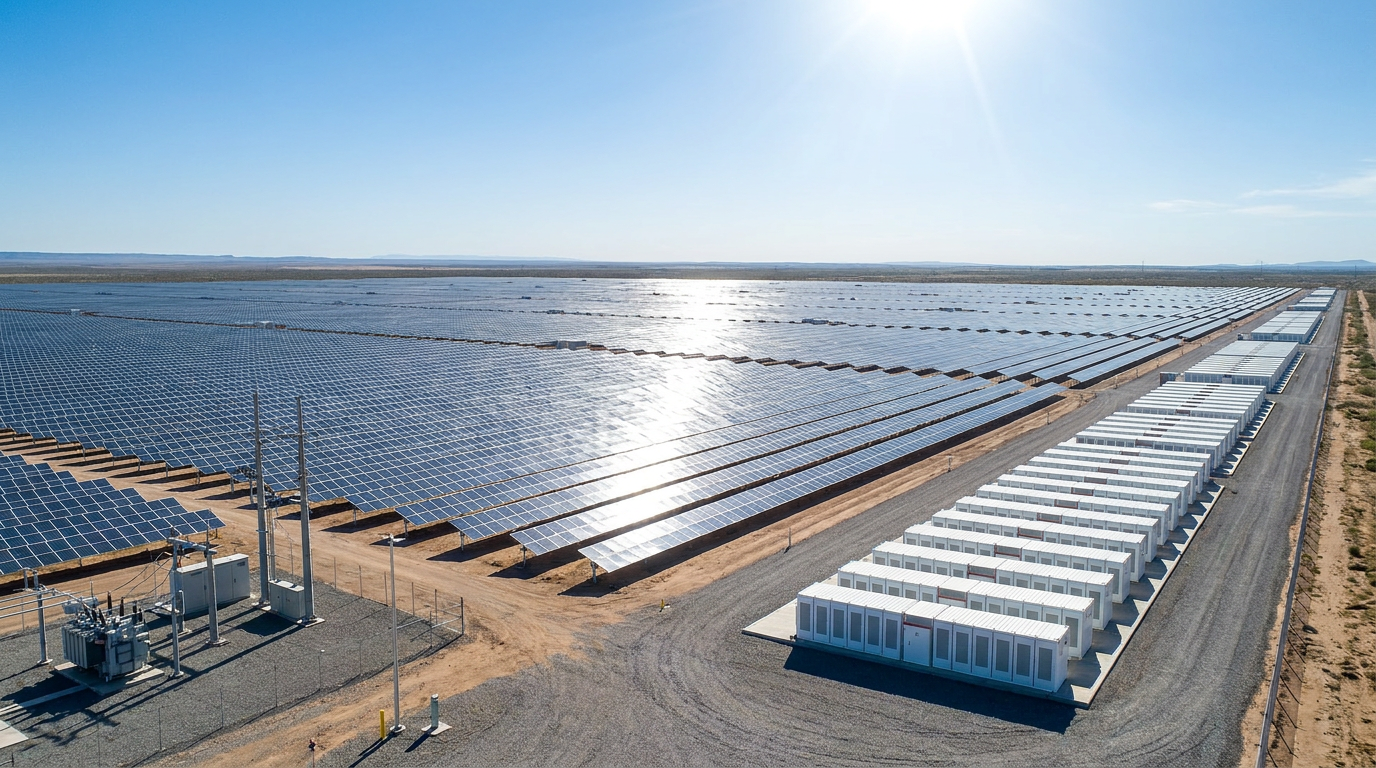
In a historic milestone for energy markets, US solar generation surpassed coal in May 2026, driven by an unprecedented expansion of grid-scale battery storage that is stabilizing wholesale prices.
By Factlen Editorial Team
- Grid Operators & Utilities
- Focused on maintaining grid reliability and managing the evening demand ramp.
- Clean Energy Developers
- Focused on the pure economic advantage and rapid deployment of solar-plus-storage.
- Industrial & Tech Consumers
- Focused on securing 24/7 reliable power to fuel manufacturing and data center growth.
What's not represented
- · Fossil Fuel Industry Advocates
- · Local Communities Near Utility-Scale Projects
Why this matters
The long-feared 'intermittency problem' of renewable energy is being solved in real-time by market economics. As giant battery installations replace expensive natural gas peaker plants, consumers and businesses are gaining access to a more resilient, cost-effective power grid even as overall electricity demand surges.
Key points
- US solar generation reached a record 12.8% of the electricity mix in May 2026, surpassing coal's 12.2%.
- The milestone is heavily supported by an unprecedented expansion in grid-scale battery storage.
- Developers plan to add a record 86 GW of new utility-scale capacity in 2026, with solar and batteries comprising nearly 80%.
- Battery systems are increasingly outcompeting natural gas peaker plants on pure market economics.
- Surging electricity demand from AI data centers and industrial manufacturing is accelerating the deployment of these rapid-build assets.
For the first time in American history, solar power has eclipsed coal in the nation's electricity mix. According to data released in June 2026 by the global energy think tank Ember, solar generation supplied a record 12.8% of US electricity in May, edging past coal, which fell to an all-time low of 12.2% for the month. The milestone marks a profound psychological and economic turning point for the US energy market, proving that renewable generation can shoulder the baseload burden of a modern, industrialized economy.[1]
The crossover is the result of a staggering multi-year buildout. Just five years ago, in May 2021, coal accounted for nearly 20% of the US power mix, while solar hovered around 5.4%. The rapid inversion of those figures is not merely a story of subsidized solar panels; it is the direct result of a parallel revolution in grid-scale battery storage that has fundamentally altered the economics of wholesale electricity.[1][2][3]

Historically, the Achilles' heel of solar power has been its intermittency—the sun sets precisely when evening residential demand begins to peak. This dynamic created the infamous "duck curve," where grid operators were forced to fire up expensive, carbon-intensive natural gas peaker plants to bridge the evening gap. But in 2026, the market has found a more lucrative solution: storing the midday solar glut and discharging it after dark.[4][7]
The sheer scale of this year's infrastructure deployment is unprecedented. Project developers are on track to add a record 86 gigawatts (GW) of new utility-scale generating capacity to the US grid in 2026. Solar power accounts for 51% of those additions, but the critical enabler is battery storage, which makes up 28% of the new capacity. An estimated 24 GW of utility-scale batteries will come online this year alone, a massive leap from the 15 GW added in 2025.[2]

This battery boom is driven by pure, unadulterated market economics. In deregulated wholesale markets, electricity prices can swing from near-zero—or even negative—during peak midday sunlight to hundreds of dollars per megawatt-hour during the evening ramp. Battery operators are capitalizing on this volatility through wholesale energy arbitrage, buying cheap, abundant solar power during the day and selling it back to the grid at a premium when the sun goes down.[7]
This battery boom is driven by pure, unadulterated market economics.
The economic viability of this model means batteries are now routinely outbidding natural gas peaker plants. A modern four-hour battery system costs a fraction of a new gas plant to build, requires virtually no maintenance, and can respond to grid frequency drops in milliseconds. As a result, the combination of solar and storage has become the quickest and most popular route for utilities to add reliable power supplies.[3][7]
The epicenter of this transformation is a high-stakes race between the nation's two largest and most complex grids: California (CAISO) and Texas (ERCOT). California pioneered the integration of grid-scale batteries, proving that they could be stitched into the daily heartbeat of grid operations to prevent summer blackouts. But Texas, driven by its massive, energy-hungry industrial sector and deregulated market, is scaling the technology at record speed.[7]
In fact, ERCOT briefly surpassed CAISO in total installed battery capacity in 2025, a stunning development for a state historically synonymous with fossil fuels. Texas utilities are aggressively deploying battery systems to capture the state's massive solar output, ensuring that the lights—and the air conditioners—stay on during the brutal summer heatwaves.[3][7]

This surge in clean, dispatchable power arrives at a critical moment for the US economy. After nearly 15 years of flatlining, American electricity demand is suddenly surging, growing at an annual rate of 1.7%. This new phase of intensification is being driven by the rapid build-out of artificial intelligence data centers, the reshoring of heavy manufacturing, and the broad electrification of the transportation sector.[3][5]
Industrial consumers are acutely aware of the stakes. Trade groups emphasize that powering this manufacturing renaissance requires an "all-of-the-above" energy strategy and significant permitting reform to get infrastructure built faster. The fact that solar and batteries are currently the fastest assets to deploy makes them indispensable to meeting this skyrocketing industrial demand.[3][6]
The US milestone mirrors a broader global realignment. Worldwide, renewables officially overtook coal as the largest source of electricity in 2025, capturing a 33.8% share of global generation. Analysts project that solar will become the world's single largest electricity source by 2032, fundamentally insulating highly electrified economies from the geopolitical price shocks that have historically plagued fossil fuel markets.[5]
As the summer of 2026 approaches, grid operators face their ultimate annual test. But with record levels of solar capacity backed by an armada of grid-scale batteries, the market has engineered a structural shift. The transition to a clean power grid is no longer a distant environmental aspiration; it is the operational reality of the modern energy economy.[1][2][7]
How we got here
2013
California brings online its first utility-grade battery project at Vaca-Dixon, laying the groundwork for grid-scale storage.
May 2021
Coal accounts for nearly 20% of the US power mix, while solar sits at just 5.4%.
2025
Renewables officially overtake coal as the largest source of electricity globally.
Q2 2025
Texas (ERCOT) briefly surpasses California (CAISO) in total installed battery capacity.
May 2026
Solar generation overtakes coal in the US for the first month on record.
Viewpoints in depth
Grid Operators & Utilities
Focused on maintaining grid reliability and managing the evening demand ramp.
For grid operators, the rapid influx of solar power initially presented a massive headache known as the 'duck curve'—a massive oversupply of midday power followed by a steep drop-off just as evening demand spiked. Their primary concern is reliability. By aggressively deploying battery storage, operators in markets like CAISO and ERCOT are turning volatile solar generation into a dispatchable asset, allowing them to retire aging fossil fuel plants without risking summer blackouts.
Clean Energy Developers
Focused on the pure economic advantage and rapid deployment of solar-plus-storage.
Developers view the current market as a definitive tipping point where green energy is no longer reliant on subsidies, but is winning on pure wholesale economics. They point to the lucrative returns of wholesale energy arbitrage—buying cheap midday power and selling it at a premium during the evening peak. For this camp, the 86 GW of planned capacity in 2026 is proof that capital markets have fully embraced the financial viability of the renewable transition.
Industrial & Tech Consumers
Focused on securing 24/7 reliable power to fuel manufacturing and data center growth.
Heavy industry and major tech companies are driving the first significant surge in US electricity demand in 15 years. While they are major buyers of renewable energy credits, their ultimate priority is uninterrupted, 24/7 power. This camp frequently advocates for an 'all-of-the-above' energy strategy and aggressive permitting reform, arguing that the current regulatory red tape is the biggest bottleneck to building the infrastructure required for America's manufacturing and AI renaissance.
What we don't know
- Whether the solar-over-coal milestone will hold through the peak air-conditioning months of July and August, when overall grid demand hits its absolute maximum.
- How quickly federal and state permitting reforms will be enacted to alleviate the backlog of renewable projects waiting to connect to the grid.
- The exact impact that the exponential growth of AI data centers will have on localized grid stability in key markets like Virginia and Texas over the next five years.
Key terms
- Duck Curve
- A graph of power production that shows the timing imbalance between peak demand and renewable energy production, typically featuring a deep midday dip when solar generation is highest.
- Peaker Plant
- Power plants, usually powered by natural gas, that generally only run when there is a high demand for electricity, in order to balance the grid.
- Wholesale Energy Arbitrage
- The practice of buying electricity when prices are low (like during a midday solar glut) and storing it to sell when prices are high (like during evening peak demand).
- Dispatchable Generation
- Sources of electricity that can be turned on or off, or have their power output adjusted, according to market needs.
Frequently asked
Why did solar overtake coal specifically in May?
May typically features strong sunlight but moderate temperatures, meaning solar output is high before the massive summer air-conditioning demand kicks in.
How do batteries make solar power more reliable?
Grid-scale batteries absorb excess solar energy generated during the middle of the day and discharge it into the grid during the evening when demand peaks and the sun goes down.
Is this transition causing electricity shortages?
No. In fact, the combination of solar and battery storage is currently the fastest way for utilities to add new, reliable capacity to meet surging electricity demand from data centers and manufacturing.
Sources
Source coverage
7 outlets
3 viewpoints surfaced







[1]EmberClean Energy Developers
Solar overtakes coal in US electricity generation for the first month ever in May 2026
Read on Ember →[2]U.S. Energy Information AdministrationGrid Operators & Utilities
New U.S. electric generating capacity expected to reach a record high in 2026
Read on U.S. Energy Information Administration →[3]PV MagazineClean Energy Developers
Combined generation from wind and utility-scale solar reached a record 17% of the US electricity mix
Read on PV Magazine →[4]Utility DiveIndustrial & Tech Consumers
Solar and wind PPA prices up, set to continue rising with energy demand
Read on Utility Dive →[5]BloombergNEFClean Energy Developers
New Energy Outlook 2026
Read on BloombergNEF →[6]National Association of ManufacturersIndustrial & Tech Consumers
U.S. wind and utility-scale solar projects generated a record 17% of U.S. electricity
Read on National Association of Manufacturers →[7]AmperonGrid Operators & Utilities
ERCOT briefly surpassed CAISO in total installed battery capacity
Read on Amperon →
Every angle. Every day.
Get energy stories with full source coverage and perspective breakdowns delivered to your inbox.