
Trail Running Shoes vs. Hiking Boots: The 2026 Backpacking Footwear Debate
As ultralight gear transforms outdoor culture, the debate between agile trail runners and supportive hiking boots comes down to pack weight, terrain, and biomechanics.
By Factlen Editorial Team
- Ultralight Backpackers
- Prioritizes weight savings and speed, viewing heavy boots as an unnecessary energy drain.
- Traditional Mountaineers
- Values durability, weather protection, and structural support for demanding backcountry environments.
- Biomechanics Researchers
- Focuses on matching footwear rigidity to the physical load and terrain variables.
What's not represented
- · Casual day-hikers who do not carry heavy packs but still purchase heavy boots out of habit.
- · Physical therapists treating overuse injuries specific to zero-drop or highly cushioned trail runners.
Why this matters
Choosing the right footwear is the single most consequential gear decision a hiker makes, directly dictating their comfort, safety, and energy levels on the trail. Understanding the biomechanical trade-offs between boots and trail runners helps outdoor enthusiasts avoid painful blisters, prevent joint fatigue, and match their shoes to their specific pack weight and terrain.
Key points
- Trail running shoes save significant energy, as one pound of weight on the feet equals roughly five pounds on the back.
- Traditional hiking boots provide essential structural rigidity for carrying packs over 35 pounds on uneven terrain.
- Trail runners dry exceptionally fast when wet, whereas waterproof boots can trap moisture and cause blisters.
- Hiking boots offer superior durability, lasting years compared to the 300-500 mile lifespan of a typical trail runner.
- The 2025 Appalachian Trail survey shows over 50% of thru-hikers now prefer trail runners for long-distance routes.
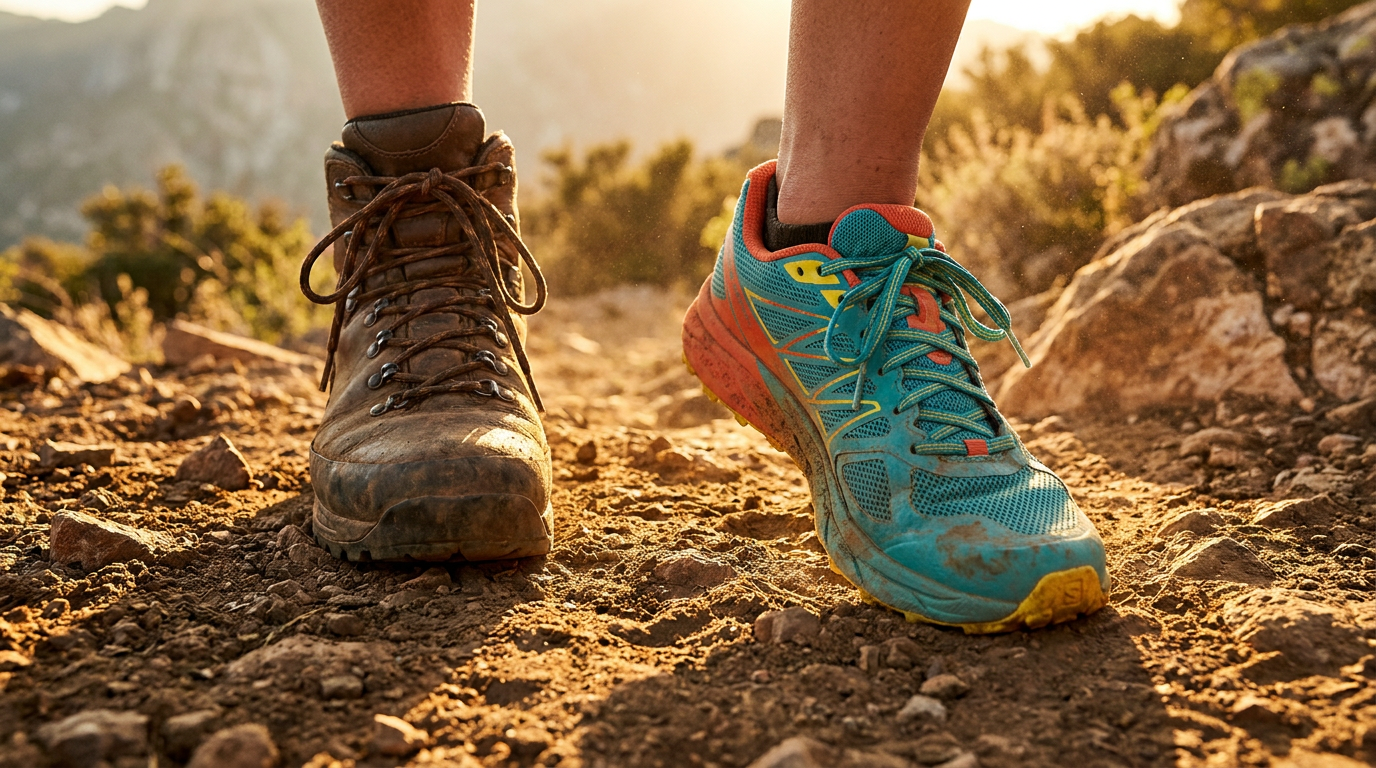
Spend enough time on a backcountry trail this summer, and you will inevitably witness the contrast: a traditional backpacker grinding uphill in heavy leather boots, passed by a thru-hiker gliding over the same rocks in brightly colored, lightweight trail running shoes. This scene represents one of the most divisive and impactful debates in the modern outdoor community. For decades, the unquestioned wisdom dictated that carrying a heavy pack required heavy, rigid footwear to protect the ankles and support the load. Today, that consensus has fractured. Driven by the ultralight backpacking movement and advances in synthetic materials, a massive shift in trail culture has elevated the trail runner from a niche racing shoe to the footwear of choice for thousands of long-distance hikers.[1][4]
The transition has not been quiet. Traditional mountaineers and casual weekend warriors often view the adoption of flimsy-looking running shoes with skepticism, citing concerns about durability and safety on rugged terrain. Conversely, modern thru-hikers argue that the traditional hiking boot is an outdated relic that causes more fatigue and blisters than it prevents. The truth, as gear testers and biomechanics researchers point out, sits somewhere in the middle. There is no universally perfect shoe, only the right tool for a specific set of conditions. Understanding the trade-offs between these two distinct philosophies is essential for anyone preparing to step onto the trail.[1][5]
The primary argument for trail runners centers on energy expenditure and the compounding cost of weight. Every comparison of outdoor footwear notes that trail runners are significantly lighter than boots, but the biomechanical impact of that difference is profound. Research consistently demonstrates that weight carried on the feet requires approximately four to six times more energy to move than the equivalent weight carried on the back. This is because every stride requires the hiker to lift the foot, decelerate it, and re-accelerate it in a pendulum motion. When a hiker swaps a 3.3-pound pair of leather boots for a 1.5-pound pair of trail runners, the energy savings over a 15-mile day are massive.[2][7]
The evidence backing this lightweight shift is substantial and visible on America's longest trails. According to the 2025 Appalachian Trail Thru-Hiker Survey, over 50 percent of hikers who completed the trail wore trail running shoes, and they reported overwhelmingly high satisfaction rates. These hikers prioritize agility and a natural foot strike over rigid support. Modern trail runners are engineered with aggressive tread patterns, utilizing premium rubber compounds like Vibram Megagrip that provide exceptional friction on wet slabs and loose dirt. For hikers moving fast with light packs, this combination of traction and low weight allows them to cover greater distances with significantly less lower-body fatigue.[2][6]

Breathability and moisture management form another core pillar of the case for trail runners. Traditional waterproof boots are designed to keep water out, but they also trap heat and sweat inside, which is a primary catalyst for blisters. Furthermore, if a hiker steps into a river that overtops the boot's collar, the waterproof membrane effectively turns the boot into a bucket that can take days to dry. Trail runners operate on the opposite philosophy: they accept that feet will get wet, but utilize highly breathable mesh uppers that drain instantly and dry rapidly as the hiker continues to walk. Paired with merino wool socks, this fast-drying approach is highly effective for three-season hiking.[3][5]
Breathability and moisture management form another core pillar of the case for trail runners.
However, the case against trail running shoes is anchored in their undeniable lack of durability. A premium leather hiking boot can easily survive years of abuse and thousands of miles of rough terrain. In stark contrast, the soft EVA foam midsoles and synthetic mesh uppers of a trail runner typically break down after just 300 to 500 miles. For a thru-hiker attempting a 2,000-mile journey, this means purchasing and breaking in four to five pairs of shoes along the way. This reality introduces a significant financial and environmental cost, forcing hikers to treat their footwear as a consumable piece of gear rather than a long-term investment.[1][5]
Furthermore, trail runners lack the structural chassis required to comfortably carry heavy loads. If a backpacker is hauling 45 pounds of gear, food, and water, the soft midsole of a running shoe will compress unevenly, leading to foot fatigue and a higher risk of rolling an ankle on uneven terrain. This is where the traditional hiking boot asserts its dominance. Boots are built with stiff shanks and wide, stable bases that prevent the shoe from twisting under heavy compression. This structural rigidity acts as a platform, transferring the weight of a heavy pack away from the small muscles of the foot and up into the stronger muscles of the legs.[2][4]
The case for hiking boots also heavily emphasizes ankle support and environmental protection. In off-trail scenarios, bushwhacking through dense undergrowth, or navigating scree fields, the high collar of a boot provides a physical barrier against sharp rocks, thorns, and even snake bites. When traversing steep, uneven slopes, the rigid upper locks the ankle in place, reducing the likelihood of a sprain when fatigue sets in. For winter hiking, mountaineering, or slogging through deep, freezing mud, the insulation and impenetrable barrier of a full-grain leather or Gore-Tex boot remain absolutely indispensable.[3][4]
Despite these protective benefits, the case against hiking boots highlights their cumbersome nature and the dreaded break-in period. Unlike trail runners, which are generally comfortable straight out of the box, rigid boots require weeks of gradual wear to soften the materials and mold to the hiker's foot. Failure to properly break in a boot is a guaranteed recipe for debilitating heel and toe blisters. Additionally, the sheer bulk of a boot reduces a hiker's proprioception—the ability to feel and react to the ground—making foot placement less precise and increasing the clumsiness of the stride on technical rock scrambles.[4][6]

Ultimately, the decision requires an honest assessment of the hiker's itinerary, pack weight, and physical conditioning. Trail running shoes fit exceptionally well when the hiker is carrying a pack under 30 pounds, traveling on established and maintained trails, and hiking in warm, three-season conditions. They are the undisputed champions for fast-paced itineraries where energy efficiency and breathability are the highest priorities. For hikers who have developed strong foot and ankle muscles, the freedom of movement offered by a trail runner can transform a grueling march into an agile, enjoyable experience.[1][2][7]
Conversely, traditional hiking boots fit perfectly when the itinerary demands carrying a heavy expedition pack exceeding 35 pounds, or when the route involves extensive off-trail navigation and rugged alpine scrambling. They remain the mandatory choice for cold weather, deep snow, and hikers who have pre-existing ankle instability or require orthotic support that a soft shoe cannot accommodate. In these demanding environments, the weight penalty of a boot is a necessary trade-off for the structural safety and thermal protection it provides.[3][4][7]

For those caught in the middle, the outdoor industry has recently introduced a compromise: the mid-cut trail runner. Models like the Altra Lone Peak Mid or the Hoka Speedgoat Mid take the lightweight foam and breathable mesh of a running shoe and extend the collar above the ankle. While they do not offer the load-bearing rigidity of a true boot, they provide a psychological sense of security and excellent protection against trail debris. As gear continues to evolve, the most experienced backpackers have stopped asking which footwear is objectively better, and instead ask which tool is best suited for the specific trail ahead.[2][7]
How we got here
1980s-1990s
Heavy leather hiking boots are considered mandatory for all backpacking trips to prevent ankle injuries.
2000s
The ultralight backpacking movement gains traction, with early adopters experimenting with standard running shoes on long trails.
2010s
Footwear brands introduce rugged trail running shoes with rock plates and aggressive lugs, specifically targeting off-road athletes.
2025
The Appalachian Trail Thru-Hiker Survey reveals that over 50% of long-distance hikers now prefer trail runners over traditional boots.
2026
Hybrid 'mid-cut' trail runners emerge as the fastest-growing footwear category, attempting to bridge the gap between agility and ankle support.
Viewpoints in depth
The Ultralight Backpacker View
Prioritizes weight savings and speed, viewing heavy boots as an unnecessary energy drain.
This camp argues that the traditional emphasis on ankle support is a myth perpetuated by the footwear industry, asserting that strong lower-leg muscles and a lighter pack are the true keys to injury prevention. They point to the 1:5 weight ratio (one pound on the foot equals five on the back) as undeniable proof that trail runners are superior for long-distance efficiency. For these hikers, the short lifespan of a trail runner is a perfectly acceptable subscription cost for the comfort and agility it provides.
The Traditional Mountaineer View
Values durability, weather protection, and structural support for demanding backcountry environments.
Traditionalists maintain that trail runners are a fair-weather trend that compromises safety when conditions deteriorate. They argue that while running shoes excel on manicured dirt paths, they fail catastrophically when tasked with supporting a 45-pound pack across off-trail scree fields or freezing mud. This camp emphasizes the long-term economic and environmental benefits of buying a single pair of resoleable leather boots that can last a decade, rather than discarding synthetic foam shoes every few hundred miles.
The Biomechanics Researcher View
Focuses on matching footwear rigidity to the physical load and terrain variables.
Sports scientists and gear researchers reject the binary nature of the debate, focusing instead on load-bearing physics. Their data shows that the soft EVA foam of a trail runner compresses unevenly under heavy pack weights, which can alter a hiker's gait and lead to knee or hip pain. Conversely, they validate the energy-expenditure claims of the ultralight camp. Their consensus is that footwear must scale with the backpack: light packs allow for flexible shoes, while heavy loads mechanically require a rigid chassis to prevent foot fatigue.
What we don't know
- Whether the long-term joint health of hikers is better served by the rigid support of boots or the natural foot articulation allowed by trail runners.
- How emerging sustainable materials will impact the notoriously short lifespan (300-500 miles) of modern trail running shoes.
Key terms
- EVA Foam
- A lightweight, shock-absorbing synthetic material commonly used in the midsoles of running shoes to provide cushioning.
- Heel Drop
- The difference in height between the heel and the toe of a shoe, which affects how the foot strikes the ground.
- Rock Plate
- A hard plastic or carbon fiber insert placed in the midsole of a trail shoe to protect the bottom of the foot from sharp rocks.
- Proprioception
- The body's ability to sense its location, movements, and actions, which is often reduced by wearing thick, heavy footwear.
- Thru-Hiker
- A backpacker who completes a long-distance trail, such as the Appalachian Trail or Pacific Crest Trail, in a single continuous journey.
Frequently asked
Can you wear trail running shoes for backpacking?
Yes. Trail running shoes are highly recommended for backpacking if your total pack weight is under 30 pounds and you are hiking on established trails. They offer superior energy efficiency and breathability.
Do hiking boots actually prevent ankle sprains?
Hiking boots provide structural support that helps prevent the ankle from rolling, especially when carrying a heavy pack. However, many experts argue that building strong foot and ankle muscles is equally important for injury prevention.
How long do trail running shoes last on the trail?
Most trail running shoes have a lifespan of 300 to 500 miles before the EVA foam midsole compresses and the tread wears down. In contrast, quality leather hiking boots can last for thousands of miles.
What happens when trail running shoes get wet?
Non-waterproof trail runners will get wet immediately in a stream crossing, but their breathable mesh uppers allow them to drain and dry very quickly as you continue to hike.
Sources
Source coverage
7 outlets
3 viewpoints surfaced







[1]UNPLUG MagazineUltralight Backpackers
Trail Running Shoes vs. Hiking Boots: The Debate
Read on UNPLUG Magazine →[2]BootsGuruBiomechanics Researchers
Trail Running Shoes vs Hiking Boots (2026): The Research-Backed Guide
Read on BootsGuru →[3]HikeSphereTraditional Mountaineers
Table Comparison between Trail Running Shoes vs Hiking Boots
Read on HikeSphere →[4]Expedition DetroitTraditional Mountaineers
The Great Trail Debate: Trail Running Shoes vs. Hiking Boots
Read on Expedition Detroit →[5]Shoe StationUltralight Backpackers
Why Hikers are Switching to Trail Runners
Read on Shoe Station →[6]The Hiking LifeUltralight Backpackers
Why Choose Trail Running Shoes over Boots for Three-Season Conditions?
Read on The Hiking Life →[7]Factlen Editorial TeamBiomechanics Researchers
Synthesis by Factlen editorial team
Read on Factlen Editorial Team →



Every angle. Every day.
Get shopping stories with full source coverage and perspective breakdowns delivered to your inbox.