
Smart Ring vs. Smartwatch: The Complete 2026 Trade-Off Analysis
As the wearable market splits, consumers face a choice between the passive, multi-day sleep tracking of smart rings and the active, real-time fitness coaching of smartwatches.
By Factlen Editorial Team
- Passive Wellness Advocates
- Prioritizing invisible, ambient tracking for sleep and recovery without digital distractions.
- Active Fitness Enthusiasts
- Demanding real-time data, GPS, and immediate biofeedback to optimize athletic performance.
- Clinical Data Researchers
- Focusing on sensor placement, signal fidelity, and medical-grade validation of biometric data.
What's not represented
- · Traditional mechanical watch collectors
- · Budget fitness tracker users
Why this matters
Choosing the wrong wearable can lead to digital fatigue or a lack of actionable fitness data. Understanding the physiological and practical differences between wrist and finger sensors ensures you invest in a tool that actually improves your daily habits.
Key points
- The wearable market has split between active, screen-based smartwatches and passive, screen-less smart rings.
- Smart rings offer superior comfort and cleaner sensor signals for overnight sleep and recovery tracking.
- Smartwatches remain the undisputed choice for real-time workout data, GPS mapping, and active coaching.
- Rings boast multi-day battery life (5–12 days) compared to the daily charging required by most smartwatches.
- Buyers must weigh the upfront cost of smartwatches against the potential ongoing subscription fees of some smart rings.
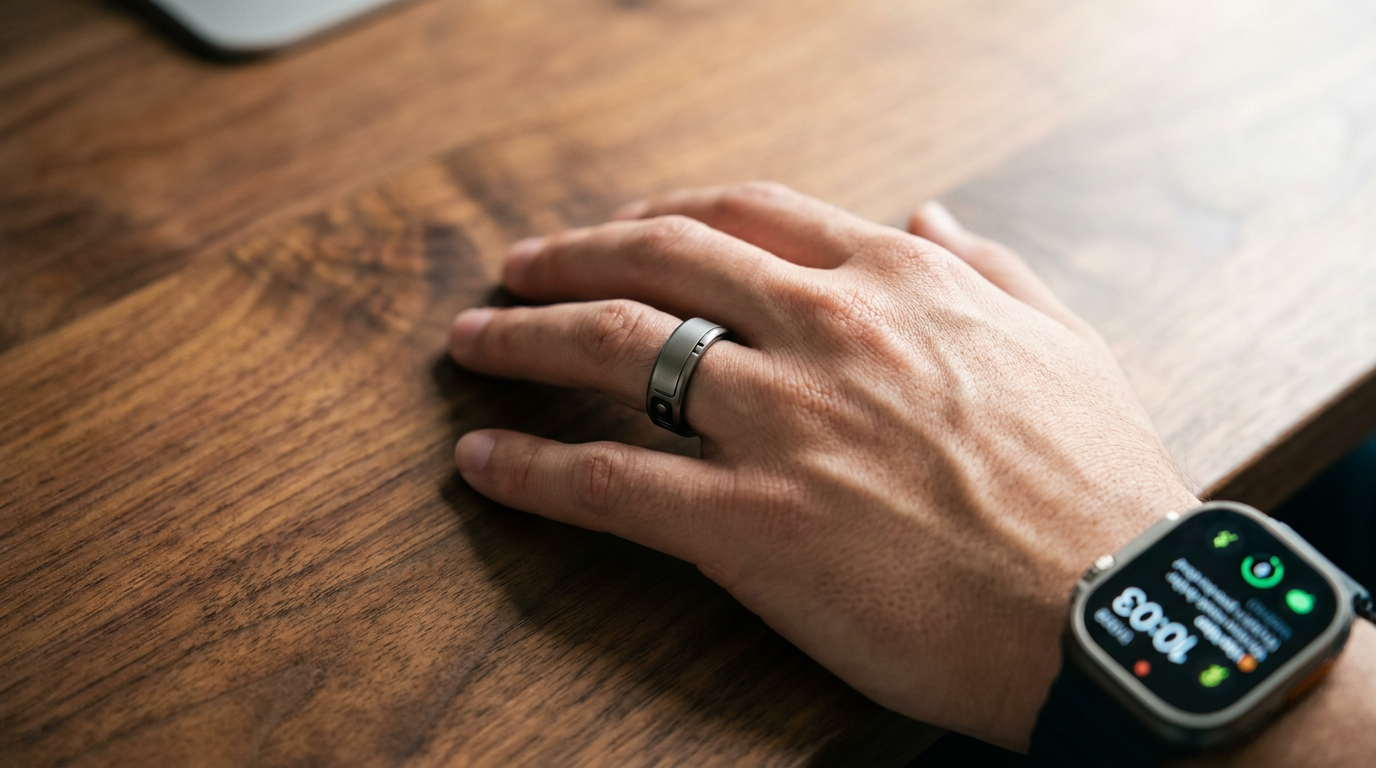
The wearable technology market in 2026 has fractured into two distinct philosophies. On one side is the smartwatch, a vibrant, wrist-worn command center that demands active engagement. On the other is the smart ring, a screen-less, ambient tracker that quietly monitors biometrics from the finger. As devices like the Apple Watch Series 11 and the Oura Ring 4 dominate the landscape, consumers are no longer just choosing a gadget; they are choosing how they want to interact with their health data.[1][3]
The core difference lies in the interaction model. Smartwatches are designed to be looked at, tapped, and consulted in real time. They serve as extensions of the smartphone, delivering notifications, pacing data during a run, and on-demand electrocardiograms. Smart rings, conversely, are entirely passive. They collect data invisibly throughout the day and night, requiring the user to open a smartphone app to view their readiness scores, sleep stages, and recovery metrics.[2][4]
In evaluating the smart ring, the arguments for the device center heavily on comfort, discretion, and battery life. A titanium ring weighing just three to four grams is vastly more comfortable to wear to bed than a glass-and-aluminum watch. This form factor eliminates the digital friction of glowing screens and vibrating notifications during rest. Furthermore, leading smart rings now boast battery lifespans of five to twelve days, allowing users to track their health continuously without the daily anxiety of finding a charger.[1][4]
The arguments against the smart ring focus on its limitations during active movement and its hidden costs. Without a screen, a ring cannot provide live feedback during a workout; you cannot glance at your finger to check your heart rate zone or running pace. Additionally, the financial model for many rings involves ongoing subscriptions. While the hardware might cost around $349, platforms like Oura require a monthly fee of roughly $6 to unlock detailed health insights, making the long-term cost higher than it initially appears.[1][3]

The evidence supporting the smart ring's efficacy is strongest in the realm of sleep and passive recovery tracking. Clinical validations, including studies published by the National Institutes of Health, demonstrate that finger-based photoplethysmography (PPG) sensors often capture a cleaner signal for resting heart rate and blood oxygen than wrist-based sensors. Because the ring fits snugly and the finger has dense capillary beds, the data collected during sleep closely matches medical-grade polysomnography, providing highly accurate sleep staging and heart rate variability metrics.[5][6]
For the smartwatch, the arguments for the device revolve around its unmatched utility as an active fitness and safety tool. Devices like the Apple Watch Series 11 and Garmin's lineup feature built-in GPS, multi-band tracking, and high-frequency sensor sampling that captures precise data even during intense, erratic movement. They also offer critical safety features, including fall detection, irregular heart rhythm notifications, and the ability to call for help without a phone nearby.[1][3]
For the smartwatch, the arguments for the device revolve around its unmatched utility as an active fitness and safety tool.
The arguments against the smartwatch highlight digital fatigue and battery constraints. Wearing a screen on the wrist invites constant interruptions, which can elevate stress rather than reduce it. More practically, the power required to run a bright OLED display, GPS, and continuous background apps means that most premium smartwatches must be charged every 18 to 36 hours. For users who want to track their sleep, finding a convenient time to charge the watch during the day becomes a daily chore.[1][4]
The evidence regarding smartwatch performance confirms their superiority in active scenarios. While wrist movement can introduce noise into optical heart rate readings, modern smartwatch algorithms are highly tuned to filter this out during exercise. Furthermore, the sheer volume of data a watch can process locally allows for real-time coaching, precise route mapping, and immediate biofeedback that a ring simply cannot process or display without being tethered to a phone.[2][7]

When comparing the two, the financial trade-offs are also distinct. A premium smartwatch typically starts around $399 and rarely requires a subscription for its core health features. A smart ring might have a slightly lower entry price, but the market is split: some brands require subscriptions, while newer entrants like RingConn and the Samsung Galaxy Ring have adopted a subscription-free model to compete. Buyers must calculate the total cost of ownership over a two-to-three-year lifespan.[1][6]
The ecosystem lock-in is another crucial variable. The Apple Watch remains strictly tethered to the iPhone, and the Samsung Galaxy Ring offers its best features only when paired with a Samsung Galaxy phone. Independent smart rings, however, are generally platform-agnostic, syncing seamlessly with both iOS and Android devices, giving users more flexibility if they decide to switch smartphones in the future.[3][8]
Ultimately, a smart ring fits well when the user prioritizes sleep tracking, recovery metrics, and passive health monitoring. It is the ideal choice for people who suffer from screen fatigue, those who prefer wearing traditional mechanical watches during the day, and individuals who want continuous biometric data without the distraction of notifications. If the goal is to understand overnight recovery and long-term stress trends, the ring is the superior tool.[4][7]
Conversely, a smart ring does not fit well when the user is a dedicated athlete who relies on real-time pacing, heart rate zones, or GPS mapping during workouts. It is also a poor fit for anyone who wants to leave their phone at home while staying connected to calls, texts, or streaming music during a run.[2][3]

A smartwatch fits well when the user needs an active coaching companion. It is perfect for runners, cyclists, and gym-goers who need immediate, glanceable data to optimize their training. It also serves as a powerful extension of the smartphone, making it invaluable for users who want to triage notifications, set quick timers, or use mobile payments directly from their wrist.[1][2]
A smartwatch does not fit well when the user finds wrist-worn devices uncomfortable to sleep in, or when they are unwilling to commit to a daily charging routine. For those who find the constant buzzing of notifications anxiety-inducing, the smartwatch can become a source of stress rather than a tool for wellness. In 2026, the choice is no longer about which device is objectively better, but which form factor best aligns with the user's daily habits and health goals.[4][8]

How we got here
2015
The original Apple Watch launches, establishing the wrist as the primary location for consumer health tracking.
2018
Oura releases its Gen 2 ring, proving that advanced sleep and recovery tracking can be miniaturized into a screen-less finger wearable.
2022
Smartwatches begin incorporating advanced health sensors like ECGs and temperature tracking, blurring the line with medical devices.
2024
The smart ring market explodes with new entrants, driving competition in battery life and subscription-free pricing models.
2026
Major tech ecosystems, including Samsung, fully integrate smart rings into their health platforms, solidifying the two-device paradigm.
Viewpoints in depth
The Passive Wellness View
Prioritizing invisible, ambient tracking for sleep and recovery without digital distractions.
Advocates for passive wellness argue that the best health tracker is one you forget you are wearing. By removing screens and notifications, smart rings reduce the digital friction that often accompanies modern wearables. This camp heavily values overnight comfort and long battery life, asserting that consistent, uninterrupted data collection over weeks and months is far more valuable than real-time alerts. For them, health tracking is about reviewing morning readiness scores to guide the day, rather than reacting to wrist vibrations.
The Active Fitness View
Demanding real-time data, GPS, and immediate biofeedback to optimize athletic performance.
For dedicated athletes and fitness enthusiasts, a tracker is a real-time coaching tool. This perspective argues that passive data is insufficient for active training; a runner needs to know their exact pace and heart rate zone mid-stride to adjust their effort. They value the high-frequency sensor sampling, built-in GPS, and standalone connectivity of smartwatches. To this camp, the necessity of daily charging is a minor inconvenience compared to the wealth of actionable, on-demand data a smartwatch provides during a workout.
The Clinical Accuracy View
Focusing on sensor placement, signal fidelity, and medical-grade validation of biometric data.
Researchers and data purists evaluate wearables based on the physiological realities of sensor placement. This camp points to clinical validations showing that the finger's dense capillary beds and lack of movement during sleep provide a significantly cleaner photoplethysmography (PPG) signal than the wrist. However, they also acknowledge that during vigorous exercise, the wrist provides a more stable platform for optical sensors than a finger gripping a barbell. Their view is strictly pragmatic: rings are scientifically superior for resting baselines, while watches are superior for active exertion.
What we don't know
- Whether future smart rings will be able to incorporate meaningful real-time feedback mechanisms without adding bulky screens.
- How long the subscription-based model for smart rings will survive as more hardware-only competitors enter the market.
- If advancements in micro-batteries will eventually allow smartwatches to match the multi-day endurance of rings.
Key terms
- Photoplethysmography (PPG)
- An optical technology used in wearables that shines light into the skin to measure changes in blood flow and calculate heart rate.
- Heart Rate Variability (HRV)
- The variation in time between consecutive heartbeats, used as a key indicator of physical recovery, stress levels, and overall readiness.
- Polysomnography
- A comprehensive, medical-grade sleep study used as the gold standard to validate the accuracy of consumer sleep trackers.
- Readiness Score
- A daily metric provided by health apps that combines sleep quality, recent activity, and biometric data to indicate how prepared the body is for exertion.
Frequently asked
Do smart rings require a monthly subscription?
It depends on the brand. The Oura Ring requires a $5.99 monthly fee for full data access, while others like the Samsung Galaxy Ring and RingConn offer subscription-free models.
Are smart rings more accurate for sleep tracking?
Yes, generally. The finger provides a cleaner signal for heart rate and blood oxygen during rest, and rings are less prone to shifting around at night compared to bulky watches.
Can a smart ring track my running pace?
No. Smart rings lack built-in GPS and screens, meaning they cannot provide real-time pacing or distance feedback during a run without relying on a connected smartphone.
How often do I need to charge a smart ring?
Most premium smart rings last between 5 and 12 days on a single charge, significantly longer than the 18 to 36 hours typical of full-featured smartwatches.
Sources
Source coverage
8 outlets
3 viewpoints surfaced








[1]ForbesActive Fitness Enthusiasts
Oura Ring 4 Vs. Apple Watch Series 11: Which Is Best For You?
Read on Forbes →[2]TechRadarActive Fitness Enthusiasts
Smart rings vs smartwatches: which is the best choice?
Read on TechRadar →[3]WareableActive Fitness Enthusiasts
Oura Ring vs Apple Watch: Which health tracker is right for you?
Read on Wareable →[4]BGRPassive Wellness Advocates
Smart Rings Vs. Smartwatches: Which Is Better For Sleep Tracking?
Read on BGR →[5]National Institutes of HealthClinical Data Researchers
Accuracy of Consumer Sleep Tracking Devices
Read on National Institutes of Health →[6]RingConnClinical Data Researchers
Smart Ring vs Smartwatch: The 2026 Wearable Guide
Read on RingConn →[7]Wearable Wellness GuidePassive Wellness Advocates
Smart Ring vs Smartwatch for Stress Tracking
Read on Wearable Wellness Guide →[8]Factlen Editorial TeamClinical Data Researchers
Synthesis by Factlen editorial team
Read on Factlen Editorial Team →

More in shopping
See all 7 stories →Backpacking Footwear
Trail Running Shoes vs. Hiking Boots: The 2026 Backpacking Footwear Debate
7 sources

E-Bikes
The 2026 E-Bike Buying Guide: Navigating Motors, Sensors, and Battery Safety
8 sources

E-Bike Tech
Mid-Drive vs. Hub Motor E-Bikes: Which Should You Choose in 2026?
6 sources

Hardware Specs
The 2026 Buying Guide to AI PCs: Why TOPS is the Only Spec That Matters
7 sources

Every angle. Every day.
Get shopping stories with full source coverage and perspective breakdowns delivered to your inbox.