
The Passivhaus Standard: How Ultra-Efficient Homes Cut Energy Use by 90%
Originating in Germany, the rigorous Passive House construction standard is moving into the mainstream, offering homeowners unparalleled comfort, pristine indoor air quality, and near-zero heating bills.
By Factlen Editorial Team
- Sustainable Builders & Architects
- View the standard as the only scientifically rigorous way to build, prioritizing long-term durability, health, and climate responsibility over initial costs.
- Conventional Construction Industry
- Acknowledge the energy benefits but point to the steep learning curve, specialized labor requirements, and 5-15% upfront cost premium as barriers to mass adoption.
- Public Health & Climate Advocates
- Focus on the societal benefits, arguing that the standard eliminates fuel poverty, reduces grid strain, and provides life-saving indoor air quality.
What's not represented
- · Volume Home Builders
- · Real Estate Appraisers
Why this matters
As utility prices fluctuate and building codes tighten to meet climate goals, the Passive House standard offers a proven blueprint for future-proofing a home. It allows buyers and builders to invest in properties that are virtually immune to energy price spikes while drastically improving daily living comfort.
Key points
- The Passive House standard reduces a home's heating and cooling energy demand by up to 90%.
- It relies on five core principles: super-insulation, airtightness, high-performance windows, thermal-bridge-free design, and heat recovery ventilation.
- While upfront construction costs are 5% to 15% higher, the massive reduction in utility bills often offsets the premium over time.
- The constant mechanical ventilation provides pristine, filtered indoor air, eliminating drafts, mold, and condensation.
- By drastically lowering energy demand, Passive Houses require far fewer solar panels to achieve true net-zero emissions.
For decades, the standard approach to keeping a house warm in the winter and cool in the summer has been brute force: installing massive furnaces and air conditioners to pump conditioned air into leaky buildings. But as energy costs rise and environmental concerns deepen, a radically different philosophy is taking hold in residential construction. It is called the Passive House, or Passivhaus, standard. Rather than relying on active machinery to fight the elements, a Passive House uses the building's own architecture and physics to maintain a perfect indoor climate, reducing heating and cooling energy demand by up to 90 percent compared to conventional homes.[1][5]
The concept is not entirely new, but it has recently crossed the threshold from a niche European experiment to a global building standard. Developed in the late 1980s by German physicist Dr. Wolfgang Feist and Swedish construction engineer Bo Adamson, the first official Passivhaus was built in Darmstadt, Germany, in 1991. Their goal was simple but ambitious: to design a home that was so efficient it essentially required no traditional heating system. Today, there are over 60,000 certified Passive House buildings worldwide, ranging from single-family homes to schools and high-rise apartments.[1][5]
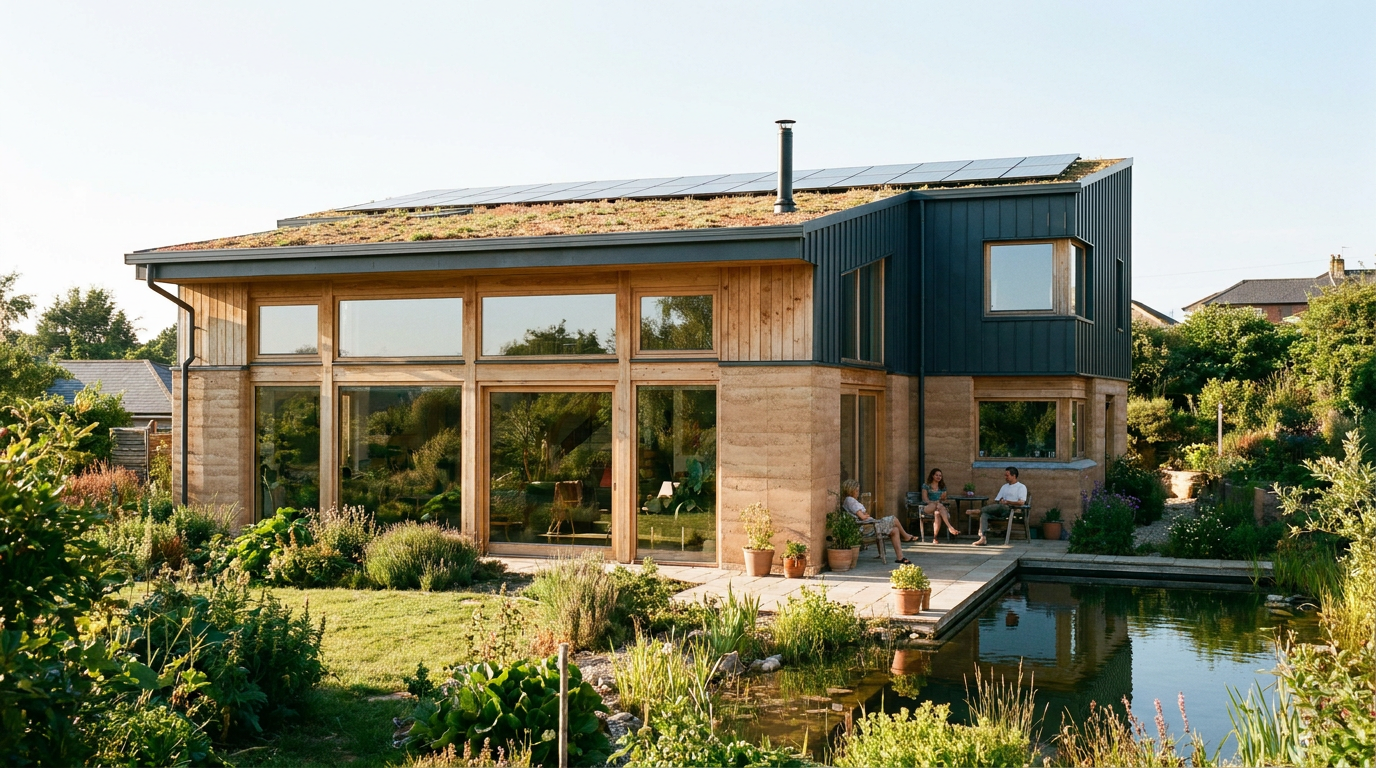
Achieving this level of performance requires a holistic approach to construction. A Passive House is not defined by a specific architectural style—it can look like a traditional farmhouse, a modern glass box, or a standard suburban build. Instead, it is defined by a rigorous set of performance metrics achieved through five interlocking design principles. If any one of these principles is compromised, the entire system's efficiency drops, making precision engineering a requirement rather than a suggestion.[1][6]

The first two principles focus on the building envelope. A Passive House features "super-insulation," utilizing significantly thicker and higher-quality insulation than standard building codes require. This creates a thermal barrier that traps heat inside during the winter and keeps it out during the summer. Paired with this is extreme airtightness. In a conventional home, conditioned air constantly escapes through gaps around doors, outlets, and structural joints. A Passive House is meticulously sealed and pressure-tested to ensure almost zero uncontrolled air leakage, preventing drafts and protecting the structure from hidden moisture damage.[1][5]
The third principle involves high-performance glazing. Passive Houses typically utilize triple-pane windows filled with insulating argon or krypton gas, set within thermally broken frames. These windows are strategically oriented to capture solar heat during the winter while utilizing exterior shading to prevent overheating in the summer. The fourth principle is thermal-bridge-free detailing. A thermal bridge is a highly conductive material—like a steel beam or a concrete balcony slab—that creates a pathway for heat to bypass the insulation. Passive House architects meticulously detail every junction to eliminate these cold spots, which also prevents interior condensation and mold growth.[1]
Passive Houses typically utilize triple-pane windows filled with insulating argon or krypton gas, set within thermally broken frames.
The final, and perhaps most crucial, principle is Mechanical Ventilation with Heat Recovery (MVHR). Because a Passive House is virtually airtight, it requires a dedicated system to provide fresh air. An MVHR unit continuously extracts stale, moisture-laden air from kitchens and bathrooms and uses it to warm the incoming fresh, filtered air from outside. The two airstreams never physically mix, but the heat exchanger captures 75 to 90 percent of the outgoing thermal energy. The result is a constant supply of fresh, room-temperature air without the massive energy penalty of opening a window in the dead of winter.[1][5]

Naturally, this level of precision engineering comes with a financial premium. Constructing a certified Passive House typically costs 5 to 15 percent more upfront than a standard, code-compliant home. The extra budget is reallocated from large HVAC systems into the building envelope—specifically the advanced windows, thicker insulation, and meticulous labor required for airtightness. In 2026, builders estimate the construction cost to range between $200 and $500 per square foot, heavily dependent on local labor markets, material choices, and design complexity.[3]
However, the long-term economics heavily favor the Passive House model. Because the home requires up to 90 percent less energy for heating and cooling, utility bills plummet. For example, data from European builders tracking real-world performance over a three-year period showed that a 1,000-square-foot Passive House cost just over $1,300 total in energy, compared to nearly $4,000 for a conventional home in the same climate. As government subsidies for fossil fuels phase out and grid electricity prices fluctuate, the financial buffer provided by a Passive House becomes increasingly valuable, often offsetting the initial construction premium within the first decade.[4]

Beyond the financial calculus, advocates argue that the true value of a Passive House lies in the lived experience. The continuous mechanical ventilation filters out pollen, dust, and outdoor pollutants, resulting in pristine indoor air quality that is particularly beneficial for asthma and allergy sufferers. Furthermore, the combination of super-insulation and triple glazing creates a formidable acoustic barrier, making the interior exceptionally quiet. The absence of cold exterior walls eliminates drafts entirely, ensuring a perfectly even, comfortable temperature in every corner of every room.[2][4]
As nations race to meet 2050 net-zero emissions targets, the construction industry is under immense pressure to decarbonize. Buildings account for a massive portion of global energy consumption. While adding solar panels to a leaky home can technically achieve "net-zero" status, it requires a massive, expensive solar array to offset the wasted energy. The Passive House standard offers a "fabric-first" approach: by slashing the building's energy demand to the absolute minimum, it requires only a fraction of the renewable energy to reach true net-zero performance, making it a foundational blueprint for the future of sustainable housing.[2][6]
How we got here
1988
Dr. Wolfgang Feist and Bo Adamson begin researching the concept of a 'house without heating'.
1991
The first official Passivhaus is constructed in Darmstadt, Germany, proving the concept's viability.
1996
The Passivhaus Institut is founded in Germany to promote and certify the building standard.
2014
The UN Intergovernmental Panel on Climate Change highlights the standard as a key mitigation option for buildings.
2025
The number of certified Passive House buildings worldwide surpasses 60,000 as the standard goes mainstream.
Viewpoints in depth
Sustainable Builders & Architects
Advocates view the standard as the only scientifically rigorous way to build for the future.
For professionals dedicated to sustainable architecture, the Passive House standard is the ultimate 'fabric-first' approach. They argue that relying on technology—like massive solar arrays or complex smart-home HVAC systems—to offset the energy waste of a poorly built home is fundamentally flawed. By investing in the building's physical envelope, they create structures that will perform flawlessly for a century with minimal maintenance, protecting occupants from volatile energy markets and extreme weather events.
Conventional Construction Industry
Mainstream builders acknowledge the benefits but point to significant barriers to mass adoption.
While few in the construction industry dispute the energy efficiency of a Passive House, many volume builders argue that the standard is difficult to scale. Achieving the required airtightness demands a level of meticulous labor and quality control that is hard to guarantee with standard subcontracting models. Furthermore, the 5 to 15 percent upfront cost premium, combined with the need to source specialized materials like triple-glazed windows and MVHR units, makes it a tough sell for budget-conscious homebuyers who prioritize square footage and cosmetic finishes over hidden energy performance.
Public Health & Climate Advocates
Focus on the societal and physiological benefits of ultra-efficient housing.
Beyond the carbon savings, public health experts champion the Passive House standard for its profound impact on human well-being. The continuous supply of filtered air drastically reduces indoor pollutants, allergens, and the risk of respiratory illnesses caused by dampness and mold—issues that plague conventional housing. From a climate policy perspective, advocates note that widespread adoption of the standard would massively reduce the peak winter heating load on national power grids, making the transition to 100 percent renewable energy significantly cheaper and more feasible.
What we don't know
- How quickly the appraisal and mortgage industries will adapt to properly value the long-term energy savings of a Passive House during the resale process.
- Whether government building codes will eventually mandate Passive House-level performance for all new construction by 2050.
Key terms
- Building Envelope
- The physical separator between the conditioned and unconditioned environment of a building, including the walls, roof, foundation, windows, and doors.
- Thermal Bridge
- An area or component of a building's envelope that has significantly higher heat transfer than the surrounding materials, creating a path for heat to escape.
- MVHR
- Mechanical Ventilation with Heat Recovery; a system that provides fresh filtered air while capturing the heat from the outgoing stale air to warm the incoming stream.
- ACH50
- Air Changes per Hour at 50 Pascals; a metric used during a blower door test to measure how airtight a building is. Passive Houses must achieve 0.6 ACH50 or lower.
- Triple Glazing
- Windows constructed with three panes of glass separated by insulating gas-filled spaces, drastically reducing heat loss compared to standard double-pane windows.
Frequently asked
Can you open the windows in a Passive House?
Yes. While the mechanical ventilation system provides constant fresh air, occupants are free to open windows whenever they like. It is simply not required for ventilation.
Does a Passive House have to look a certain way?
No. The standard is a set of performance metrics, not an architectural style. A Passive House can be designed to look like a traditional colonial, a modern minimalist home, or anything in between.
Is the Passive House standard only for cold climates?
No. The same principles that keep heat inside during a harsh winter also keep heat outside during a scorching summer, making the standard highly effective in hot and humid climates as well.
What is the difference between Passive House and Net Zero?
Passive House focuses on drastically reducing the amount of energy a building needs. Net Zero focuses on generating enough renewable energy (like solar) to meet a building's needs. The two are highly complementary.
Sources
Source coverage
6 outlets
3 viewpoints surfaced






[1]Passive House AcceleratorSustainable Builders & Architects
What is Passive House? The 5 Principles Explained
Read on Passive House Accelerator →[2]Passivhaus Trust UKPublic Health & Climate Advocates
Passivhaus: The Gold Standard for Energy Efficient Buildings
Read on Passivhaus Trust UK →[3]8TFive StudioConventional Construction Industry
Understanding Passive House Costs and Long-Term Value
Read on 8TFive Studio →[4]BiobuildsSustainable Builders & Architects
Passive House Costs After 3 Years: Full Breakdown
Read on Biobuilds →[5]Intelligent MembranesPublic Health & Climate Advocates
The Origins and Evolution of the Passivhaus Standard
Read on Intelligent Membranes →[6]Factlen Editorial TeamPublic Health & Climate Advocates
Synthesis by Factlen editorial team
Read on Factlen Editorial Team →
Every angle. Every day.
Get home stories with full source coverage and perspective breakdowns delivered to your inbox.