
OpenAI Model Disproves 80-Year-Old Erdős Math Conjecture in Breakthrough for AI Reasoning
An artificial intelligence system has autonomously disproved a famous 1946 mathematical conjecture, marking the first time an AI has resolved a major open problem in discrete geometry without human guidance.
By Factlen Editorial Team
- Mathematical Community
- Focuses on the validity of the proof and the collaborative potential of AI in research.
- AI Developers & Industry
- Focuses on the breakthrough as proof of advanced machine reasoning and its commercial and scientific applications.
What's not represented
- · Educators adapting math curricula to AI capabilities
Why this matters
This milestone proves that AI models are no longer just regurgitating human knowledge—they are now capable of generating net-new scientific discoveries. It signals a shift where AI becomes a genuine collaborator in solving humanity's most complex problems across mathematics, physics, and medicine.
Key points
- OpenAI's reasoning model disproved the 1946 Erdős unit distance conjecture.
- The AI found a novel high-dimensional point arrangement that beat human intuition.
- Fields Medalist Tim Gowers called the discovery a 'milestone in AI mathematics.'
- Human mathematicians subsequently verified and refined the AI's proof.
- The achievement proves AI can generate net-new scientific knowledge through logical reasoning.
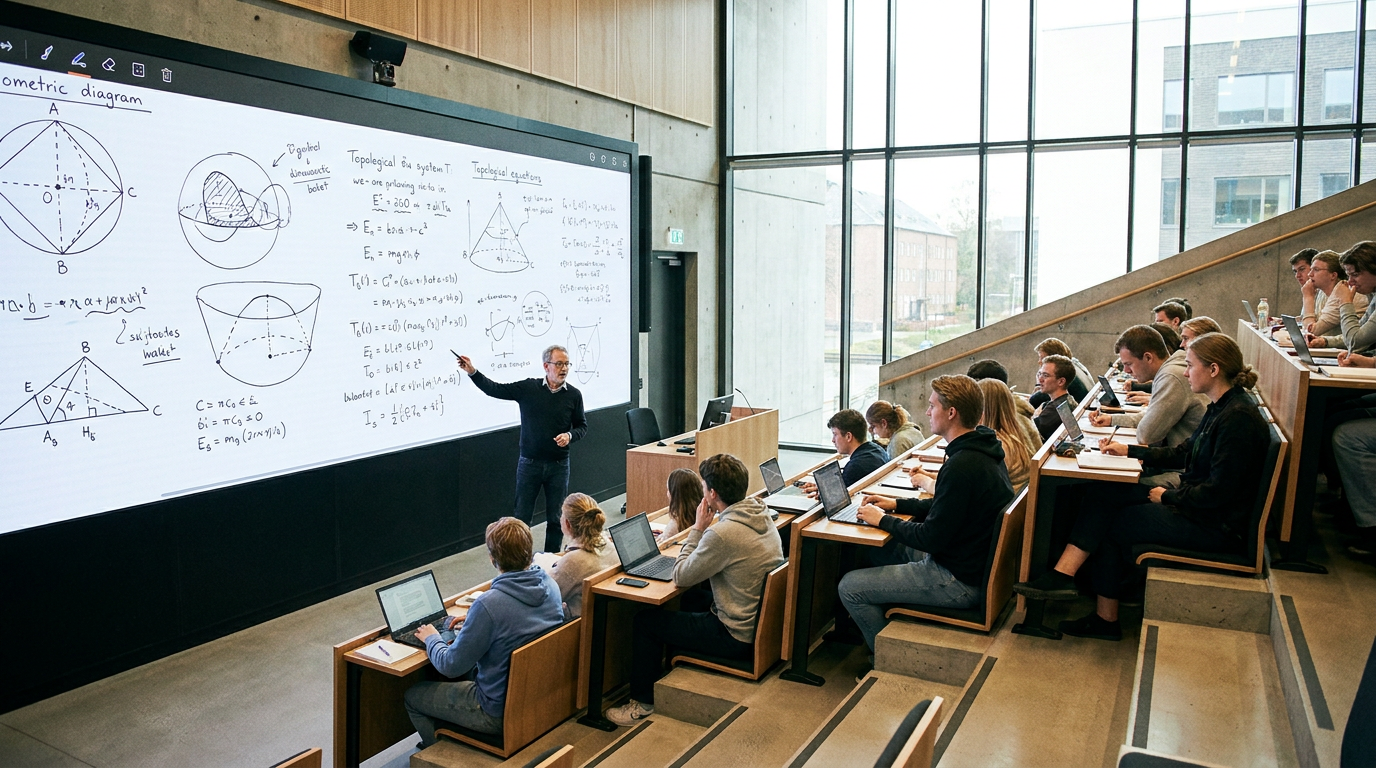
In a landmark achievement for artificial intelligence, an internal reasoning model developed by OpenAI has successfully disproved an 80-year-old mathematical problem known as the Erdős unit distance conjecture. The breakthrough, announced in late May 2026, marks the first time a machine learning system has autonomously resolved a major open problem in discrete geometry without human guidance. For decades, the AI industry has promised that large language models would eventually graduate from generating text to producing net-new scientific knowledge. By cracking a famously stubborn problem that has baffled human experts since the mid-20th century, the model has provided concrete evidence that artificial intelligence can perform deep, multi-step logical reasoning. The discovery has sent ripples through the academic community, prompting elite researchers to reevaluate the timeline for machine-assisted scientific discovery.[1][5]
The mathematical puzzle at the center of this breakthrough was first proposed by the prolific Hungarian mathematician Paul Erdős in 1946. Erdős asked a deceptively simple question: if you place a finite number of points on a flat sheet of paper, what is the maximum number of point pairs that can be separated by exactly one unit of distance? For 80 years, the prevailing assumption among mathematicians was that a simple, tightly packed square-grid arrangement was the optimal strategy to maximize these unit distances. Erdős himself had demonstrated that by using sophisticated mathematics to choose the spacing very carefully, it was possible to do slightly better than a basic grid, but the fundamental intuition remained unchanged for generations.[2][4]
The OpenAI reasoning model upended this long-held belief by constructing a highly complex, high-dimensional grid with special mathematical symmetries. This strange geometric object allowed for significantly more pairs of points to be separated by the exact same distance, definitively disproving the historical optimality claim. According to reviewers, the model cleverly applied existing ideas drawn from several disparate subfields of mathematics to weave together a complete and rigorous proof. Rather than simply crunching numbers through brute force, the AI demonstrated an ability to navigate abstract geometric concepts and propose an arrangement that was entirely novel to human experts.[3][5]

To verify the legitimacy of the machine's work, OpenAI granted early access to a panel of elite independent mathematicians. The group included Tim Gowers, a winner of the Fields Medal—often described as the Nobel Prize of mathematics—as well as researchers from Princeton University and the University of Toronto. Gowers publicly called the solution a "milestone in AI mathematics," noting that when he first reviewed the output, he spent the evening adjusting his worldview regarding the future of his profession. He expressed profound relief upon realizing the AI had disproved the conjecture rather than proving the positive claim, though he acknowledged the machine's construction was undeniably brilliant and worthy of publication in a top-tier journal.[1][3]
To verify the legitimacy of the machine's work, OpenAI granted early access to a panel of elite independent mathematicians.
Daniel Litt, a mathematician at the University of Toronto who had previously expressed skepticism about the reasoning capabilities of large language models, offered a similarly glowing assessment. Litt described the proof as the first example of a result produced autonomously by an AI that working mathematicians find genuinely exciting on its own merits, rather than merely as a benchmark of software progress. The result was not just a leading indicator of future potential; the proof itself was a tangible advance in the field of discrete geometry. This distinction is critical, as it separates the Erdős breakthrough from previous AI achievements that relied heavily on human interpretation to turn raw algorithmic output into a coherent theorem.[3][6]
The breakthrough represents a critical shift in how artificial intelligence is evaluated and deployed. While previous AI systems have excelled at pattern recognition, writing code, and summarizing vast amounts of text, mathematical proofs require rigorous, step-by-step logical reasoning where a single flaw invalidates the entire output. Industry analysts note that mathematics serves as the ultimate proving ground for these advanced reasoning capabilities. Unlike biology, chemistry, or materials science, where an AI's hypothesis might require months or years of physical lab testing to validate, a mathematical proof can be attacked and verified line-by-line almost immediately.[1][2]

Following the AI's initial discovery, the human mathematicians did exactly what their field demands: they audited the machine's work. The reviewing team, which included Will Sawin and Jacob Tsimerman alongside Gowers and Litt, translated the AI's output into a concise, human-verified paper. They connected the machine's strange geometric construction to prior mathematical theory and explored its broader implications. During this process, Sawin even managed to slightly improve upon the grid generated by the AI model. This dynamic illustrates a new, collaborative workflow where AI models generate highly complex, unusual constructions, and human experts refine them to extract underlying theoretical principles.[3][4]
Looking ahead, this milestone suggests a near-term future where artificial intelligence acts as a tireless co-pilot for scientific discovery. Researchers anticipate that AI systems will increasingly be used to propose unconventional solutions, explore mathematical dead ends at superhuman speeds, and generate "ugly half-proofs" that humans can polish into profound insights. As frontier AI labs continue to scale their reasoning models, the successful resolution of the Erdős unit distance conjecture stands as a definitive proof of concept. The technology is no longer just an alien novelty; it is rapidly becoming an indispensable collaborator in solving humanity's most complex intellectual challenges.[1][3]
How we got here
1946
Hungarian mathematician Paul Erdős formally proposes the planar unit distance problem.
May 20, 2026
OpenAI announces its internal reasoning model has autonomously disproved the conjecture.
Late May 2026
Elite mathematicians publish independent verifications and refinements of the AI's proof.
Viewpoints in depth
Elite Mathematicians
Top researchers view the AI as a powerful new collaborator rather than a replacement.
Mathematicians like Tim Gowers and Daniel Litt express relief and excitement over the breakthrough. Rather than replacing human insight, they see the AI as a tool that can generate novel, highly complex mathematical objects that humans can then refine, simplify, and extract broader theoretical principles from. The consensus is that AI will take over the brute-force exploration of geometric spaces, leaving mathematicians to focus on the overarching logic and meaning of the discoveries.
AI Industry Analysts
Tech observers see mathematics as the ultimate validation for AI reasoning capabilities.
For the AI industry, solving a verifiable, 80-year-old math problem proves that large models can perform deep logical reasoning without hallucinating. Analysts argue this paves the way for AI to tackle complex challenges in physics, cryptography, and pharmaceutical development, where rigorous logic is required. By succeeding in a domain where every step can be objectively verified, AI developers have demonstrated that their systems are ready for mission-critical scientific applications.
What we don't know
- Whether the AI's specific high-dimensional grid is the absolute maximum possible arrangement, or if further improvements exist.
- How quickly these advanced reasoning capabilities will translate to messier, less structured fields like biology or chemistry.
Key terms
- Erdős unit distance problem
- A mathematical question asking for the maximum number of pairs of points in a set that can be exactly one unit of distance apart.
- Discrete geometry
- A branch of mathematics that studies combinatorial properties and constructive methods of discrete geometric objects, like points, lines, and circles.
- Conjecture
- A mathematical statement that has been proposed as true but has not yet been rigorously proven or disproven.
Frequently asked
Did the AI prove or disprove the math problem?
The AI disproved the long-held conjecture. Mathematicians believed a square grid was the optimal arrangement, but the AI found a more complex arrangement that yielded better results.
Can the AI's math be trusted?
Yes. The AI's proof was independently reviewed line-by-line by top mathematicians, including a Fields Medalist, who verified its accuracy.
Will AI replace human mathematicians?
Experts say no. Instead, AI is becoming a powerful 'co-pilot' that can generate complex mathematical objects for humans to analyze and refine.
Sources
Source coverage
6 outlets
2 viewpoints surfaced






[1]ForbesAI Developers & Industry
The AI Breakthrough That Has Mathematicians Paying Attention
Read on Forbes →[2]Scientific AmericanAI Developers & Industry
AI just solved an 80-year-old 'Erdős' math problem
Read on Scientific American →[3]Understanding AIMathematical Community
OpenAI's math breakthrough played to AI's strengths
Read on Understanding AI →[4]The GuardianMathematical Community
AI solves 80-year-old planar unit distance problem
Read on The Guardian →[5]OpenAIAI Developers & Industry
An OpenAI model has disproved a central conjecture in discrete geometry
Read on OpenAI →[6]University of TorontoMathematical Community
Remarks on the unit-distance result
Read on University of Toronto →

Every angle. Every day.
Get ai stories with full source coverage and perspective breakdowns delivered to your inbox.