
OLED vs. Mini-LED TVs: Which Display Technology Wins in 2026?
As TV technology advances in 2026, the battle between OLED's perfect contrast and Mini-LED's blinding brightness has never been closer. Here is how to choose the right panel for your living room, gaming setup, or home theater.
By Factlen Editorial Team
- Home Theater Purists
- Advocates for OLED's pixel-level precision and infinite contrast.
- Bright-Room Viewers
- Advocates for Mini-LED's superior brightness and glare-fighting capabilities.
- Hardcore Gamers
- Players weighing OLED's motion clarity against Mini-LED's durability.
What's not represented
- · Budget TV Buyers
- · Professional Colorists
Why this matters
Buying a premium TV is a multi-year investment, and choosing the wrong panel technology for your room's lighting or viewing habits can mean fighting glare every afternoon or missing cinematic shadow details during movie nights. Understanding the specific trade-offs between OLED and Mini-LED ensures you get the right screen for your specific environment.
Key points
- OLED TVs utilize self-emissive pixels to achieve perfect black levels and infinite contrast, making them ideal for dark rooms.
- Mini-LED TVs use thousands of backlight dimming zones to produce blinding peak brightness, perfect for overcoming glare in sunlit rooms.
- 2026 OLED advancements like Tandem and QD-OLED have improved brightness and durability, though they still trail LCDs in full-screen luminance.
- Mini-LED offers significantly better value at massive screen sizes, making 85-inch and larger displays more accessible to consumers.
The choice between OLED and Mini-LED has become the defining consumer technology dilemma for home entertainment in 2026. As manufacturers push the boundaries of brightness, contrast, and color volume, the gap between these two premium display technologies has narrowed, yet their fundamental differences remain stark. Buyers are no longer simply choosing the "best" television; they are choosing the television that best fits their specific room environment, viewing habits, and budget. With both technologies seeing massive leaps in performance this year, understanding the underlying mechanics and real-world trade-offs is essential before making a multi-year investment.[1][2]
At the core of the debate is how each technology generates light. OLED, or Organic Light-Emitting Diode, relies on self-emissive pixels. Because each of the millions of pixels on the screen generates its own light and color, they can be turned off completely independently of one another. This allows OLED panels to achieve perfect, inky black levels and an infinite contrast ratio. In 2026, the technology has evolved significantly with the widespread adoption of QD-OLED—which uses a quantum dot layer for purer colors—and Tandem OLED, which stacks emissive layers to boost brightness and panel longevity.[3][4][5]
Mini-LED, conversely, is the ultimate evolution of the traditional LCD television. Instead of self-illuminating pixels, Mini-LED screens rely on a backlight shining through a liquid crystal layer. However, rather than a few dozen bulky lights, these TVs utilize thousands of microscopic LEDs divided into hundreds or thousands of independent "local dimming zones." These zones can brighten or darken dynamically based on the scene. By 2026, advanced processing algorithms have made these dimming zones incredibly precise, allowing Mini-LEDs to mimic the contrast of OLEDs while pushing overall brightness to staggering new heights.[2][6][7]

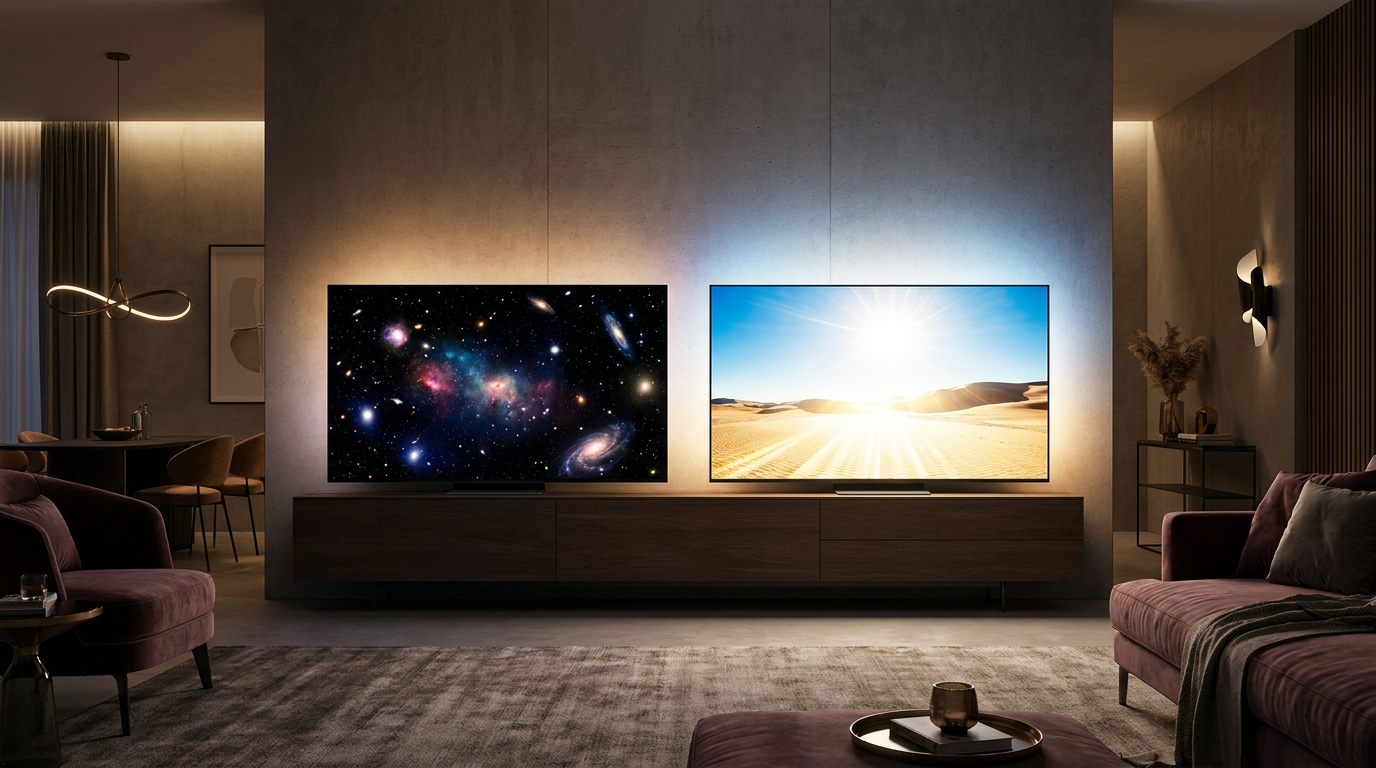
When evaluating OLED, the primary argument for the technology is its unbeatable precision and cinematic depth. Because light control happens at the individual pixel level, an OLED can display a blindingly bright star directly next to the pitch-black vacuum of space without any light bleeding between the two. The evidence for this superiority is clear in standardized testing; reviewers consistently note that OLEDs emit zero light in dark areas, creating perfect uniformity. Furthermore, OLED panels offer exceptionally wide viewing angles, ensuring that colors and contrast remain perfectly intact even for viewers sitting at the far edges of a wide living room.[1][4][8]
The argument against OLED centers on its brightness limitations and the lingering, albeit reduced, risk of permanent image retention. While 2026 OLEDs can hit impressive peak highlights of around 2,000 nits in small window sizes, their full-screen brightness—the average picture level across the entire display—still lags significantly behind LCD-based panels. Evidence shows that in sun-drenched rooms with heavy window glare, OLEDs can look dim or washed out. Additionally, while modern heat sinks and pixel-shifting algorithms have made burn-in exceedingly rare, the organic materials can still degrade unevenly if static elements, like news tickers or gaming HUDs, are displayed for thousands of hours.[3][7]
The argument against OLED centers on its brightness limitations and the lingering, albeit reduced, risk of permanent image retention.
For Mini-LED, the strongest argument is its sheer, blinding power and massive scale. These televisions are designed to overpower ambient light, making them the undisputed champions of daytime viewing. The evidence is found in their peak brightness metrics, with top 2026 models effortlessly pushing past 2,500 nits while maintaining a brilliant full-screen average picture level. Beyond brightness, Mini-LED offers a massive economic advantage at larger screen sizes. Because LCD manufacturing is highly scalable, consumers can purchase 85-inch, 98-inch, or even 115-inch Mini-LED TVs for a fraction of what an equivalent OLED would cost, making true home theater scale accessible to a wider audience.[2][5][8]

The argument against Mini-LED focuses on its inherent backlight limitations and off-angle degradation. Despite having thousands of dimming zones, a Mini-LED zone is still vastly larger than a single pixel. The evidence of this limitation manifests as "blooming" or the halo effect—a faint glow of light bleeding into the dark areas surrounding bright objects, such as white subtitles on a black cinematic letterbox. Furthermore, unlike OLED, the liquid crystal layer in Mini-LED TVs inherently restricts viewing angles. Testing demonstrates that contrast and color saturation begin to fade when viewing the screen from off-center positions, which can be a drawback for wide seating arrangements.[1][6][7]
The trade-offs become particularly pronounced when evaluating gaming performance. OLED panels offer a near-instantaneous pixel response time of roughly 0.1 milliseconds, providing flawless motion clarity with zero ghosting or blur during high-speed competitive gaming. Mini-LEDs, while supporting the same 144Hz refresh rates and HDMI 2.1 features, have slower liquid crystal transitions that can introduce slight motion smearing. However, Mini-LED counters with absolute durability; gamers who play the same title for marathon sessions never have to worry about a static minimap or health bar permanently burning into their expensive display.[3][6]

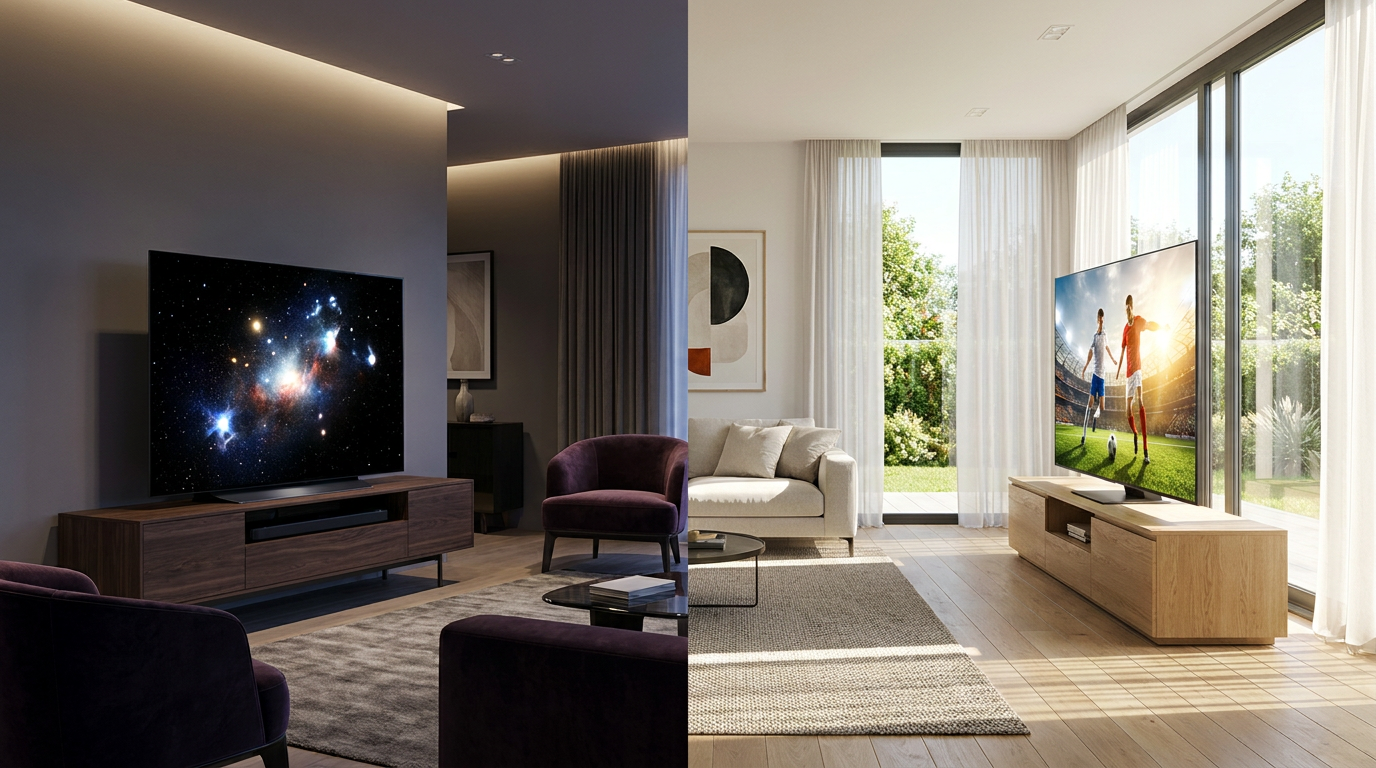
Ultimately, OLED fits well when the television is placed in a light-controlled room or a dedicated home theater. It is the ideal choice for cinephiles who prioritize perfect shadow detail, wide seating arrangements, and gamers who demand the absolute best motion clarity. It does not fit well when the television is placed in a bright, sunlit room with massive windows, or when the display will be used primarily as a background screen running static news channels or sports tickers all day.[4][5]
Conversely, Mini-LED fits well when the living room is flooded with natural light, requiring a screen that can punch through heavy glare. It is the perfect fit for buyers who want an absolutely massive 85-inch or larger display without spending a fortune, or for households where the TV is left on for hours with static content. It does not fit well when the viewer is a home theater purist who is highly sensitive to backlight blooming, or when the primary seating arrangement forces viewers to watch the screen from extreme side angles.[2][7][8]
How we got here
2013
The first consumer OLED TVs hit the market, introducing perfect black levels but struggling with low brightness and high prices.
2019
Mini-LED technology begins appearing in premium consumer TVs, offering a brighter alternative to OLED with vastly improved LCD contrast.
2022
QD-OLED panels are introduced, combining OLED's perfect blacks with quantum dot color purity for brighter highlights.
2024
Mini-LED TVs break the 100-inch barrier for mainstream consumers, offering massive screens at a fraction of the cost of large OLEDs.
2026
Tandem OLED and advanced Mini-LED algorithms push both technologies to new extremes in brightness and contrast performance.
Viewpoints in depth
Home Theater Purists
Advocates for OLED's pixel-level precision and infinite contrast.
For cinephiles and home theater enthusiasts, the conversation begins and ends with pixel-level light control. Because OLED panels can turn off individual pixels completely, they produce true, inky blacks that LCD-based technologies simply cannot replicate. This camp argues that while Mini-LEDs have improved their local dimming algorithms, the inevitable 'blooming' or halo effect around bright objects on dark backgrounds breaks immersion during moody, cinematic films. To these viewers, absolute contrast is far more important than blinding peak brightness.
Bright-Room Viewers
Advocates for Mini-LED's superior brightness and glare-fighting capabilities.
Viewers with sun-drenched living rooms or those who primarily watch daytime sports argue that OLED's perfect blacks are useless if the screen acts like a mirror. Mini-LED technology, driven by thousands of backlight zones, can push full-screen brightness levels that easily overpower ambient light and window glare. Furthermore, this camp points out that Mini-LED offers significantly better value at massive screen sizes—making 85-inch and 98-inch displays accessible to consumers who would be priced out of equivalent OLED models.
Hardcore Gamers
Players weighing OLED's motion clarity against Mini-LED's durability.
The gaming community remains split based on play style. Competitive gamers heavily favor OLED for its near-instantaneous 0.1-millisecond response time, which eliminates motion blur and ghosting during fast-paced action. However, gamers who play MMOs or UI-heavy titles for hours on end often champion Mini-LED. They argue that the peace of mind provided by an LCD panel—which is entirely immune to the permanent image retention (burn-in) that can occasionally plague OLEDs displaying static health bars or minimaps—makes it the superior long-term investment.
What we don't know
- It remains unclear when or if MicroLED technology—which combines the best traits of both OLED and Mini-LED—will become affordable enough for mainstream consumers.
- The long-term durability of the newly introduced Tandem OLED panels in real-world, heavy-use consumer environments has yet to be fully proven over a multi-year span.
Key terms
- Local Dimming Zones
- Specific areas of a TV's backlight that can independently dim or brighten to improve contrast and black levels on an LCD screen.
- Blooming (Halo Effect)
- A visual artifact where light bleeds from a bright object into the surrounding dark areas of the screen, common on backlit TVs.
- QD-OLED
- A hybrid display technology that uses a blue OLED light source passed through a quantum dot layer to produce brighter, purer colors.
- Nits
- A unit of measurement used to quantify the brightness of a display; a higher number indicates a brighter screen.
- Response Time
- The time it takes for a pixel to change from one color to another, crucial for reducing motion blur in fast-moving scenes or video games.
Frequently asked
Does OLED still suffer from burn-in in 2026?
While the risk of permanent image retention still exists due to the organic nature of the pixels, 2026 models use advanced heat sinks, pixel-shifting, and logo-dimming algorithms that make it incredibly rare under normal viewing conditions.
What is Tandem OLED technology?
Tandem OLED stacks multiple light-emitting layers on top of each other. This allows the TV to achieve significantly higher brightness levels and a longer overall lifespan without sacrificing perfect black levels.
Is Mini-LED the same as MicroLED?
No. Mini-LED uses tiny backlights behind a traditional LCD panel. MicroLED is an ultra-premium, modular technology where the microscopic LEDs are the actual pixels themselves, but it remains prohibitively expensive for most consumers.
Which TV is better for a bright living room?
Mini-LED is generally the better choice for bright rooms with lots of windows, as its superior full-screen brightness can easily overpower glare and reflections.
Sources
Source coverage
8 outlets
3 viewpoints surfaced







[1]RTINGSHome Theater Purists
OLED vs Mini LED: Which is better in 2026?
Read on RTINGS →[2]CurrysBright-Room Viewers
OLED vs Mini LED TV Guide 2026
Read on Currys →[3]Pixel PrimeHardcore Gamers
LED vs QLED vs OLED vs Mini LED - The REAL Winner in 2026
Read on Pixel Prime →[4]Jeff RauseoHome Theater Purists
OLED vs. Mini-LED vs. QLED: What's the Best TV for You?
Read on Jeff Rauseo →[5]Data Wire SolutionsBright-Room Viewers
Best TVs for 2026: 10 OLED and Mini-LED Picks
Read on Data Wire Solutions →[6]EcoPicksGoHardcore Gamers
LG G5 OLED vs LG QNED9M Mini LED Comparison (2026 Buyer's Guide)
Read on EcoPicksGo →Is the TCL X11L an OLED killer?
Read on Digital Trends →[8]What Hi-Fi?Bright-Room Viewers
Best Mini LED TVs 2026
Read on What Hi-Fi? →

Every angle. Every day.
Get shopping stories with full source coverage and perspective breakdowns delivered to your inbox.