
The Evidence on Universal Free School Meals: What the Data Shows Three Years In
As more US states permanently adopt universal free school meals, early data reveals strong benefits for student participation and household savings, though academic gains and state fiscal impacts present a more complex picture.
By Factlen Editorial Team
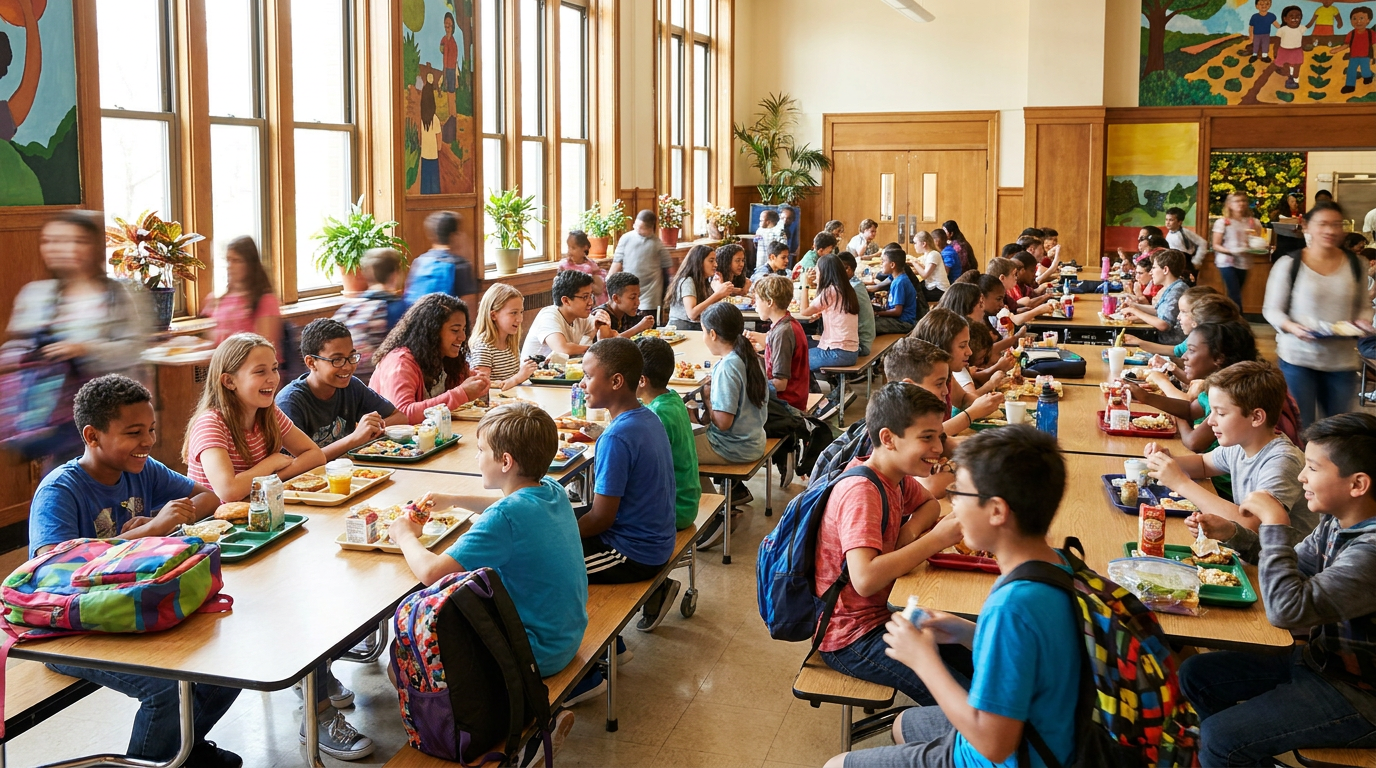
- Child Welfare Advocates
- Argue that universal meals are essential for eliminating cafeteria stigma and ensuring baseline childhood nutrition.
- Fiscal Conservatives
- Emphasize the ballooning costs to state budgets and argue that food assistance should be strictly targeted to low-income families.
- Education Administrators
- Focus on the logistical realities of feeding more students, managing kitchen capacity, and navigating federal reimbursement formulas.
What's not represented
- · Cafeteria Workers
- · Local Farmers / Food Suppliers
Why this matters
With food costs remaining a pressure point for families, understanding whether universal school meals actually deliver on their promises helps voters evaluate if these multi-million dollar state investments are yielding real returns for their communities.
Key points
- Eight US states have permanently implemented universal free school meals since the pandemic.
- Participation in school lunch programs has surged by an average of 22 percent in these states.
- The policy effectively eliminates cafeteria stigma and saves families roughly $1,200 annually.
- Academic gains are marginal, and states are grappling with higher-than-expected program costs.
Since the expiration of pandemic-era federal waivers, a quiet policy revolution has swept through state legislatures. Eight states—including Minnesota, Colorado, and Massachusetts—have permanently enacted universal free school meals, decoupling a child's access to breakfast and lunch from their family's income bracket.[1][6]
This shift represents one of the largest expansions of the social safety net in recent state-level history. Proponents promised that feeding every student would erase stigma, boost test scores, and ease household financial strain, while skeptics warned of unsustainable ballooning costs.[5][6]
Three years into this localized rollout, a robust body of evidence has emerged. By analyzing state budget reports, academic studies, and federal nutrition data, researchers can now separate the political rhetoric from the measurable outcomes of universal school meals.[2][3]

The strongest evidence lies in participation rates. When meals are universally free, the number of students eating school-provided food surges dramatically. The USDA Economic Research Service reports that states implementing universal programs saw an average 22 percent increase in daily lunch participation and a 34 percent jump in breakfast participation compared to their pre-pandemic baselines.[2]
This surge is not solely driven by low-income students who were previously eligible but unenrolled. Chalkbeat's analysis of district-level data indicates that middle-income students—those whose families previously earned just above the cutoff for subsidized meals—account for the largest share of the increase.[4]
Education administrators point to the psychological benefits of this universal uptake. By removing the tiered system of free, reduced, and paid lunches, schools have effectively eliminated lunch shaming—the practice of giving alternative meals or stamping the hands of students with negative account balances.[4][6]

However, the evidence regarding academic performance is more nuanced. Early political pitches heavily emphasized that well-fed children test better, but large-scale data presents a modest reality. A comprehensive working paper from the National Bureau of Economic Research found that universal meals lead to statistically significant, but marginal, improvements in standardized math scores.[3]
However, the evidence regarding academic performance is more nuanced.
The NBER researchers noted that the academic gains are most pronounced among students who were on the margins of eligibility under the old system. For students already receiving free meals, the universal policy did not dramatically alter their nutritional intake or their test scores, though it did improve the overall classroom environment.[3]
Attendance data offers a similarly mixed picture. While some districts hoped free breakfast would act as a powerful magnet to combat chronic absenteeism, reporting from The 74 Million shows that attendance bumps are highly localized.[8]
Schools in dense urban centers saw slight improvements in morning tardiness, but district-wide chronic absenteeism rates remained largely driven by broader structural issues rather than food access alone.[8]
Where the policy undeniably succeeds is in household economic relief. A study published in the Journal of Public Economics tracked grocery spending in states that adopted universal meals, finding a measurable decrease in food insecurity among families with school-aged children.[7]
For a family with two children, eliminating the daily cost of school meals translates to roughly $1,000 to $1,200 in retained income per academic year. Vox highlights that this localized economic stimulus disproportionately benefits the missing middle—families earning between $50,000 and $80,000 who previously did not qualify for federal assistance but struggled with rising grocery bills.[6][7]

The primary vulnerability of the universal model is its fiscal sustainability. State governments are bearing the cost of feeding students who do not qualify for federal reimbursement, and initial budget projections frequently underestimated the sheer volume of demand.[1][5]
The Wall Street Journal reports that several early-adopter states have had to pass emergency supplemental funding to cover cafeteria shortfalls. In some cases, the cost of the program exceeded initial legislative estimates by as much as 30 percent in the first fully operational year.[5]
This fiscal pressure has forced states to get creative. Some are aggressively auditing their direct certification processes—automatically enrolling students who receive Medicaid or SNAP—to maximize the matching funds they can draw from the federal government, thereby reducing the state's out-of-pocket burden.[1][4]
Ultimately, the evidence pack on universal free school meals points to a clear trade-off. The policy is highly effective at reducing child hunger, eliminating cafeteria stigma, and putting money back into the pockets of working-class families. Yet, it requires states to commit to a permanent, escalating financial obligation that may not deliver the sweeping academic miracles some advocates initially promised.[3][5][6][7]
How we got here
March 2020
The USDA issues pandemic waivers allowing all public schools to serve free meals to all students regardless of income.
June 2022
The federal pandemic waivers expire, returning most of the country to a tiered income-based meal system.
2023–2024
Several early-adopter states, including California, Maine, and Colorado, pass legislation to permanently fund universal meals at the state level.
2026
Eight states now operate permanent universal programs, providing enough longitudinal data to assess the policy's true impact.
Viewpoints in depth
Child Welfare Advocates
Argue that universal meals are essential for eliminating cafeteria stigma and ensuring baseline childhood nutrition.
Advocates point to the psychological and social benefits of a unified cafeteria experience. By removing the financial transaction at the lunch line, schools eliminate the visible markers of poverty that lead to bullying and 'lunch shaming.' Furthermore, they argue that just as textbooks and school buses are provided universally without means-testing, basic nutrition should be considered a fundamental component of public education.
Fiscal Conservatives
Emphasize the ballooning costs to state budgets and argue that food assistance should be strictly targeted to low-income families.
Critics of the universal model focus on the inefficiency of subsidizing meals for affluent families. They argue that state funds are finite and that spending millions to feed children whose parents can easily afford to pack a lunch diverts resources away from targeted educational interventions, such as tutoring or teacher pay raises. The unexpected budget shortfalls in early-adopter states are frequently cited as proof that the policy is fiscally reckless.
Education Administrators
Focus on the logistical realities of feeding more students, managing kitchen capacity, and navigating federal reimbursement formulas.
For school leaders, the debate is highly practical. While they welcome the reduction in administrative paperwork—no longer having to chase down parents for unpaid meal debt—they face severe operational bottlenecks. Many older schools lack the physical kitchen space, cold storage, and staffing levels required to prepare 30 percent more meals each day, forcing a reliance on pre-packaged foods that contradict the nutritional goals of the program.
What we don't know
- Whether the long-term health outcomes of students eating universal school meals will show reductions in childhood obesity or diet-related diseases.
- If states facing broader economic downturns will be able to maintain the funding for these programs without cutting other educational services.
Key terms
- Lunch Shaming
- The practice of singling out students who have unpaid cafeteria debt, often by providing them with a lesser alternative meal or stamping their hands.
- Direct Certification
- A process where school districts automatically enroll students for free meals based on their family's participation in other assistance programs like SNAP or Medicaid.
- Missing Middle
- Families whose income is too high to qualify for federal assistance programs but who still struggle with the rising cost of living.
Frequently asked
Do universal free meals improve test scores?
Evidence shows only marginal improvements in standardized math scores, mostly concentrated among students who were previously on the borderline of qualifying for free meals.
How much money do families save?
Research indicates that a family with two school-aged children saves approximately $1,000 to $1,200 per academic year on grocery and meal-prep costs.
Who pays for the universal meals?
While the federal government reimburses states for low-income students, the state governments must cover the cost of meals for students from middle- and upper-income families.
Sources
Source coverage
8 outlets
3 viewpoints surfaced








[1]Associated PressEducation Administrators
More states make school meals free, but funding challenges loom
Read on Associated Press →[2]USDA Economic Research Service
National School Lunch Program Participation and Costs 2025
Read on USDA Economic Research Service →[3]National Bureau of Economic Research
The Academic and Behavioral Impacts of Universal School Meals
Read on National Bureau of Economic Research →[4]ChalkbeatChild Welfare Advocates
Inside the cafeteria: How universal free lunch is changing the school day
Read on Chalkbeat →[5]Wall Street JournalFiscal Conservatives
The Hidden Costs of Free School Meals for All
Read on Wall Street Journal →[6]VoxChild Welfare Advocates
The quiet triumph of universal school lunch
Read on Vox →[7]Journal of Public Economics
Household Food Security and Universal School Meals
Read on Journal of Public Economics →[8]The 74 MillionEducation Administrators
Can free lunch fix chronic absenteeism? The data is complicated
Read on The 74 Million →
Every angle. Every day.
Get news politics stories with full source coverage and perspective breakdowns delivered to your inbox.