
What Is in the US-Iran 14-Point Agreement Signed at Versailles?
The United States and Iran have signed a 14-point Memorandum of Understanding aimed at ending hostilities, triggering a drop in global oil prices while drawing sharp criticism from Israeli and some Republican leaders.
By Factlen Editorial Team
- Diplomatic Proponents
- View the agreement as a necessary and successful step to end a costly war and stabilize the region.
- Regional Skeptics
- Argue the framework is a strategic disaster that abandons allies and capitulates to Iranian demands.
- Economic Beneficiaries
- Focus on the immediate relief to global energy markets and supply chains caused by the de-escalation.
What's not represented
- · Civilians displaced by the conflict
- · European Union diplomatic leadership
Why this matters
This 14-point framework represents a sudden and dramatic shift in Middle Eastern geopolitics, immediately lowering global energy costs while isolating Israel's current administration. For the global economy, it signals a potential end to war-driven inflation, but for regional security, it introduces deep uncertainty about the balance of power.
Key points
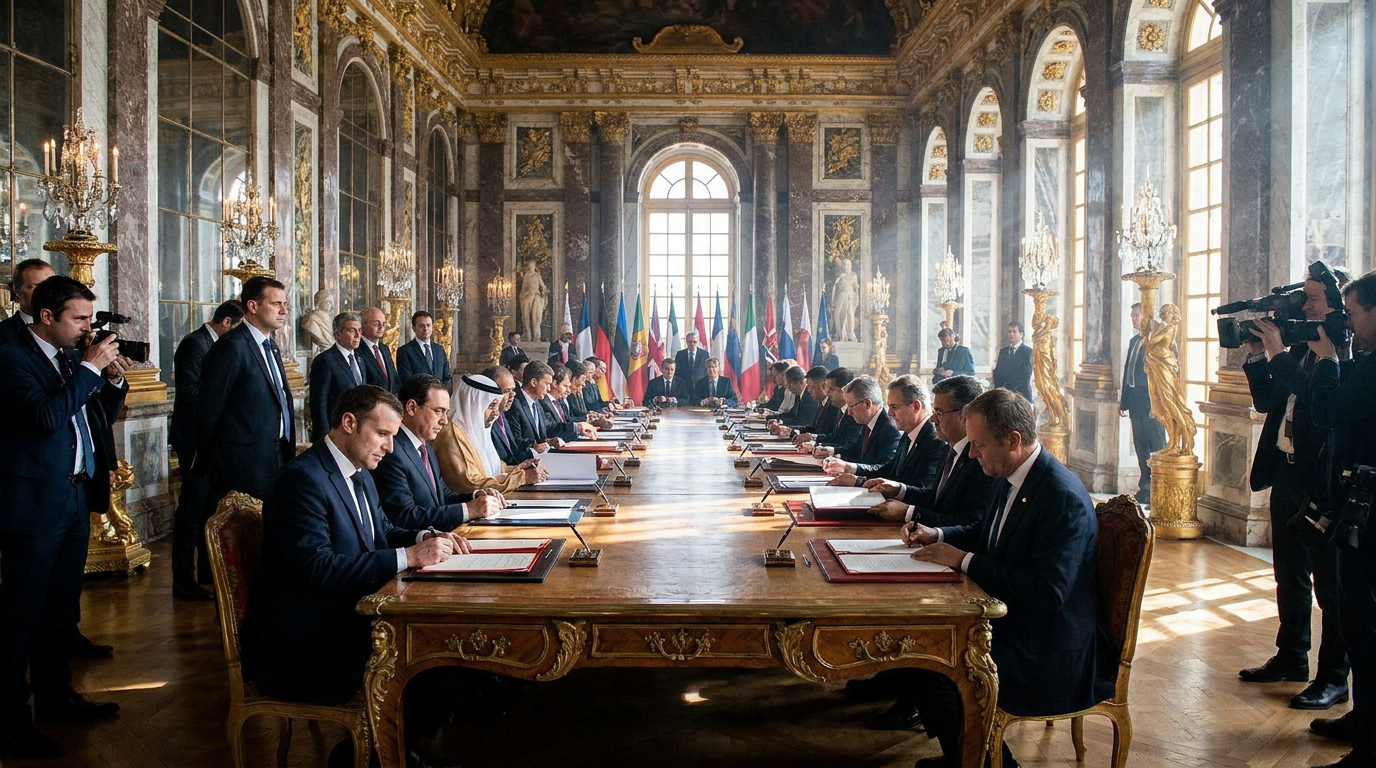
- The US and Iran signed a 14-point Memorandum of Understanding at the Palace of Versailles to end hostilities.
- Global markets reacted positively, with Brent crude prices falling 1.6% and Asian stocks rallying.
- Israeli Prime Minister Benjamin Netanyahu was excluded from the negotiations, sparking anger among his allies.
- The deal faces domestic opposition in the US, including strong criticism from some Republican senators.
- Both Washington and Tehran are publicly claiming the agreement as a major victory for their respective sides.
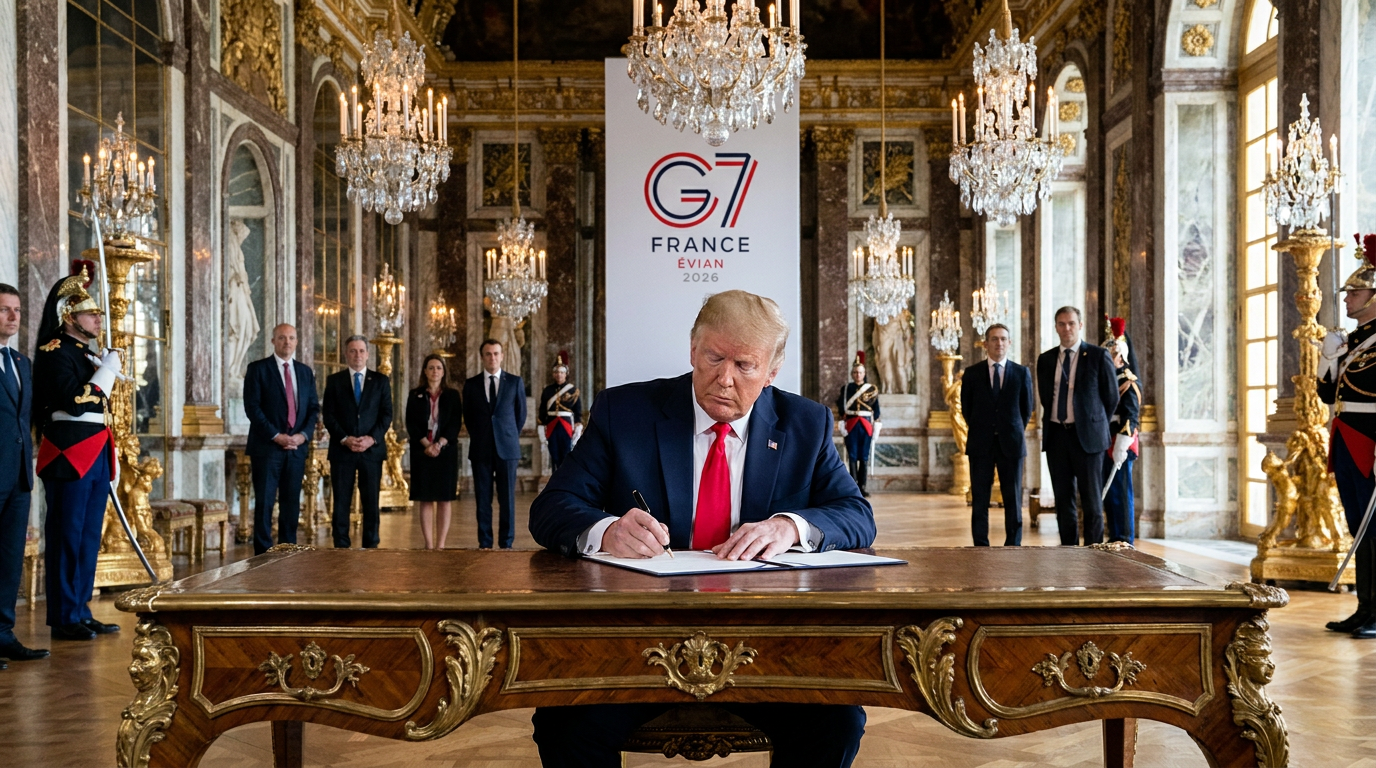
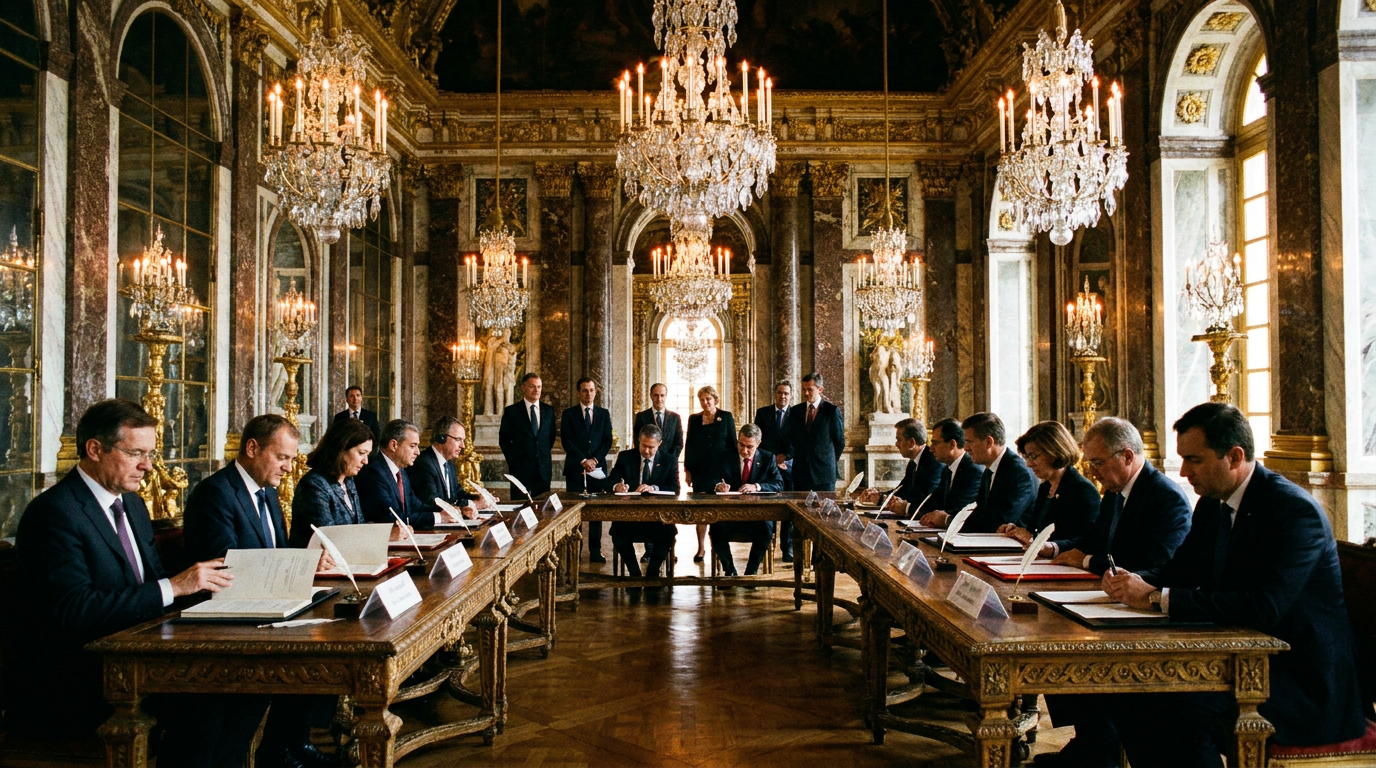
In a highly symbolic diplomatic maneuver, President Donald Trump signed a 14-point Memorandum of Understanding (MoU) with Iran at the Palace of Versailles, establishing a framework to end the ongoing military hostilities between the two nations.[1][3]
The signing took place following a post-G7 dinner in France, utilizing the historic backdrop of Versailles—the site of the treaty that ended the First World War—to underscore the magnitude of the de-escalation.[1][3]
The immediate mechanism of the deal focuses on a cessation of direct military engagement, outlining 14 specific points that govern troop postures, maritime navigation, and a phased framework for sanctions relief in exchange for security guarantees.[1][2]
Global markets reacted instantly to the prospect of stability in the world's most critical energy corridor. Brent crude, the global oil benchmark, dropped by as much as 1.6 percent as the geopolitical risk premium evaporated from energy prices.[2]

The economic relief was particularly pronounced in Asia, where key stock indices in Japan, South Korea, and Taiwan climbed sharply. These manufacturing-heavy economies rely heavily on imported Middle Eastern oil, making them highly sensitive to conflicts involving Iran.[2]
Despite the economic optimism, the political framing of the agreement reveals deep fractures. Both Washington and Tehran are aggressively selling the MoU to their domestic audiences as a capitulation by the other side.[3]
The Trump administration immediately declared the framework a "major win," framing it as a successful execution of an "America First" foreign policy that extracts the United States from costly foreign entanglements while securing its core interests.[3]
Conversely, Iranian leadership is projecting triumph. Iran's chief negotiator, Mohammad Bagher Ghalibaf, publicly characterized the agreement as a "record of US failure," urging the public to read the text and judge for themselves.[3]

This narrative of resistance was echoed across Iran's regional proxy network. Naim Qassem, the chief of Hezbollah, proclaimed the Versailles signing a "great victory" for the axis of resistance against Western intervention.[3]
This narrative of resistance was echoed across Iran's regional proxy network.
The most glaring absence from the Versailles framework is Israel. Israeli Prime Minister Benjamin Netanyahu was reportedly cut entirely out of the US-Iran negotiations, a move that has sent shockwaves through Jerusalem.[4][6]
Netanyahu, who had promised the Israeli public "total victory" over Iran, maintained a public silence on Wednesday as the details of the memorandum were released. However, behind closed doors, his allies are reportedly raging.[4]
Israeli officials view the bilateral agreement as a "strategic and political disaster." By bypassing Israel, the US has effectively neutralized Jerusalem's ability to shape the post-war security architecture, leaving Netanyahu facing mounting domestic pressure.[4][6]

The diplomatic shockwaves are also reverberating through Washington, where the Trump administration is facing a revolt from the hawkish wing of the Republican Party.[5]
Senator Bill Cassidy of Louisiana issued a blistering critique of the framework, blasting the MoU as the "worst foreign policy blunder in decades" and signaling that the White House will face fierce congressional resistance.[5]
Because the agreement is structured as a Memorandum of Understanding rather than a formal treaty, it does not require a two-thirds ratification vote in the US Senate. This allows the executive branch to bypass immediate legislative blockades, but makes the deal inherently fragile.[1][5]
An MoU relies entirely on mutual, ongoing compliance and executive enforcement. Without the binding weight of a ratified treaty, future administrations—or even the current one, if terms are breached—can abandon the framework with minimal legal friction.[1]
How we got here
June 17, 2026
President Trump signs the 14-point US-Iran Memorandum of Understanding at the Palace of Versailles.
June 18, 2026
Global oil prices drop and Asian markets rally in response to the de-escalation.
June 18, 2026
Israeli and US Republican officials voice strong opposition to the bilateral framework.
Viewpoints in depth
The US Administration
Frames the agreement as a successful execution of foreign policy that ends a costly war.
The Trump administration is projecting the 14-point framework as a definitive "major win." By securing a cessation of hostilities without committing to a prolonged ground presence or nation-building, the administration argues it has successfully protected American interests while extracting the US from a costly Middle Eastern entanglement. This framing relies heavily on the immediate positive reaction from global markets as proof of success.
Iranian Leadership & Allies
Views the MoU as a successful resistance against US pressure and a capitulation by Washington.
In Tehran and among its proxy network, the agreement is being celebrated as a triumph of endurance. Iranian chief negotiator Mohammad Bagher Ghalibaf has labeled the document a "record of US failure," suggesting that Washington was forced to the negotiating table. Allied groups, such as Hezbollah, have echoed this sentiment, framing the Versailles signing as proof that the "axis of resistance" successfully withstood Western military and economic pressure.
The Israeli Government
Considers the bilateral US-Iran framework an abandonment and a strategic disaster.
For Jerusalem, the MoU represents a worst-case diplomatic scenario. Prime Minister Benjamin Netanyahu, who had staked his political capital on achieving "total victory" over Iran, was entirely sidelined during the negotiations. Israeli officials view the agreement as a strategic disaster that leaves Iran's regional infrastructure intact while neutralizing Israel's ability to influence the post-war security environment alongside its closest ally.
Global Markets
Reacting positively to the de-escalation of a major oil-producing region.
Financial markets and energy importers are viewing the agreement purely through the lens of risk reduction. The immediate drop in Brent crude prices and the rally in Asian stock indices reflect a collective sigh of relief that the threat to the Strait of Hormuz—a vital artery for global energy supplies—has been paused. For these stakeholders, the political nuances of the deal are secondary to the restoration of supply chain stability.
What we don't know
- The specific enforcement mechanisms and verification protocols for the 14 points outlined in the memorandum.
- How Israel will adjust its military and diplomatic posture now that its primary ally has signed a bilateral framework with Iran.
- Whether the MoU will face formal legal challenges or attempts to block its implementation by the US Congress.
Key terms
- Memorandum of Understanding (MoU)
- A formal agreement between two or more parties that establishes a framework for cooperation, though it is often not legally binding in the same way as a ratified treaty.
- Brent Crude
- A major global benchmark for oil prices, heavily influenced by geopolitical stability in the Middle East.
- Axis of Resistance
- A political and military alliance network in the Middle East, led by Iran, which includes groups like Hezbollah.
Frequently asked
Did Israel participate in the agreement?
No. Israeli Prime Minister Benjamin Netanyahu was reportedly cut out of the negotiations, leading to significant backlash from his allies who view the deal as a strategic disaster.
Is the US-Iran war officially over?
The MoU establishes a framework to end the war and cease direct military engagement, but it is an initial diplomatic step rather than a finalized, fully implemented peace treaty.
How did the global markets react?
Markets reacted positively to the prospect of stability. Brent crude oil prices fell by 1.6%, and major Asian stock indices rallied.
Does the US Senate need to approve this deal?
Because it is structured as a Memorandum of Understanding rather than a formal treaty, it does not require a two-thirds ratification vote in the US Senate.
Sources
Source coverage
6 outlets
3 viewpoints surfaced




[1]BBCDiplomatic Proponents
Moment Trump signs US-Iran agreement at Palace of Versailles
Read on BBC →[2]Al JazeeraEconomic Beneficiaries
Oil prices fall, stocks rally as US, Iran sign framework to end war
Read on Al Jazeera →[3]The GuardianDiplomatic Proponents
Trump news at a glance: Donald Trump surrenders himself to Iran deal
Read on The Guardian →[4]AxiosRegional Skeptics
Netanyahu fumes, allies rage over Trump's Iran deal
Read on Axios →Trump’s MoU with Iran draws backlash from some Republicans
Read on Al Jazeera →Netanyahu under pressure in Israel after US-Iran agreement
Read on Al Jazeera →
More in news politics
See all 6 stories →School Nutrition
The Evidence on Universal Free School Meals: What the Data Shows Three Years In
8 sources

Ranked Choice Voting
Fact-Checking Ranked Choice Voting: Does It Actually Fix Polarization and Turnout?
9 sources
US Foreign Policy
US and Iran Sign 14-Point Peace Memorandum, Triggering Market Rally and Political Backlash
7 sources
Iran Deal
U.S. and Iran Sign 14-Point Framework Agreement to End War
6 sources
Every angle. Every day.
Get news politics stories with full source coverage and perspective breakdowns delivered to your inbox.