
U.S. and Iran Sign 14-Point Framework Agreement to End War
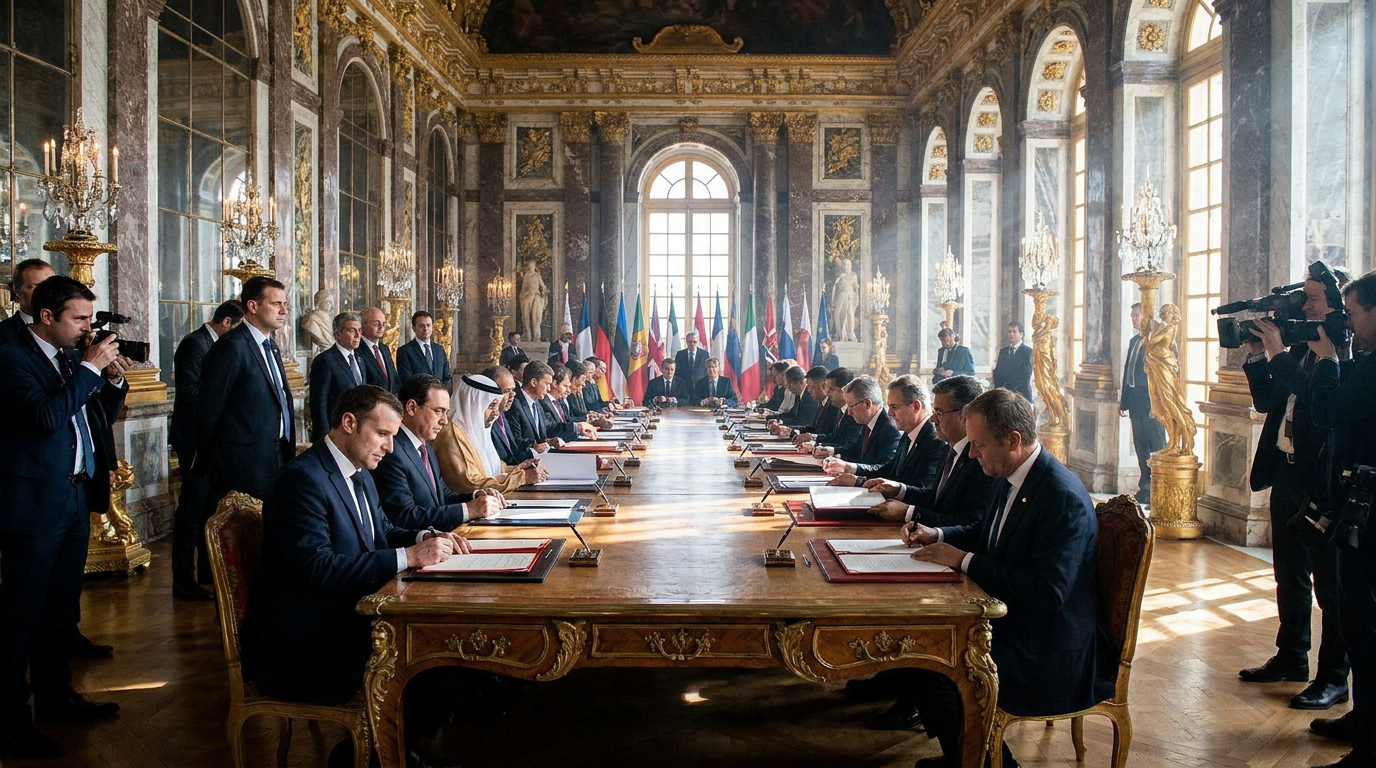
The United States and Iran have signed a 14-point Memorandum of Understanding at the Palace of Versailles to end the ongoing conflict, triggering a drop in global oil prices but sparking fierce political backlash in Israel and Washington.
By Factlen Editorial Team
- Market & Economic Observers
- Focuses on the immediate relief the agreement brings to strained global supply chains and energy prices.
- Israeli Leadership
- Views the agreement as a strategic disaster that abandons a key ally and fails to neutralize the Iranian threat.
- Iranian Coalition
- Frames the 14-point memorandum as a historic victory and a demonstration of US failure to impose its will militarily.
- US Conservative Critics
- Argues the deal is a major foreign policy blunder that makes dangerous concessions to Tehran.
What's not represented
- · Lebanese civilians affected by the conflict
- · European Union diplomatic mediators
Why this matters
This framework agreement signals the potential end to a conflict that has severely disrupted global energy markets and shipping routes. However, the exclusion of Israel from the final terms threatens to destabilize the Israeli government and reshape Middle Eastern security alliances.
Key points
- The US and Iran signed a 14-point Memorandum of Understanding at the Palace of Versailles.
- Global markets rallied and oil prices dropped 1.6% following the announcement.
- Israeli Prime Minister Benjamin Netanyahu faces intense domestic pressure after being excluded from the deal.
- The agreement has drawn sharp criticism from some US Republicans who call it a foreign policy blunder.
The United States and Iran have officially signed a 14-point Memorandum of Understanding (MoU) aimed at ending the ongoing war. Signed at the Palace of Versailles, the framework represents a sudden and dramatic diplomatic breakthrough in a conflict that has reshaped global energy markets and Middle Eastern alliances. The Trump administration immediately heralded the agreement as a "major win" that fulfills promises to end overseas entanglements and stabilize the global economy.[2]
The immediate economic impact of the signing was felt across global markets. Brent crude oil prices dropped by as much as 1.6 percent within hours of the announcement, reflecting investor relief that the threat to major Middle Eastern energy infrastructure might be subsiding. Key stock indices in Japan, South Korea, and Taiwan also climbed, signaling optimism in regions heavily dependent on imported oil.[3]
The conflict had previously driven severe energy crises worldwide. In regions like Southeast Asia, soaring oil prices had forced homeowners and businesses to rapidly accelerate the installation of rooftop solar panels just to manage crippling energy costs. The new framework offers the first concrete hope of relief for these strained global supply chains and energy grids.[6]

Despite the economic optimism, the political reception of the MoU has been fiercely contested. While the White House projects strength, Iranian and allied officials have publicly framed the agreement as a capitulation by Washington. Iran’s chief negotiator, Mohammad Bagher Ghalibaf, stated that the agreement is "a record of US failure," while Hezbollah's deputy chief, Naim Qassem, proclaimed the outcome a "great victory" for their coalition.[2]
The most explosive reaction has come from Israel, where Prime Minister Benjamin Netanyahu is facing mounting domestic and political pressure. Israeli officials were reportedly cut out of the final negotiations, leading to what insiders describe as a "strategic and political disaster" for the current Israeli government.[1][5]
The most explosive reaction has come from Israel, where Prime Minister Benjamin Netanyahu is facing mounting domestic and political pressure.
Netanyahu had repeatedly promised the Israeli public "total victory" against Iran and its proxy networks. Having to settle for a US-brokered memorandum that leaves key Iranian infrastructure intact has sparked fury among his hardline allies, threatening the stability of his ruling coalition and raising questions about his political survival.[1]

The diplomatic fallout is not limited to the Middle East. In Washington, the framework has drawn sharp backlash from within the President's own party. Several prominent Republicans have voiced deep concerns over the concessions made to Tehran, arguing that the administration prioritized a quick exit over long-term regional security.[4]
Louisiana Senator Bill Cassidy publicly blasted the MoU, labeling it the "worst foreign policy blunder in decades." Critics argue that the 14-point plan fails to impose sufficient constraints on Iran's regional ambitions and effectively abandons key regional allies, particularly Israel, in the pursuit of a headline-grabbing peace deal.[4]

The choice of the Palace of Versailles for the signing ceremony has also drawn historical scrutiny. Observers noted the symbolic weight of the venue—famous for the treaty that ended the First World War—with some critics arguing the optics inadvertently play into Iranian narratives of forcing a Western power to the negotiating table under duress.[2]
Moving forward, the success of the MoU will depend entirely on the implementation of its 14 points, the specifics of which remain highly sensitive. While global markets are pricing in an end to hostilities, the deep dissatisfaction in Jerusalem and among US defense hawks suggests that the political war over the agreement's legacy is only just beginning.[1][2][3]
How we got here
Pre-June 2026
Conflict between the US, Israel, and Iran causes severe disruptions to global energy markets.
June 17, 2026
The text of a 14-point US-Iran memorandum of understanding becomes public.
June 18, 2026
The agreement is officially signed at the Palace of Versailles, triggering immediate market rallies and political backlash.
Viewpoints in depth
The US Administration
Argues the deal is a major diplomatic win that ends a costly war and stabilizes global energy markets.
For the White House, the 14-point framework represents the fulfillment of a core promise to extract the United States from an escalating Middle Eastern conflict. Administration officials argue that by bringing Iran to the table, they have prevented a broader regional war that was actively crippling the global economy. They point to the immediate drop in oil prices and the rallying of Asian markets as proof that the diplomatic intervention was both necessary and effective.
The Israeli Government
Views the agreement as a strategic disaster and a betrayal that leaves Iranian capabilities intact.
In Jerusalem, the MoU is viewed not as a peace deal, but as a dangerous capitulation. Having promised the Israeli public 'total victory,' Prime Minister Benjamin Netanyahu and his hardline allies argue that the framework fails to dismantle Iran's proxy networks or its core military infrastructure. The fact that Israeli officials were reportedly excluded from the final negotiations has compounded the sense of betrayal, leading to fears that the US is pivoting away from its traditional security commitments in the region.
The Iranian Coalition
Frames the 14-point memorandum as a historic victory and a demonstration of US failure to impose its will.
Iranian officials and their regional allies, including Hezbollah, have aggressively marketed the agreement as a triumph of resistance. By forcing the United States to sign a memorandum rather than achieving a military victory, figures like Mohammad Bagher Ghalibaf argue that Washington has effectively admitted the limits of its power. They view the concessions secured in the 14 points as validation of their long-term strategy to outlast Western military pressure.
What we don't know
- The exact details and enforcement mechanisms of the 14 points within the MoU.
- Whether the Israeli government will abide by the terms of the US-brokered framework.
- How the agreement will impact the long-term political survival of Prime Minister Netanyahu.
Key terms
- Memorandum of Understanding (MoU)
- A formal agreement between two or more parties that outlines the terms and details of a mutual understanding, often serving as the foundation for a binding treaty.
- Brent Crude
- A major trading classification of sweet light crude oil that serves as a benchmark price for purchases of oil worldwide.
Frequently asked
What is the 14-point framework?
It is a Memorandum of Understanding signed by the US and Iran at the Palace of Versailles designed to establish terms for ending the ongoing war.
How did global markets react?
Markets reacted positively, with Brent crude oil prices falling by 1.6% and Asian stock indices rallying on hopes of energy stabilization.
Why is Israel upset about the deal?
Israeli officials, including Prime Minister Netanyahu, were reportedly cut out of the agreement, which they view as a strategic disaster that fails to achieve 'total victory' over Iran.
Sources
Source coverage
6 outlets
4 viewpoints surfaced




[1]AxiosIsraeli Leadership
Netanyahu fumes, allies rage over Trump's Iran deal
Read on Axios →[2]The GuardianIranian Coalition
Trump news at a glance: Donald Trump surrenders himself to Iran deal
Read on The Guardian →[3]Al JazeeraUS Conservative Critics
Oil prices fall, stocks rally as US, Iran sign framework to end war
Read on Al Jazeera →Trump’s MoU with Iran draws backlash from some Republicans
Read on Al Jazeera →Netanyahu under pressure in Israel after US-Iran agreement
Read on Al Jazeera →[6]NYTMarket & Economic Observers
In Southeast Asia, Switching to Solar Offers Relief from Energy Crisis Caused by Iran War
Read on NYT →

Every angle. Every day.
Get news politics stories with full source coverage and perspective breakdowns delivered to your inbox.