
How Photonic Chips Are Using Light to Solve AI's Energy Crisis
A new generation of optical processors is replacing electricity with light, promising to run artificial intelligence models at unprecedented speeds while virtually eliminating heat.
By Factlen Editorial Team
- Optical Computing Pioneers
- Argue that computing with light is the only viable path to bypass the thermal and bandwidth limits of traditional silicon.
- Academic Researchers
- Focus on pushing the theoretical limits of optical neural networks and proving their viability in real-world applications.
- Industry Analysts
- Track the commercialization timeline and the practical integration of optical technology into existing infrastructure.
- Edge & Auto Integrators
- Value the technology for its low heat and power efficiency in constrained environments like EVs and edge devices.
What's not represented
- · Traditional Silicon Manufacturers
- · Data Center Operators
Why this matters
The exponential growth of AI is currently constrained by the physical limits of silicon and the massive energy required to cool data centers. Photonic computing offers a physics-based breakthrough that could make AI vastly faster, cheaper, and environmentally sustainable.
Key points
- The AI industry is hitting a physical limit as traditional silicon chips generate unsustainable amounts of heat.
- Photonic AI accelerators use light instead of electricity to perform calculations, offering massive leaps in speed and efficiency.
- New optical interconnects allow data to move between chips at the speed of light, solving the AI 'memory wall'.
- Researchers have demonstrated fully integrated optical processors capable of running deep learning models in nanoseconds.
- The technology promises to dramatically reduce power consumption in data centers and enable real-time AI in edge devices like autonomous vehicles.
Artificial intelligence is colliding with the laws of physics. The energy required to train and run large language models is doubling at a staggering rate, threatening to outstrip the capacity of global power grids and making advanced AI prohibitively expensive to operate.[8]
For decades, the technology industry relied on Moore's Law—shrinking silicon transistors to pack more computing power into smaller spaces. But that era is ending. Pushing electrons through microscopic copper wires generates immense heat, and cooling those systems now accounts for nearly half of a modern data center's energy bill.[8]
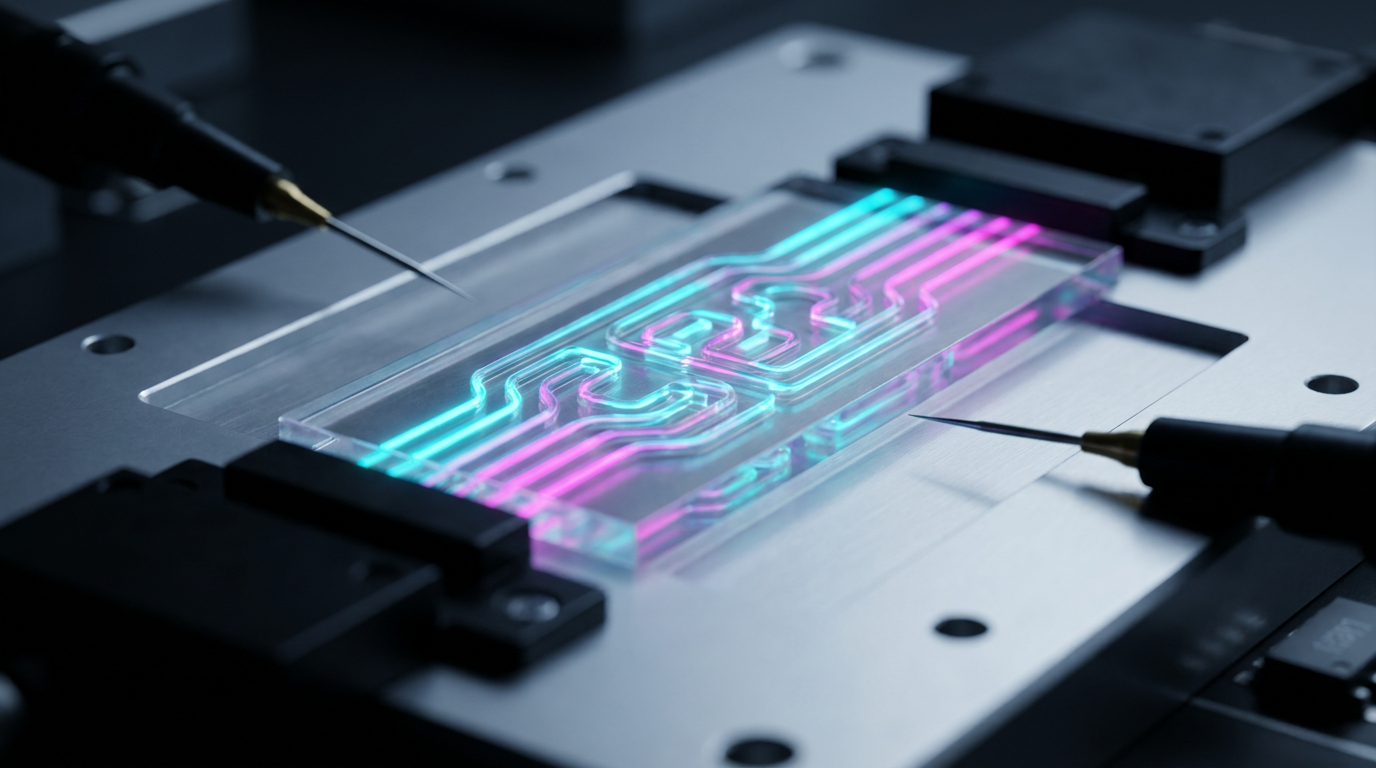
To break this bottleneck, the semiconductor industry is turning to a fundamentally different medium: light. A new generation of "photonic AI accelerators" is emerging, designed to compute using photons instead of electrons, promising to rewrite the rules of hardware performance.[8]
The physics of light offer profound advantages for computation. Unlike electrons, which repel each other and generate friction, photons do not interact unless specifically engineered to do so. Multiple wavelengths of light can travel through the same microscopic channel simultaneously—a property known as wavelength multiplexing.[2][8]

This allows photonic chips to perform calculations in parallel at the speed of light. When light passes through an optical system, the natural physics of wave interference can execute matrix multiplication—the core mathematical operation of neural networks—without a single transistor switching.[2][7]
The most immediate crisis in AI infrastructure isn't just computation; it is data movement. Moving information between memory banks and processors consumes significantly more energy than the actual math, creating a "memory wall" that starves high-performance GPUs of data.[3]
Companies are attacking this bottleneck with optical interconnects. Celestial AI recently introduced its Photonic Fabric technology, which allows data to move optically across chips and servers. This architecture enables up to 32 terabytes of shared memory at ultra-low latency, bypassing traditional electrical limits.[3]
Companies are attacking this bottleneck with optical interconnects.
Lightmatter, another pioneer in the space, has demonstrated a 16-wavelength bidirectional optical link that delivers an eight-fold leap in bandwidth density. Their "Passage" interconnect platform allows massive GPU clusters to scale seamlessly, replacing copper bottlenecks with fiber optics.[2]

But the ultimate goal is fully optical computation. In a landmark paper published in the journal Nature, Lightmatter demonstrated a photonic processor executing production AI workloads. The system performed 65.5 trillion operations per second while consuming just 1.6 watts of optical power.[2][7]
Academic institutions are pushing these theoretical limits even further. Researchers at MIT recently unveiled a fully integrated photonic processor capable of classifying wireless signals in nanoseconds—roughly 100 times faster than the best digital alternatives.[1]
The MIT chip fits 10,000 "neurons" onto a single device and operates with 95% accuracy. By using a technique called photoelectric multiplication, the processor handles both linear and nonlinear operations in-line, dramatically reducing the physical footprint required for optical deep learning.[1]
The implications of this technology extend far beyond hyperscale data centers. In the automotive sector, self-driving cars require billions of calculations per second, currently demanding power-hungry GPUs and complex liquid cooling systems that drain electric vehicle batteries.[6]
Photonic chips could process LiDAR and high-resolution camera feeds with virtually no heat output. By shifting the computational burden from electrons to photons, automakers could vastly improve autonomous reaction times while simultaneously extending vehicle range.[6]
European innovators are also entering the fray. German startup Q.ANT is commercializing photonic chips that promise 30 times greater energy efficiency at the chip level, aiming to replace the sprawling thermoelectric furnaces of modern computing with cool, light-driven processors.[4]

The transition to optical computing will not happen overnight. The industry is currently entering a hybrid phase, where optical interconnects bridge traditional silicon processors, allowing data centers to adopt the technology incrementally without discarding existing infrastructure.[5][8]
However, the economic imperative is accelerating the shift. The global photonic AI accelerator market is projected to surge from $2.13 billion in 2025 to over $41 billion by 2035. As the physical limits of silicon become undeniable, the fusion of light and computation is no longer a theoretical pursuit—it is the necessary foundation for the next era of artificial intelligence.[5]
How we got here
1980s
Early theoretical work on optical computing begins at Bell Labs, but struggles to compete with the rapid scaling of silicon transistors.
2019
Startups begin demonstrating early prototypes of Mach-Zehnder Interferometer arrays for AI computation.
December 2024
MIT researchers unveil a fully integrated photonic processor capable of classifying wireless signals in nanoseconds.
April 2025
Lightmatter publishes a landmark paper in Nature demonstrating a photonic processor executing production AI workloads.
August 2025
Celestial AI introduces the world's first System-on-Chip with an in-die optical interconnect at Hot Chips.
Viewpoints in depth
Optical Computing Pioneers
Argue that computing with light is the only viable path to bypass the thermal and bandwidth limits of traditional silicon.
Companies developing photonic hardware view the current AI boom as fundamentally constrained by physics. They argue that as long as the industry relies on pushing electrons through copper, power consumption and heat generation will scale unsustainably. By shifting to photons, these pioneers believe they can unlock massive parallelism and near-zero latency, fundamentally inverting the economics of AI training and inference.
Academic Researchers
Focus on pushing the theoretical limits of optical neural networks and proving their viability in real-world applications.
Researchers at institutions like MIT are less concerned with immediate data center deployment and more focused on proving that optical systems can handle complex, non-linear math. Their work demonstrates that entire neural networks can be mapped onto optical circuits, achieving extreme energy efficiency and nanosecond processing speeds that could redefine edge computing and telecommunications.
Industry Analysts
Track the commercialization timeline and the practical integration of optical technology into existing infrastructure.
Market analysts view optical computing not as an overnight replacement for silicon, but as a phased integration. They project that the immediate commercial impact will be in 'co-packaged optics'—using light to move data between traditional GPUs. Over the next decade, as manufacturing processes mature and costs drop, analysts expect fully optical compute accelerators to capture a massive share of the high-performance computing market.
What we don't know
- How quickly semiconductor foundries can scale up the mass manufacturing of highly complex photonic integrated circuits.
- Whether the software ecosystem and programming frameworks will adapt fast enough to fully utilize analog optical hardware.
- The exact timeline for when fully optical compute chips will reach cost-parity with traditional silicon GPUs.
Key terms
- Photonic Integrated Circuit (PIC)
- A microchip containing optical components that process and route light, similar to how an electronic chip routes electricity.
- Wavelength Multiplexing
- A technique that allows multiple distinct signals of light (different colors) to travel down the same optical path simultaneously without interfering.
- Mach-Zehnder Interferometer (MZI)
- An optical device used in photonic chips that splits a beam of light and recombines it to perform mathematical calculations through wave interference.
- Co-Packaged Optics (CPO)
- An advanced manufacturing technique that places optical communication components on the same package as the main processor to eliminate data bottlenecks.
- Matrix Multiplication
- The core mathematical operation underlying neural networks, which photonic chips can execute naturally at the speed of light.
Frequently asked
What is a photonic AI accelerator?
It is a computer chip that uses light (photons) instead of electricity (electrons) to perform the massive mathematical calculations required for artificial intelligence.
Why is optical computing better than traditional silicon?
Light generates virtually no heat and allows multiple data streams to travel simultaneously on different wavelengths, vastly increasing speed and energy efficiency.
Will photonic chips replace GPUs completely?
Not immediately. The first wave of commercialization uses hybrid systems, where light handles data transfer and matrix math, while traditional silicon handles memory and control flow.
When will this technology be widely available?
Early commercial deployments in data centers are beginning now, with widespread adoption and edge applications like autonomous vehicles expected to scale between 2027 and 2030.
Sources
Source coverage
8 outlets
4 viewpoints surfaced








[1]MIT NewsAcademic Researchers
Photonic processor could enable ultrafast AI computations with extreme energy efficiency
Read on MIT News →[2]LightmatterOptical Computing Pioneers
A New Computing Pathway: Universal Photonic AI Acceleration
Read on Lightmatter →[3]ServeTheHomeOptical Computing Pioneers
Celestial AI Photonic Fabric Module at Hot Chips 2025
Read on ServeTheHome →[4]Cherry VenturesOptical Computing Pioneers
Q.ANT's Photonic Chips Are Rewiring the Future of AI
Read on Cherry Ventures →[5]DataM IntelligenceIndustry Analysts
Global Photonic AI Accelerators Market Report 2026-2035
Read on DataM Intelligence →[6]AutoblogEdge & Auto Integrators
MIT's new photonic AI chip processes data with light instead of electricity
Read on Autoblog →[7]NatureAcademic Researchers
Universal photonic artificial intelligence acceleration
Read on Nature →[8]Factlen Editorial TeamIndustry Analysts
Synthesis by Factlen editorial team
Read on Factlen Editorial Team →

More in ai
See all 6 stories →AI Copyright Law
The AI Copyright Liability Trap: Evidence Pack on the 2026 Supreme Court Fallout
7 sources

Self-Driving Labs
How Self-Driving Labs and Agentic AI Are Automating Scientific Discovery
6 sources

Medical AI
UK Launches 'London Region I' Sandbox to Fast-Track AI Medical Devices into NHS Clinics
7 sources

AI Reasoning
OpenAI Model Disproves 80-Year-Old Erdős Math Conjecture in Breakthrough for AI Reasoning
6 sources

Every angle. Every day.
Get ai stories with full source coverage and perspective breakdowns delivered to your inbox.