
The Rise of the Cozy Web and Digital Gardens
As algorithmic fatigue sets in, internet users are retreating to the 'Cozy Web' and cultivating 'digital gardens'—personal, slow-paced corners of the internet focused on intentionality and ownership.
By Factlen Editorial Team
- Digital Gardeners
- Advocates for slow, intentional internet use who prioritize personal ownership and learning in public over algorithmic reach.
- Tech Minimalists
- Developers and creators focused on the technical architecture of the Small Web, championing simple code and decentralized protocols.
- Mainstream Users
- Internet users who rely on centralized platforms for frictionless discovery, real-time news, and broad community building.
What's not represented
- · Social Media Executives
- · Algorithmic Content Creators
Why this matters
This movement represents a fundamental shift in how we consume and create online, offering a blueprint for escaping toxic social media feeds and reclaiming ownership of our digital identities.
Key points
- Internet users are increasingly experiencing algorithmic fatigue, driving a migration away from centralized social media platforms.
- The 'Cozy Web' encompasses private group chats and independent, human-scale websites that prioritize connection over virality.
- Digital gardening is a growing practice where users build non-linear, evolving personal websites rather than traditional chronological blogs.
- Accessible tools like Notion and Obsidian have democratized the creation of digital gardens, removing the need for coding skills.
- While the movement offers a healthier alternative to the attention economy, it faces challenges with content discoverability.
For the better part of a decade, the internet has felt like a high-speed treadmill. The dominant platforms—Facebook, X, TikTok, and Instagram—are built on the architecture of the "stream," where information flows in a reverse-chronological torrent. Users are incentivized to post polished, performative content optimized for algorithmic reach, leading to an environment that many cultural critics now describe as the "Dark Forest" of the web. In this forest, visibility invites toxicity, and genuine human connection is frequently drowned out by engagement bait and algorithmic outrage. As social media has shifted from connecting friends to serving as one-to-many broadcast networks for influencers and brands, a profound sense of algorithmic fatigue has set in among everyday users.[3][7]
But a quiet, intentional rebellion is taking root across the internet. Driven by this widespread fatigue and a renewed desire for digital ownership, a growing cohort of creatives, professionals, and everyday internet users are retreating from the centralized platforms. They are migrating toward what technologists and cultural observers call the "Cozy Web" and the "Small Web"—human-scale, interconnected spaces that prioritize slow, deliberate thought over viral engagement. This movement is not about abandoning the internet; it is about reclaiming it, building digital environments where users are the architects rather than the product.[2][6]
The Cozy Web, a term popularized by writer Venkatesh Rao and expanded upon by internet anthropologists, refers to the private, gatekeeper-maintained spaces where people actually talk to one another. This includes Discord servers, group chats, and private Slack channels—a retreat underground away from the public eye. But alongside this private retreat is a vibrant, public-facing renaissance: the return of the personal website, reimagined for the 2020s. These aren't the corporate portfolios of the 2010s, but highly personalized, idiosyncratic spaces that reflect the mind of the creator.[1][3]
This resurgence isn't merely a wave of 1990s nostalgia, though the aesthetic often nods to the quirky, hand-coded Geocities pages of the early internet. It is a strategic response to the fundamental vulnerabilities of the attention economy. When you build your digital identity on a centralized platform, you are essentially renting space in a corporate walled garden. The platform dictates the rules, owns the distribution channels, and can change the algorithm—or delete your account—overnight. Building a personal website is a reassertion of a core internet principle: true ownership matters.[3][5]
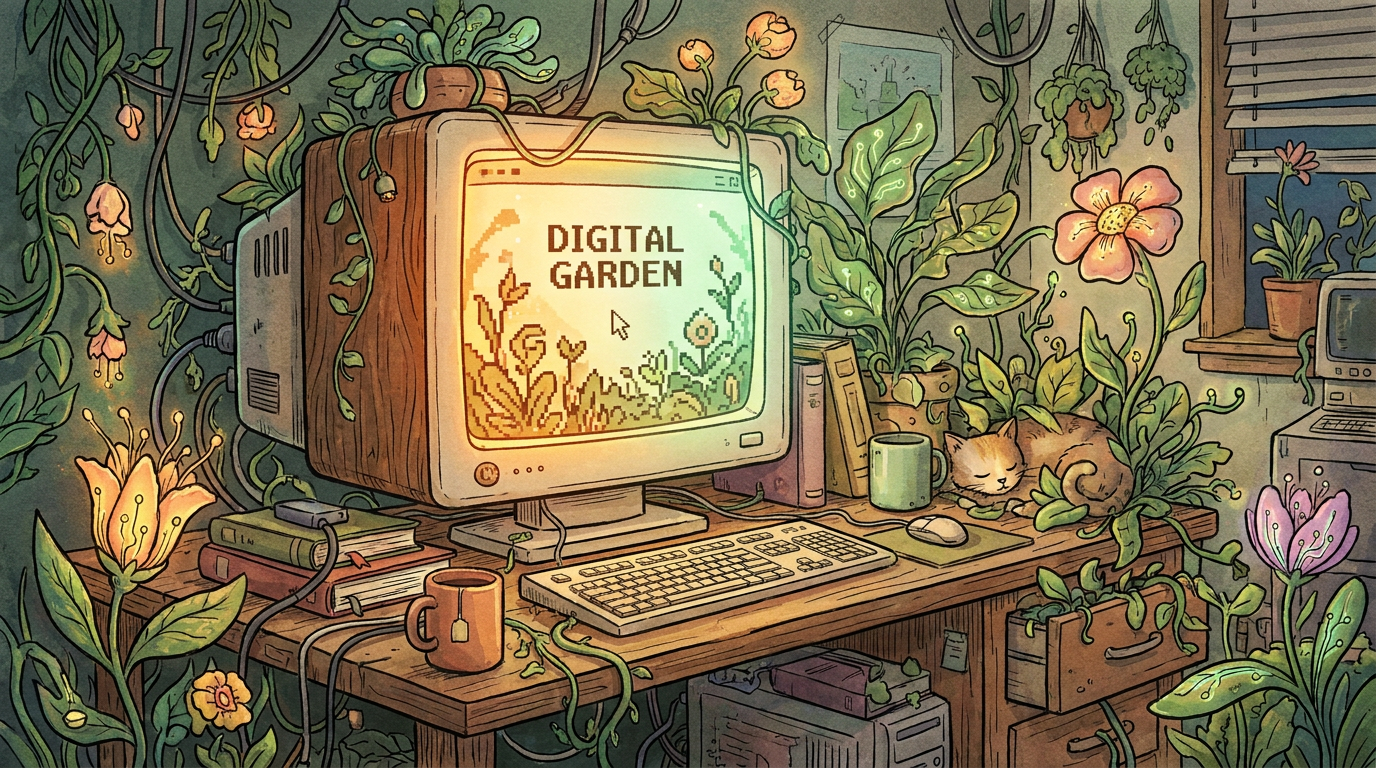
At the heart of this movement is a specific publishing practice known as "digital gardening." If a traditional blog is a stream—presenting finished, highly polished thoughts in strict chronological order—a digital garden is a topographical landscape. It is a collection of evolving notes, essays, and ideas that are interconnected and cultivated over time. Digital gardens reject the reverse-chronological feed entirely, opting instead for an explorable space where knowledge accumulates and matures at its own pace.[1][8]

In a digital garden, content is rarely marked with a publication date. Instead, it is often tagged by its "growth stage." A creator might publish a "seed" for a nascent, unformed thought, a "sapling" for a developing concept, and an "evergreen" for a fully fleshed-out, comprehensive essay. This framework fundamentally changes the psychology of publishing online. It lowers the barrier to entry, encouraging users to "learn in public" without the paralyzing pressure of producing a flawless final product before hitting publish.[1][7]
The technical mechanism that makes a digital garden function is bidirectional linking. Unlike traditional hyperlinks, which point in one direction (from Page A to Page B), bidirectional links automatically create a reciprocal connection. If Page A links to Page B, Page B automatically displays a "backlink" showing that Page A referenced it. This creates a dense, visible web of interconnected thought, allowing readers to see exactly how different concepts relate to one another within the creator's mind.[1][8]
This architecture allows readers to wander through a digital garden via serendipitous rabbit holes rather than scrolling down a linear feed. It mimics how human memory and cognition actually work—associative, non-linear, and constantly updating based on new information. By clicking through backlinks, a visitor might start on an essay about urban planning and seamlessly navigate to a note about community building, discovering the underlying connective tissue of the author's worldview.[7][8]
This architecture allows readers to wander through a digital garden via serendipitous rabbit holes rather than scrolling down a linear feed.
Historically, cultivating a digital garden required significant technical expertise. Early adopters were primarily web developers who used static site generators like Jekyll or Gatsby, writing their notes in Markdown and deploying code via GitHub repositories. This high barrier to entry kept the digital gardening movement confined to a niche technical subculture for years, inaccessible to writers, artists, and thinkers who lacked a background in programming.[1]
Today, that technical barrier has completely collapsed. The rise of accessible "tools for thought" has democratized the practice of digital gardening. Applications like Notion, Obsidian, and Roam Research allow users to build complex, interlinked knowledge bases without writing a single line of code. Furthermore, third-party services have emerged that can instantly publish an Obsidian vault or a Notion workspace to the public web, turning a private note-taking system into a public garden with a single click.[1][8]

The movement is also intersecting with the rapid development of decentralized social protocols. For example, developers building on ATProto—the open-source protocol underlying the social network Bluesky—have launched projects like "spores.garden." These applications automatically generate unique digital gardens for users based on their decentralized identifiers. They allow users to pull in short-form posts, long-form essays, and media into a centralized, owned space that remains interoperable with the broader decentralized web, completely free from corporate control.[4]
As the Small Web grows, it is resurrecting discovery mechanisms that predated algorithmic feeds. Webrings—circular networks of independent sites linked together by a common theme or community—are making a massive comeback. Similarly, blogrolls, which are curated lists of recommended sites maintained by human beings, are replacing automated recommendation engines. These tools prioritize human curation over machine optimization.[3]
This human-curated discovery feels refreshingly different from the frictionless, infinite scroll of modern social media. It requires active participation and curiosity. Finding a new, fascinating corner of the internet on the Small Web feels like stumbling upon a hidden, independent bookstore in a new city, rather than having a mass-market product shoved into your hands by a digital billboard. It restores a sense of serendipity and adventure to web browsing.[5][6]
It is important to note that the Small Web and IndieWeb movements, while related, have distinct philosophies. The IndieWeb is platform-agnostic, focusing on developing open standards that allow independent sites to talk to each other—enabling cross-site comments, likes, and follows. The Small Web, by contrast, is often platform-minimalist. Its advocates champion simple HTML, the removal of heavy JavaScript dependencies, and lightning-fast load times that respect the user's bandwidth, privacy, and attention.[2]

Despite its rapid growth and passionate community, the digital gardening movement faces inherent limitations. The most pressing challenge is the "discoverability crisis." Without a central algorithm to push content to millions of personalized feeds, independent websites struggle to find an audience outside of their immediate niche. For creators whose primary goal is massive reach or monetization, the Small Web offers little utility.[7]
Furthermore, the Small Web is unlikely to ever fully replace centralized platforms. Mainstream social media remains unparalleled for real-time news gathering, global political activism, and frictionless e-commerce. The digital garden is not designed for breaking news or viral marketing campaigns; it is fundamentally designed for slow, deliberate thought and niche community building.[2][7]
Yet, for the creators participating in this renaissance, that friction is entirely the point. They are not trying to reach a million people; they are trying to reach the right people, in an environment that fosters genuine connection rather than performative outrage. By stepping off the algorithmic treadmill, they are trading viral metrics for creative freedom and intellectual sustainability.[5][6]
The return to personal websites and the cultivation of digital gardens represents a profound, optimistic shift in internet culture. It is a definitive rejection of the idea that users must be products to be consumed by algorithms. By reclaiming their digital presence and tending to their own corners of the web, these internet users are proving that the internet can still be a cozy, weird, and deeply human place.[3][7]
How we got here
Late 1990s - Early 2000s
The era of the 'Old Web,' characterized by hand-coded personal websites, webrings, and decentralized digital ownership.
2010s
The rise of the 'Stream,' as centralized social media platforms like Facebook and Twitter dominate internet traffic and algorithmic feeds become the norm.
2018 - 2020
The concept of 'digital gardening' gains traction among web developers, popularized by essays from technologists seeking alternatives to the chronological blog.
2024 - 2026
The movement goes mainstream as no-code tools like Notion and Obsidian make digital gardening accessible, sparking a broader 'Small Web' renaissance.
Viewpoints in depth
The Gardeners' View
Reclaiming the internet through intentionality and ownership.
For digital gardeners, the modern internet has become a toxic, performative space optimized for advertisers rather than users. They argue that by moving away from algorithmic feeds and building personal, interconnected websites, individuals can reclaim their digital identities. This camp values 'learning in public'—publishing unfinished thoughts and allowing them to evolve over time—which they believe fosters deeper critical thinking and more genuine human connection than the rapid-fire takes rewarded by social media.
The Tech Minimalists' View
Fixing the web by returning to simple, decentralized architecture.
Tech minimalists focus on the infrastructure of the internet. They argue that the modern web is bloated with unnecessary code, tracking scripts, and corporate dependencies. By championing the 'Small Web,' they advocate for a return to simple HTML and CSS, ensuring websites load instantly and respect user privacy. This group also heavily supports decentralized protocols like ATProto, believing that the future of the internet relies on interoperable systems where no single corporation can control the flow of information.
The Mainstream Reality
The enduring utility of centralized social platforms.
While acknowledging the flaws of the attention economy, this perspective highlights that the Cozy Web and digital gardens are inherently niche. Centralized platforms remain unmatched for real-time news dissemination, global activism, and frictionless e-commerce. Critics of the Small Web movement point out that it suffers from a severe discoverability crisis; without algorithms to surface content, independent creators struggle to find an audience. For many, the friction of navigating decentralized webrings is simply too high compared to the convenience of a unified feed.
What we don't know
- Whether the Small Web movement will remain a niche subculture or achieve mainstream adoption as decentralized protocols mature.
- How independent creators will solve the discoverability crisis without relying on the very algorithmic feeds they are trying to escape.
Key terms
- Cozy Web
- Private, gatekeeper-maintained online spaces like group chats and Discord servers where people communicate away from public algorithms.
- Digital Garden
- A personal website that acts as an evolving, non-linear collection of notes and essays, rather than a reverse-chronological blog.
- Bidirectional Linking
- A type of hyperlink that automatically creates a reciprocal connection between two pages, showing both where a link points and where it came from.
- The Stream
- The dominant architecture of modern social media, characterized by a fast-moving, reverse-chronological feed of polished content.
- Small Web
- A movement advocating for independent, platform-minimalist websites that prioritize simple code, fast load times, and personal ownership.
Frequently asked
What is the difference between a blog and a digital garden?
A blog is typically a reverse-chronological stream of finished, polished posts. A digital garden is a non-linear, interconnected collection of notes and essays that evolve over time, often categorized by how 'mature' the thought is rather than when it was published.
Do I need to know how to code to build a digital garden?
Not anymore. While early digital gardens required web development skills, modern tools like Notion, Obsidian, and Roam Research allow anyone to build and publish an interconnected knowledge base without writing code.
What is the 'Cozy Web'?
The Cozy Web refers to private, gatekeeper-maintained online spaces—like Discord servers, group chats, and private Slack channels—where people communicate away from the public, algorithmic feeds of major social media platforms.
Can digital gardens replace social media?
No. Digital gardens are designed for slow, deliberate thought and personal ownership, while social media excels at real-time news, viral reach, and frictionless discovery. The two serve entirely different purposes.
Sources
Source coverage
8 outlets
3 viewpoints surfaced








[1]Maggie AppletonDigital Gardeners
A Brief History and Ethos of the Digital Garden
Read on Maggie Appleton →[2]MediumTech Minimalists
The Small Web and IndieWeb Movements
Read on Medium →[3]GuideLight InnovationsDigital Gardeners
The Personal Website Renaissance
Read on GuideLight Innovations →[4]Hypha Co-opTech Minimalists
Building digital gardens on ATProto
Read on Hypha Co-op →[5]ELPiS MagazineTech Minimalists
Small web is not just a technical phenomenon. It is a culture
Read on ELPiS Magazine →[6]SubstackMainstream Users
The Alt-Digital: Resisting in Place
Read on Substack →[7]Factlen Editorial TeamDigital Gardeners
Synthesis by Factlen editorial team
Read on Factlen Editorial Team →[8]DEV CommunityDigital Gardeners
What is a Digital Garden?
Read on DEV Community →

Every angle. Every day.
Get culture stories with full source coverage and perspective breakdowns delivered to your inbox.