
Japan Prepares to Beam Solar Power from Space to Earth in Historic Test
Japan's OHISAMA project is preparing to launch a satellite that will test transmitting solar energy wirelessly from orbit, aiming to unlock 24/7 clean baseload power.
By Factlen Editorial Team
- Space Solar Advocates
- Argue that orbital solar is the ultimate solution for continuous, weather-proof clean energy.
- Economic Pragmatists
- Highlight the massive cost disparity between space-based systems and rapidly cheapening terrestrial renewables.
- Energy Security Planners
- View space solar as a strategic necessity for resource-poor nations to achieve energy independence.
What's not represented
- · Environmental groups concerned about the ecological impact of frequent heavy-lift rocket launches required to build massive orbital arrays.
- · Aviation regulators who must manage airspace around high-power microwave transmission corridors.
Why this matters
If successful, space-based solar power could provide continuous, weather-proof renewable energy, eliminating the need for massive battery storage and offering true energy independence to resource-poor nations.
Key points
- Japan's OHISAMA project will test beaming solar energy from a satellite to Earth.
- The satellite will convert sunlight into microwaves and transmit them to a ground station in Suwa.
- Space-based solar panels can generate 13 times more energy annually than terrestrial panels.
- The technology could provide 24/7 baseload renewable energy, though high costs remain a major hurdle.
The concept of the sun never setting in space offers a tantalizing solution to the holy grail of renewable energy: continuous baseload power without the need for massive battery storage.[1][2]
Japan is preparing to turn this science fiction concept into reality with the OHISAMA project, named after the Japanese word for "sun." Led by the Japan Aerospace Exploration Agency (JAXA) and Japan Space Systems, the initiative is gearing up for a historic orbital test.[2][3]
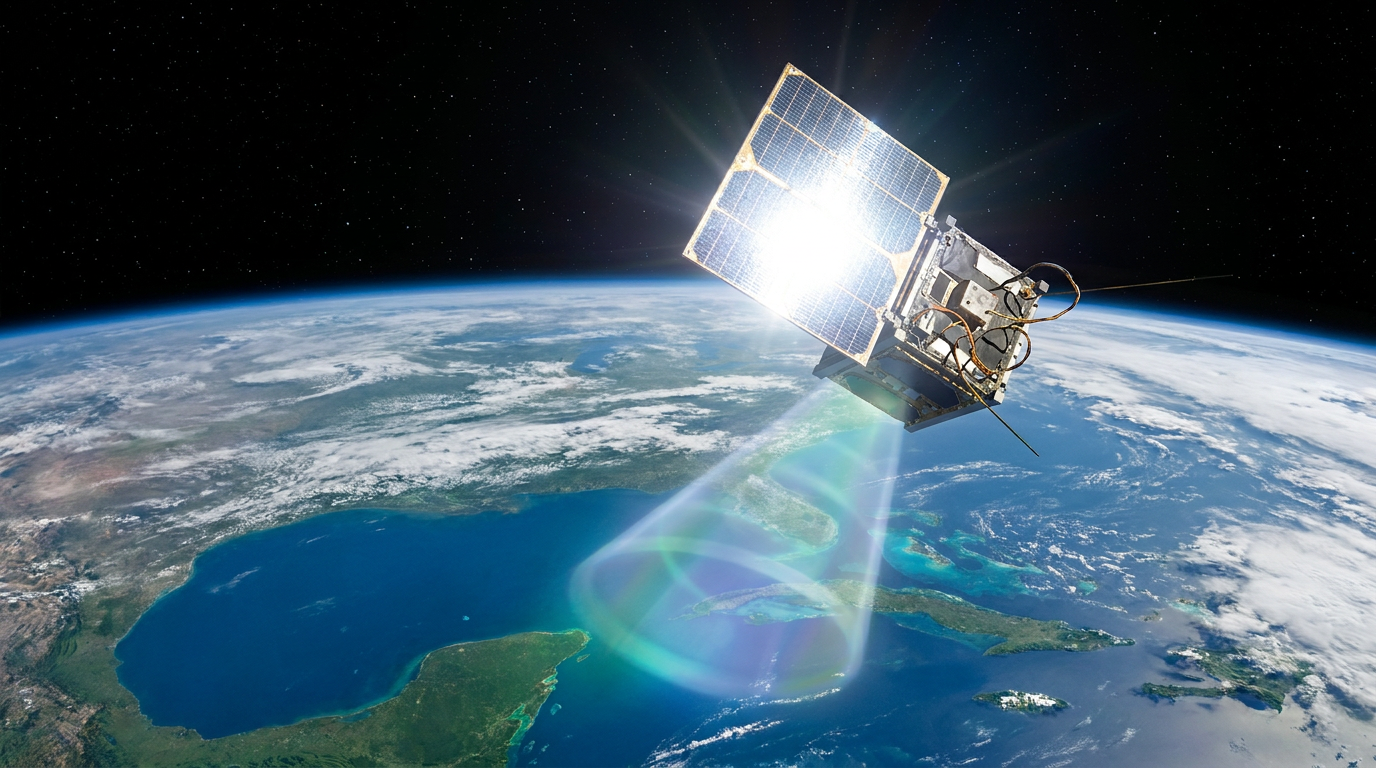
The upcoming demonstration involves a 180-kilogram satellite, roughly the size of a standard washing machine, which will be launched into Low Earth Orbit at an altitude of approximately 400 kilometers.[1][5]
Once in orbit, the satellite's two-square-meter solar panel will collect constant sunlight, convert it into electricity, and then transform that power into high-frequency microwaves in the gigahertz range.[3][4]

These microwaves will then be beamed down to a dedicated receiving station in Suwa, central Japan. The ground station features a 600-square-meter array equipped with 13 specialized antennas, known as "rectennas," designed to catch the signal and convert it back into usable electricity.[2][3]
The initial output of this test will be highly modest. The system is designed to transmit about one kilowatt of power—roughly enough to run a standard coffee maker or a dishwasher for a single hour.[1][5]
However, the significance of the OHISAMA mission lies entirely in the proof of concept. Successfully transferring energy wirelessly from orbit to Earth in a matter of minutes will demonstrate that the fundamental physics and engineering of space-based solar power are viable.[1][5]
The primary motivation for moving solar infrastructure into space is to overcome the inherent limitations of terrestrial renewable energy. On Earth, solar panels are strictly at the mercy of the weather, the changing seasons, and the daily setting of the sun.[2][3]
In orbit, the environment is radically different. There are no clouds to block the light, no atmospheric interference, and no nightfall, allowing satellites to harvest sunlight 24 hours a day, 365 days a year.[5]
There are no clouds to block the light, no atmospheric interference, and no nightfall, allowing satellites to harvest sunlight 24 hours a day, 365 days a year.
This constant, uninterrupted exposure means that an orbital solar array can generate approximately 13 times more energy annually than an identically sized installation on the ground.[2]
For Japan, the stakes behind this technology are existential. The island nation currently imports more than 90 percent of its energy, leaving its economy highly vulnerable to global supply chain shocks and geopolitical tensions.[2][5]
Following the 2011 Fukushima Daiichi nuclear disaster, Japan's urgency to find reliable, non-nuclear, domestic energy sources intensified dramatically. Space-based solar offers a path to energy independence without requiring the massive land footprint that terrestrial solar farms demand.[2][5]
The engineering challenges required to make this a reality, however, are staggering. Beaming power from space demands extreme precision, as the microwave signal must stay perfectly focused on a fixed point on Earth while the satellite hurtles through orbit at more than 17,000 miles per hour.[2][5]
The margin for error is razor-thin. The angular deviation of the beam must remain below 0.001 degrees; even a slight misalignment means lost energy or scattered radiation.[2][5]

Beyond the physics, there is the formidable question of economics. Skeptics, including analysts from NASA, point out that space-based solar power could cost up to ten times more than land-based solar or wind energy.[2][5]
When factoring in the immense costs of rocket launches, satellite construction, orbital maintenance, and transmission losses, the financial math is daunting, especially as terrestrial solar prices continue to plummet.[2][5]
Public safety concerns also linger regarding the transmission of microwaves through the atmosphere. While researchers emphasize that the frequencies used are similar to standard Wi-Fi and the beam intensity at ground level is comparable to natural sunlight, public perception remains a hurdle.[5]

Despite these formidable obstacles, the OHISAMA project represents a critical first step. If this kilowatt-scale test succeeds, Japan plans to scale the technology dramatically over the next 25 years.[5]
How we got here
1960s
The concept of space-based solar power is first proposed by scientists but deemed too expensive.
2011
The Fukushima nuclear disaster accelerates Japan's search for alternative baseload renewable energy.
Dec 2024
Researchers successfully demonstrate wireless power transmission using an aircraft-mounted microwave transmitter.
2026
The OHISAMA satellite is scheduled to launch, conducting the first orbital power transmission test.
Viewpoints in depth
Space Solar Advocates
Argue that orbital solar is the ultimate solution for continuous, weather-proof clean energy.
Proponents, including JAXA and Japan Space Systems, emphasize that terrestrial solar will always be limited by the day-night cycle and weather patterns. By moving collection to orbit, humanity can access a virtually infinite, uninterrupted power source. They argue that while initial costs are high, the long-term payoff of 24/7 baseload renewable energy justifies the investment, especially as launch costs continue to fall thanks to commercial spaceflight.
Economic Pragmatists
Highlight the massive cost disparity between space-based systems and rapidly cheapening terrestrial renewables.
Skeptics, drawing on analyses from organizations like NASA, point out that space solar power could cost up to ten times more than land-based alternatives. They argue that the combination of cheap terrestrial solar panels, wind turbines, and grid-scale battery storage is already solving the intermittency problem at a fraction of the cost. From this view, the expense of rocket launches, orbital maintenance, and complex microwave transmission makes space solar an engineering marvel but an economic dead end.
Energy Security Planners
View space solar as a strategic necessity for resource-poor nations to achieve energy independence.
For policymakers in nations like Japan, which imports over 90 percent of its energy, the calculation goes beyond pure economics. Following the Fukushima disaster, the need for reliable, domestic, non-nuclear power became an existential priority. Energy security planners view space-based solar not just as a green initiative, but as a critical geopolitical asset that insulates the country from volatile global fossil fuel markets and supply chain disruptions.
What we don't know
- Whether the cost of launching and maintaining massive orbital arrays will ever become competitive with terrestrial renewables.
- How international aviation and space agencies will regulate the airspace around high-power microwave beams.
- The exact timeline for when gigawatt-class space solar arrays will be commercially viable.
Key terms
- Space-Based Solar Power (SBSP)
- The concept of collecting solar power in outer space and distributing it to Earth via wireless transmission.
- Low Earth Orbit (LEO)
- An Earth-centered orbit with an altitude of 2,000 kilometers or less, where the OHISAMA test satellite will operate.
- Rectenna
- A specialized rectifying antenna used to convert microwave energy directly into direct current (DC) electricity.
- Baseload Power
- The minimum amount of electric power needed to be supplied to the electrical grid at any given time, traditionally provided by coal or nuclear plants.
Frequently asked
Is it safe to beam microwaves to Earth?
Yes, researchers state that the microwave frequencies used are similar to standard Wi-Fi, and the beam intensity at ground level is comparable to natural sunlight.
Why not just build more solar panels on Earth?
Terrestrial solar panels are limited by weather and the day-night cycle. Space-based panels receive sunlight 24/7, allowing them to generate roughly 13 times more energy annually.
When will this technology power homes?
The current OHISAMA project is a small-scale 1-kilowatt test. Japan hopes to scale up to commercial, gigawatt-class arrays over the next 25 years.
Sources
Source coverage
5 outlets
3 viewpoints surfaced





[1]RatedPowerSpace Solar Advocates
What if the sun never set? Japan's OHISAMA project is exploring that possibility
Read on RatedPower →[2]EcoSocialists VancouverEnergy Security Planners
Japan Achieves Breakthrough in Space-Based Solar Power
Read on EcoSocialists Vancouver →[3]NotebookCheckSpace Solar Advocates
Japan's OHISAMA project aims to beam solar power from space to earth
Read on NotebookCheck →[4]Supercar BlondieSpace Solar Advocates
Japan is gearing up to test its space-based solar power station
Read on Supercar Blondie →[5]Futura SciencesEnergy Security Planners
Japan is preparing to launch OHISAMA: a satellite designed to capture sunlight in space
Read on Futura Sciences →
Every angle. Every day.
Get world stories with full source coverage and perspective breakdowns delivered to your inbox.