
The Evidence Is In: 'Missing Middle' Zoning Reforms Definitively Lower Rents
A wave of rigorous economic studies analyzing early adopters like Auckland and Minneapolis proves that broad upzoning successfully increases housing supply and reduces rental costs.
By Factlen Editorial Team
- Housing Economists
- Focus on empirical data, synthetic controls, and the macroeconomic effects of supply elasticity.
- Free-Market Advocates
- Emphasize property rights, deregulation, and the removal of government barriers to construction.
- Urban Planners
- Prioritize walkable communities, transit-oriented development, and diverse housing typologies.
What's not represented
- · Local Homeowner Associations (HOAs)
- · Anti-Gentrification Tenant Coalitions
Why this matters
For years, the debate over housing affordability relied on competing economic theories and political rhetoric. Now, definitive empirical evidence proves that legalizing 'missing middle' housing actually works to lower rents—giving policymakers a proven blueprint to solve the housing crisis.
Key points
- Rigorous empirical studies from 2024 to 2026 confirm that large-scale zoning reform effectively lowers rent prices.
- Auckland's 2016 upzoning resulted in rents for three-bedroom homes dropping 26% to 33% compared to a counterfactual model.
- The Minneapolis 2040 Plan lowered rents by 17.5% to 34% relative to peer cities, partly by cooling speculative demand.
- Evidence shows that citywide upzoning works, whereas localized 'spot upzoning' often fails to improve affordability.
For decades, the debate over housing affordability was trapped in a theoretical stalemate. Proponents of zoning reform argued that allowing denser construction would naturally increase supply and lower rents. Meanwhile, skeptics—ranging from neighborhood preservationists to anti-gentrification advocates—warned that deregulation would only enrich developers, spark localized speculation, and drive prices higher.[3][4]
Today, that theoretical debate is being settled by hard empirical data. Over the past few years, a wave of rigorous economic studies has analyzed the first major cities to implement large-scale zoning reforms, providing the first long-term look at what happens when a city actually rewrites its housing rules.[1][2]
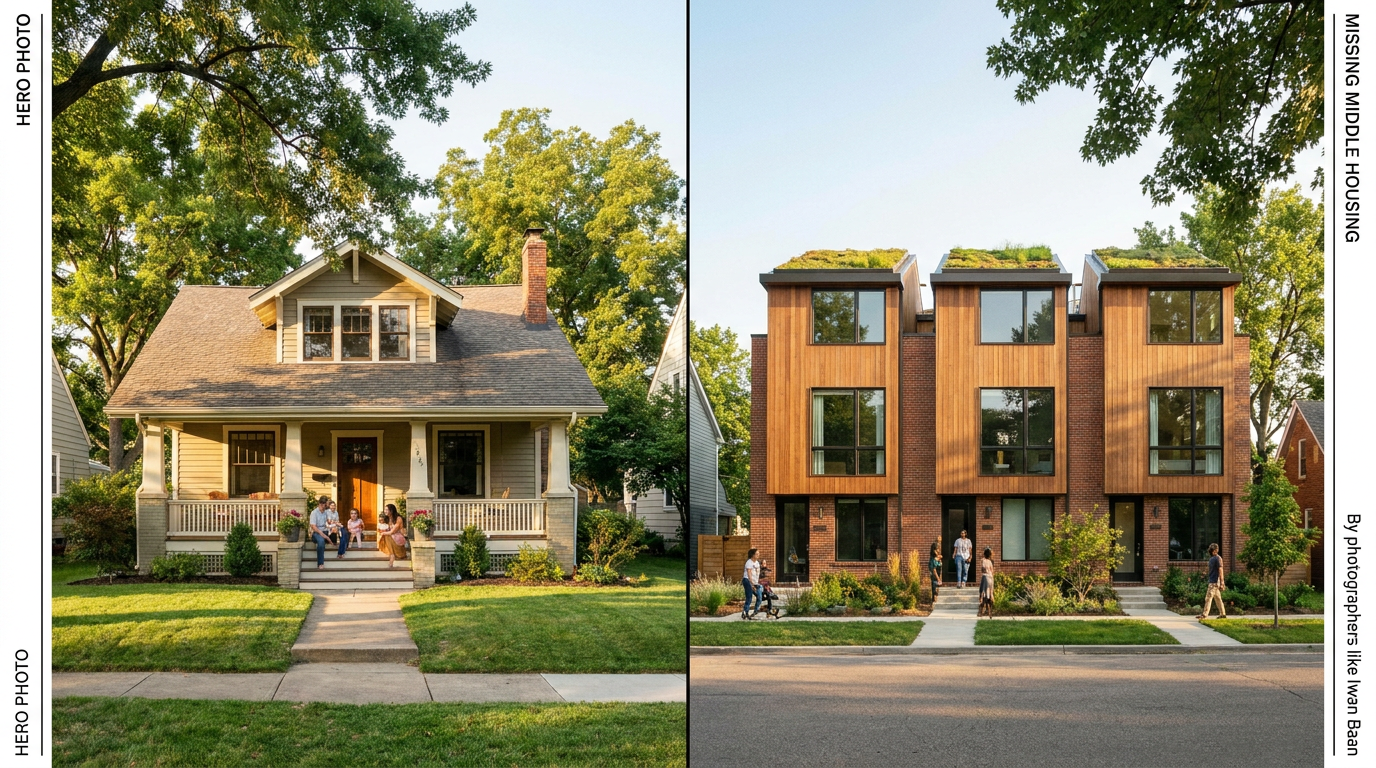
The verdict is increasingly unequivocal: broadly eliminating single-family zoning and legalizing "missing middle" housing—such as duplexes, triplexes, and courtyard apartments—definitively slows rent growth and improves affordability for local residents.[4][6]
The most compelling evidence comes from Auckland, New Zealand, which executed one of the world's most aggressive upzoning policies in 2016. The city rezoned approximately three-quarters of its residential land to allow for denser development, sparking a historic construction boom.[1]

A landmark study from the University of Auckland utilized a "synthetic control" method to isolate the policy's impact. Researchers constructed a counterfactual model of what Auckland's rents would look like without the reform, based on data from peer cities that maintained strict zoning laws.[1]
The results were staggering. Six years after the reform, rents for three-bedroom family homes in Auckland were 26 to 33 percent lower than the synthetic control. Rents for two-bedroom units were roughly 21 to 24 percent lower.[1]
"Our findings support the proposition that large-scale zoning reform can enhance housing affordability," the researchers concluded, noting that the policy specifically succeeded in making family-sized dwellings more accessible to the middle class.[1]
Similar results are emerging in the United States, where Minneapolis became the first major city to abolish single-family zoning citywide with its 2040 Plan, passed in 2018.[2][5]

A 2025 study by economists at Middlebury College applied the same synthetic control methodology to Minneapolis. They found that in the five years following the reform's implementation, home prices were 16 to 34 percent lower, and rents were 17.5 to 34 percent lower, compared to a counterfactual Minneapolis.[2][5]
A 2025 study by economists at Middlebury College applied the same synthetic control methodology to Minneapolis.
Crucially, the Minneapolis study revealed an unexpected mechanism. The price reductions did not stem purely from an immediate, massive surge in new construction. Instead, the policy shift fundamentally altered market expectations.[2][5]
By signaling that future housing supply would be elastic and abundant, the reform cooled speculative demand. Investors and buyers anticipated a less constrained market, which suppressed the urgency and bidding wars that typically drive up housing prices.[5]
In cities where construction did surge, the price impacts have been equally clear. Austin, Texas, implemented a series of pro-housing policies starting in 2015 to ease developer restrictions. Between 2015 and 2024, developers built roughly 120,000 new units.[3]

As a result, Austin's rent trajectory inverted. In 2021, the city's rents were 15 percent higher than the national average. By early 2026, following the sustained influx of new supply, Austin rents had fallen to 4 percent below the national average.[3]
However, the data also highlights a critical caveat for policymakers: scale matters. Studies show that "spot upzoning"—rezoning only a few specific parcels or a single neighborhood—often fails to improve affordability and can actually exacerbate gentrification.[1][4]
When upzoning is localized, the newly zoned land becomes highly scarce and valuable, leading to localized land speculation without moving the macroeconomic needle on citywide supply. Broad, citywide upzoning diffuses this pressure, preventing any single neighborhood from absorbing all the development demand.[1][6]

As the evidence mounts, the political calculus is shifting. From statehouses in California and Oregon to municipal governments across the Midwest, the empirical success of Auckland and Minneapolis is providing policymakers with the data they need to dismantle exclusionary zoning and restore the missing middle of the housing market.[4][7]
How we got here
2015
Austin, Texas begins implementing a series of pro-housing policies to ease developer restrictions.
2016
Auckland, New Zealand upzones approximately three-quarters of its residential land.
Dec 2018
Minneapolis passes the 2040 Plan, becoming the first major U.S. city to eliminate single-family zoning.
2024–2026
A wave of peer-reviewed economic studies confirms that these large-scale zoning reforms successfully lowered rent growth.
Viewpoints in depth
Housing Economists' View
Empirical data proves that supply elasticity is the primary driver of housing affordability.
Economists utilizing synthetic control models argue that the debate over zoning is effectively settled by the data. By comparing cities that reformed their zoning laws against mathematically constructed counterfactuals, researchers have isolated the effect of the policy change. They emphasize that while building new units is crucial, the mere expectation of a less constrained market can immediately cool speculative demand and stabilize prices. Furthermore, they stress that broad, citywide reform is necessary, as localized 'spot upzoning' only creates artificial scarcity and drives up land values in targeted neighborhoods.
Urban Planners' View
Zoning reform is about restoring diverse, walkable communities, not just lowering prices.
For urban planners, the re-legalization of the 'missing middle' is a return to historical city building. Before the widespread adoption of exclusionary single-family zoning in the mid-20th century, cities naturally integrated duplexes, triplexes, and courtyard apartments into residential neighborhoods. Planners argue that these typologies not only provide naturally affordable housing options but also support local transit, reduce carbon footprints by limiting suburban sprawl, and create more vibrant, walkable communities.
Free-Market Advocates' View
The housing crisis is a government-created problem solved by deregulation and property rights.
Free-market think tanks view exclusionary zoning as an infringement on private property rights and a massive regulatory failure. They argue that the housing shortage was artificially engineered by local governments bowing to NIMBY (Not In My Backyard) pressure, which made it illegal to build enough homes to meet demand. From this perspective, the success of Auckland and Minneapolis is proof that when government gets out of the way and allows developers to build what the market demands, prices naturally fall and supply constraints evaporate.
What we don't know
- Whether upzoning immediately lowers rents for the lowest-income brackets, or primarily stabilizes middle-income housing first.
- How long-term demographic shifts and remote work trends will interact with the new housing supply over the next decade.
Key terms
- Upzoning
- Changing local regulations to allow for denser housing development on a given parcel of land.
- Synthetic Control Method
- A statistical technique used to evaluate the effect of an intervention by comparing the treated city to a weighted combination of untreated peer cities.
- Spot Upzoning
- The practice of relaxing zoning restrictions on a very small, localized scale rather than across an entire city or region.
- Missing Middle
- A range of multi-unit or clustered housing types compatible in scale with single-family homes, designed to be affordable for middle-income earners.
- Filtering
- The process by which new, market-rate housing construction frees up older, more affordable units as higher-income residents move into the new buildings.
Frequently asked
What is 'missing middle' housing?
It refers to multi-unit housing types—like duplexes, triplexes, and courtyard apartments—that bridge the gap between single-family homes and large high-rise apartment buildings.
What is a 'synthetic control' in these studies?
It is a statistical method that creates a hypothetical version of a city using data from similar peer cities, allowing researchers to measure what would have happened if a policy had never been passed.
Why doesn't 'spot upzoning' work as well?
Rezoning only a small area makes that specific land artificially valuable, which can drive up local prices and spur gentrification. Citywide upzoning diffuses the development pressure across a much larger area.
Did Minneapolis prices drop just because of new buildings?
Not entirely. Studies show that the mere expectation of future housing supply cooled speculative demand and bidding wars, lowering prices even before massive construction took place.
Sources
Source coverage
7 outlets
3 viewpoints surfaced







[1]University of Auckland ResearchHousing Economists
Can zoning reform increase housing construction? Evidence from Auckland
Read on University of Auckland Research →[2]Global Labor OrganizationHousing Economists
Zoning Reforms and Housing Affordability: Evidence from the Minneapolis 2040 Plan
Read on Global Labor Organization →[3]Mackinac CenterFree-Market Advocates
Zoning reform can increase housing affordability, birth rates. Theory predicts it, history confirms it.
Read on Mackinac Center →[4]Reason FoundationFree-Market Advocates
Missing middle housing reform is one promising and increasingly popular policy tool
Read on Reason Foundation →[5]Center of the American ExperimentFree-Market Advocates
Has the Minneapolis 2040 Plan worked?
Read on Center of the American Experiment →[6]Regional Plan AssociationUrban Planners
Solving the Missing Middle: Adopting strategies to address missing middle housing typologies
Read on Regional Plan Association →[7]Factlen Editorial TeamUrban Planners
Synthesis by Factlen editorial team
Read on Factlen Editorial Team →

Every angle. Every day.
Get real estate stories with full source coverage and perspective breakdowns delivered to your inbox.