
How Hotels Are Using Neuroscience and Acoustic Engineering to Fix Our Sleep
The hospitality industry is pivoting from thread counts to circadian science, engineering rooms to combat modern exhaustion.
By Factlen Editorial Team
- Hospitality Innovators
- Viewing sleep as the ultimate luxury amenity and a key market differentiator.
- Sleep Scientists & Clinicians
- Focusing on the biological mechanisms of rest and the elimination of environmental disruptors.
- Wellness Analysts
- Highlighting the societal implications of commodifying a fundamental biological need.
What's not represented
- · Everyday Consumers
- · Shift Workers
Why this matters
As digital fatigue and burnout reach all-time highs, understanding the environmental triggers of deep sleep can help you optimize your own rest—whether you are traveling or upgrading your own bedroom.
Key points
- Sleep tourism has evolved into a $75.7 billion global market as travelers prioritize rest over sightseeing.
- Hotels are adopting "neuro-architecture" to align room environments with the body's natural circadian rhythms.
- Interventions include removing blue light, maintaining a 19°C ambient temperature, and utilizing AI-driven smart beds.
- Advanced acoustic cocooning techniques drop interior room noise to 30-35 decibels to prevent micro-awakenings.
- Experts warn of a growing "sleep divide," where restorative rest is increasingly commodified as a luxury experience.
Hustle culture has left the modern traveler exhausted. Vacations used to be defined by packed itineraries, early alarms, and the pressure to see as many sights as possible. Today, a rapidly growing demographic is traveling thousands of miles simply to close their eyes. Welcome to the era of "sleep tourism," where rest is no longer the byproduct of a holiday, but the entire destination.
The financial scale of this shift is staggering. The global sleep tourism market was valued at $75.7 billion in 2024 and is projected to grow at over 8% annually through the end of the decade. Major hospitality conglomerates, including Hilton and Accor, have identified sleep-centric travel as one of the most dominant forces shaping the industry in 2025 and 2026.[2][7]
To capture this market, the hospitality industry is moving far beyond the traditional luxury markers of high thread counts and blackout curtains. Instead, properties are pivoting toward "neuro-architecture"—designing physical environments rooted in biological science to actively lower cortisol levels and induce deep, restorative rest.[4]
To understand this architectural shift, one must look at the underlying science of sleep. Human rest is governed by the circadian rhythm, a 24-hour internal clock regulated by the suprachiasmatic nucleus (SCN) in the brain. The SCN controls the production of melatonin, the hormone responsible for initiating and sustaining sleep, which is highly sensitive to environmental cues.[6]

Light is the most powerful of these cues. Because the SCN is acutely sensitive to blue light, standard hotel lighting and glowing electronics can severely disrupt melatonin production. In response, cutting-edge properties are installing circadian lighting systems that automatically transition from bright, cool tones in the morning to amber and red wavelengths in the evening, signaling to the brain that it is time to power down.[3]
Sound is an equally critical variable. Sleep scientists note that even soft, ambient noises can cause "micro-awakenings"—brief neurological disruptions that pull sleepers out of restorative deep sleep without them ever consciously waking up. To combat this, luxury properties are employing a technique known as "acoustic cocooning."[4]
To combat this, luxury properties are employing a technique known as "acoustic cocooning."
Acoustic cocooning treats the hotel room as an isolated acoustic system. Engineers utilize triple-glazed windows with varying glass thicknesses to prevent resonance, floating floors that disconnect the room from the building's structural vibrations, and specialized acoustic doors. While standard urban hotel corridors often register above 60 decibels, these engineered rooms drop interior noise levels to the 30–35 decibel range—the optimal threshold for uninterrupted rest.[4]

Thermal regulation plays a similarly vital role in sleep architecture. The scientifically optimal ambient temperature for sleep is roughly 19°C (67°F). High-end properties are now integrating smart thermostats and AI-driven beds, such as the Bryte Balance, which continuously adjust firmness and micro-climate throughout the night to keep the body in an optimal thermal state.[3][6]
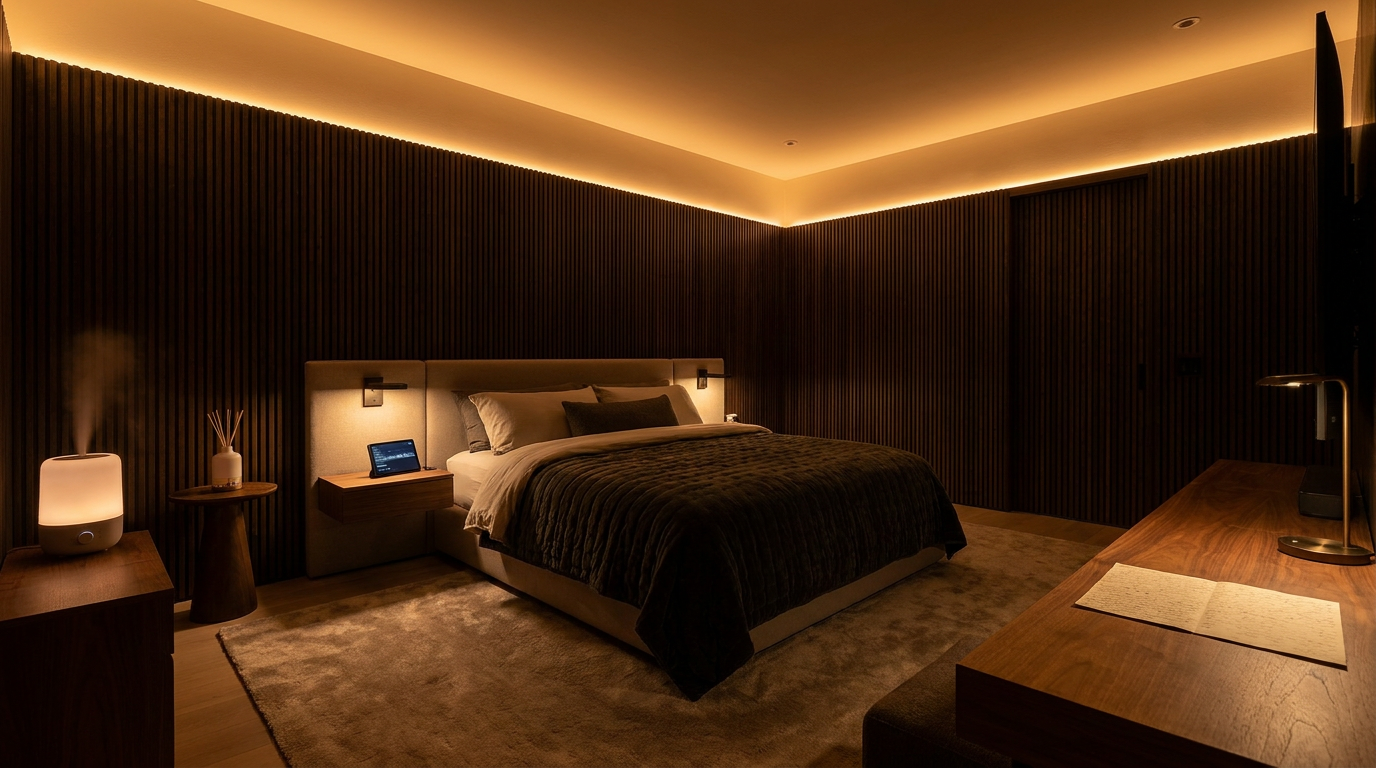
The Equinox Hotel in New York City exemplifies this hyper-engineered approach. Designed in partnership with clinical sleep scientists, the property subverts traditional hospitality design. While most hotels use light colors to make rooms feel larger, Equinox utilizes dark, sound-absorbing materials and eliminates glowing electronics entirely to create a sensory-deprivation environment tailored for deep slumber.[5]
The interventions extend well past the physical architecture of the room. Recognizing that late-night digestion spikes cortisol and disrupts slow-wave sleep, culinary teams are redesigning room service. Hotels now offer sleep-friendly menus featuring light, nutrient-dense evening snacks, replacing traditional alcohol-heavy nightcaps with melatonin-boosting cherry juice and herbal infusions.[3][5]

For guests requiring deeper intervention, properties like Six Senses in Ibiza and RAKxa in Bangkok offer multi-day, immersive sleep retreats. These comprehensive programs include biometric tracking, wellness screenings, and one-on-one consultations with resident sleep psychologists to help guests map their natural chronotypes and rebuild healthy routines.[2][5]
Yet, the explosion of sleep tourism highlights a stark societal irony. As the Global Wellness Institute notes, sleep is a fundamental biological requirement, but it is increasingly being commodified as an aspirational luxury. The ability to access deeply restorative rest—free from noise pollution, light pollution, and chronic stress—is becoming stratified, available primarily to those who can afford to travel for it.[1]
Furthermore, sleep experts caution against viewing these highly engineered vacations as a permanent cure for chronic exhaustion. As one industry analyst bluntly noted, if a person sleeps perfectly in a hotel but terribly at home, the hotel isn't magic—the home environment is simply flawed. A weekend of acoustic cocooning cannot permanently undo the damage of poor daily sleep hygiene.[7]
Nevertheless, sleep tourism serves as a powerful proof of concept. By demonstrating exactly how much environmental design impacts human biology, these sanctuaries are teaching travelers what optimal rest actually feels like. Ultimately, the true value of a sleep vacation may not be the rest achieved during the stay, but the blueprint it provides for redesigning the bedroom long after checkout.
How we got here
Pre-2020
Hotel luxury is primarily defined by opulent design, expansive square footage, and high-end traditional bedding.
2021–2023
Post-pandemic burnout and the rise of wearable health trackers spark widespread consumer interest in sleep metrics and recovery.
2024
The global sleep tourism market reaches $75.7 billion as major hospitality brands begin launching dedicated 'sleep suites.'
2025–2026
Hotels transition to 'Sleep Tourism 2.0,' integrating biometric tracking, AI climate control, and architectural acoustic cocooning.
Viewpoints in depth
Hospitality Innovators
Viewing sleep as the ultimate luxury amenity and a key market differentiator.
For major hotel brands and boutique resorts, the pivot to sleep tourism is a highly lucrative response to consumer demand. With the market valued at over $75 billion, hoteliers are moving beyond traditional luxury markers like high thread counts and marble bathrooms. Instead, they are investing heavily in 'neuro-architecture'—using AI-driven beds, advanced HVAC systems, and acoustic engineering to guarantee a measurable improvement in guest sleep scores. This approach allows properties to command premium rates while addressing the number one complaint of modern travelers: exhaustion.
Sleep Scientists & Clinicians
Focusing on the biological mechanisms of rest and the elimination of environmental disruptors.
Medical professionals and sleep researchers view the hotel room as a controlled laboratory for circadian health. Their focus is on the suprachiasmatic nucleus (SCN) and how environmental stimuli either help or hinder melatonin production. From this perspective, the success of sleep tourism lies in its strict adherence to biology: eliminating blue light, maintaining a core ambient temperature of 19°C (67°F), and preventing the micro-awakenings caused by fluctuating noise levels. They advocate for these interventions not as luxury perks, but as necessary medical baselines for cognitive recovery.
Wellness Analysts
Highlighting the societal implications of commodifying a fundamental biological need.
Industry analysts and wellness economists observe the boom in sleep tourism with a mix of optimism and caution. While they applaud the mainstreaming of sleep hygiene, they point to a growing 'sleep divide.' Rest is a biological necessity, yet the environments required to achieve it—free from noise pollution, light pollution, and stress—are increasingly becoming premium commodities. Furthermore, analysts warn that a temporary sleep vacation cannot cure chronic home-environment issues, urging consumers to view these trips as educational resets rather than permanent fixes.
What we don't know
- Whether the short-term circadian reset achieved during a sleep vacation leads to lasting behavioral changes at home.
- How the hospitality industry will scale these expensive acoustic and thermal interventions to mid-tier and budget properties.
Key terms
- Circadian Rhythm
- The body's internal 24-hour clock that regulates the sleep-wake cycle based on environmental cues like light and temperature.
- Suprachiasmatic Nucleus (SCN)
- A tiny region in the brain that acts as the master pacemaker, controlling the production of sleep hormones.
- Melatonin
- A hormone produced by the brain in response to darkness that helps initiate and maintain sleep.
- Acoustic Cocooning
- The architectural practice of isolating a room from external noise and vibrations using specialized materials and construction techniques.
- Chronotype
- A person's natural biological inclination regarding the times of day when they prefer to sleep or be active.
Frequently asked
What exactly is sleep tourism?
It is a growing travel trend where the primary goal of the vacation is to achieve restorative rest, utilizing scientifically engineered hotel rooms and sleep coaching.
How do hotels block out noise effectively?
Luxury properties use "acoustic cocooning," which involves triple-glazed windows, floating floors, and specialized insulation to drop room noise to 30-35 decibels.
Why do sleep hotels use red or amber lighting?
Blue light disrupts the brain's suprachiasmatic nucleus and halts melatonin production. Amber and red wavelengths allow the body to naturally prepare for sleep.
Can a sleep vacation cure chronic insomnia?
While it can help reset circadian rhythms and demonstrate what optimal sleep feels like, experts note that long-term improvement requires bringing those environmental changes into the home.
Sources
Source coverage
7 outlets
3 viewpoints surfaced







[1]Global Wellness InstituteWellness Analysts
The Growing Sleep Divide and Sleep Tourism
Read on Global Wellness Institute →[2]ForbesHospitality Innovators
How Sleep Tourism Became The Ultimate Luxury Travel Trend
Read on Forbes →[3]Hotel MogelSleep Scientists & Clinicians
The Science Of Sleep For Hotels
Read on Hotel Mogel →[4]Incredible StaySleep Scientists & Clinicians
Acoustic Cocooning And Air Purification In Wellness Hotels
Read on Incredible Stay →[5]Azure RoadHospitality Innovators
The Rise of Sleep Tourism: Hotels Engineered for Rest
Read on Azure Road →[6]Majestic HospitalityHospitality Innovators
Sleep Science in Hospitality: Enhancing the Guest Experience
Read on Majestic Hospitality →[7]Mattress MiracleWellness Analysts
Sleep Tourism Trends 2026
Read on Mattress Miracle →

Every angle. Every day.
Get travel stories with full source coverage and perspective breakdowns delivered to your inbox.