
Understanding the 14-Point US-Iran Peace Framework: Mechanisms, Markets, and Global Fallout
The United States and Iran have signed a 14-point memorandum of understanding to end their ongoing conflict, triggering a drop in global oil prices. However, the framework faces intense backlash from Israeli leadership and US lawmakers who argue the terms concede too much to Tehran.
By Factlen Editorial Team
- Israeli Leadership
- Views the deal as a strategic disaster that abandons allies and allows Iran to rebuild its proxy networks unchecked.
- US Administration
- Argues the framework is a major diplomatic victory that prevents a devastating regional war and stabilizes the global economy.
- Iranian Government & Allies
- Frames the agreement as a historic victory of resistance, proving that the US failed to achieve its military objectives.
- US Domestic Critics
- Believes the executive branch squandered American leverage and committed a massive foreign policy blunder by not holding Tehran accountable.
What's not represented
- · European Union Mediators
- · Gulf Arab States (Saudi Arabia, UAE)
Why this matters
This framework halts a major geopolitical conflict that has severely disrupted global energy markets and shipping lanes. However, the exclusion of key US allies like Israel from the final terms threatens to realign Middle Eastern security dynamics and could trigger secondary regional conflicts.
Key points
- The US and Iran signed a 14-point memorandum of understanding at the Palace of Versailles to end direct hostilities.
- Global markets rallied and oil prices dropped 1.6% as the threat to Middle Eastern shipping lanes eased.
- Israeli Prime Minister Benjamin Netanyahu and his allies view the deal as a strategic disaster.
- Iranian officials and Hezbollah leadership publicly claimed the agreement as a victory over US pressure.
- Several US Republicans criticized the framework, calling it a major foreign policy blunder.
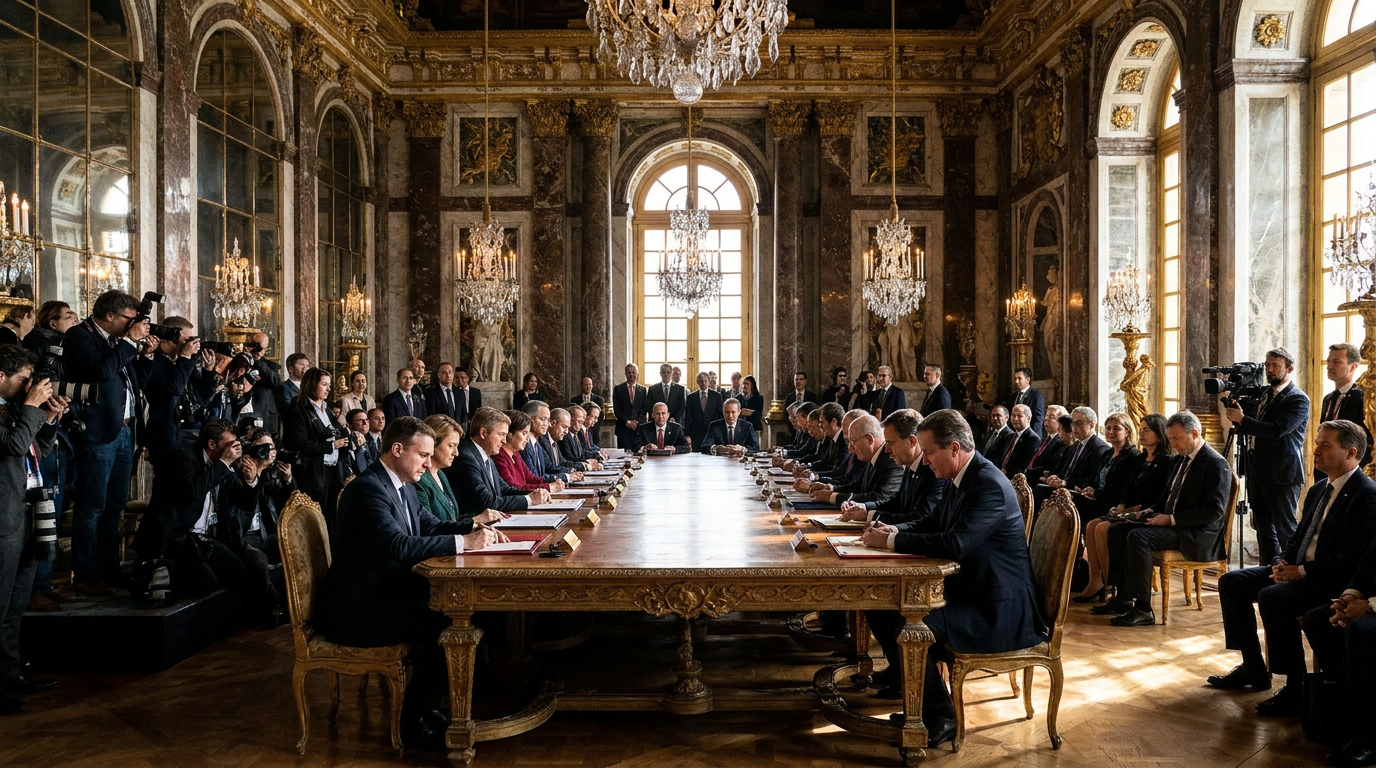
In a highly symbolic diplomatic maneuver, the United States and Iran have officially signed a 14-point memorandum of understanding (MoU) aimed at ending the ongoing military conflict between the two nations. The signing ceremony took place at the Palace of Versailles, a location steeped in historical resonance regarding the conclusion of major global conflicts. The Trump administration immediately declared the agreement a "major win" that would stabilize the Middle East and bring American forces out of the direct line of fire.[2][6]
The mechanism of the agreement is an MoU rather than a formal, Senate-ratified treaty. This distinction is critical: it allows the executive branch to implement immediate de-escalation measures, troop repositioning, and mutual pauses in hostilities without requiring a two-thirds majority vote in a deeply divided US Congress. However, it also means the framework relies heavily on executive enforcement and mutual compliance rather than binding international law.[6]
While the full technical annexes of the 14 points remain classified, the broad strokes involve a sequenced stand-down of direct military engagements, the reopening of contested maritime shipping lanes, and a framework for addressing regional proxy hostilities. The immediate cessation of direct state-on-state violence is the cornerstone of the document, designed to pull both nations back from the brink of a wider, uncontainable war.[6]
Global financial markets reacted instantly to the de-escalation. Brent crude oil, which had been trading at steep premiums due to the threat of supply disruptions in the Strait of Hormuz, dropped by as much as 1.6 percent in early trading. Energy analysts noted that the removal of the immediate war premium provided much-needed relief to global importers who have struggled with soaring energy costs over the past year.[3][5]

The relief extended beyond commodities. Key stock indices across Asia, including those in Japan, South Korea, and Taiwan, climbed sharply on the news. Because these manufacturing-heavy economies rely heavily on Middle Eastern oil imports, the prospect of stabilized energy prices and secure shipping routes prompted a broad equity rally.[3]
Despite the market optimism, the diplomatic fallout among US allies has been severe. Israeli Prime Minister Benjamin Netanyahu, who had previously promised the Israeli public "total victory" against Iran, was notably silent in the immediate aftermath of the signing. According to Axios, Israeli officials view the framework as a "strategic and political disaster," expressing fury that Jerusalem was effectively cut out of the final negotiations.[1]
Despite the market optimism, the diplomatic fallout among US allies has been severe.
Israel's primary concern is that the MoU halts direct US-Iran hostilities but fails to adequately dismantle Iran's nuclear infrastructure or its network of regional proxy militias. Security analysts in Jerusalem argue that the agreement merely pauses the clock, allowing Tehran to rebuild its capabilities while leaving Israel to face a fortified network of adversaries on its borders without guaranteed US military backing.[1][6]

Conversely, Iranian leadership and its allied factions have publicly framed the agreement as a capitulation by Washington. Iran's chief negotiator, Mohammad Bagher Ghalibaf, stated that the agreement is a "record of US failure," urging the public to read the text and judge for themselves. Iranian state media heavily amplified this narrative, portraying the survival of the current government and its military apparatus as a definitive victory over Western pressure.[2]
This sentiment was echoed across Iran's network of regional allies. Naim Qassem, the deputy secretary-general of Hezbollah, proclaimed the 14-point framework a "great victory" for the so-called Axis of Resistance. By surviving a direct confrontation with the United States and securing an MoU that leaves their regional influence largely intact, these groups are signaling to their supporters that their strategic deterrence was successful.[2]
Domestically, the Trump administration is facing significant pushback from within its own party. Several prominent Republicans have publicly criticized the framework, arguing that it squanders American leverage. Louisiana Senator Bill Cassidy blasted the MoU, calling it the "worst foreign policy blunder in decades" and arguing that it fails to hold Tehran accountable for its initial escalations.[4][7]

The domestic political divide highlights the fragility of the MoU. Because it is an executive agreement, critics in Congress are already exploring legislative avenues to impose new, non-military sanctions on Iran that could complicate the framework's implementation. The administration maintains that the deal was the only viable off-ramp to prevent a multi-trillion-dollar regional war that would have devastated the global economy.[6][7]
A major point of uncertainty remains the verification mechanisms embedded within the 14 points. While the US and Iran have agreed to a ceasefire, the protocols for monitoring troop movements, proxy financing, and maritime harassment are reportedly complex and rely on third-party intermediaries. If a skirmish occurs in the Persian Gulf or along the Lebanese border, it is unclear what threshold of violence would officially void the MoU.[6]

Furthermore, the agreement's impact on ongoing secondary conflicts—particularly the tensions between Israel and Hezbollah in Lebanon—remains unresolved. With the US formally stepping back from direct engagement with Iran, regional analysts warn that Israel may feel compelled to act unilaterally to degrade proxy forces before they can fully rearm under the cover of the new framework.[1][2]
Ultimately, the Versailles MoU represents a pragmatic, if highly controversial, freeze in hostilities. It has successfully averted a worst-case scenario for global energy markets and secured a pause in direct state-on-state warfare. However, by leaving the underlying regional power struggles unresolved and alienating key allies, the framework may simply shift the theater of conflict rather than ending it entirely.[1][3][6]
How we got here
Late 2025
Direct military hostilities escalate between US and Iranian forces, disrupting global shipping.
Early 2026
Oil prices surge as the conflict threatens the Strait of Hormuz, prompting secret diplomatic backchannels.
June 17, 2026
The US and Iran officially sign a 14-point memorandum of understanding at the Palace of Versailles.
Viewpoints in depth
US Administration
Defends the agreement as a necessary and successful de-escalation.
The executive branch frames the 14-point MoU as a triumph of pragmatic diplomacy over endless war. By securing an immediate ceasefire and reopening global shipping lanes, the administration argues it has protected the US economy from a catastrophic oil shock. Officials maintain that an executive agreement was the only viable path forward, as a formal treaty would have been stalled indefinitely by partisan gridlock in Congress.
Israeli Leadership
Views the framework as an abandonment that leaves Israel vulnerable.
For Jerusalem, the MoU represents a worst-case scenario. Having promised the public "total victory" against Iranian influence, Prime Minister Netanyahu now faces a reality where the US has formally stepped back from the conflict. Israeli security hawks argue the deal merely pauses the clock, allowing Tehran to resupply its proxy network—including Hezbollah—without the threat of American military intervention, effectively forcing Israel to manage a multi-front threat alone.
Iranian & Allied Forces
Celebrates the survival of their regime and military apparatus as a victory.
Tehran and its regional allies are utilizing the MoU as a powerful domestic propaganda tool. By surviving a direct military confrontation with the United States without conceding their core regional influence, Iranian negotiators claim they have exposed the limits of American power. Hezbollah and other proxy groups view the framework as validation of their "resistance" strategy, arguing that their military deterrence forced Washington to the negotiating table.
Global Markets
Relieved by the removal of the immediate war premium on energy.
Energy importers and financial analysts are largely indifferent to the geopolitical grievances, focusing instead on the stabilization of supply chains. The immediate drop in Brent crude and the rally in Asian equities reflect a collective sigh of relief from manufacturing economies that were bracing for a prolonged closure of the Strait of Hormuz. For the markets, the MoU is a successful circuit breaker.
What we don't know
- How the 14 points will be enforced if a proxy group violates the ceasefire.
- Whether Israel will launch unilateral strikes against Iranian assets now that the US has stepped back.
- If the US Congress will successfully pass new sanctions that could undermine the executive agreement.
Key terms
- Memorandum of Understanding (MoU)
- A formal agreement between two or more parties that establishes a framework for cooperation but is generally not legally binding in the same way as a ratified treaty.
- Brent Crude
- A major trading classification of sweet light crude oil that serves as a benchmark price for purchases of oil worldwide.
- Axis of Resistance
- An informal political and military coalition led by Iran, which includes state and non-state actors like Hezbollah, aimed at opposing Western and Israeli influence in the Middle East.
Frequently asked
Is this a permanent peace treaty?
No. It is a memorandum of understanding (MoU), which is an executive framework to pause hostilities, rather than a formal, Senate-ratified treaty.
Why is Israel upset about the agreement?
Israeli officials feel they were cut out of the negotiations and argue the deal fails to dismantle Iran's nuclear program or its regional proxy militias.
How did global markets react to the news?
Markets reacted positively. Brent crude oil prices dropped by 1.6 percent, and major Asian stock indices rallied due to the reduced threat to energy supplies.
Did Congress approve this deal?
No. Because it was signed as an executive memorandum of understanding, it bypassed the need for a two-thirds approval vote in the US Senate, drawing anger from several lawmakers.
Sources
Source coverage
7 outlets
4 viewpoints surfaced






[1]AxiosIsraeli Leadership
Netanyahu fumes, allies rage over Trump's Iran deal
Read on Axios →[2]The GuardianIranian Government & Allies
Trump news at a glance: Donald Trump surrenders himself to Iran deal
Read on The Guardian →[3]Al JazeeraUS Domestic Critics
Oil prices fall, stocks rally as US, Iran sign framework to end war
Read on Al Jazeera →Trump’s MoU with Iran draws backlash from some Republicans
Read on Al Jazeera →[5]Reuters
Brent crude drops 1.6% following US-Iran memorandum of understanding
Read on Reuters →[6]The New York TimesUS Administration
Inside the 14-Point Framework: How the U.S. and Iran Reached a Ceasefire
Read on The New York Times →[7]Fox NewsUS Domestic Critics
Republicans blast Trump-Iran MoU as 'foreign policy blunder'
Read on Fox News →

Every angle. Every day.
Get news politics stories with full source coverage and perspective breakdowns delivered to your inbox.