
The Knicks Won Their First Title in 53 Years. Now the NBA's 'Second Apron' Threatens to Break Them Up.
New York ended a half-century championship drought, but owner James Dolan's refusal to cross the NBA's punitive new salary cap threshold means the title-winning roster will face immediate casualties.
By Factlen Editorial Team
- Knicks Front Office
- Focused on maintaining long-term flexibility and avoiding the paralysis of frozen draft picks.
- Championship Maximizers
- Believe teams should spend whatever it takes to keep a title-winning core together.
- League Parity Advocates
- View the breakup of expensive rosters as proof that the new CBA is working as intended.
What's not represented
- · The players union's view on how the second apron is suppressing middle-class contracts.
- · The perspective of the departing free agents who helped win the title but are now forced to relocate.
Why this matters
The Knicks' victory proves that patient, chemistry-focused team building can overcome the 'superteam' era. However, their immediate offseason dilemma serves as a masterclass in how the NBA's new financial rules are designed to break up deep rosters, affecting how every franchise manages its salary cap.
Key points
- The New York Knicks won the 2026 NBA Finals, ending a 53-year championship drought.
- Jalen Brunson was named Finals MVP after the Knicks defeated the Spurs 4-1.
- Owner James Dolan stated the team will not cross the NBA's 'second apron' next season.
- The second apron imposes severe roster-building penalties, including frozen draft picks.
- The Knicks have $201 million committed to eight players, leaving little room to retain free agents.
- Key reserves like Mitchell Robinson and Landry Shamet are expected to leave in free agency.
For the first time since the Nixon administration, the New York Knicks are NBA Champions. The 53-year drought—a half-century defined by agonizing near-misses, front-office dysfunction, and a rotating cast of failed saviors—officially ended when the Knicks defeated the San Antonio Spurs in five games to claim the 2026 title.[4][8]
The culmination of the series was a masterpiece of resilience. In Game 4, New York fell behind by 29 points in the third quarter, only to mount the largest comeback in NBA Finals history. The rally was capped by OG Anunoby's miraculous tip-in with 1.2 seconds remaining, breaking the Spurs' spirit before the Knicks closed out the series at Madison Square Garden in Game 5.[4][8]
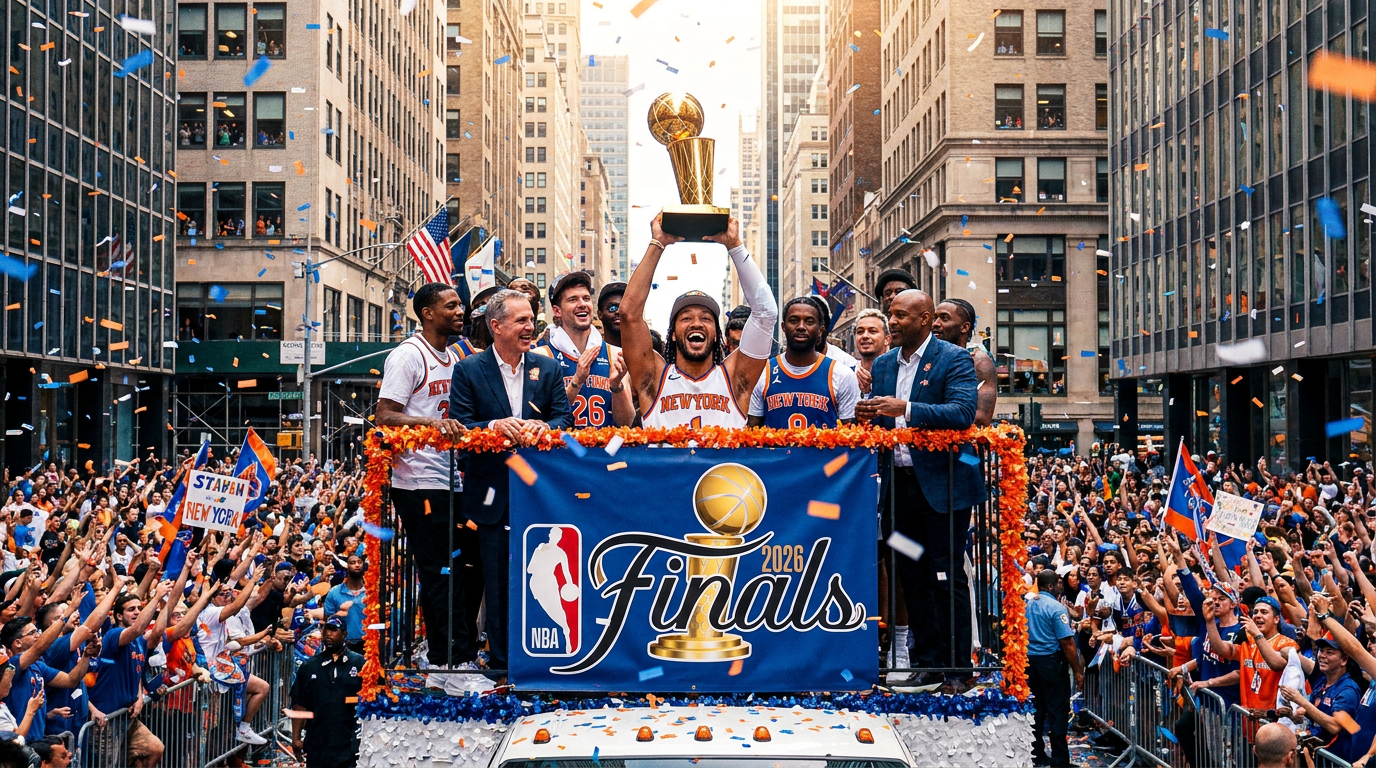
Led by Finals MVP Jalen Brunson, who averaged 32.6 points per game, and anchored by a historically dominant defense that suffocated the Eastern Conference, the Knicks transformed into an unstoppable machine. The city's response has been appropriately massive, with the NYPD deploying a record 10,000 officers to safeguard Thursday's victory parade through the Canyon of Heroes.[1][7][8]

But before the confetti has even been swept from the streets of Manhattan, the franchise is colliding with a harsh administrative reality. The team that president Leon Rose meticulously assembled is about to be tested by the NBA's new Collective Bargaining Agreement (CBA), a financial framework explicitly designed to punish teams that try to keep deep, expensive rosters intact.[3]
The immediate threat is a salary cap threshold known as the "second apron." And in a surprising radio interview on Wednesday, Knicks owner James Dolan made it unequivocally clear that the defending champions will not cross it. Speaking on WFAN, Dolan stated that while he would love to bring the entire team back, doing so would be "suicidal" under the league's current rules.[2][5]
"There's certain things in the NBA that you'd have to be suicidal to do, and we're not going to do those," Dolan said. "One of them is the second apron. Cannot go into the second apron. I'll write as big of a check as possible, but I can't write a check that goes into the second apron."[2][5]
To understand Dolan's stance, one must understand the mechanics of the 2023 CBA. Historically, the NBA operated with a "soft cap," allowing wealthy owners like Dolan to spend infinitely into the luxury tax to retain their players. The new CBA changed the math by introducing two "aprons" above the luxury tax line, which impose severe roster-building restrictions rather than just financial penalties.[3][5]
To understand Dolan's stance, one must understand the mechanics of the 2023 CBA.
The second apron, projected to be $221.7 million for the 2026-27 season, is the ultimate hard line. Teams that cross it lose access to the taxpayer mid-level exception, meaning they can only sign outside free agents to minimum contracts. They are forbidden from aggregating multiple salaries in trades, cannot send cash in deals, and cannot take back more salary than they send out.[3][6]

Most punitively, finishing a season above the second apron freezes a team's first-round draft pick seven years in the future, rendering it untradable. If a team stays above the apron for multiple years, that frozen pick is automatically moved to the very end of the first round, regardless of the team's actual record.[2][6]
For Dolan, a billionaire who has historically been willing to outspend the rest of the league, the refusal to cross the line is not about the money. It is about the paralysis it inflicts on the front office. Being trapped above the second apron strips a franchise of the flexibility needed to make mid-season upgrades or pivot if injuries strike.[5][6]
The Knicks' current cap sheet illustrates the dilemma perfectly. New York already has approximately $201 million tied up in just eight guaranteed contracts for next season, headlined by Karl-Anthony Towns, Jalen Brunson, OG Anunoby, Mikal Bridges, and Josh Hart. That leaves them roughly $13 to $16 million below the second apron with seven roster spots left to fill.[3][5][6]

This mathematical reality means the championship roster will inevitably suffer casualties. Key rotation pieces like Mitchell Robinson, Landry Shamet, and Jordan Clarkson are entering unrestricted free agency. Re-signing even one of them to a market-value contract would likely push New York over the $221.7 million threshold.[5][6]
The Knicks will likely be forced to let their veteran depth walk, replacing them with players on minimum contracts and utilizing their upcoming draft picks to fill out the bench. It is a stark reminder that the NBA's new parity measures are working exactly as intended, forcing even the richest, most successful teams to make painful sacrifices.[3][6]

Some analysts refer to this dynamic as the "Hokey Pokey" strategy. Teams might dip their toe into the second apron for a single "all-in" season, but they must quickly step back out to avoid the compounding penalties. By staying under the line now, the Knicks are preserving their ability to make a massive move in 2027 or 2028 when the contracts of Towns and Hart begin to expire.[3]
For now, the city of New York is focused on the parade and the euphoria of a drought extinguished. The core that brought the Larry O'Brien trophy back to Madison Square Garden remains locked in. But as the front office prepares for free agency, the reality of the modern NBA looms large: winning a championship is historically difficult, but keeping the band together is now mathematically impossible.[3][4]
How we got here
1973
The New York Knicks win their second NBA Championship, beginning a 53-year drought.
July 2023
The NBA implements a new Collective Bargaining Agreement, introducing the punitive 'second apron'.
June 10, 2026
The Knicks mount a 29-point comeback in Game 4 of the Finals, capped by an OG Anunoby game-winner.
June 13, 2026
New York defeats San Antonio in Game 5 to officially claim the 2026 NBA Championship.
June 17, 2026
Owner James Dolan announces on WFAN that the team will not cross the second apron to retain free agents.
Viewpoints in depth
Front Office Pragmatists
Executives who prioritize long-term flexibility over retaining expensive bench depth.
From a management perspective, crossing the second apron is a trap that short-circuits a team's future. By staying under the $221.7 million threshold, the Knicks retain the ability to trade future first-round picks and use salary-matching exceptions. Pragmatists argue that the core of Brunson, Towns, Anunoby, and Bridges is enough to contend, and that paying a premium for role players like Mitchell Robinson isn't worth sacrificing the franchise's ability to pivot if injuries or age catch up to the starters.
Championship Maximizers
Fans and analysts who believe teams should spend whatever it takes while their title window is open.
This camp argues that championship windows are fleeting, and breaking up a proven, title-winning rotation over future draft pick penalties is a mistake. They point out that James Dolan has the financial resources to pay any luxury tax bill, and that letting key defensive anchors and shooters walk for nothing weakens the team's chances of repeating. For maximizers, the goal is to win now, and worrying about a frozen draft pick seven years in the future is a problem for another day.
League Parity Advocates
Small-market teams and league officials who designed the CBA to prevent financial dominance.
For the architects of the 2023 CBA, the Knicks' current dilemma is proof that the system is working flawlessly. The second apron was explicitly designed to prevent massive-market teams from hoarding talent and outspending smaller markets. By forcing New York to let talented role players enter free agency, the league ensures that talent is redistributed across the NBA, maintaining competitive balance and preventing the formation of untouchable, decade-long dynasties.
What we don't know
- Which specific minimum-contract veterans the Knicks will target to fill out their bench.
- Whether Jose Alvarado will opt into his $4.5 million player option or test free agency.
- How the loss of key defensive depth will impact the Knicks' ability to defend their title next season.
Key terms
- Second Apron
- A salary cap threshold set above the luxury tax line that triggers severe roster-building restrictions, such as freezing future draft picks.
- Soft Cap
- A salary cap system that allows teams to exceed the spending limit by using specific exceptions, though they must pay a luxury tax.
- Taxpayer Mid-Level Exception
- A tool that allows teams over the salary cap to sign free agents to mid-tier contracts; this tool is revoked if a team crosses the second apron.
- Bird Rights
- A rule allowing teams to exceed the salary cap to re-sign their own veteran free agents.
Frequently asked
When did the Knicks last win a championship?
Before 2026, the New York Knicks last won the NBA Championship in 1973.
What is the NBA's second apron?
It is a spending limit above the luxury tax that imposes harsh penalties, such as freezing future draft picks and restricting trades, to prevent teams from hoarding talent.
Why won't James Dolan just pay the luxury tax?
Dolan is willing to pay the financial tax, but he refuses to cross the second apron because the resulting roster-building restrictions would paralyze the front office's ability to make future trades.
Which Knicks players are leaving?
Because of the cap restrictions, the Knicks are likely to lose key free agents like Mitchell Robinson, Landry Shamet, and Jordan Clarkson.
Sources
Source coverage
8 outlets
3 viewpoints surfaced






[1]ESPNKnicks Front Office
NYPD to deploy 10K officers for Knicks title parade
Read on ESPN →Dolan says second apron not an option for Knicks
Read on ESPN →[3]CBS SportsChampionship Maximizers
How the NBA champion New York Knicks can run it back: Roster gets expensive, but the core can stay intact
Read on CBS Sports →[4]TSNChampionship Maximizers
NBA Finals 2026: The Knicks finally have their New York sports moment
Read on TSN →[5]Sports IllustratedKnicks Front Office
James Dolan says the Knicks won't go above the second apron
Read on Sports Illustrated →[6]Hoops RumorsLeague Parity Advocates
Knicks Owner Dolan Determined To Avoid Second Tax Apron
Read on Hoops Rumors →[7]Olympics.comLeague Parity Advocates
New York Knicks' historic postseason run to the 2026 NBA Finals
Read on Olympics.com →[8]Wikipedia
2026 NBA Finals
Read on Wikipedia →
Every angle. Every day.
Get sports stories with full source coverage and perspective breakdowns delivered to your inbox.