
The Global Race to Build the Olympics of Esports
Following the collapse of the IOC's initial partnership with Saudi Arabia, the dream of an 'Esports Olympics' has fractured into a multi-front race, accelerating the shift toward true national representation in competitive gaming.
By Factlen Editorial Team
- Traditional Olympic Movement
- Argues that esports must adapt to strict Olympic governance, non-discrimination clauses, and traditional sporting values to achieve true global legitimacy.
- Independent Global Organizers
- Believes that nation-based esports should move at the speed of the gaming industry, prioritizing massive prize pools and direct publisher partnerships over bureaucratic traditions.
- National Esports Federations
- Focused on the logistical realities of building national teams, securing state funding, and navigating domestic laws like military service exemptions.
- Esports Media & Analysts
- Views the fragmentation of the Olympic esports dream as a necessary growing pain that will ultimately force the standardization of national representation.
What's not represented
- · Grassroots amateur players
- · Non-endemic Olympic sponsors
Why this matters
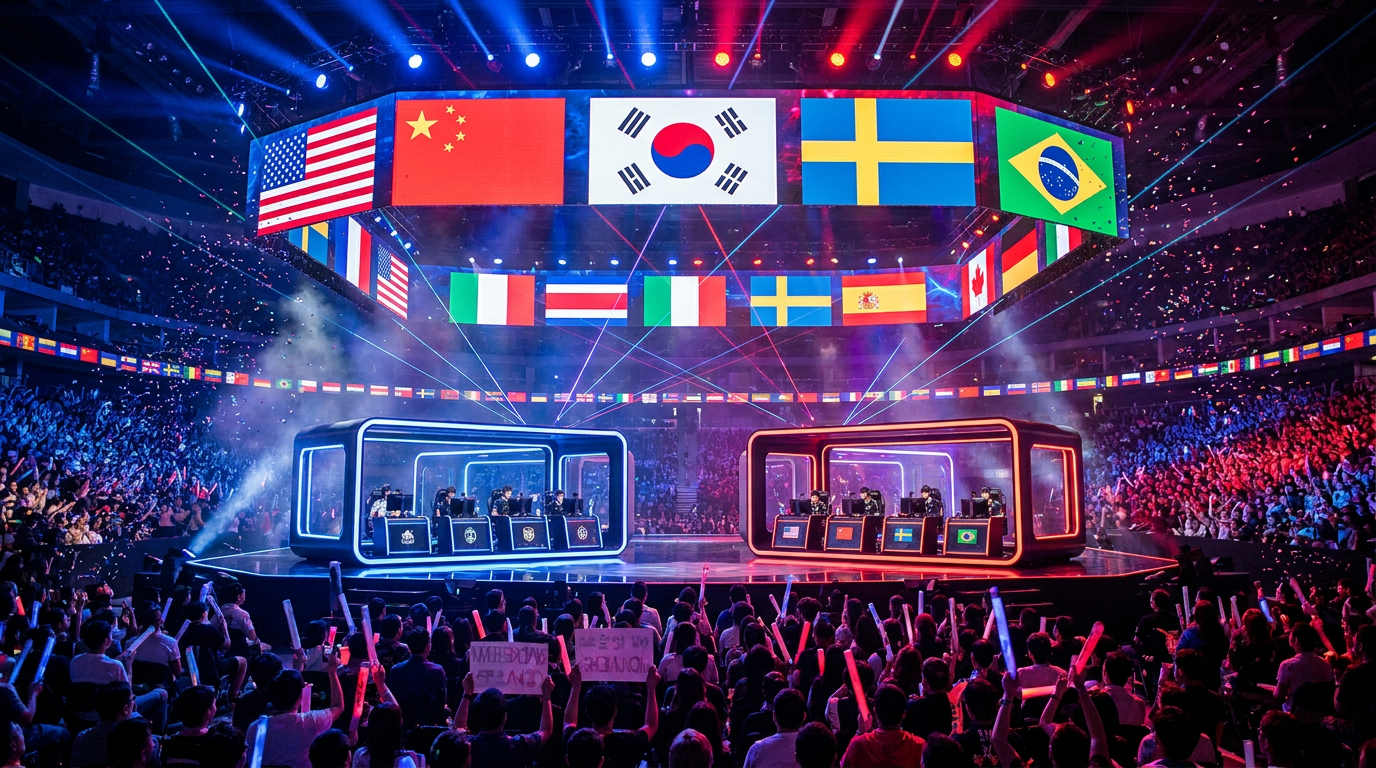
For decades, esports has been dominated by private, corporate-owned clubs. The current race to establish nation-based tournaments means fans will soon be able to root for their home countries in major gaming titles, fundamentally changing the industry's economic and cultural landscape.
Key points
- The IOC and Saudi Arabia mutually ended their 12-year partnership to host the Olympic Esports Games in late 2025.
- In response, Saudi Arabia's Esports World Cup Foundation launched the independent Esports Nations Cup for November 2026.
- South Korea has formed a state-backed working group to bid for the IOC's revised Olympic Esports Games.
- The shift toward nation-based tournaments is forcing the industry to solve complex issues regarding publisher IP rights and player eligibility.
The dream of watching national teams compete in League of Legends or Counter-Strike under a global banner is finally materializing, but not exactly how the International Olympic Committee (IOC) originally planned.
For decades, the competitive gaming ecosystem has been defined by a corporate, franchise-based model. Fans root for privately owned clubs like T1, Team Liquid, or Fnatic, whose rosters are assembled through international free agency rather than shared citizenship.
In July 2024, the IOC attempted to fundamentally rewrite that paradigm. Following the success of a preliminary virtual sports week in Singapore, the 142nd IOC Session in Paris unanimously approved the creation of the Olympic Esports Games.[1][2]
To fund and execute the massive undertaking, the IOC signed a landmark 12-year partnership with the Saudi Olympic and Paralympic Committee, scheduling the inaugural event for 2025 before quickly delaying it to 2027.[1][7]
The marriage between traditional Olympic governance and the digital frontier, however, proved structurally fragile. The IOC operates on strict universal principles regarding non-discrimination, gender equality, and the absolute right of all National Olympic Committees to participate—frameworks that clashed with the realities of the host nation and the fragmented nature of the gaming industry.[3][5]

By late 2025, the ambitious deal unraveled. The IOC and Saudi Arabia mutually agreed to terminate the 12-year partnership, citing a need to "Pause and Reflect" on how to better align the event with the long-term ambitions of the Olympic Movement.[2][3][7]
The institutional reset culminated in May 2026, when IOC President Kirsty Coventry formally suspended the operations of the dedicated Esports Commission, pulling the project's development directly into the executive office to rethink the partnership model.[3][7]
Yet, rather than killing the momentum for nation-based esports, the IOC's pivot catalyzed a massive, multi-front race. The vacuum left by the delayed Olympic project has sparked a rush by independent organizers and national governments to build the definitive "World Cup" of gaming.
Saudi Arabia's Esports World Cup Foundation immediately stepped into the breach, announcing the creation of the Esports Nations Cup (ENC) just weeks after the initial IOC friction became apparent.[3][6]
Scheduled to debut in Riyadh in November 2026, the ENC operates entirely independently of the Olympic Movement. It is designed to be the esports equivalent of the FIFA World Cup, utilizing a rotating host-city model for future biennial editions.[6]
Scheduled to debut in Riyadh in November 2026, the ENC operates entirely independently of the Olympic Movement.
The ENC has secured partnerships to feature 16 major titles—including League of Legends, VALORANT, Mobile Legends, and PUBG—with a massive financial incentive structure that guarantees $50,000 to each winning player per title.[6]
Meanwhile, the IOC's revised Olympic Esports Games project has found a highly motivated new champion: South Korea. Recognizing the diplomatic and cultural opportunity, the historic capital of competitive gaming is actively maneuvering to host the IOC's delayed inaugural event.[3][4]

In early 2026, the Korean Sport & Olympic Committee (KSOC) launched a state-backed working group to assess the feasibility of hosting the Games and to build the frameworks required to manage representative national squads.[4][5][8]
Driven by influential figures like quadruple Olympic shooting champion and current lawmaker Jin Jong-oh, the South Korean task force aims to elevate esports to the exact same integrated status as traditional Olympic disciplines.[3][8]
To achieve this, the KSOC explicitly acknowledged that esports cannot be governed like track and field. The working group includes representatives from government ministries, academic institutions, and game publishers to tackle the unique friction points of digital sports.[5][8]
The task force is actively negotiating how to respect publisher intellectual property rights, integrate private league schedules without exhausting players, and navigate South Korea's compulsory military service rules for official "athlete" status.[5][8]
Adding to the global momentum, the traditional sports world is already proving that the model works regionally. The upcoming 2026 Aichi-Nagoya Asian Games will feature 13 esports titles as genuine medal events, building on the massive viewership success of the 2022 Hangzhou Games.[7]

For players and fans, this institutional fragmentation is actually a net positive. The competition between the IOC's prestige-driven model, Saudi Arabia's prize-heavy ENC, and the Asian Games' regional dominance is accelerating the industry's evolution.
These competing initiatives are forcing publishers, national esports federations, and traditional sports bodies to finally standardize how national teams are formed, funded, and recognized on the global stage.
The road to a unified "Esports Olympics" may have hit a structural detour, but the destination remains unchanged. By the end of 2026, fans will finally see the world's best digital athletes trading their corporate jerseys for their national flags.
How we got here
June 2023
The IOC hosts the inaugural Olympic Esports Week in Singapore, successfully proving the concept of integrating competitive gaming.
July 2024
The IOC officially announces the creation of the Olympic Esports Games, signing a 12-year hosting partnership with Saudi Arabia.
October 2025
The IOC and Saudi Arabia mutually agree to terminate their partnership due to structural and governance disagreements.
January 2026
The Korean Sport & Olympic Committee forms a dedicated task force to bid for the revised Olympic Esports Games.
May 2026
IOC President Kirsty Coventry formally suspends the Esports Commission to rethink the organization's partnership model.
November 2026
The independent Esports Nations Cup is scheduled to debut in Riyadh, featuring 16 titles and national teams.
Viewpoints in depth
The Olympic Movement's View
Prioritizing universal values and strict governance over rapid deployment.
For the IOC and traditional sports bodies, the integration of esports is a delicate balancing act. They argue that to bear the Olympic rings, an event must adhere to the Olympic Charter—meaning strict non-discrimination clauses, gender equality initiatives, and the universal right of all National Olympic Committees to participate. This perspective views the 'Pause and Reflect' period not as a failure, but as a necessary step to ensure that private game publishers and regional hosts do not compromise the foundational ethics of the Olympic Movement.
Independent Organizers' View
Moving at the speed of the gaming industry to deliver immediate, high-stakes competition.
Independent entities like the Esports World Cup Foundation argue that the traditional Olympic bureaucracy is too slow and rigid for the fast-paced digital economy. By launching the Esports Nations Cup independently, they bypass the friction of Olympic governance. This camp believes that massive prize pools, direct negotiations with game publishers, and high-production-value tournaments are what players and fans actually want, rendering traditional sporting recognition secondary to immediate entertainment value.
National Federations' View
Solving the complex domestic logistics of turning private gamers into state-backed athletes.
Organizations like South Korea's KeSPA are caught in the middle, tasked with the actual execution of building national teams. Their primary concerns are logistical and legal: how to secure player release windows from private franchise leagues, how to manage the intellectual property rights of game developers, and how to classify gamers under national sports laws. For these federations, hosting an Olympic-level event is a tool to force domestic policy changes, such as securing military service exemptions and state funding for digital athletes.
What we don't know
- It remains unclear when the IOC will officially announce a new host and timeline for the inaugural Olympic Esports Games.
- Game publishers have not yet finalized how they will adjust their private league schedules to accommodate multiple nation-based tournaments.
- It is unknown if South Korea's bid will successfully secure military service exemptions for players competing in the IOC's revised event.
Key terms
- Esports Nations Cup (ENC)
- An independent, country-based esports tournament hosted in Riyadh featuring national teams rather than private corporate clubs.
- KeSPA
- The Korea e-Sports Association, the South Korean governing body responsible for managing the country's national esports teams and domestic regulations.
- Publisher IP Rights
- The legal ownership that video game developers hold over their titles, giving them total control over where and how their games are played competitively.
- Solidarity Slots
- Qualification spots reserved in international tournaments for underrepresented or emerging nations to ensure global diversity.
Frequently asked
Why did the IOC and Saudi Arabia cancel their esports partnership?
The two parties mutually agreed to end the 12-year deal in late 2025 due to friction over strict Olympic governance requirements, non-discrimination clauses, and the unique structural demands of the gaming industry.
Is esports going to be in the regular Summer Olympics?
No. The IOC is developing a separate 'Olympic Esports Games' with its own financial and organizational structure, distinct from the traditional Summer and Winter Games.
How is the Esports Nations Cup different from normal esports?
Traditional esports relies on private, franchise-based clubs. The ENC requires players to compete exclusively for their home countries, similar to the FIFA World Cup.
Will real video games be played, or just virtual sports?
Both. While early IOC experiments focused on virtual cycling and archery, upcoming events like the ENC and the Asian Games feature mainstream competitive titles like League of Legends, VALORANT, and Counter-Strike.
Sources
Source coverage
8 outlets
4 viewpoints surfaced








[1]AP NewsTraditional Olympic Movement
Esports Olympics set to launch after IOC presents proposal for video games project
Read on AP News →[2]Olympics.comTraditional Olympic Movement
IOC statement on the Olympic Esports Games
Read on Olympics.com →[3]Sheep EsportsEsports Media & Analysts
South Korea eyes the inaugural Olympic Esports Games
Read on Sheep Esports →[4]Esports InsiderNational Esports Federations
South Korea forms working group for Olympic Esports Games
Read on Esports Insider →[5]Inside the GamesTraditional Olympic Movement
South Korea sets up task force to bid for Olympic Esports Games
Read on Inside the Games →[6]LiquipediaIndependent Global Organizers
Esports Nations Cup 2026
Read on Liquipedia →[7]MediumIndependent Global Organizers
The IOC approved the Olympic Esports Games unanimously in 2024. What happened next?
Read on Medium →[8]Esports RadarNational Esports Federations
Korean Sport & Olympic Committee launches working group for Olympic Esports Games
Read on Esports Radar →
Every angle. Every day.
Get gaming esports stories with full source coverage and perspective breakdowns delivered to your inbox.