
The Next Decade of Energy: Expert Predictions for Solid-State Batteries by 2030
As automakers and startups move from lab prototypes to pilot production, solid-state batteries are poised to double EV ranges and slash charging times by the end of the decade.
By Factlen Editorial Team
- Automakers & Innovators
- Focused on aggressive commercialization to win the next generation of the EV market.
- Market Analysts
- Tracking the realistic timeline of manufacturing scale and cost parity.
- Grid & Infrastructure Advocates
- Viewing solid-state batteries as the missing link for renewable energy storage.
What's not represented
- · Lithium-ion manufacturers defending current tech
- · Raw material mining operators
Why this matters
Solid-state batteries are the key to eliminating EV range anxiety and fire risks. Their successful commercialization will accelerate the transition away from fossil fuels by making electric vehicles lighter, safer, and capable of charging in 10 minutes.
Key points
- Solid-state batteries replace flammable liquid electrolytes with solid materials, eliminating fire risks.
- The technology allows for 50% to 100% more energy density, potentially pushing EV ranges past 600 miles.
- Major automakers like Toyota and Nissan target 2027-2028 for their first commercial solid-state EVs.
- Manufacturing costs remain high, but are projected to reach parity with lithium-ion by 2030.
The electric vehicle revolution has a persistent bottleneck: the traditional lithium-ion battery. While modern EVs can travel over 300 miles on a charge, consumers still grapple with range anxiety, heavy vehicle weights, and charging times that stretch past 30 minutes. The industry has long sought a breakthrough to push past the chemical limits of current technology.[1][7]
The solution on the horizon is the solid-state battery. For years, this technology was confined to laboratory experiments and theoretical papers. Now, in 2026, the industry is crossing the threshold from prototype testing to commercialization, with major automakers and startups racing to bring the technology to the mass market.[2][7]
Forecasts suggest a massive market expansion over the next decade. The global solid-state battery market is projected to grow from roughly $1.6 billion in 2025 to over $27 billion by 2035. This explosive growth is driven primarily by the automotive sector's desperate need for safer, more energy-dense storage.[5][6]

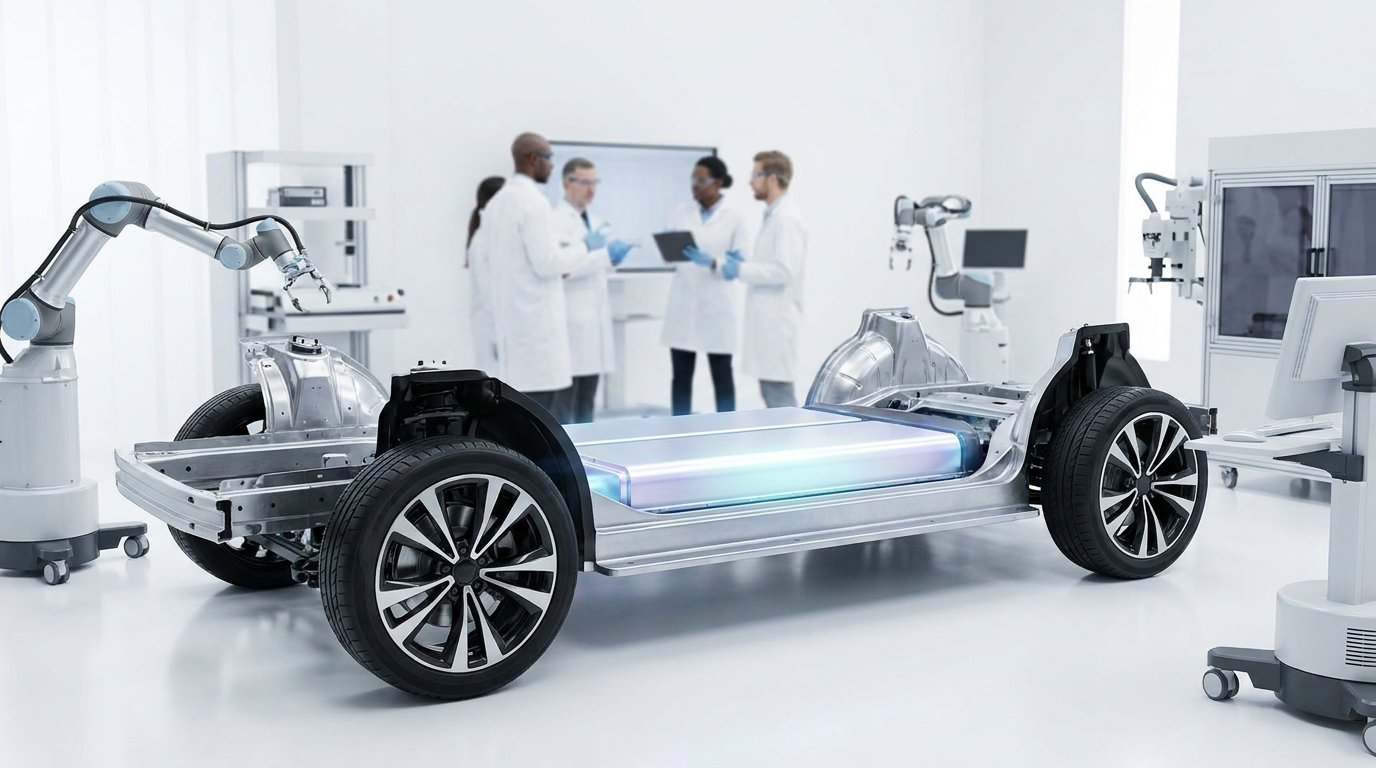
How do they work? Traditional lithium-ion batteries use a liquid electrolyte to shuttle ions back and forth between the anode and cathode. Solid-state batteries replace this volatile liquid with a solid conductive material—typically a ceramic, polymer, or sulfide glass.[2][7]
This structural change yields immediate safety benefits. By eliminating the flammable liquid, solid-state batteries strip away 90% of the thermal runaway risk, drastically reducing the chance of battery fires and explosions even if the cell is punctured or damaged.[7]
Beyond safety, the performance gains are staggering. The solid architecture allows manufacturers to use a pure lithium-metal anode, which can deliver 50% to 100% more energy density than current packs. This could push EV ranges from today's averages to well over 600 miles on a single charge, fundamentally altering the economics of road trips.[1][7]

Charging times are also expected to plummet. Because solid electrolytes resist heat buildup and dendrite formation, vehicles could safely accept ultra-fast DC charging, going from near-empty to 80% capacity in just 10 to 15 minutes—rivaling the time it takes to fill a gas tank.[6][7]
The timeline to mass adoption is becoming clearer. 2025 and 2026 are serving as the years of pilot lines and high-volume sample deliveries. Automakers are actively validating these cells in prototype vehicles on test tracks, moving the technology out of the lab and into the real world.[2][5]
2025 and 2026 are serving as the years of pilot lines and high-volume sample deliveries.
Toyota is leading the legacy automaker pack, partnering with petroleum refiner Idemitsu Kosan to produce commercial-grade cells by 2027 or 2028. The Japanese automaker aims to deliver a vehicle with a 621-mile range capable of a 10-minute recharge, setting a high bar for the rest of the industry.[1][6]
Startups are also hitting critical milestones. QuantumScape, backed heavily by Volkswagen, is delivering higher-volume samples of its QSE-5 cells to automotive partners. Meanwhile, Solid Power is advancing its roll-to-roll manufacturing alongside BMW, proving that the technology can be integrated into existing production methods.[2][5]
Other automotive giants are pacing themselves for the end of the decade. Hyundai and Nissan both target 2028 to 2030 for mass production. These companies acknowledge that while the chemistry is proven, scaling up manufacturing is the hardest hurdle to clear.[1][3]

The manufacturing challenge is indeed immense. Producing a solid electrolyte layer that is microscopically thin, mechanically robust enough to survive assembly, and chemically stable requires entirely new precision manufacturing techniques that the industry is still perfecting.[4][7]
This complexity keeps current production costs several times higher than traditional lithium-ion. Analysts project that solid-state batteries will only reach cost parity—converging toward $80 to $120 per kilowatt-hour—after 2030, once economies of scale fully kick in.[4][7]
Beyond passenger cars, the aviation sector is watching closely. The high energy density and inherent safety of solid-state batteries make them the enabling technology for electric vertical take-off and landing (eVTOL) aircraft and urban air mobility, where weight and fire safety are paramount.[2][6]
Grid storage is another massive frontier. While early commercial applications will favor premium EVs due to high initial costs, stationary grid storage at scale—crucial for backing up solar and wind power—is targeted for the 2030–2035 timeframe.[4]

Government policy is accelerating this timeline. The U.S. Inflation Reduction Act and the National Blueprint for Lithium Batteries provide tax credits and funding to establish domestic solid-state supply chains, while Japan and South Korea fund their own national consortiums to maintain technological leadership.[1][2]
Despite the momentum, uncertainties remain. The durability of solid electrolytes under real-world temperature extremes and thousands of charge cycles is still being proven outside the controlled environment of the lab.[7]
How we got here
2025–2026
Battery startups and automakers validate high-volume sample cells in prototype vehicles.
2027–2028
Toyota, Nissan, and early adopters plan to launch the first commercial EVs powered by solid-state batteries.
2030
Projected tipping point for mass production and mainstream EV adoption.
2030–2035
Solid-state battery costs are expected to reach parity with lithium-ion, unlocking grid-scale renewable energy storage.
Viewpoints in depth
Automakers & Innovators
Focused on aggressive commercialization to win the next generation of the EV market.
Legacy automakers like Toyota and startups like QuantumScape view solid-state technology as an existential race. They argue that whoever commercializes a 600-mile, 10-minute-charging battery first will dominate the 2030s. Their timelines are aggressive, targeting 2027-2028 for initial rollouts, driven by the belief that engineering hurdles can be solved through massive capital investment and strategic partnerships.
Market Analysts
Tracking the realistic timeline of manufacturing scale and cost parity.
Industry analysts acknowledge the transformative potential of the technology but caution against overly optimistic timelines. They emphasize that building a working cell in a lab is vastly different from producing millions of cells flawlessly on an assembly line. Analysts predict that while premium EVs will see the tech by 2028, true market dominance and cost parity with lithium-ion won't arrive until after 2030.
Grid & Infrastructure Advocates
Viewing solid-state batteries as the missing link for renewable energy storage.
For the energy sector, the EV race is just the opening act. Grid advocates argue that the ultimate value of solid-state batteries lies in their safety and longevity for stationary storage. Because they don't pose the fire risks of lithium-ion, massive solid-state banks could be safely installed in dense urban areas to store solar and wind power, though this application will have to wait until costs drop significantly in the 2030s.
What we don't know
- Whether solid electrolytes can maintain their structural integrity over hundreds of thousands of miles in extreme real-world weather conditions.
- Exactly how quickly manufacturing costs will fall, as precision engineering at massive scale remains unproven.
- How far traditional lithium-ion technology will advance by 2030, potentially narrowing the competitive advantage of solid-state cells.
Key terms
- Solid electrolyte
- A solid material (ceramic, polymer, or sulfide) that conducts ions between a battery's anode and cathode, replacing flammable liquids.
- Thermal runaway
- A dangerous chain reaction in traditional batteries where overheating causes a fire or explosion.
- Energy density
- The amount of energy a battery can store for a given weight or volume, directly determining an EV's range.
- Anode-less architecture
- A battery design that forms a pure lithium-metal anode in situ during charging, saving space and weight.
- eVTOL
- Electric Vertical Take-Off and Landing aircraft, essentially electric flying taxis that require highly energy-dense batteries.
Frequently asked
When will solid-state batteries be in cars I can buy?
Premium and luxury EVs with solid-state batteries are expected to debut between 2027 and 2028, with wider mainstream availability projected for 2030.
Are solid-state batteries safer than current EV batteries?
Yes. Because they eliminate the flammable liquid electrolyte used in lithium-ion batteries, they drastically reduce the risk of fires and thermal runaway.
How fast will a solid-state battery charge?
Automakers project that solid-state batteries will be able to charge from 10% to 80% in just 10 to 15 minutes, rivaling the time it takes to pump gas.
Why aren't they in cars right now?
Manufacturing them at scale is incredibly difficult and expensive. The industry is currently building pilot lines to perfect the precision manufacturing required to lower costs.
Sources
Source coverage
7 outlets
3 viewpoints surfaced







[1]TechBriefsAutomakers & Innovators
Automakers Accelerate Solid-State Battery Commercialization
Read on TechBriefs →[2]IDTechExMarket Analysts
Solid-State and Polymer Batteries 2025-2035: Technology, Forecasts, Players
Read on IDTechEx →[3]Top SpeedAutomakers & Innovators
Hyundai's Solid-State Battery Timeline Aligns With Broader Forecasts
Read on Top Speed →[4]Green Fuel JournalGrid & Infrastructure Advocates
When Will Solid State Batteries Be Available for Renewable Energy Storage?
Read on Green Fuel Journal →[5]Financial ContentAutomakers & Innovators
QuantumScape: A Deep Dive into the Future of Solid-State Batteries
Read on Financial Content →[6]Expert Market ResearchMarket Analysts
Global Solid-State Batteries Market Outlook 2026-2035
Read on Expert Market Research →[7]EV DancesAutomakers & Innovators
The Future of Solid-State Batteries: Timeline and Mass Adoption
Read on EV Dances →
Every angle. Every day.
Get opinion stories with full source coverage and perspective breakdowns delivered to your inbox.