
How Enhanced Geothermal Systems Are Unlocking Limitless Clean Energy
By repurposing oil and gas drilling techniques, next-generation geothermal technology is creating artificial reservoirs to harvest 24/7 carbon-free power from deep underground.
By Factlen Editorial Team
- Geothermal Developers
- Argue that EGS is the only viable way to rapidly deploy 24/7 clean firm power by repurposing existing oil and gas technology.
- Energy Economists
- Focus on the learning curve, noting that while initial capital costs are high, EGS will become cheaper than solar-plus-batteries at scale.
- Environmental Watchdogs
- Support the zero-carbon output but demand strict oversight on water usage and induced seismicity from the hydraulic fracturing process.
What's not represented
- · Local communities near drilling sites
- · Fossil fuel workers transitioning to geothermal
Why this matters
As artificial intelligence and data centers place unprecedented strain on the electrical grid, the world desperately needs clean power that runs 24/7. Enhanced geothermal solves the intermittency problem of solar and wind, offering a scalable path to a fully decarbonized grid.
Key points
- Enhanced Geothermal Systems (EGS) allow clean, 24/7 power generation anywhere by drilling into hot, dry rock.
- The technology repurposes horizontal drilling and hydraulic fracturing techniques pioneered by the oil and gas industry.
- The U.S. Department of Energy projects EGS could provide 90 gigawatts of firm capacity by 2050.
- Fervo Energy's Cape Station in Utah will deliver its first 100 megawatts of commercial EGS power in 2026.
- EGS solves the intermittency problem of solar and wind, providing crucial baseload power for AI data centers.
For decades, the holy grail of the clean energy transition has been "firm" power—electricity that generates around the clock, regardless of whether the sun is shining or the wind is blowing. As the explosive growth of artificial intelligence and massive data centers places unprecedented strain on the electrical grid, the need for 24/7 carbon-free energy has never been more urgent. While nuclear power offers one solution, its agonizingly slow deployment timelines have left a gap. Now, a breakthrough technology known as Enhanced Geothermal Systems (EGS) is stepping in to fill that void, promising to unlock near-limitless clean energy from the heat beneath our feet.[7]
Traditional geothermal energy is a proven but geographically limited resource. To build a conventional geothermal plant, developers must find a rare geological trifecta: underground heat, naturally permeable rock, and an existing fluid—like water or steam—to carry that heat to the surface. Because these natural hydrothermal systems only exist in specific tectonic regions, such as Iceland, California's Geysers, or parts of Kenya, geothermal has historically accounted for less than 1% of the global energy mix.[2][5]
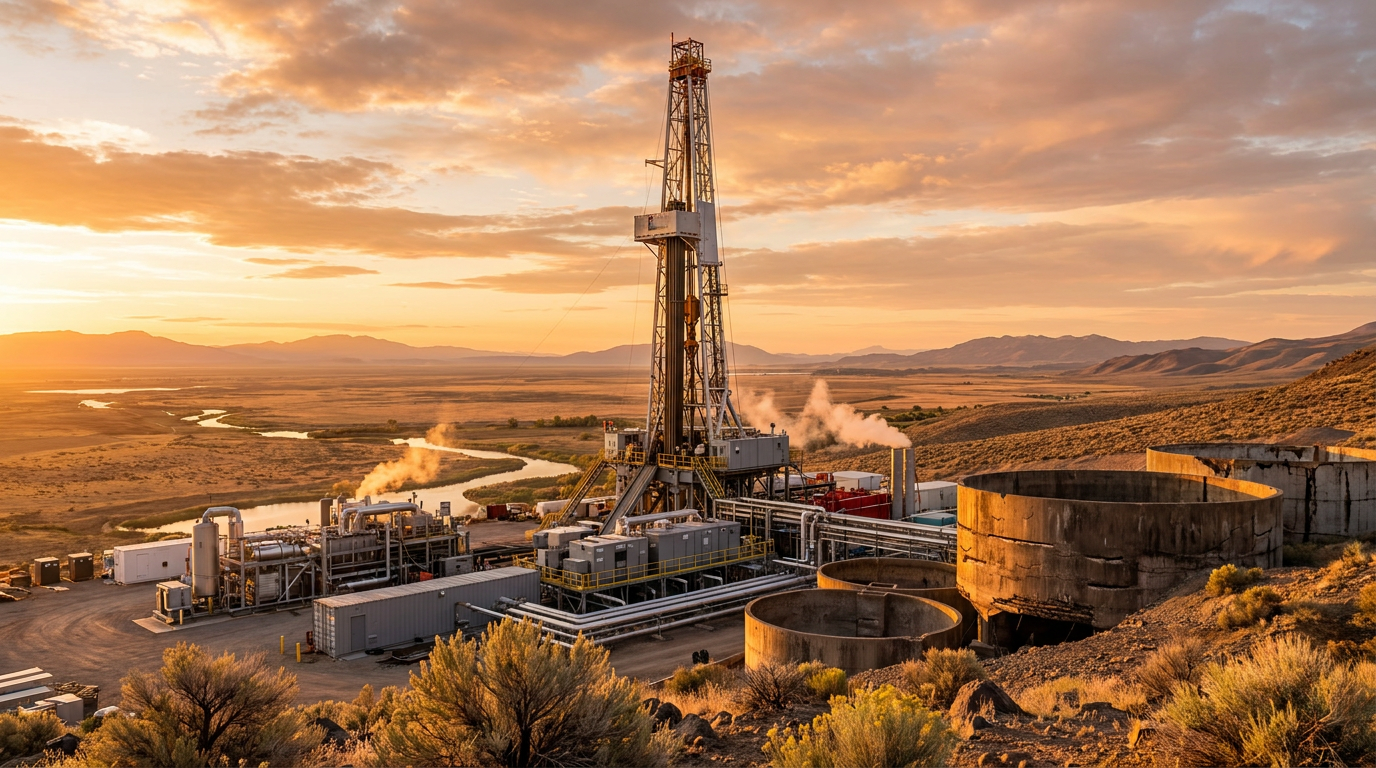
Enhanced Geothermal Systems remove the need for natural permeability and fluid, effectively allowing developers to build a geothermal power plant almost anywhere on Earth, provided they can drill deep enough. The Earth's crust naturally warms by roughly 2 to 3 degrees Celsius for every 100 meters of depth. By drilling into hot, dry, and impermeable rock, engineers can inject water at high pressures to create a human-made fracture network, engineering a reservoir where none naturally existed.[1][2]
Once the deep rock is fractured, cold water is pumped down an injection well. As the fluid flows through the artificial fissures, it absorbs the immense heat of the surrounding rock. It is then drawn back up to the surface through a separate production well. At the surface, this superheated fluid drives a turbine to generate electricity before being cooled and recirculated back underground in a continuous, closed loop.[1]

The irony of this clean energy breakthrough is that it relies heavily on techniques pioneered by the fossil fuel industry. The shale gas boom of the 2010s perfected the art of horizontal drilling and multi-stage hydraulic fracturing. Today, next-generation geothermal startups are repurposing those exact tools—polycrystalline diamond compact drill bits, fiber-optic sensors, and directional drilling—to harvest zero-carbon heat instead of hydrocarbons.[6][7]
The epicenter of this innovation is the Utah Frontier Observatory for Research in Geothermal Energy (FORGE), a dedicated field laboratory sponsored by the U.S. Department of Energy. At the FORGE site in Milford, Utah, researchers from national laboratories and private industry have been testing cutting-edge drilling methods, successfully reducing the time and cost required to bore through hard, igneous rock.[1][6]
These government-backed experiments have paved the way for rapid commercial deployment. Fervo Energy, a leading EGS startup, is currently constructing Cape Station, a massive commercial facility in Beaver County, Utah. The plant is slated to deliver its first 100 megawatts of electricity to the grid in 2026, with ambitious plans to scale up to 400 megawatts by 2028.[3]
These government-backed experiments have paved the way for rapid commercial deployment.
The commercial momentum is accelerating rapidly across the sector. Fervo recently signed power purchase agreements totaling 320 megawatts with Southern California Edison, and has partnered with oilfield services giant Baker Hughes to standardize equipment and de-risk future projects. This transition from pilot projects to bankable, utility-scale deployments marks a critical turning point for the geothermal industry.[4][7]
If EGS can scale globally, the macroeconomic implications are staggering. A comprehensive analysis by Princeton University researchers found that enhanced geothermal could supply up to 20% of the United States' electricity by 2050, emerging as the third most significant clean energy technology behind wind and solar.[4]
Similarly, the U.S. Department of Energy estimates that 90 gigawatts of EGS capacity could be economically built across the country by 2050. That volume of firm, flexible power would be enough to supply more than 10% of the clean baseload generation required to complement intermittent renewables in a zero-emissions grid, drastically reducing the need for massive lithium-ion battery installations.[3][4]

The primary hurdle to widespread EGS adoption remains the steep upfront capital cost. Drilling deep wells into hard rock can cost millions of dollars, and the financial risk of a "dry hole" remains a deterrent for traditional project financiers. However, researchers at Stanford University estimate that as the industry moves down the learning curve, the cost of electricity from EGS plants will fall below $80 per megawatt-hour, making it highly competitive with solar-plus-battery storage systems.[3][5]
Beyond economics, developers must navigate environmental and community concerns. Because EGS relies on hydraulic fracturing, it carries a risk of induced seismicity—small earthquakes triggered by the injection of pressurized fluids into fault lines. While the Department of Energy has established strict protocols to monitor and mitigate seismic risks, public perception remains a hurdle, particularly in densely populated areas.[1][7]
Additionally, while most EGS designs recycle their working fluids in a closed loop, the initial stimulation process requires significant volumes of water. In arid regions like the American West, securing water rights for geothermal fracturing operations requires careful resource management, technological recycling innovations, and transparent community negotiation.[5][7]

Despite these logistical challenges, the trajectory of next-generation geothermal is overwhelmingly positive. By marrying the drilling prowess and workforce of the oil and gas sector with the urgent mandate for clean energy, EGS offers a rare, bipartisan path forward for the energy transition, turning former fossil-fuel engineers into climate-tech pioneers.[7]
As the first wave of commercial EGS plants comes online in 2026, the technology is poised to graduate from a promising scientific concept to a foundational pillar of the global electrical grid. For a world desperate for reliable, carbon-free power to fuel the next generation of computing, the solution has literally been under our feet all along.[7]
How we got here
1970s
Early landmark experiments at the Fenton Hill test site in New Mexico prove the basic concept of fracturing hot, dry rock.
2010s
The shale gas boom perfects horizontal drilling and hydraulic fracturing technologies, drastically lowering the cost of deep drilling.
2024
The U.S. Department of Energy's FORGE lab in Utah successfully demonstrates advanced EGS drilling techniques, de-risking the technology.
2026
Fervo Energy's Cape Station in Utah begins delivering its first 100 megawatts of commercial EGS power to the grid.
2050 (Projected)
The U.S. Department of Energy estimates that EGS could provide 90 gigawatts of clean, firm power nationwide.
Viewpoints in depth
Geothermal Developers' view
Focus on the speed of deployment and the ability to repurpose existing oil and gas infrastructure.
Developers argue that by repurposing the technology, supply chains, and workforce of the fossil fuel industry, EGS can scale much faster than competing firm-power options like advanced nuclear reactors. They view the Department of Energy's 90-gigawatt target as a conservative baseline rather than a ceiling, emphasizing that the sheer volume of heat beneath the Earth's crust is virtually inexhaustible if drilling costs continue to fall.
Grid Operators' view
Value EGS primarily for its reliability and ability to stabilize a grid heavy with intermittent renewables.
For those managing the electrical grid, the appeal of EGS is not just its carbon-free nature, but its "firmness." As more intermittent solar and wind generation is added to the grid, operators desperately need baseload power that can be dispatched 24/7 to prevent blackouts. They view EGS as a critical tool to meet the surging power demands of artificial intelligence data centers without resorting to natural gas peaker plants.
Environmental Watchdogs' view
Support the decarbonization benefits but demand strict oversight on local environmental impacts.
While broadly supportive of any technology that displaces fossil fuels, environmental groups emphasize that EGS is still fundamentally a form of fracking. They advocate for stringent seismic monitoring to prevent induced earthquakes and insist on closed-loop water systems to ensure that deep drilling operations do not deplete local aquifers or contaminate groundwater supplies in drought-prone regions.
What we don't know
- Whether the cost of deep drilling will fall fast enough to compete with next-generation nuclear reactors.
- How frequently induced seismicity will halt operations in densely populated regions.
- The long-term thermal degradation rate of artificially fractured rock reservoirs over decades of continuous use.
Key terms
- Enhanced Geothermal Systems (EGS)
- A technology that generates electricity by pumping water into artificially fractured hot rock deep underground.
- Baseload power
- The minimum amount of electrical power needed to be supplied to the electrical grid at any given time, requiring energy sources that run 24/7.
- Permeability
- The ability of a rock formation to allow fluids, like water or steam, to pass through its pores and fractures.
- Induced seismicity
- Minor earthquakes and tremors that are caused by human activity, such as fluid injection or extraction from the Earth's crust.
- Hydraulic fracturing
- A technique that uses high-pressure fluid to create fractures in deep rock formations, increasing their permeability.
Frequently asked
What is the difference between traditional geothermal and EGS?
Traditional geothermal requires natural hot water and permeable rock. EGS creates its own permeability by injecting fluid into hot, dry rock, allowing plants to be built almost anywhere.
Does enhanced geothermal use fracking?
Yes, EGS uses a form of hydraulic fracturing to create tiny fissures in deep underground rock, though it typically uses pure water rather than the chemical mixtures common in oil and gas fracking.
Can EGS cause earthquakes?
Injecting pressurized fluid underground can cause induced seismicity (micro-earthquakes). However, developers use strict monitoring protocols to manage pressures and prevent noticeable seismic events.
How much does EGS electricity cost?
While initial drilling costs are high, researchers estimate that at scale, EGS electricity could cost less than $80 per megawatt-hour, making it competitive with solar paired with battery storage.
Sources
Source coverage
7 outlets
3 viewpoints surfaced






[1]U.S. Department of EnergyEnvironmental Watchdogs
How Enhanced Geothermal Systems Work
Read on U.S. Department of Energy →[2]U.S. Energy Information AdministrationEnergy Economists
Geothermal Energy Explained
Read on U.S. Energy Information Administration →[3]Proceedings of the National Academy of SciencesEnvironmental Watchdogs
Enhanced geothermal systems for clean firm energy generation
Read on Proceedings of the National Academy of Sciences →[4]Princeton UniversityEnergy Economists
Enhanced geothermal could supply 20% of US electricity by 2050
Read on Princeton University →[5]Stanford UniversityEnergy Economists
Understand Energy: Geothermal
Read on Stanford University →[6]Utah FORGEGeothermal Developers
Unlocking the Future of Geothermal Energy
Read on Utah FORGE →[7]Factlen Editorial TeamGeothermal Developers
Synthesis by Factlen editorial team
Read on Factlen Editorial Team →

Every angle. Every day.
Get guides stories with full source coverage and perspective breakdowns delivered to your inbox.