
Controlled Forest Fires Reduce Long-Term Smoke Pollution, Stanford Study Finds
A two-decade analysis reveals that intentionally burning forests reduces cumulative wildfire smoke exposure by 10% over a decade, despite creating upfront emissions.
By Factlen Editorial Team
- Environmental Economists
- Focus on the long-term mathematical payoff of prescribed burns over a decade-long horizon.
- Air Quality Researchers
- Highlight the immediate public health risks and the variability of the benefits.
- Forest Management Advocates
- Emphasize the ecological necessity and the logistical hurdles of scaling up the treatments.
What's not represented
- · Indigenous cultural burn practitioners
- · Frontline communities living immediately adjacent to prescribed burn sites
Why this matters
Wildfire smoke has become a dominant public health threat in the American West. This data proves that tolerating small amounts of controlled smoke today is the most mathematically sound way to prevent toxic, continent-spanning plumes tomorrow.
Key points
- A Stanford University analysis of 20 years of satellite data confirms that prescribed burns yield a net reduction in wildfire smoke.
- Treating 500,000 acres annually in California would cut cumulative smoke exposure by 10% over a decade.
- During catastrophic fire years, the reduction in deadly fine-particle pollution reaches up to 25%.
- The air quality benefits outweigh the initial smoke generated by the controlled burns by a factor of 5 to 1.
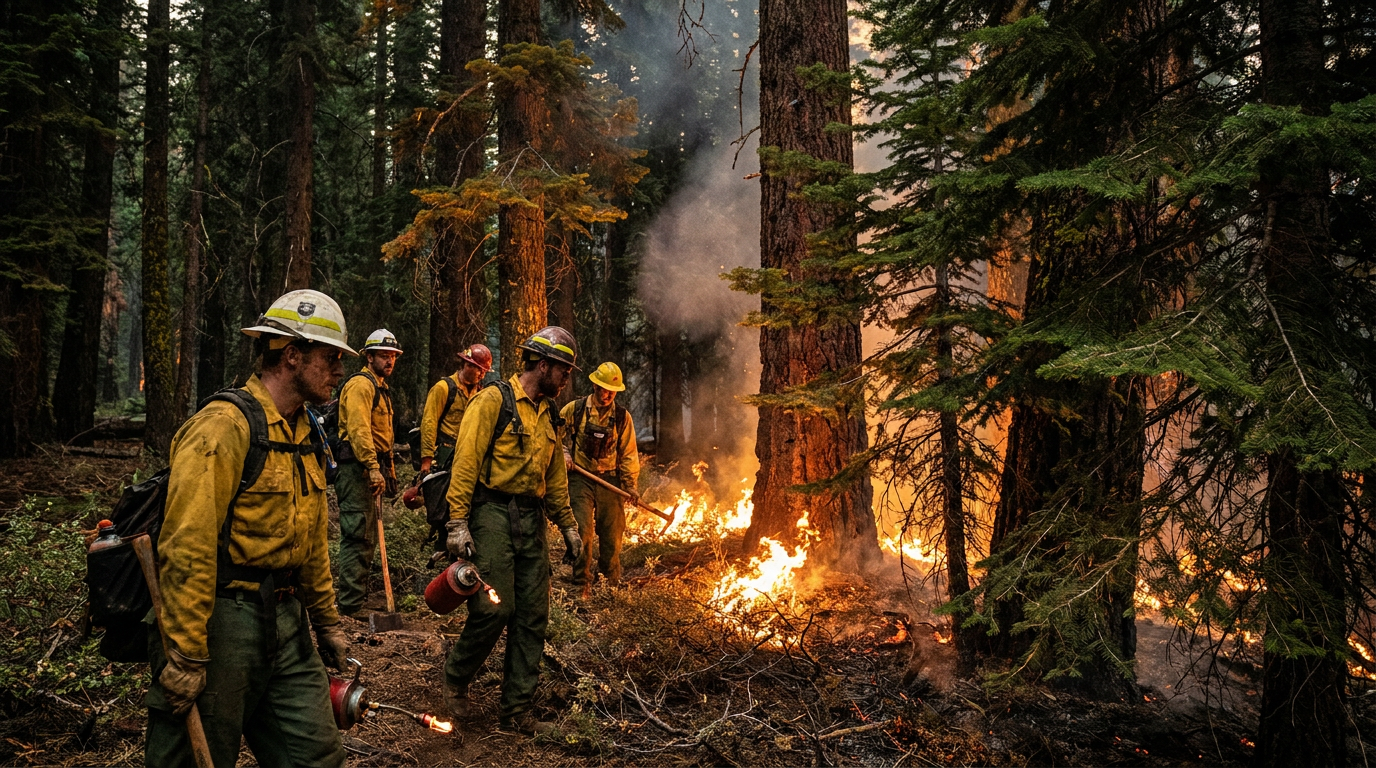
The paradox of fighting fire with fire has long troubled environmental policymakers. For decades, land managers have known that intentionally burning forests clears the dry underbrush that fuels catastrophic wildfires. Yet, these "prescribed burns" release their own toxic smoke, raising a difficult public health question: does setting fires actually save lungs in the long run?[1][2]
A comprehensive new analysis published in the journal Science and highlighted by Nature provides the first large-scale mathematical answer. The verdict is a resounding yes, though it requires a societal tolerance for delayed gratification.[1][2]
The central claim of the evidence pack is that intentionally burning 500,000 acres of California conifer forests annually would reduce cumulative wildfire smoke exposure by roughly 10% over a decade. During the most catastrophic fire years, that reduction jumps to an impressive 25%.[1][3][4]

To build this model, researchers from Stanford University's Doerr School of Sustainability analyzed two decades of satellite data. They tracked both fire severity and the movement of fine particulate matter (PM2.5) across the American West, mapping exactly how previous fires influenced subsequent air quality.[1][3]
The mechanism hinges on fuel reduction. A century of aggressive fire suppression has left Western forests loaded with dead wood and dense thickets. When lightning or human error sparks a blaze, this "fuel ladder" carries the fire into the forest canopy, creating the massive, uncontrollable infernos that blanket the continent in smoke.[3][6]
By using natural low-severity fires as a proxy for prescribed burns, the Stanford team quantified the protective effect. They found that a low-severity fire immediately cuts the risk of a subsequent severe wildfire in the exact same location by 92%.[1][4][5]

Crucially, this protective umbrella extends outward. The data shows that the risk reduction holds for up to a decade and provides a buffer zone that extends up to 5 kilometers (about 3 miles) beyond the directly treated ground, offering "free" air quality gains to neighboring regions.[1][3][6]
However, the evidence also highlights a stark temporal trade-off. Prescribed burns generate immediate emissions. The modeling indicates that in the first three years of an aggressive burning campaign, local air quality would actually worsen by roughly 50% during otherwise quiet fire seasons.[1][6]
However, the evidence also highlights a stark temporal trade-off.
The mathematical tipping point arrives in year four. By this time, the cumulative reduction in smoke from averted mega-fires begins to outweigh the upfront pollution generated by the controlled burns.[1][4][5]

Over a full ten-year horizon, the benefit-to-cost ratio is striking. For every acre treated, the long-term air quality benefits beat the initial smoke costs by a factor of five to one.[1][3][6]
The most profound health benefits materialize when they are needed most. During historically devastating fire seasons, such as California's 2020 and 2021, the modeled 500,000-acre treatment plan would have cut deadly fine-particle pollution by a quarter, protecting millions of vulnerable residents.[3][6]
Despite the strong long-term data, transparent uncertainty remains regarding year-to-year health impacts. Researchers at the UC Davis Air Quality Research Center caution that aggressive prescribed burning could be a net detriment to public health during years with very few natural wildfires.[4][6][7]
Furthermore, the Science study does not directly translate the 10% smoke reduction into specific clinical outcomes, such as the exact number of avoided asthma attacks or premature deaths, though previous regional studies suggest the relationship between smoke volume and mortality is nearly linear.[3][6]

There are also logistical and financial hurdles. California currently treats only about a quarter of the 500,000-acre target. Prescribed burns require highly specific weather conditions, extensive labor, and cost roughly $170 per acre to execute safely.[3][6]
Alternative fuel reduction methods, such as mechanical thinning, produce zero smoke and are actively used near urban centers. However, thinning is prohibitively expensive on a landscape scale and impossible to execute on the steep, rugged terrain where many Western wildfires originate.[3][6]
Ultimately, the data presents a clear but politically challenging reality. While humans are notoriously poor at accepting short-term costs for long-term gains, the evidence suggests that tolerating a controlled amount of smoke today is the most mathematically sound strategy for preventing toxic, continent-spanning plumes tomorrow.[4][5]
How we got here
Pre-1900s
Indigenous communities and natural lightning strikes regularly burn Western forests, maintaining low fuel loads.
20th Century
Federal and state agencies adopt aggressive fire suppression policies, causing dead wood and dense underbrush to accumulate.
2020–2021
California experiences its worst wildfire smoke years on record, prompting urgent calls for new management strategies.
June 2026
Stanford researchers publish definitive data in Science proving that prescribed burns yield a net reduction in long-term smoke pollution.
Viewpoints in depth
Environmental Economists
Focus on the long-term mathematical payoff of prescribed burns over a decade-long horizon.
Researchers modeling the long-term impacts argue that fire management is fundamentally an exercise in delayed gratification. By accepting a quantifiable increase in smoke emissions today, society buys a massive reduction in catastrophic, continent-spanning smoke plumes tomorrow. They emphasize that the 5-to-1 benefit ratio makes prescribed burning one of the most cost-effective public health interventions available for the American West, provided policymakers can sustain the funding and withstand short-term public complaints.
Air Quality Researchers
Highlight the immediate public health risks and the variability of the benefits.
While acknowledging the long-term math, air quality experts caution that the upfront costs are paid in human health. In years with naturally low wildfire activity, an aggressive prescribed burning campaign could actually make the air dirtier than it would have been otherwise. They advocate for highly targeted burning and warn that the models do not yet perfectly translate the 10% reduction in particulate matter into specific clinical outcomes, such as avoided asthma hospitalizations.
Forest Management Advocates
Emphasize the ecological necessity and the logistical hurdles of scaling up the treatments.
For land managers, the debate over smoke is secondary to the reality of the fuel load. A century of fire suppression has left forests dangerously overgrown, making catastrophic fires inevitable. This camp stresses that treating 500,000 acres annually is a monumental logistical challenge, requiring specific weather windows, massive labor forces, and roughly $170 per acre in funding. They argue that without these burns, the forests themselves will not survive the era of climate change.
What we don't know
- The exact number of asthma attacks, hospitalizations, or premature deaths that would be avoided by the 10% reduction in smoke.
- How climate change will alter the narrow weather windows required to safely conduct prescribed burns.
- Whether state and federal agencies can secure the funding and labor required to scale treatments to the 500,000-acre annual target.
Key terms
- Prescribed burn
- A fire intentionally ignited by land managers under specific weather conditions to clear dead brush and reduce the fuel available for future wildfires.
- PM2.5
- Fine particulate matter measuring 2.5 micrometers or less, which is found in wildfire smoke and can penetrate deep into the lungs and bloodstream.
- Low-severity fire
- A fire that burns close to the ground, consuming underbrush and dead wood without reaching the forest canopy or killing large, mature trees.
- Fuel ladder
- Vegetation of varying heights that allows a fire to climb from the forest floor up into the tree canopy, leading to catastrophic blazes.
- Mechanical thinning
- The physical removal of trees and brush using chainsaws or heavy machinery, used as a smoke-free alternative to prescribed burning.
Frequently asked
Do prescribed burns create their own smoke pollution?
Yes. The models show that in the first three years of an aggressive burning campaign, local air quality can worsen as the controlled fires release particulate matter.
When do the air quality benefits actually start?
The data indicates a tipping point around year four, when the reduction in smoke from averted mega-fires begins to outweigh the emissions from the prescribed burns.
Why not just physically remove the dead wood instead of burning it?
Mechanical thinning produces no smoke, but it is highly expensive and often impossible to execute on the steep, rugged terrain where many Western wildfires originate.
Does a prescribed burn stop future wildfires completely?
No, but it reduces the risk of a subsequent severe wildfire in the exact same location by 92%, and that protective effect extends up to 3 miles beyond the treated area.
Sources
Source coverage
7 outlets
3 viewpoints surfaced







[1]ScienceEnvironmental Economists
The air pollution benefits of low-severity fire
Read on Science →[2]NatureForest Management Advocates
Fiery data hint that controlled forest fires benefit human health
Read on Nature →[3]Stanford UniversityEnvironmental Economists
Prescribed burns reduce wildfire smoke pollution
Read on Stanford University →[4]SFGATEAir Quality Researchers
Stanford study finds prescribed burns reduce wildfire smoke
Read on SFGATE →[5]KQEDEnvironmental Economists
A new Stanford University study finds that annual prescribed burning could substantially reduce smoke pollution
Read on KQED →[6]Wood CentralForest Management Advocates
Prescribed Burns Cut Deadly Smoke by 10% Over a Decade
Read on Wood Central →[7]UC Davis Air Quality Research CenterAir Quality Researchers
Air Quality Impacts of Prescribed Fire
Read on UC Davis Air Quality Research Center →


Every angle. Every day.
Get science stories with full source coverage and perspective breakdowns delivered to your inbox.