
The Ultimate Guide to Open Educational Resources and Free Digital Libraries
As textbook costs and subscription paywalls restrict access to knowledge, the Open Educational Resources (OER) movement is providing millions with free, adaptable learning materials.
By Factlen Editorial Team
- Open Education Advocates
- Argue that knowledge is a digital public good and must be freely accessible to remove systemic barriers.
- Institutional Administrators
- Focus on the financial sustainability, copyright compliance, and quality control of integrating open resources.
- Lifelong Learners
- Value practical, on-demand access to skill-building and literature outside of formal degree programs.
What's not represented
- · Traditional Textbook Publishers
- · Proprietary EdTech Companies
Why this matters
The shift toward Open Educational Resources dismantles the financial paywalls surrounding high-quality knowledge. For students, it means the end of crippling textbook costs; for adult learners, it provides free, unrestricted access to the skills needed to thrive in a rapidly changing economy.
Key points
- Open Educational Resources (OER) provide free, legally adaptable learning materials to students and adults worldwide.
- The UNESCO Dubai Declaration formally recognizes OER as essential 'digital public goods'.
- Universities are increasingly adopting open textbooks to eliminate financial barriers for students.
- Creative Commons licenses allow educators to instantly translate and localize materials for their specific communities.
- Long-term sustainability remains a challenge, requiring institutional grants rather than just volunteer labor.
In an increasingly knowledge-driven global economy, access to high-quality information remains one of the most significant determinants of personal and professional success. Yet, despite the internet's promise of democratized information, millions of lifelong learners and students find themselves locked out by prohibitive textbook costs, expensive academic journal subscriptions, and proprietary educational platforms. The financial barriers to continuous learning have never been more apparent, prompting a global pushback against the commodification of knowledge.[6]
Enter the Open Educational Resources (OER) movement, a decentralized but highly coordinated effort to make learning materials universally accessible. OER encompasses teaching, learning, and research materials in any medium that reside in the public domain or have been released under an open license. This legal framework permits no-cost access, re-use, adaptation, and redistribution by others with no or limited restrictions. By shifting the default from "all rights reserved" to "some rights reserved," the OER ecosystem is fundamentally rewiring how knowledge is distributed.[1]
The stakes of this transition are recognized at the highest levels of international policy. UNESCO has formally championed OER as a critical tool for achieving equitable education worldwide, culminating in the recent Dubai Declaration on OER, which explicitly frames these resources as "digital public goods." This designation is crucial; it elevates educational materials from commercial products to essential infrastructure, much like public roads or clean water, ensuring that learners in developing nations with limited hardware or connectivity can still access world-class pedagogical tools.[1]
For university students, the impact of OER is immediate and deeply financial. Traditional textbooks have long been a source of economic strain, often forcing students to choose between purchasing required reading and meeting basic living expenses. Institutions are increasingly intervening to break this cycle. In early 2026, Oregon State University’s Division of Educational Ventures launched a comprehensive blueprint to help faculty transition to open textbooks. Their initiative demonstrates that removing cost barriers not only increases student access but also grants educators unprecedented flexibility to tailor materials to their specific syllabi.[2]

However, as the volume of free material expands, the conversation has inevitably shifted from mere access to rigorous quality control. Skeptics of the open model often question whether free resources can match the editorial standards of legacy publishers. To address this, the Open Education Network recently released a standardized guide detailing the essential and exemplary features of high-quality open textbooks. This framework provides a shared language for educators, ensuring that openly licensed materials are pedagogically sound, accessible to students with disabilities, and inclusive in their representation.[2][3]
The mechanics of OER rely heavily on alternative copyright frameworks, most notably Creative Commons licenses. A standard designation like "CC BY 4.0" allows anyone to use, adapt, and share a work, provided they give appropriate credit to the original creator. This legal innovation solves a massive friction point in academia and self-directed learning. Instead of navigating labyrinthine permission requests to translate a chapter or update a dataset, educators and learners are legally empowered to remix content instantly, keeping the material relevant and localized.[2][4]
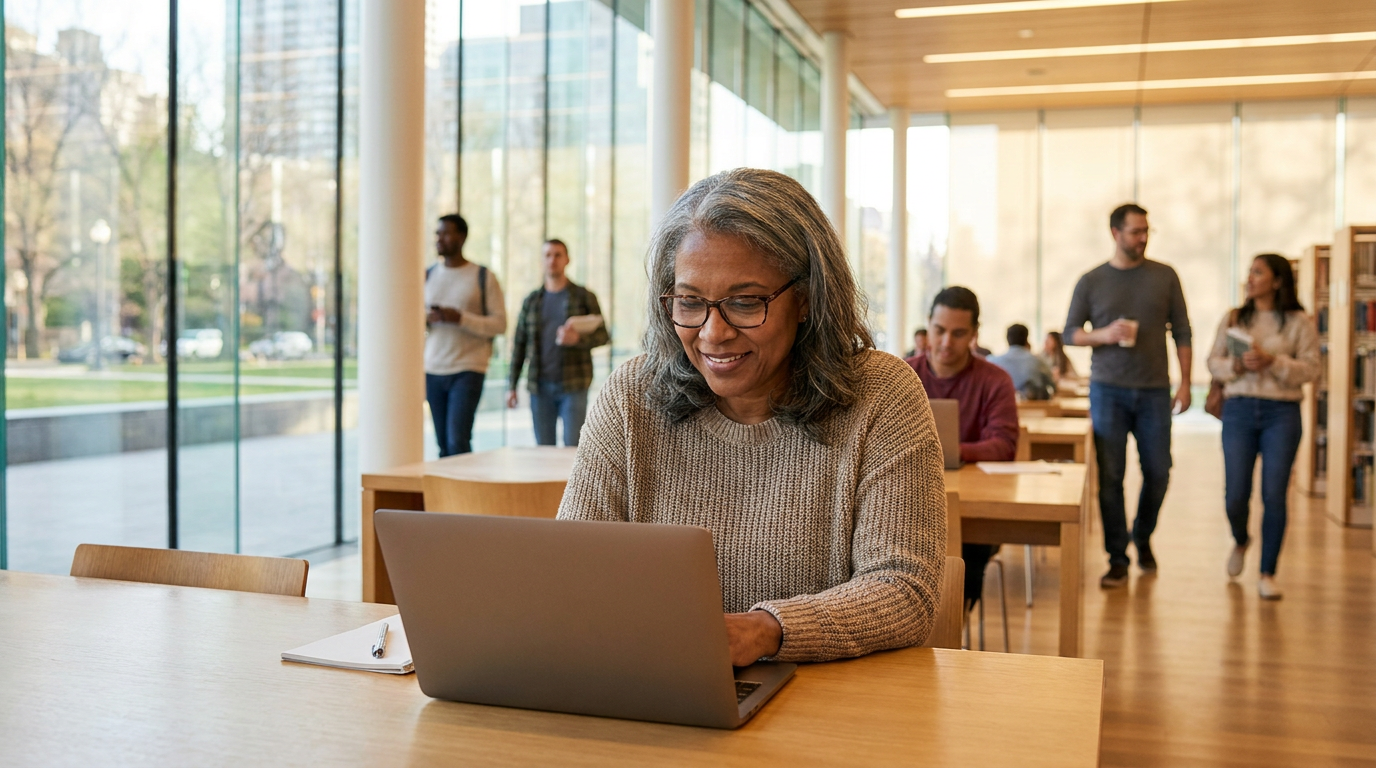
Beyond formal higher education, the open knowledge movement is a lifeline for adult learners seeking to upskill in a rapidly shifting labor market. Platforms like the Digital Skills Library have emerged as open repositories specifically designed to help adults develop digital resilience. Curated by educators, these resources align with standardized skill frameworks, offering everything from basic computer literacy modules to advanced communication tutorials, all completely free of charge.[5]
Beyond formal higher education, the open knowledge movement is a lifeline for adult learners seeking to upskill in a rapidly shifting labor market.
Foundational digital libraries serve as the bedrock for this entire ecosystem. The Internet Archive, functioning as a non-profit digital library, hosts millions of free books, movies, software, and audio files, preserving the cultural and intellectual heritage of the digital age. Similarly, volunteer-driven initiatives like Project Gutenberg continue to digitize public domain cultural works, offering over 60,000 free eBooks in long-lasting, open formats that can be read on almost any device.[6]

Despite these triumphs, the OER movement faces significant structural challenges, primarily concerning long-term sustainability. Creating high-quality educational content requires immense effort, expertise, and financial investment. When the end product is given away for free, the funding must come from alternative sources. Recent academic reviews of OER initiatives highlight that sustainability depends heavily on institutional backing, government grants, and collaborative consortiums rather than individual volunteerism.[4]
The integration of Generative Artificial Intelligence into the educational landscape has introduced a new layer of complexity to this sustainability challenge. AI acts as a double-edged sword for the open education community. On one hand, it can rapidly translate open texts into multiple languages or adapt reading levels for different audiences, massively scaling the reach of OER. On the other hand, the ingestion of openly licensed materials by proprietary AI models raises difficult questions about the future of the digital commons and who ultimately profits from open labor.[3][6]
Cross-border collaboration is emerging as the most viable solution to these challenges. European university alliances are increasingly utilizing OER to legally and securely share educational resources across national borders, bypassing the complex copyright hurdles that traditionally stifle international academic cooperation. By pooling resources and expertise, these alliances can fund the creation of comprehensive, peer-reviewed open textbooks that no single institution could easily afford to produce alone.[4]
For the individual lifelong learner, navigating this vast ocean of free resources requires a strategic approach. Rather than passively consuming content, learners are encouraged to build their own "personal curricula" by aggregating materials from diverse open repositories. This might involve pairing a public domain classic from Project Gutenberg with an interactive module from the Digital Skills Library, supplemented by an open textbook from a major university.[5][6]

The true power of Open Educational Resources lies in their adaptability. A static, copyrighted textbook is a finished product; an openly licensed resource is a living document. An engineering professor in Nairobi can take an open textbook written in Massachusetts, translate it, replace the localized examples with regionally relevant case studies, and instantly distribute it to their students at zero cost. This localized adaptation is the ultimate realization of knowledge equity.[1][6]
As we move further into 2026, the definition of a "library" continues to evolve from a physical building housing printed books to a globally distributed network of digital public goods. The success of this transition depends not just on the creation of more free content, but on the cultivation of open educational practices—teaching methods that actively involve students in the creation and refinement of knowledge.[3][6]
Ultimately, the open education movement proves that the artificial scarcity of knowledge is a policy choice, not an inevitability. By leveraging open licenses, institutional collaboration, and digital distribution, the global community is successfully building an educational infrastructure where the ability to learn is limited only by one's curiosity, never by their bank account.[1][6]
How we got here
2001
Creative Commons is founded, providing the legal framework for open sharing.
2012
Open Education Week is launched globally to raise awareness of OER.
2019
UNESCO adopts the Recommendation on OER, the first international normative instrument for open materials.
2024
The Dubai Declaration on OER is adopted, framing open resources as digital public goods.
2026
Major universities standardize quality frameworks for open textbooks to accelerate mainstream adoption.
Viewpoints in depth
Open Education Advocates
Argue that knowledge is a digital public good and must be freely accessible to remove systemic barriers.
This camp, spearheaded by international organizations like UNESCO and academic coalitions, views the paywalling of educational materials as a fundamental barrier to human development. They argue that because the marginal cost of distributing digital information is effectively zero, society has a moral imperative to make high-quality pedagogical tools available to everyone. Their focus is on expanding the adoption of Creative Commons licenses and convincing governments to mandate that publicly funded research and educational materials be released into the public domain.
Institutional Administrators
Focus on the financial sustainability, copyright compliance, and quality control of integrating open resources.
While generally supportive of the open education mission, university administrators and institutional researchers focus on the pragmatic challenges of implementation. They point out that 'free to read' does not mean 'free to produce.' Creating rigorous, peer-reviewed textbooks requires significant labor, editing, and technical infrastructure. This perspective emphasizes the need for sustainable funding models, such as inter-university consortiums and dedicated government grants, to ensure that OER initiatives do not collapse when initial grant money runs out or key volunteers step down.
Lifelong Learners
Value practical, on-demand access to skill-building and literature outside of formal degree programs.
For adults navigating career transitions or pursuing personal enrichment, the OER movement is less about academic policy and more about immediate utility. This demographic relies heavily on open repositories like the Digital Skills Library and the Internet Archive to bypass the rigid structures and high tuition costs of formal higher education. They prioritize resources that are modular, self-paced, and directly applicable to real-world challenges, demonstrating that the demand for open knowledge extends far beyond the traditional university campus.
What we don't know
- How the ingestion of OER data by proprietary generative AI models will impact the open licensing ecosystem.
- Whether long-term funding models can sustain the continuous updating of complex open textbooks without commercial revenue.
Key terms
- Open Educational Resources (OER)
- Teaching and learning materials provided for free under an open license that allows for adaptation and redistribution.
- Creative Commons (CC)
- A nonprofit organization that provides free legal tools to let creators grant copyright permissions to the public.
- Digital Public Good
- Open-source software, open data, open AI models, and open content that adhere to privacy and do no harm.
- Public Domain
- Creative materials that are not protected by intellectual property laws and are free for anyone to use.
- Open License
- A legal framework that respects the creator's copyright while granting the public permission to access, re-use, and adapt the work.
Frequently asked
Are Open Educational Resources completely free to use?
Yes. OER materials are released under open licenses or reside in the public domain, meaning they can be accessed, downloaded, and often modified without any cost.
How do I know if an open textbook is high quality?
Many open textbooks undergo rigorous peer review, similar to traditional publishing. Organizations like the Open Education Network provide standardized frameworks to evaluate their pedagogical value and accessibility.
Can I use OER materials for my own business or teaching?
In most cases, yes. However, you must check the specific Creative Commons license attached to the resource. Some licenses allow commercial use, while others restrict usage to non-commercial purposes.
What is the difference between OER and the public domain?
Public domain works have no copyright restrictions at all. OER materials are usually still copyrighted by their creators but are shared under an open license (like Creative Commons) that grants specific permissions to the public.
Sources
Source coverage
6 outlets
3 viewpoints surfaced






[1]UNESCOOpen Education Advocates
Guidelines for open educational resources (OER) in higher education
Read on UNESCO →[2]Oregon State UniversityOpen Education Advocates
What makes a high-quality OER? Oregon State University launches a guide for faculty
Read on Oregon State University →[3]Open Education NetworkOpen Education Advocates
Guide to Open Textbook Essential and Exemplary Features
Read on Open Education Network →[4]ResearchGateInstitutional Administrators
Sustainability of open educational resources (OER) initiatives
Read on ResearchGate →[5]Digital Skills LibraryLifelong Learners
Open repository of free learning resources for adult learners
Read on Digital Skills Library →[6]Factlen Editorial TeamLifelong Learners
Synthesis by Factlen editorial team
Read on Factlen Editorial Team →

Every angle. Every day.
Get guides stories with full source coverage and perspective breakdowns delivered to your inbox.