
How Drones and AI Are Accelerating the Clearance of Global Minefields
Humanitarian organizations and tech companies are deploying machine learning and sensor-equipped drones to map unexploded ordnance, reducing analysis time from days to hours.
By Factlen Editorial Team
- Humanitarian Deminers
- Focus on accelerating the safe return of agricultural land to communities while maintaining zero tolerance for clearance errors.
- Technology Providers
- Emphasize the power of cloud computing, sensor fusion, and machine learning to solve massive data bottlenecks.
- Academic Researchers
- Prioritize rigorous peer-reviewed validation of algorithmic accuracy, focusing on reducing false positives and optimizing neural networks.
What's not represented
- · Local farmers awaiting land clearance
- · Traditional human sappers adapting to new technology
Why this matters
By replacing slow, dangerous manual labor with rapid aerial mapping, this technology is safely returning millions of acres of agricultural land to communities and restoring the global food supply.
Key points
- Ukraine is currently the most heavily mined country in the world, with up to 62,000 square miles contaminated.
- Traditional manual clearance methods are too slow to address the scale of the global landmine crisis.
- Drones equipped with RGB, thermal, and magnetometer sensors can safely map minefields from the air.
- Machine learning algorithms process terabytes of drone data, cutting analysis time from days to hours.
- Academic studies show AI models can detect surface and shallow mines with over 96% accuracy.
- AI does not replace physical clearance but directs ground robots and human sappers with unprecedented precision.
The legacy of modern warfare is often buried just beneath the topsoil. Across the globe, an estimated 110 million unexploded landmines and remnants of war contaminate agricultural fields, forests, and migration corridors. In Ukraine alone, government estimates suggest up to 62,000 square miles of land—an area larger than the state of Georgia—may be contaminated by explosives. For the communities living in these regions, the threat is both lethal and economic, preventing farmers from cultivating crops and families from returning home.[1][2][6]
Historically, humanitarian demining has been a painstakingly slow and dangerous process. The traditional image of mine clearance involves sapper teams advancing inch by inch across hazardous terrain, relying on handheld metal detectors and physical probes. While this methodical approach is highly effective, it is fundamentally unscalable. At the current pace of manual clearance, removing the world's unexploded ordnance would take generations and cost hundreds of billions of dollars.[1][2]
However, a paradigm shift is currently underway in post-conflict stabilization. A coalition of humanitarian organizations, cloud computing giants, and academic researchers is deploying a new generation of autonomous drones and artificial intelligence to fundamentally accelerate the pace of landmine detection. By shifting the initial reconnaissance from the ground to the sky, these technologies are removing humans from the most dangerous phases of the clearance process.[3][7]

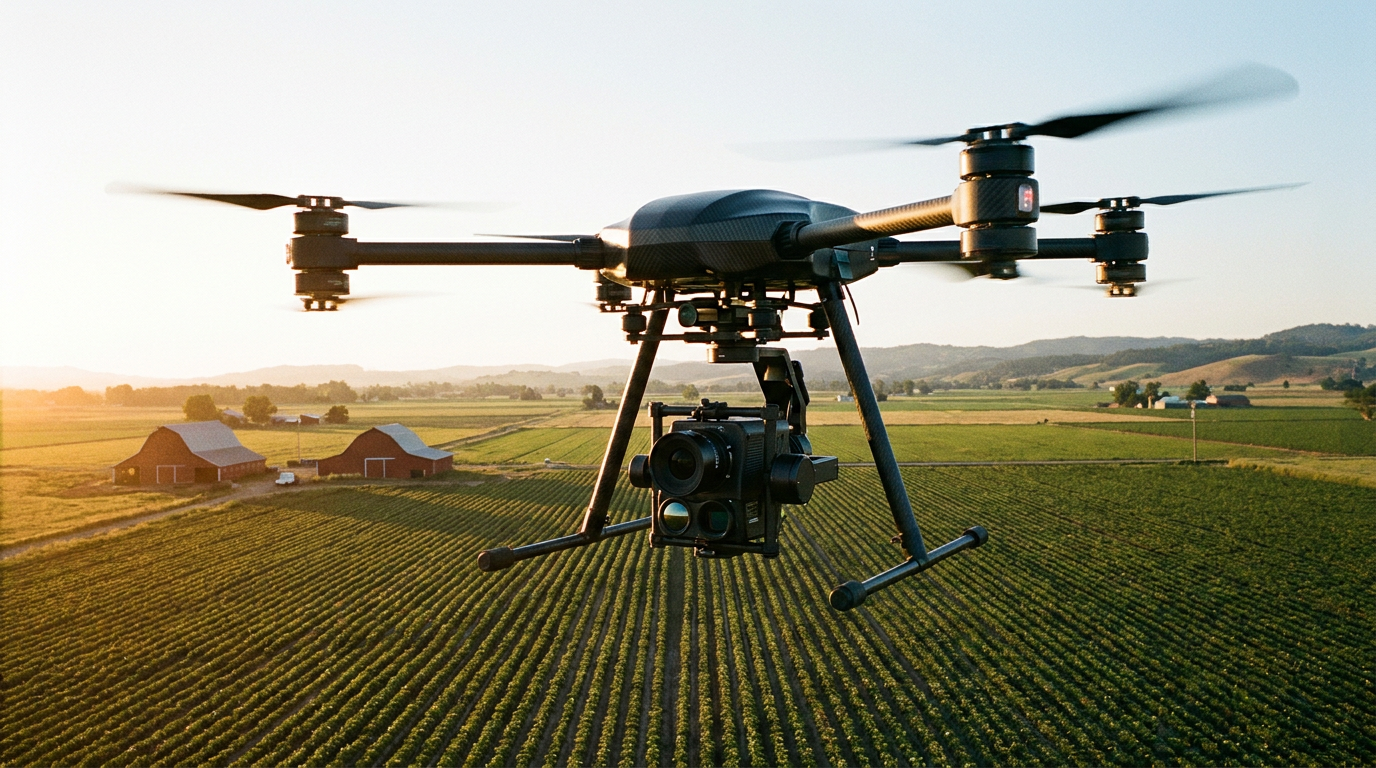
The technological mechanism begins with aerial data collection. Commercial and specialized drones, such as those manufactured by Draganfly and DJI, are deployed over suspected minefields to conduct high-resolution surveys. Rather than relying on a single visual spectrum, these unmanned aerial vehicles (UAVs) are equipped with a suite of advanced sensors, including high-definition RGB cameras, thermal imaging payloads, and magnetometers.[4][5][6]
This multi-sensor approach, known as sensor fusion, allows operators to detect anomalies that are invisible to the naked eye. For example, thermal cameras can identify the subtle temperature differences between a buried plastic mine and the surrounding soil, as explosives heat and cool at different rates than natural earth. Meanwhile, magnetometers detect the metallic components of the ordnance, and ground-penetrating radar provides a volumetric view of the subsurface.[5][8]
While drones solve the problem of safe data collection, they create a secondary challenge: data overload. The HALO Trust, the world's largest humanitarian mine clearance organization, has flown hundreds of drone sorties over contaminated regions, generating upwards of 11 terabytes of raw visual data. For a human analyst, manually reviewing the imagery from a single average-sized minefield can take between three and five days.[2][7]
This is where artificial intelligence bridges the gap. To process this massive influx of geospatial data, organizations are turning to advanced machine learning models. In a major pilot program, Amazon Web Services (AWS) invested $4 million to provide The HALO Trust with access to Amazon SageMaker, a cloud-based machine learning platform. The goal is to train AI models to automatically identify the visual signatures of landmines, craters, and destroyed military hardware.[3][7]

To process this massive influx of geospatial data, organizations are turning to advanced machine learning models.
The introduction of AI has dramatically compressed the timeline for threat analysis. According to researchers at The HALO Trust, algorithms can process the same drone imagery that would take a human team nearly a week to review in a matter of hours. By rapidly delineating the boundaries of a danger zone, organizations can immediately warn local populations to stay away while prioritizing which areas require urgent physical clearance.[2][7]
The academic evidence supporting these AI models is robust and rapidly expanding. In a recent study published on arXiv, computer vision researchers evaluated multiple deep learning foundation models on a custom dataset of drone flyby imagery. The study found that models like YOLOF could detect small, surface-laid Russian landmines with a mean Average Precision (mAP) score of 0.89, demonstrating high reliability even when analyzing images captured from ten meters above the ground.[4]
Thermal imaging combined with lightweight neural networks has shown even higher accuracy rates. A separate peer-reviewed study evaluated a deep learning model based on the MobileNetV3-Large architecture, trained on 2,700 thermographic images captured by a drone. The researchers reported a test accuracy of 96.14 percent in identifying landmines across different terrains. Because the model is computationally lightweight, it can be deployed on edge devices in resource-constrained environments without requiring constant cloud connectivity.[5]
Despite these high accuracy rates, the mine action community approaches AI with necessary caution. In humanitarian demining, the tolerance for error is effectively zero. While a false positive—flagging a rock or a clump of grass as a mine—merely wastes time, a false negative can be lethal. Consequently, AI is not currently used to declare an area definitively safe; rather, it is used to map the presence of threats and direct physical clearance teams with unprecedented precision.[7][8]

Furthermore, the technology faces distinct environmental limitations. While AI and drones excel at identifying surface-laid mines and ordnance in relatively open terrain, their efficacy drops in areas with dense vegetation or thick forest canopies. Deeply buried mines that have been in the ground for decades also remain difficult to detect from the air, requiring the continued use of traditional ground-based methods.[7][8]
To address the physical removal of the ordnance, the industry is increasingly pairing aerial AI with unmanned ground vehicles (UGVs). Once the drone software maps the exact coordinates of a minefield, robotic platforms equipped with specialized clearance attachments can be sent into the hot zone. These ground robots can either detonate the explosives in place or safely neutralize them, ensuring that human sappers only enter the area when the primary threats have been eliminated.[1]
The integration of these technologies is already yielding measurable humanitarian benefits. By accelerating the survey phase, demining organizations can return safe land to communities much faster. In agricultural economies, clearing a field means restoring a family's livelihood and contributing to the global food supply. Furthermore, the data-driven approach allows governments to prioritize the clearance of critical infrastructure, such as roads and power lines, maximizing the economic impact of the recovery effort.[1][3]

Looking forward, the innovations being battle-tested today will likely become the standard operating procedure for post-conflict recovery worldwide. The United Nations Development Programme (UNDP) and other international bodies are actively funding hackathons and tech incubators to refine these algorithms, ensuring that the software remains open and accessible to NGOs operating in other heavily mined countries like Cambodia, Angola, and Colombia.[8]
Ultimately, the fusion of drones and artificial intelligence represents one of the most significant advancements in humanitarian aid in decades. While technology cannot undo the devastation of conflict, it is providing a highly effective tool to heal the landscape. By replacing slow, dangerous manual labor with rapid, autonomous precision, the international community is moving closer to the goal of a mine-free world.[1][9]
How we got here
2022
The scale of landmine contamination in Ukraine accelerates dramatically, prompting a search for scalable clearance solutions.
2023
Humanitarian organizations begin widespread deployment of specialized drones to map contaminated agricultural land.
2024
AWS announces a $4 million partnership with The HALO Trust to process terabytes of drone imagery using machine learning.
2025
Hackathons and tech incubators in Kyiv successfully train new AI models to detect explosive hazards in drone imagery.
2026
Peer-reviewed studies confirm deep learning models achieve over 96% accuracy in detecting landmines via thermal imaging.
Viewpoints in depth
Humanitarian Deminers
Focus on accelerating the safe return of agricultural land to communities while maintaining zero tolerance for clearance errors.
For organizations like The HALO Trust and UNMAS, the primary metric of success is not algorithmic elegance, but human safety and economic restoration. They view AI as a triage tool—a way to rapidly identify which areas are safe for farmers to return to and which require immediate physical intervention. Because a single missed mine can result in a civilian casualty, these groups insist on keeping a 'human in the loop' to verify AI findings before any land is officially declared clear.
Technology Providers
Emphasize the power of cloud computing, sensor fusion, and machine learning to solve massive data bottlenecks.
Cloud providers and drone manufacturers approach the landmine crisis as a massive data processing challenge. By deploying high-resolution sensors and edge-computing capabilities, they aim to digitize the battlefield. Their focus is on scaling infrastructure—such as AWS's deployment of Amazon SageMaker—to ensure that the terabytes of visual data collected by drones can be processed in hours rather than weeks, fundamentally altering the logistics of humanitarian aid.
Academic Researchers
Prioritize rigorous peer-reviewed validation of algorithmic accuracy, focusing on reducing false positives and optimizing neural networks.
Computer vision scientists and engineers are focused on the mathematical and environmental limitations of the technology. Through peer-reviewed studies, they test various neural network architectures against custom datasets to find the optimal balance between processing speed and detection accuracy. Their ongoing research aims to solve edge cases, such as detecting mines obscured by heavy vegetation or distinguishing between a plastic explosive and a similarly shaped rock.
What we don't know
- How quickly these AI models can be adapted to detect entirely new types of improvised explosive devices.
- The exact timeline for when fully autonomous ground robots will be trusted to clear minefields without human oversight.
- How effectively these aerial detection methods will perform in densely forested regions outside of Eastern Europe.
Key terms
- Unexploded Ordnance (UXO)
- Explosive weapons, such as bombs, shells, and landmines, that did not explode when they were deployed and still pose a lethal risk.
- Sensor Fusion
- The process of combining data from multiple different sensors (like RGB cameras, thermal imaging, and radar) to create a more accurate understanding of an environment.
- False Negative
- In demining, a dangerous scenario where a detection system incorrectly concludes that an area is free of explosives when a mine is actually present.
- Ground-Penetrating Radar (GPR)
- A geophysical method that uses radar pulses to image the subsurface, helping to detect buried objects.
Frequently asked
Can artificial intelligence physically remove landmines?
No. AI is used to analyze drone imagery and map the exact locations of explosives. Physical removal is still conducted by specialized ground robots or human sappers.
Does this technology work for deeply buried mines?
It is highly effective for surface-laid mines and shallowly buried ordnance using thermal imaging. However, deeply buried mines or those hidden under dense forest canopies still require traditional ground-based detection.
Why is AI necessary if drones are already taking pictures?
Drones generate massive amounts of data—often terabytes per minefield. AI reduces the time required to analyze this imagery from several days to a matter of hours.
How accurate are these machine learning models?
Peer-reviewed studies show that specialized deep learning models can achieve over 96% accuracy when analyzing thermal imagery of landmines, though environmental factors can affect performance.
Sources
Source coverage
9 outlets
3 viewpoints surfaced









[1]UN Mine Action Service (UNMAS)Humanitarian Deminers
Mine Action in Ukraine: Impact and Activities
Read on UN Mine Action Service (UNMAS) →[2]The HALO TrustHumanitarian Deminers
Eradicating landmines with drones and AI
Read on The HALO Trust →[3]Amazon Web ServicesTechnology Providers
AWS invests $4 million to support HALO Trust demining in Ukraine
Read on Amazon Web Services →[4]arXivAcademic Researchers
Comparing Surface Landmine Object Detection Models on a New Drone Flyby Dataset
Read on arXiv →[5]ResearchGateAcademic Researchers
Deep Learning-Based Landmine Detection Using Unmanned Aerial Vehicles and Thermal Imaging
Read on ResearchGate →[6]GizmodoTechnology Providers
Ukrainian Forces Are Using Draganfly Drones to Spot Russian Landmines
Read on Gizmodo →[7]Computer WeeklyTechnology Providers
Halo Trust taps AWS AI tools to speed up Ukraine landmine clearance
Read on Computer Weekly →[8]UNDPHumanitarian Deminers
AI for demining: Ukrainian innovators train algorithms to detect explosives in drone images
Read on UNDP →[9]Factlen Editorial Team
Synthesis by Factlen editorial team
Read on Factlen Editorial Team →
Every angle. Every day.
Get defense security stories with full source coverage and perspective breakdowns delivered to your inbox.