
Smart Ring vs. Smartwatch: The 2026 Guide to Choosing Your Health Tracker
As wearable technology fractures into two distinct design philosophies, choosing between a smart ring and a smartwatch comes down to whether you prioritize passive recovery data or active real-time coaching.
By Factlen Editorial Team
- Passive Health Trackers
- Users who prioritize sleep data, continuous recovery metrics, and digital minimalism without the distraction of screens.
- Active Fitness Enthusiasts
- Athletes who require real-time pacing, GPS tracking, and on-the-go connectivity during intense workouts.
- Dual-Wear Optimizers
- Data-driven users who wear a watch during the day for workouts and a ring at night for unobstructed sleep tracking.
What's not represented
- · Traditional watch enthusiasts who use smart rings to track health while wearing mechanical timepieces
- · Medical professionals evaluating the clinical accuracy of consumer wearables
Why this matters
Wearable health trackers now dictate how millions of people sleep, train, and recover. Understanding the anatomical and functional trade-offs between the wrist and the finger ensures you invest in a device that actually fits your lifestyle, rather than one that ends up abandoned in a drawer.
Key points
- Smart rings offer superior passive tracking for sleep and recovery due to stable finger placement.
- Smartwatches dominate active fitness tracking, offering real-time GPS, pacing, and heart rate zones.
- Gripping weights or handlebars causes smart rings to lose heart rate signals during workouts.
- Rings provide 4 to 8 days of battery life, while premium watches require daily charging.
- Smartwatches offer life-saving safety features like fall detection and ECGs that rings lack.
- Many serious users now wear a watch during the day and a ring at night to maximize data accuracy.
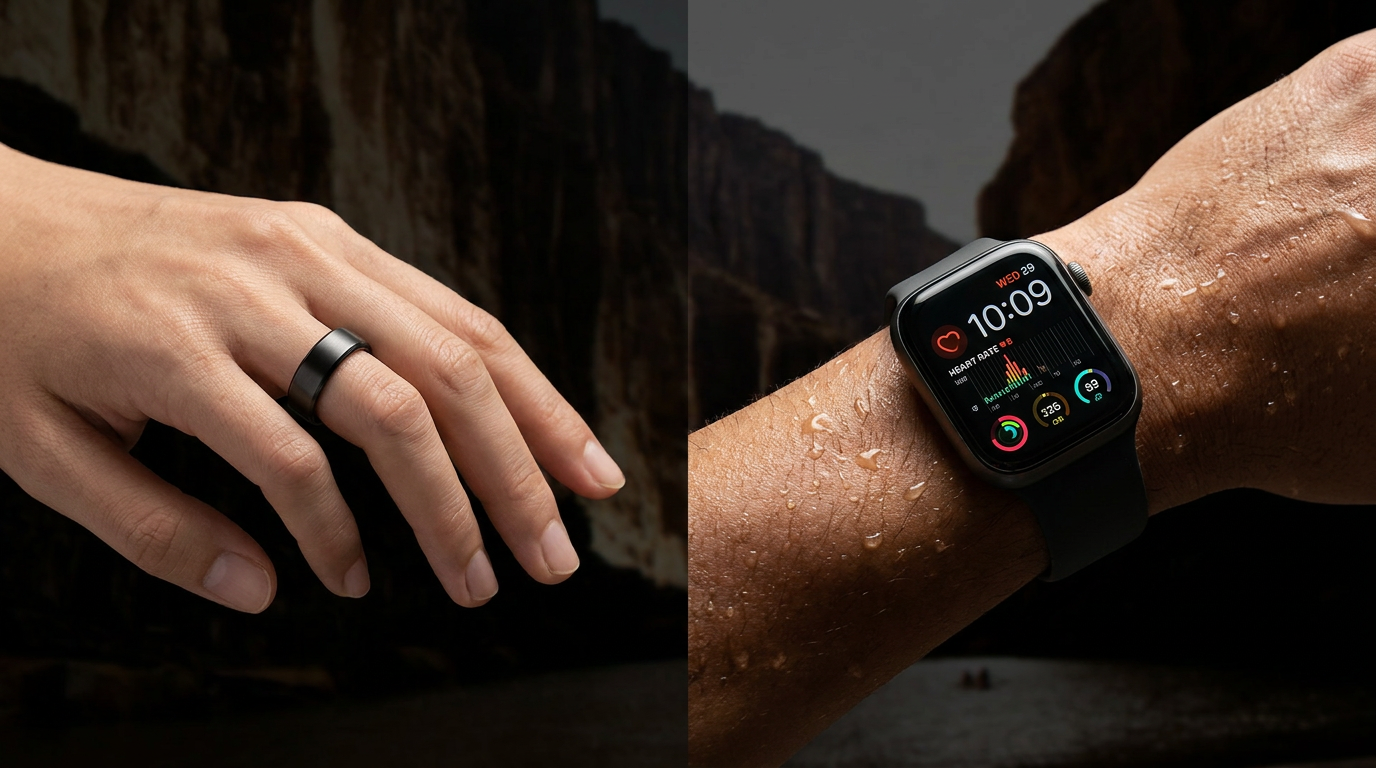
The wearable technology market in 2026 has fractured into two distinct design philosophies: the wrist and the finger. As dominant tech giants like Samsung and Apple battle specialized pioneers like Oura, consumers are no longer just choosing a brand ecosystem. They are being forced to choose between active digital engagement and passive biometric monitoring.[2][3]
The fundamental technological difference between the two form factors is not the sensors themselves. Both smartwatches and smart rings rely heavily on photoplethysmography (PPG) to track blood volume changes using tiny LEDs. The true differentiator is human anatomy, and how those sensors interact with the body throughout the day and night.[5]
The finger offers a unique physiological advantage for passive health tracking. Because the finger features thinner soft tissue, denser capillaries near the surface, and far less erratic movement than the wrist, smart rings can capture incredibly clear signals when the body is at rest.[5][6]

This anatomical edge makes smart rings the undisputed champions of sleep and recovery tracking. The snug, circumferential fit ensures the sensor rarely loses contact with the skin. Industry surveys note that an overwhelming majority of users prefer rings for overnight wear, citing the sheer discomfort of taking a bulky, glowing smartwatch to bed.[4][5]
Because they are rarely removed, smart rings also dominate in tracking Heart Rate Variability (HRV) and basal body temperature. By establishing highly accurate, uninterrupted baseline metrics, rings excel at predicting illness, calculating daily readiness scores, and tracking menstrual cycles with clinical precision.[2][5]
However, the finger's physiological advantage vanishes the moment you step into a gym. Physical pressure on a smart ring—such as gripping a heavy barbell, holding a bicycle handlebar, or carrying groceries—literally pushes blood away from the sensor. This causes severe data dropouts and inaccurate heart rate readings during strength training and high-intensity workouts.[1][5]
This is exactly where smartwatches reclaim their territory. For active workout tracking, watches remain vastly superior. They offer real-time heart rate zones, built-in multi-band GPS for precise run tracking, and automatic stroke detection for swimmers, all without the signal loss that plagues rings under pressure.[1][2]
For active workout tracking, watches remain vastly superior.
Smartwatches also serve as active digital companions rather than silent observers. With bright OLED screens, they provide instant feedback, pacing alerts, and the ability to leave your smartphone at home while still receiving emergency calls, streaming music, or paying for a post-workout coffee.[2][3]
The trade-off for that vibrant screen and constant connectivity is battery life. Premium smartwatches typically demand a charger every 18 to 30 hours. This creates a daily friction point that often results in missing overnight data, as users are forced to charge their devices exactly when they should be tracking their sleep.[1][4]

Conversely, smart rings sip power. By eliminating the screen and relying entirely on background data collection, most premium rings boast battery lives of four to eight days. This "set it and forget it" nature appeals heavily to users seeking digital minimalism and a reduction in daily screen time.[4][5]
Cost structures between the two categories also diverge significantly. While smartwatches require a higher upfront investment—often ranging from $250 to $800—they rarely charge ongoing fees to access your basic health and fitness data.[2][6]
Smart rings, typically priced between $300 and $400, have historically hidden their deepest insights behind monthly subscriptions. While pioneers like Oura still charge a monthly fee for premium analytics, newer entrants in 2026 are increasingly abandoning the paywall model to compete, making long-term ownership costs more predictable.[2][5]
Safety features present another stark contrast that buyers must weigh. Smartwatches are equipped with advanced accelerometers and gyroscopes calibrated for fall detection, severe crash detection, and FDA-cleared irregular heart rhythm (ECG) alerts—life-saving features that the miniaturized hardware of a ring simply cannot support yet.[1][2]

Ultimately, the decision hinges entirely on how you want to interact with your health data. If you want a proactive coach on your wrist pushing you through a marathon with live metrics, the smartwatch is the only logical choice. If you want a silent guardian monitoring your recovery in the background, the ring is unmatched.[5][6]
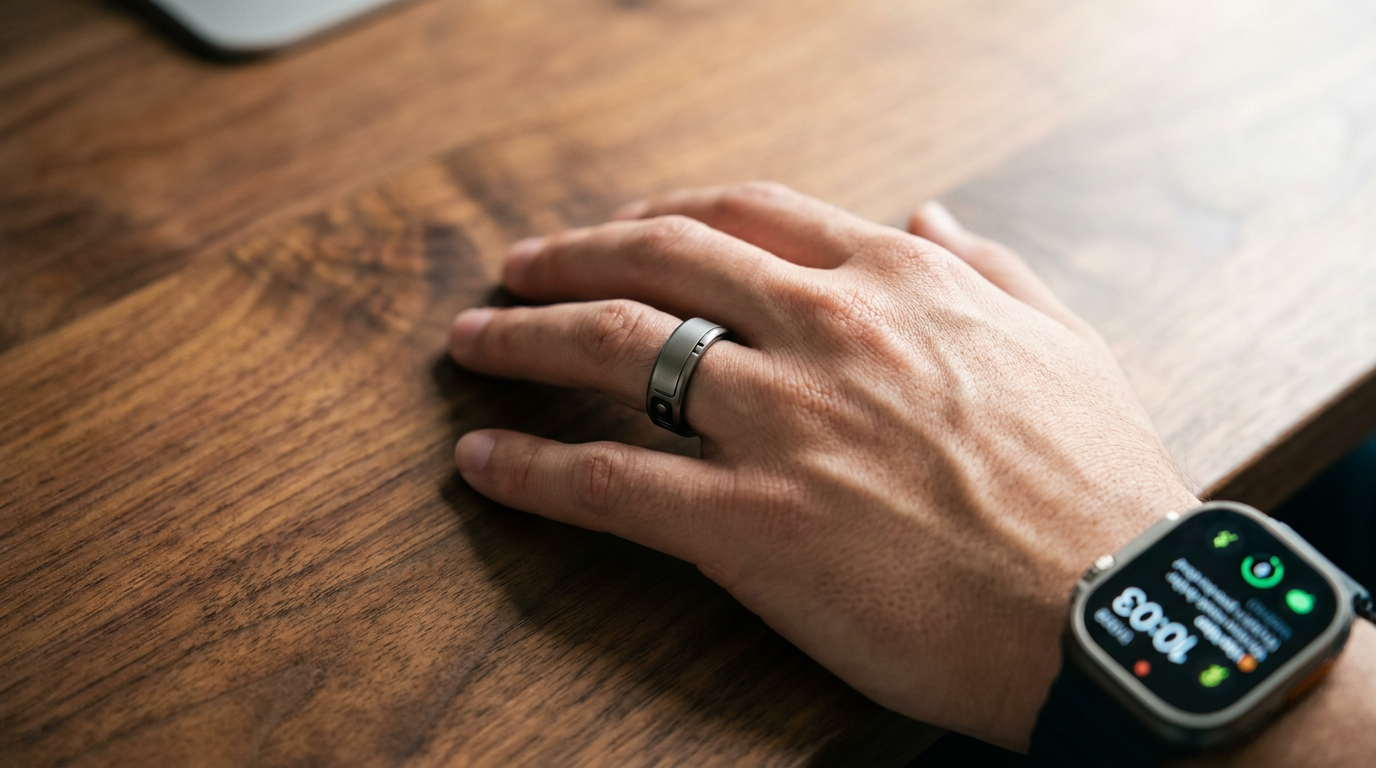
For many health-conscious consumers in 2026, the solution has simply become wearing both. By utilizing a smartwatch for daytime activity and a ring for nighttime recovery, users are bypassing the compromises of each form factor entirely, achieving a complete, 24-hour picture of their biometric health.[2][5]
How we got here
2015
The Apple Watch launches, establishing the wrist as the default home for wearable health technology.
2018
The Oura Ring Gen 2 proves that highly accurate sleep and recovery tracking can be achieved from the finger.
2022
Smartwatches introduce advanced temperature sensing and crash detection, widening the feature gap between the two form factors.
2024
Samsung enters the ring market with the Galaxy Ring, validating the form factor for mainstream Android users.
2026
Subscription-free smart rings and AI-driven recovery software force a direct feature-for-feature battle between rings and watches.
Viewpoints in depth
The Smartwatch Case
Best for active athletes and those who want real-time connectivity.
Fits well when you need live pacing, GPS tracking, and on-the-go notifications. The smartwatch acts as a digital tether, allowing you to leave your phone behind while still tracking complex workout metrics and maintaining emergency connectivity. Does not fit when you suffer from screen fatigue, find bulky wristwear uncomfortable during sleep, or despise having to charge another device every single day.
The Smart Ring Case
Best for passive health monitoring, sleep tracking, and digital minimalism.
Fits well when you prioritize sleep data, continuous HRV tracking, and multi-day battery life without the distraction of a screen. It seamlessly blends into your life as a piece of jewelry, quietly collecting high-fidelity recovery data in the background. Does not fit when you need real-time workout feedback, rely on wrist-based notifications, or frequently engage in heavy weightlifting that disrupts the ring's sensors.
The Dual-Wearer Approach
Utilizing both devices to cover the anatomical blind spots of each.
Fits well when budget allows and maximum data fidelity is required. Users in this camp wear a smartwatch during the day for active workout tracking, mobile payments, and notifications, then switch to a smart ring at night for unobstructed, highly accurate sleep and recovery metrics. This approach eliminates the battery anxiety of the watch and the workout limitations of the ring.
What we don't know
- Whether smart rings will eventually be able to support FDA-cleared ECG and fall detection features.
- If Apple will release its own smart ring to compete directly with Samsung and Oura.
- How long subscription-based models can survive as more hardware companies offer free data access.
Key terms
- PPG Sensor (Photoplethysmography)
- An optical sensor that uses light to measure changes in blood volume, utilized by both rings and watches to track heart rate.
- HRV (Heart Rate Variability)
- The variance in time between consecutive heartbeats, used as a key indicator of physical recovery, stress, and impending illness.
- SpO2
- A measure of the amount of oxygen-carrying hemoglobin in the blood, tracked overnight to detect breathing disturbances.
- Sleep Staging
- The process of categorizing sleep into light, deep, and REM cycles based on movement, heart rate, and temperature data.
Frequently asked
Can a smart ring completely replace my smartwatch?
Not if you rely on your wearable for notifications, GPS tracking, or real-time workout data. Rings are designed for passive background monitoring, not active interaction.
Do all smart rings require a monthly subscription?
No. While pioneers like Oura charge a monthly fee for premium data analysis, newer competitors like Samsung and RingConn offer subscription-free models.
Which device is better for tracking weightlifting?
A smartwatch. Gripping heavy barbells pushes blood away from the finger, which causes smart rings to lose their optical heart rate signal during strength training.
Are smart rings waterproof enough for daily use?
Yes, most premium smart rings are water-resistant up to 100 meters, making them perfectly safe for showering, swimming, and continuous daily wear.
Sources
Source coverage
6 outlets
3 viewpoints surfaced






[1]ForbesActive Fitness Enthusiasts
Oura Ring Vs. Apple Watch: Fitness Tracking
Read on Forbes →[2]CNETActive Fitness Enthusiasts
The Apple Watch vs. Oura Ring Debate
Read on CNET →[3]WareableDual-Wear Optimizers
Samsung Galaxy Ring vs Galaxy Watch comparison
Read on Wareable →[4]Android PolicePassive Health Trackers
Why the Galaxy Ring is a better purchase than a Galaxy Watch
Read on Android Police →[5]SmartRingHQPassive Health Trackers
Smart Ring vs Smartwatch: The Honest 2026 Comparison
Read on SmartRingHQ →[6]Global SourcesDual-Wear Optimizers
Smart Ring vs Smartwatch: Features and Differences
Read on Global Sources →

Every angle. Every day.
Get shopping stories with full source coverage and perspective breakdowns delivered to your inbox.