
The Rise of Local AI: How Indie Creators Are Reclaiming Their IP with Open-Weight Models
Independent artists and studios are abandoning expensive cloud AI subscriptions in favor of open-weight models that run locally on consumer hardware. This shift allows creators to protect sensitive client data, eliminate API costs, and train custom algorithms on their own unique art styles.
By Factlen Editorial Team
- Indie Creators & Studios
- Independent artists prioritize cost control, IP ownership, and the ability to fine-tune models to their specific aesthetic.
- Open-Source Developers
- The technical community focuses on transparency, collaborative optimization, and democratizing access to frontier models.
- Commercial AI Providers
- Enterprise platforms emphasize scalable infrastructure, guaranteed uptime, and out-of-the-box usability.
- IP Legal Experts
- Legal professionals focus on copyright provenance, data privacy, and the documentation of human authorship.
What's not represented
- · Traditional non-AI digital artists who feel their styles are being replicated by local fine-tuning.
- · Hardware manufacturers who are seeing a surge in consumer GPU demand driven by local AI inference.
Why this matters
For independent creators and small studios, the shift to local AI breaks the dependency on expensive cloud subscriptions and protects sensitive client data from being used to train corporate models. By running open-weight systems on their own hardware, artists can finally harness the power of generative AI while retaining full legal ownership and creative control over their intellectual property.
Key points
- Indie creators are rapidly shifting from cloud-based AI subscriptions to running open-weight models locally on their own hardware.
- Modern video models like LTX-2.3 and Wan2.2 have been optimized to run on consumer graphics cards with just 12GB of VRAM.
- Local workflows ensure that proprietary client data and unreleased IP never leave the creator's machine, satisfying strict NDAs.
- Node-based interfaces like ComfyUI allow artists to build auditable digital paper trails, strengthening their legal claims to copyright.
- Creators are using Low-Rank Adaptations (LoRAs) to train local models exclusively on their own art, guaranteeing consistent visual styles.
The artificial intelligence revolution for digital creators started in the cloud. Tools like Midjourney and Runway democratized high-end visual generation, allowing solo artists to produce studio-quality concepts in seconds. But this accessibility came with a significant catch: monthly subscriptions, strict API usage limits, and the unsettling reality that every prompt, reference image, and proprietary asset was being processed on a third-party corporate server.[8]
In 2026, a quiet but powerful rebellion is reshaping the creator economy. Independent filmmakers, game developers, and digital artists are migrating their workflows entirely offline, fundamentally changing how creative technology is deployed.[8]
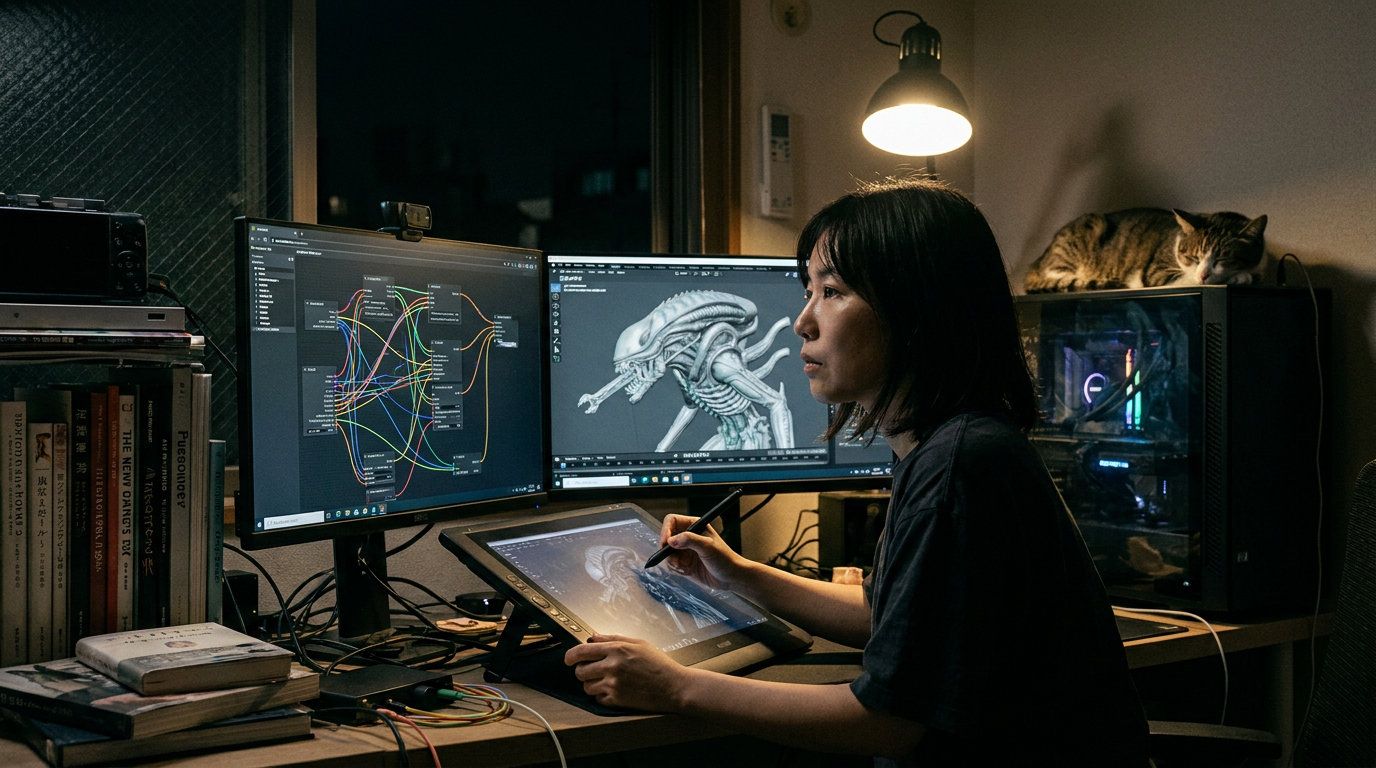
They are adopting "open-weight" AI models—powerful generative systems whose underlying trained parameters are freely available to download. By running these models locally on their own consumer hardware, creators are reclaiming absolute control over their intellectual property, eliminating recurring cloud costs, and customizing the technology to match their exact artistic visions.[8]
This industry-wide shift is largely driven by dramatic, rapid improvements in hardware optimization. Just two years ago, generating high-definition, temporally consistent video required datacenter-class graphics processing units (GPUs) that were entirely out of reach for the average freelancer.[8]

Today, highly optimized open-weight models like LTX-2.3 and Alibaba's Wan2.2 have been engineered to run efficiently on standard consumer graphics cards with as little as 12 gigabytes of Video RAM (VRAM). This breakthrough means that a five-year-old gaming PC or a modern Apple Silicon Mac can now serve as a self-contained, offline AI production studio.[3][5][7]
"The entire system is open," notes tech educator Tim Ruscica regarding the LTX-2 video model. "The weights are open, the training code is open, and it runs on-premise on your own hardware. If you're a solo creator with sensitive IP, nothing needs to leave your machine."[7]
At the heart of this thriving local ecosystem is ComfyUI, a node-based graphical interface that has become nearly ubiquitous among indie creators. Instead of typing a simple text prompt into a web browser and hoping for the best, ComfyUI allows artists to visually wire together complex pipelines of different AI models, image filters, and upscalers.[2]
This modular approach treats AI not as a magic button, but as a highly controllable post-production tool. During the recent Project Odyssey AI film competition, judges noted that nearly every entry utilized ComfyUI to apply consistent rendering effects across thousands of frames, seamlessly blending traditional video editing software with generative augmentation.[2]

This modular approach treats AI not as a magic button, but as a highly controllable post-production tool.
The capabilities of these local models have expanded far beyond static images. The open-source community has recently delivered robust text-to-video and audio generation tools that rival, and in some cases exceed, proprietary cloud services.[8]
Models like LTX-2.3 offer native 4K output with synchronized audio directly out of the box, while open text-to-speech architectures like Kokoro-82M and Resemble AI's Chatterbox allow developers to generate highly expressive, real-time voiceovers without paying per-character API fees.[2][5][6]
For commercial creators, the move to local AI is fundamentally about intellectual property risk management. When client work is uploaded to a cloud-based AI generator, it often enters a legal gray area regarding data privacy, confidentiality, and future model training.[4]
By keeping the inference process entirely on-device, creators ensure that unreleased product designs, sensitive corporate scripts, and proprietary character art remain strictly confidential. This air-gapped approach satisfies the stringent non-disclosure agreements required by major brands and traditional Hollywood studios.[4]

Furthermore, local execution simplifies the increasingly complex issue of copyright provenance. Intellectual property law in 2026 heavily emphasizes the "human-in-the-loop" requirement; patents and copyrights depend on proving that a human exercised meaningful, documented creative control over the final output.[4]
As IP advisory firm Lumenci highlights, the more autonomous a system is, the more fragile the resulting IP claim becomes. Local workflows inherently generate a digital paper trail of human contribution. Every node connection, parameter adjustment, and specific seed selection in a local pipeline serves as auditable evidence of human authorship.[4]
Beyond privacy and legal protection, local models offer a level of artistic customization that cloud APIs simply cannot match. Creators are utilizing Low-Rank Adaptations (LoRAs)—lightweight training files that teach an AI model a specific concept—to enforce strict visual consistency.[1]

Instead of relying on a generic model that mimics broad internet aesthetics, an indie studio can train a custom LoRA exclusively on their own concept art. This forces the AI to generate new frames that perfectly match the studio's unique, proprietary art style, ensuring brand consistency across an entire project.[1]
"It was very important for us to release this, so the community can fine-tune their own data," explained LTX co-founder Yaron Inger, emphasizing that these custom adapters allow creators to build a stable foundation for long-term projects without fearing that a vendor will suddenly alter their underlying model.[1]
While commercial cloud platforms will undoubtedly continue to serve enterprise clients who require massive, on-demand scale, the indie landscape has permanently shifted. By combining open-weight models, consumer hardware, and node-based workflows, independent creators have secured the means of production—ensuring that the future of digital art remains firmly in the hands of the artists.[8]
How we got here
Mid-2024
Cloud-based generative AI tools reach mainstream adoption, raising concerns over API costs and IP ownership.
Early 2025
Node-based interfaces like ComfyUI gain massive popularity, allowing creators to build custom local workflows.
Late 2025
Highly optimized open-weight models begin running efficiently on consumer-grade Apple Silicon and standard PC graphics cards.
Early 2026
LTX-2 and Wan2.2 launch, bringing synchronized audio and 4K video generation to local machines with just 12GB of VRAM.
June 2026
Local AI workflows become the standard for indie studios, driven by the need for strict data privacy and copyright provenance.
Viewpoints in depth
Indie Creators & Studios
Independent artists prioritize cost control, IP ownership, and the ability to fine-tune models to their specific aesthetic.
For solo developers and small studios, cloud-based AI subscriptions quickly become cost-prohibitive, especially when generating thousands of video frames. More importantly, uploading proprietary client assets to third-party servers violates many non-disclosure agreements. By running open-weight models locally, creators ensure their data remains air-gapped, allowing them to safely integrate AI into commercial pipelines while training custom adapters (LoRAs) that perfectly replicate their unique art styles.
Open-Source Developers
The technical community focuses on transparency, collaborative optimization, and democratizing access to frontier models.
Open-source advocates argue that black-box commercial models stifle genuine innovation. By releasing model weights publicly, developers allow the global community to optimize the code for consumer hardware—such as reducing VRAM requirements to 12GB. This collaborative ecosystem has rapidly produced specialized tools, from node-based interfaces like ComfyUI to highly efficient text-to-speech models, proving that decentralized development can match or exceed the capabilities of heavily funded corporate labs.
Commercial AI Providers
Enterprise platforms emphasize scalable infrastructure, guaranteed uptime, and out-of-the-box usability.
While acknowledging the appeal of local models for hobbyists and indie studios, commercial providers argue that enterprise clients require a different tier of service. Managing local hardware, updating dependencies, and troubleshooting node-based workflows is time-consuming. Cloud platforms offer SOC 2 compliance, massive parallel processing for rapid generation, and seamless API integration, arguing that for large organizations, the cost of a subscription is far lower than the cost of maintaining dedicated local AI infrastructure.
IP Legal Experts
Legal professionals focus on copyright provenance, data privacy, and the documentation of human authorship.
From a legal perspective, the shift to local AI solves several pressing intellectual property challenges. Courts and patent offices increasingly require proof of 'human-in-the-loop' contribution to grant copyright or patent protection. Cloud-based prompt generation often lacks this granular evidence. Local workflows, however, generate a detailed digital paper trail—specific seed numbers, node configurations, and parameter adjustments—that clearly demonstrates human intellectual control over the final output, making the resulting IP far more legally defensible.
What we don't know
- Whether future regulatory frameworks will require open-weight models to include mandatory watermarking or safety guardrails.
- How quickly consumer hardware manufacturers will increase base VRAM to natively support even larger, uncompressed local models.
- If major cloud AI providers will eventually lower their API costs enough to tempt indie creators back from local workflows.
Key terms
- Open-Weight Model
- An AI system where the underlying trained parameters are publicly available, allowing anyone to download and run the model offline.
- ComfyUI
- A popular, node-based graphical interface that allows creators to visually wire together complex, custom AI generation pipelines.
- LoRA (Low-Rank Adaptation)
- A lightweight training file that allows creators to teach an AI model a specific art style or character without retraining the entire massive system.
- VRAM (Video RAM)
- The dedicated memory on a graphics card, which dictates how large and complex of an AI model a computer can run locally.
- Inference
- The actual process of running live data or prompts through a trained AI model to generate an output, such as an image or video.
Frequently asked
Do I need an expensive computer to run local AI?
While high-end hardware helps, modern open-weight models are highly optimized. Many frontier video and image models now run on standard consumer graphics cards with as little as 12GB of VRAM, or on modern Apple Silicon Macs.
Is it legal to use open-source AI for commercial client work?
Yes, models like LTX-2.3 and Wan2.2 are released under permissive licenses (such as Apache 2.0) that explicitly allow for commercial use, provided users adhere to their specific terms.
How does local AI protect my intellectual property?
Because the processing happens entirely on your own machine, your proprietary files, client data, and custom training images are never uploaded to a third-party cloud server, ensuring strict confidentiality.
What is the difference between open-source and open-weight?
Open-source typically refers to the software code itself, while open-weight means the actual trained parameters of the neural network are available to download, allowing you to run the exact model offline.
Sources
Source coverage
8 outlets
4 viewpoints surfaced








[1]CNETIndie Creators & Studios
LTX is introducing new tools for creators to experiment with custom AI models
Read on CNET →[2]SaladOpen-Source Developers
The State of Generative AI in Indie Filmmaking
Read on Salad →[3]ModalOpen-Source Developers
Comparing the Best Open-Source Text-to-Video AI Models
Read on Modal →[4]LumenciIP Legal Experts
Redefining AI in IP: How It Affects Ownership and Inventorship in 2026
Read on Lumenci →[5]LTXOpen-Source Developers
LTX-2.3: The Open Source Video Generation Model
Read on LTX →[6]Resemble AICommercial AI Providers
Why Developers Prefer Open Source Voice Models
Read on Resemble AI →[7]Tech With TimIndie Creators & Studios
A new AI video generation model just dropped that is free, open source
Read on Tech With Tim →[8]Factlen Editorial TeamIP Legal Experts
Synthesis by Factlen editorial team
Read on Factlen Editorial Team →

More in ai
See all 6 stories →On-Device AI
How Local AI Works: The Tech Letting You Run Language Models on Your Laptop
7 sources

Content Provenance
How Content Credentials and Invisible Watermarks Are Solving the AI Deepfake Problem
7 sources

AI Copyright Law
The Evidence Weighing on NYT v. OpenAI: Does 'Regurgitation' Defeat AI Fair Use?
7 sources

Medical AI
Generative AI Matches Human Experts in Complex Medical Data Analysis, Accelerating Research
7 sources

Every angle. Every day.
Get ai stories with full source coverage and perspective breakdowns delivered to your inbox.