
How Biophilic Design is Rewiring Cities for Mental Health and Climate Resilience
Architects are moving beyond concrete and steel to integrate living ecosystems into urban buildings, a shift that drastically lowers urban temperatures and measurably improves human cognitive health.
By Factlen Editorial Team
- Architects & Urban Planners
- Focus on integrating living systems into the built environment to solve climate, aesthetic, and spatial challenges.
- Public Health Researchers
- Emphasize the measurable cognitive and physiological benefits, such as lowered cortisol and faster hospital recovery times.
- Real Estate Developers
- Prioritize the economic incentives, including energy savings, stormwater management cost reductions, and increased property values.
- Environmental Ecologists
- Advocate for biodiversity restoration, urban heat island mitigation, and creating habitats for non-human species within cities.
What's not represented
- · Low-income urban residents facing green gentrification
- · Building maintenance and facilities management workers
Why this matters
As global populations increasingly migrate to dense urban centers, the psychological and thermal toll of concrete environments is escalating. Integrating living systems into architecture offers a scalable, scientifically backed solution to reduce urban heat, lower energy costs, and actively improve the mental health of city dwellers.
Key points
- Biophilic design integrates natural elements like light, water, and vegetation directly into a building's architecture.
- Exposure to nature-mimicking environments lowers cortisol levels and accelerates stress recovery.
- Green roofs and living walls combat the Urban Heat Island effect by insulating buildings and cooling the air.
- Biophilic infrastructure can reduce a building's heating and cooling costs by up to 50 percent.
- Street-level integrations like bioswales naturally filter rainwater, saving cities millions in stormwater management.
- New technologies are enabling 'indoor ecosystems' and AI-driven lighting to simulate nature in tight urban spaces.
The modern city is a marvel of engineering, but it is often a biological desert. With nearly 68 percent of the global population projected to live in urban areas by 2050, the psychological and physiological toll of concrete, steel, and glass is becoming impossible to ignore. In response, a quiet revolution is reshaping the skylines of major metropolises. It is called biophilic design, and it is transforming buildings from inert shelters into living, breathing ecosystems.[1][4]
The term biophilia, popularized by Harvard biologist E.O. Wilson in the 1980s, translates to love of life and posits that humans possess an innate, evolutionary drive to connect with nature. In architecture, biophilic design translates this biological need into a structural framework. It moves far beyond the superficial placement of potted plants in a lobby. Instead, it involves the deep integration of natural light, organic textures, flowing water, and living vegetation into the very DNA of a building.[1][5]
The most immediate impact of this architectural shift is on human neurobiology. For decades, environmental psychologists have studied how sterile environments spike cortisol levels and induce mental fatigue. Conversely, environments that mimic natural settings trigger a parasympathetic nervous system response, lowering heart rates and reducing anxiety. A 2025 study published by the National Institutes of Health tested multiple biophilic spaces and found that high-quality natural integrations not only accelerated stress recovery but actively stimulated cognitive inspiration.[2]

These neurological benefits translate into measurable outcomes across various sectors. In healthcare, hospitals incorporating biophilic elements, such as natural light and views of greenery, report faster patient recovery times, reduced reliance on pain medication, and lower staff burnout. In the corporate sector, the financial incentives are equally stark. Workplaces designed with abundant daylight and natural materials see up to a 15 percent reduction in employee absenteeism and a marked increase in creative problem-solving.[3][6]
To quantify these benefits, cutting-edge projects are now treating human health as a measurable performance metric. The Spine, a landmark building in Liverpool designed by AHR Architects, is currently establishing a global benchmark for biophilic workplaces by continuously monitoring occupant health and cognitive function. By tracking air quality, circadian lighting impacts, and stress levels, the project aims to prove that human-centric design is not an aesthetic luxury, but a biological necessity.[1][5]
Beyond human health, biophilic design is emerging as a critical tool for climate resilience, specifically in combating the Urban Heat Island effect. Cities, dominated by asphalt and concrete, absorb and trap solar radiation, making them significantly hotter than surrounding rural areas. Living infrastructure, such as green roofs and vine-covered facades, acts as a natural thermal shield. The vegetation prevents solar radiation from baking the building's exterior while actively cooling the surrounding air through a process called evapotranspiration.[7]

Beyond human health, biophilic design is emerging as a critical tool for climate resilience, specifically in combating the Urban Heat Island effect.
This ambient cooling effect drastically reduces a building's reliance on artificial climate control. Studies indicate that integrating green roofs and walls can lower heating and cooling costs by 20 to 50 percent. Furthermore, this natural cooling can enhance other green technologies. For instance, at the 145 Baltimore Avenue project in Asheville, North Carolina, a large-scale green roof lowers the ambient air temperature around rooftop solar panels, allowing them to operate closer to their optimal thermal range and generate more electricity.[1][6]
The environmental benefits extend downward to the street level, where biophilic urbanism tackles the escalating threat of urban flooding. Traditional grey infrastructure, like concrete gutters and storm drains, is frequently overwhelmed by the extreme weather events associated with climate change. Biophilic alternatives, such as bioswales, rain gardens, and permeable pavements, absorb and filter rainwater naturally. These systems not only reduce the burden on municipal sewers but can also cut stormwater infrastructure costs by 10 to 30 percent.[4][6]

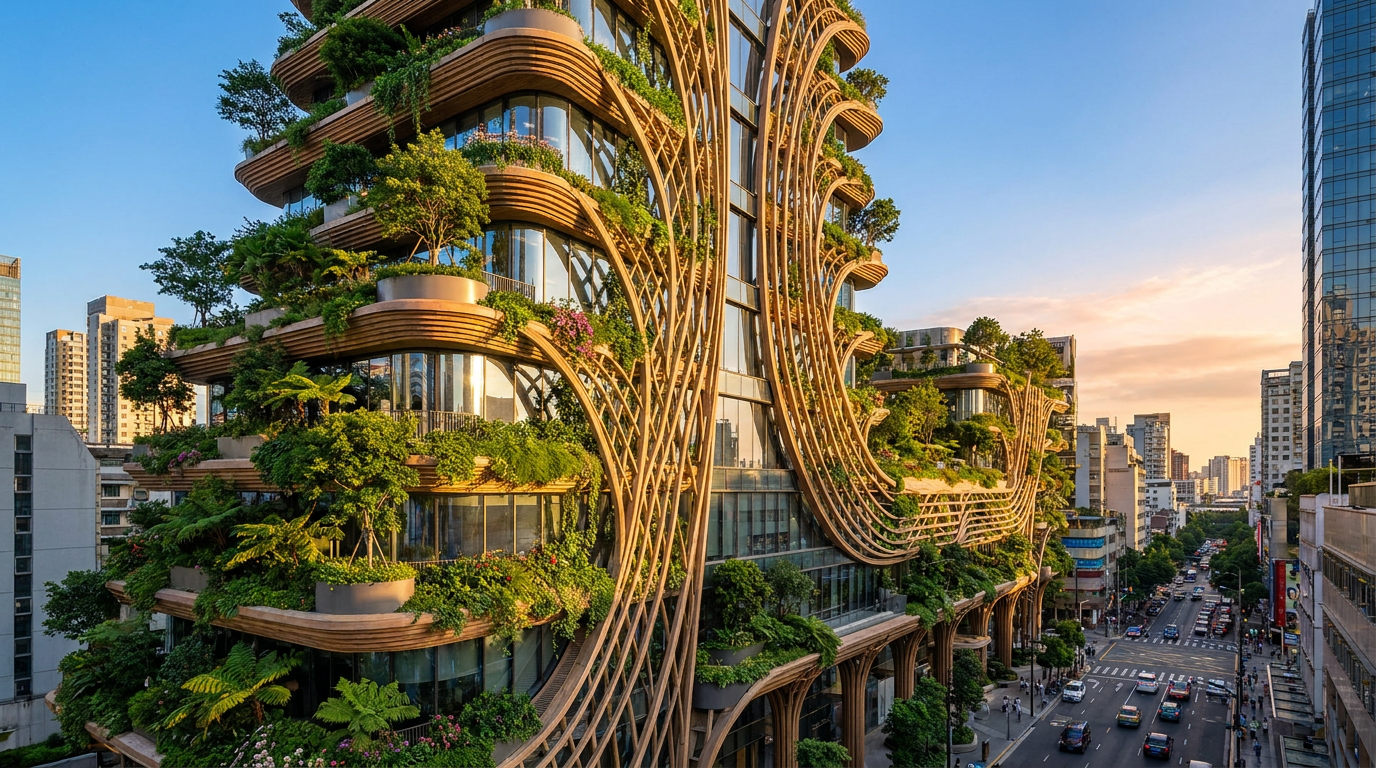
The global poster child for this movement remains the Bosco Verticale, or Vertical Forest, in Milan. Designed by Stefano Boeri Architetti, the twin residential towers host over 800 trees and 20,000 plants across their balconies. This suspended forest absorbs carbon dioxide, filters urban dust, produces oxygen, and creates a microclimate that insulates the apartments. Similarly, the Vibes Office in Ho Chi Minh City utilizes a bamboo sunshade skin to reduce thermal radiation, proving that biophilic principles can be adapted to diverse climates and local materials.[1][6]
Despite the clear benefits, the widespread adoption of biophilic design faces structural and economic hurdles. Retrofitting existing buildings to support the immense weight of wet soil and mature trees requires significant engineering and capital. Furthermore, as the trend accelerates, experts warn of greenwashing, where developers attach superficial greenery to fundamentally unsustainable buildings to secure premium real estate pricing, without integrating the deeper principles of natural ventilation or sustainable materials.[5][7]
As the discipline matures in 2026, architects are exploring the intersection of biology and advanced technology. When physical greenery is impossible due to space or structural constraints, designers are turning to technological nature. This involves sensor-rich, AI-driven systems that simulate natural rhythms, such as dynamic lighting that shifts color temperature to match the circadian cycle, or acoustic landscapes that mask urban noise with the frequencies of flowing water.[5]

In smaller urban spaces, the trend is shifting away from isolated potted plants toward self-sustaining indoor ecosystems. Micro-zone vertical forests and compact hydroponic systems are being integrated directly into apartment walls and office partitions. These closed-loop systems bring the textures, sounds, and air-purifying qualities of nature into dense urban environments without requiring extensive floor space or complex plumbing.[1]
Ultimately, biophilic design represents a profound shift in how humanity conceives of its habitat. It rejects the industrial-era notion that a building is a machine for living, separated from the natural world by a hermetic seal. By weaving the biological processes that sustained our ancestors into the fabric of our modern cities, architects are proving that the built environment can heal both the people who inhabit it and the planet it stands upon.[1][4]
How we got here
1984
Biologist E.O. Wilson publishes 'Biophilia', popularizing the hypothesis that humans have an innate affinity for the natural world.
2014
The Bosco Verticale (Vertical Forest) is completed in Milan, becoming a global benchmark for integrating mature trees into high-rise architecture.
2021
The Vibes Office opens in Vietnam, demonstrating how biophilic principles like bamboo sunshades can drastically reduce thermal radiation.
2025
The National Institutes of Health publishes data confirming that high-quality biophilic spaces actively stimulate cognitive inspiration and stress recovery.
Viewpoints in depth
Architects & Urban Planners
Viewing biophilic design as a structural imperative rather than an aesthetic choice.
For the architectural community, biophilic design represents a paradigm shift away from the industrial-era concept of buildings as hermetically sealed machines. Planners argue that as urban density increases, integrating living systems is the only viable way to manage spatial constraints while delivering necessary public health benefits. They emphasize that true biophilic architecture requires holistic engineering—such as orienting buildings for maximum natural light and utilizing cross-ventilation—rather than simply attaching greenery to conventional structures.
Public Health Researchers
Focusing on the measurable neurological and physiological outcomes of nature exposure.
Medical and psychological researchers view the built environment as a critical determinant of public health. They point to decades of data showing that sterile, concrete-heavy environments elevate cortisol levels and induce mental fatigue. By contrast, biophilic spaces trigger parasympathetic nervous system responses. Researchers advocate for biophilic design as a non-pharmacological intervention, citing evidence that patients in nature-integrated hospitals recover faster and require less pain medication, while office workers experience significantly lower rates of burnout.
Real Estate Developers
Evaluating the long-term financial return on investment of green infrastructure.
While developers acknowledge the higher upfront capital required for structural reinforcement and complex irrigation systems, they increasingly view biophilic design as a sound financial strategy. Green roofs and living walls act as natural insulation, slashing long-term heating and cooling costs by up to 50 percent. Furthermore, commercial properties with biophilic features command premium lease rates and experience lower tenant turnover, driven by corporate desires to boost employee productivity and reduce absenteeism.
What we don't know
- The long-term structural impact of mature tree root systems and constant moisture on high-rise facades over a 50-year lifespan.
- How to effectively scale biophilic design in low-income housing developments without triggering 'green gentrification' that displaces residents.
- The precise threshold at which 'technological nature' (like digital skylights) fails to provide the same neurological benefits as actual biological nature.
Key terms
- Biophilia
- The hypothesis that humans possess an innate, evolutionary drive to seek connections with nature and other forms of life.
- Evapotranspiration
- The process by which water is transferred from the land to the atmosphere by evaporation from the soil and by transpiration from plants, creating a natural cooling effect.
- Urban Heat Island Effect
- A phenomenon where urban areas experience significantly higher temperatures than surrounding rural areas due to human activities and heat-absorbing infrastructure like concrete and asphalt.
- Bioswale
- A landscaped drainage course designed to remove silt and pollution from surface runoff water, naturally managing stormwater surges.
- Circadian Lighting
- Artificial lighting systems designed to mimic the natural progression of daylight, supporting the human body's internal biological clock.
Frequently asked
What is the difference between biophilic design and having houseplants?
Houseplants are a superficial addition to a space, whereas biophilic design integrates natural elements—like daylighting, organic materials, and living walls—into the fundamental architecture and engineering of the building.
How does biophilic design cool a building?
Living infrastructure like green roofs provides a layer of thermal insulation that blocks solar radiation. Additionally, plants release water vapor into the air through evapotranspiration, which actively cools the surrounding microclimate.
Is biophilic design more expensive to build?
Initial construction costs can be higher due to the structural engineering required to support soil and water. However, these costs are often offset long-term by 20 to 50 percent reductions in heating and cooling expenses.
Can biophilic design be applied to existing buildings?
Yes, through retrofitting. While adding a massive green roof might require structural reinforcement, existing buildings can integrate indoor living walls, bioswales in courtyards, and circadian lighting systems.
Sources
Source coverage
7 outlets
4 viewpoints surfaced







[1]Factlen Editorial TeamArchitects & Urban Planners
Synthesis by Factlen editorial team
Read on Factlen Editorial Team →[2]National Institutes of HealthPublic Health Researchers
Biophilic designs and their impact on psychological health and inspiration
Read on National Institutes of Health →[3]Global Wellness InstitutePublic Health Researchers
Biophilic Design in Architecture and Its Contributions to Health and Wellbeing
Read on Global Wellness Institute →[4]United NationsEnvironmental Ecologists
Sustainable Cities and Communities: The 2050 Urbanization Challenge
Read on United Nations →[5]Metropolis MagazineArchitects & Urban Planners
The Science of Stress: Fractals, Neuroaesthetics, and Biophilic Design
Read on Metropolis Magazine →[6]Future of CitiesReal Estate Developers
The Financial Benefits of Biophilic Urbanism and Real Estate Integration
Read on Future of Cities →[7]ResearchGateEnvironmental Ecologists
Biophilic Design: Pinpointing Nature-Based Techniques in Urban Areas to Combat Global Warming
Read on ResearchGate →

Every angle. Every day.
Get culture stories with full source coverage and perspective breakdowns delivered to your inbox.