
Fresh Dog Food vs. Kibble: Weighing the Costs, Convenience, and Canine Health Benefits
As fresh, gently cooked dog food surges in popularity, pet owners are weighing its high digestibility and whole-food ingredients against the unmatched affordability and convenience of traditional dry kibble.
By Factlen Editorial Team
- Veterinary Consensus
- Focus on AAFCO compliance, safety from pathogens, and evidence-based dietary management.
- Fresh Food Advocates
- Prioritize whole-food ingredients, minimal processing, and maximum nutrient bioavailability.
- Pragmatic Pet Owners
- Balance nutritional adequacy with budget, convenience, and shelf stability.
What's not represented
- · Large-breed rescue organizations managing tight food budgets
- · Sustainable packaging advocates concerned by fresh food shipping materials
Why this matters
Dog owners are spending hundreds of dollars a month on premium pet food subscriptions. Understanding the objective trade-offs between fresh diets and traditional kibble helps households balance their budget with their pet's specific health needs without falling for marketing hype.
Key points
- Fresh dog food is gently cooked, retaining up to 40% more digestibility and natural moisture than dry alternatives.
- Kibble is highly processed via extrusion but remains the most affordable and convenient option for complete nutrition.
- Feeding a medium dog a fresh diet costs $100 to $350 monthly, compared to $30 to $120 for premium kibble.
- Veterinarians confirm both formats can meet AAFCO standards and support a healthy canine lifespan.
- Mixing fresh food as a topper over kibble is a popular compromise for budget-conscious households.
The pet food aisle has undergone a radical transformation over the past decade. Driven by the humanization of pets, owners are increasingly scrutinizing ingredient labels and questioning the heavily processed nature of traditional dry diets. This shift has fueled an explosion in the fresh dog food market, promising human-grade ingredients delivered straight to the door. But with fresh subscriptions costing significantly more than a bag of dry food, pet parents are left weighing the ultimate trade-off: is the nutritional upgrade worth the premium price, or does traditional kibble still hold its ground?[1][7]
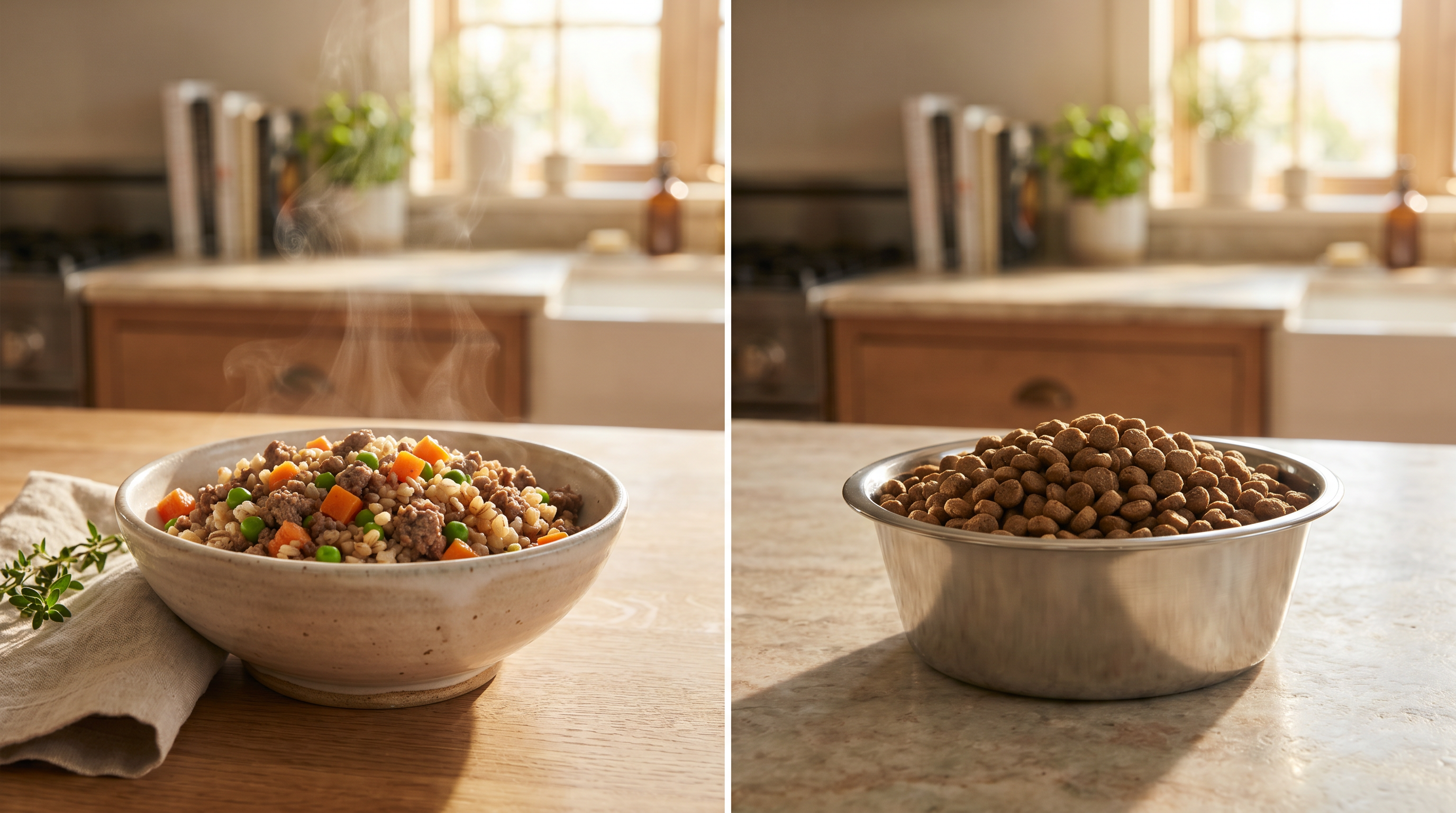
To understand the comparison, it is essential to define the contenders. Fresh dog food is crafted from whole, recognizable ingredients—such as lean meats, visible vegetables, and whole grains—that are gently cooked at low temperatures. This minimal processing is designed to kill harmful pathogens while preserving the natural integrity of the nutrients. The resulting meals boast a moisture content of 70 to 75 percent and are typically shipped frozen, requiring refrigeration and careful portioning before serving.[2][6]
The primary argument for fresh food centers on bioavailability and digestion. Because the ingredients avoid extreme heat, the natural vitamins, minerals, and amino acids remain highly intact. Clinical studies have demonstrated that gently cooked fresh diets can be up to 40 percent more digestible than dry alternatives, meaning dogs absorb more nutrients and produce less waste. Furthermore, the high moisture content naturally supports hydration, while the rich aromas make fresh food exceptionally palatable—a crucial advantage for senior dogs, picky eaters, or pets recovering from illness.[2][4]

However, the case against fresh food is anchored in economics and logistics. The financial commitment is substantial; feeding a medium-sized dog a fully fresh diet typically costs between $100 and $350 per month. Beyond the price tag, fresh food demands dedicated freezer space and strict adherence to food safety protocols. Because it lacks artificial preservatives, a thawed package only lasts five to seven days in the refrigerator. For busy households or owners who frequently travel with their pets, the perishability of fresh food presents a genuine logistical hurdle.[5][6]
On the other side of the spectrum sits traditional kibble, the undisputed king of convenience. Kibble is manufactured through extrusion, a process where a dough of meats, grains, and vegetables is subjected to extreme heat—often between 250 and 400 degrees Fahrenheit—and high pressure. This method creates dry, crunchy pellets that are remarkably shelf-stable. To compensate for the nutrients degraded during the high-heat cooking process, manufacturers fortify the mixture with comprehensive vitamin and mineral premixes to ensure the final product meets strict regulatory standards.[4][6]
On the other side of the spectrum sits traditional kibble, the undisputed king of convenience.
The strongest evidence for kibble lies in its unmatched practicality and affordability. A premium kibble diet for a medium dog generally runs between $30 and $120 per month, a fraction of the cost of fresh delivery. It requires no refrigeration, can be bought in bulk, and safely sits in a bowl all day without spoiling. For multi-pet households, large breeds with massive caloric needs, or owners on a strict budget, kibble provides a reliable, cost-effective way to deliver complete nutrition without upending the household budget.[5][7]

The arguments against kibble focus on its heavy processing and low moisture content, which hovers around 8 to 10 percent. The extrusion process inherently requires a significant carbohydrate load—often starches—to bind the pellets together, which some advocates argue is biologically unnecessary for canines. Additionally, the dry nature of the food means dogs must consume more standing water to stay hydrated, and the reliance on synthetic nutrient fortification is viewed by some holistic practitioners as inferior to naturally occurring vitamins.[4][6]
When evaluating these trade-offs, the veterinary consensus offers a grounding perspective. Board-certified veterinary nutritionists emphasize that both fresh food and high-quality kibble can meet the Association of American Feed Control Officials (AAFCO) standards for complete and balanced nutrition. Veterinarians frequently prescribe fresh diets for dogs with specific medical conditions, such as inflammatory bowel disease or food allergies, where novel proteins and high digestibility are paramount. Yet, they also stress that healthy adult dogs can thrive perfectly well on a properly formulated dry diet.[1][3]

For owners caught between the desire for fresh nutrition and the reality of their budget, a hybrid strategy has emerged as a highly effective middle ground. By utilizing a high-quality kibble as the caloric base and adding a spoonful of fresh food as a topper, dogs receive the benefits of increased moisture, varied textures, and whole-food nutrients. This mixed approach significantly reduces the monthly cost while still elevating the dog's daily mealtime experience.[5][7]
Ultimately, choosing the right format requires matching the diet to the specific circumstances of the household. Fresh dog food fits well when the budget comfortably allows for it, when a dog suffers from digestive sensitivities or chronic illness, or when palatability is a daily struggle. Conversely, traditional kibble fits well when economic efficiency is a priority, for households managing large or multiple dogs, and for owners who require the flexibility of shelf-stable, travel-friendly meals.[2][7]
How we got here
Pre-2010s
Commercial dog food is overwhelmingly dominated by extruded dry kibble and canned wet food.
Mid-2010s
Direct-to-consumer fresh pet food companies launch, offering human-grade, gently cooked meals via subscription.
2021
Fresh pet food sales surge by 86% as pet humanization trends accelerate during the pandemic.
2026
Veterinary consensus solidifies around fresh food as a highly digestible alternative, while maintaining that premium kibble remains nutritionally adequate.
Viewpoints in depth
Fresh Food Advocates
Argue that minimal processing and whole ingredients lead to superior long-term health outcomes.
Proponents of fresh diets emphasize that canine biology benefits from moisture-rich, minimally processed foods. They point to studies showing up to 40 percent higher digestibility and better retention of heat-sensitive vitamins compared to extruded kibble. For this camp, the upfront financial cost is an investment that pays dividends in shinier coats, improved digestion, higher energy levels, and potentially lower veterinary bills over the dog's lifespan.
Veterinary Nutritionists
Focus on objective nutritional adequacy and safety rather than marketing terminology.
Board-certified veterinary nutritionists maintain a pragmatic stance: a diet's formulation matters more than its format. They acknowledge that fresh food is highly palatable and excellent for dogs with specific medical conditions like inflammatory bowel disease or cancer cachexia. However, they caution against the assumption that kibble is inherently 'bad.' As long as a diet meets AAFCO standards and undergoes rigorous feeding trials, veterinarians confirm that both fresh and dry options can support a long, healthy life.
Pragmatic Pet Owners
Balance the desire for premium nutrition with the realities of budget and convenience.
For many households, the logistical and financial demands of a 100 percent fresh diet are simply unsustainable. Spending upwards of $300 a month on dog food, coupled with the need for dedicated freezer space and strict expiration dates, presents a significant barrier. This camp often adopts a hybrid approach—relying on high-quality kibble for a caloric baseline and affordability, while supplementing with fresh food toppers to enhance flavor and hydration.
What we don't know
- Whether feeding a lifelong fresh diet definitively extends canine life expectancy compared to a lifelong premium kibble diet.
- How the environmental footprint of shipping frozen fresh food compares long-term to the mass production of dry kibble.
Key terms
- Extrusion
- A high-heat, high-pressure manufacturing process used to cook and shape dry kibble, which can degrade some heat-sensitive nutrients.
- AAFCO
- The Association of American Feed Control Officials, an organization that sets the nutritional standards for complete and balanced pet foods.
- Bioavailability
- The degree and rate at which nutrients from food are absorbed and utilized by the dog's body.
- Cachexia
- Muscle wasting and severe weight loss often seen in dogs with chronic illnesses like cancer, which can sometimes be countered with highly palatable fresh diets.
Frequently asked
Is fresh dog food safer than raw dog food?
Yes. Fresh food is gently cooked to kill dangerous pathogens like Salmonella and E. coli, offering the benefits of whole ingredients without the foodborne illness risks associated with raw diets.
Can I mix fresh food and kibble?
Absolutely. Many owners use fresh food as a topper over a kibble base, which provides a boost in moisture and palatability while keeping monthly costs manageable.
Does kibble clean a dog's teeth better than fresh food?
While kibble's crunchy texture may offer minor tartar reduction compared to soft foods, veterinarians note that neither diet replaces the need for regular canine dental care and toothbrushing.
Do fresh diets meet veterinary standards?
High-quality fresh diets are formulated by board-certified veterinary nutritionists to meet or exceed AAFCO standards for complete and balanced nutrition.
Sources
Source coverage
7 outlets
3 viewpoints surfaced







[1]NBC NewsVeterinary Consensus
Best fresh dog food delivery services of 2025, according to vets
Read on NBC News →[2]PetMDVeterinary Consensus
Is Fresh Dog Food Better Than Kibble?
Read on PetMD →[3]Tufts Clinical Nutrition ServiceVeterinary Consensus
Petfoodology: Finding the Best Food for Your Pet
Read on Tufts Clinical Nutrition Service →[4]The Honest KitchenFresh Food Advocates
Fresh Dog Food vs. Dry Dog Food: Which is Better?
Read on The Honest Kitchen →[5]PawFavPragmatic Pet Owners
Kibble vs Wet vs Raw vs Fresh: Every Dog Food Type Compared
Read on PawFav →[6]Spot & TangoFresh Food Advocates
Fresh Dog Food vs. Kibble: Which Is Better?
Read on Spot & Tango →[7]Factlen Editorial TeamPragmatic Pet Owners
Synthesis by Factlen editorial team
Read on Factlen Editorial Team →

More in shopping
See all 50 stories →E-Bike Tech
The 2026 E-Bike Buying Guide: Motors, Batteries, and the New Safety Rules
8 sources

Audio Tech
Solid-State MEMS Speakers Are Replacing Traditional Headphone Drivers
7 sources

Nursery Tech
Smart Bassinets vs. Traditional Sleepers: The Complete Trade-Off Analysis
8 sources

Kitchen Upgrades
Induction vs. Gas Cooktops: The 2026 Trade-Off Analysis
8 sources

Every angle. Every day.
Get shopping stories with full source coverage and perspective breakdowns delivered to your inbox.