
US Prepares to Deport Iranian Asylum-Seekers to Central African Republic Under New Deal
The Trump administration is preparing to deport a group of Iranian asylum-seekers and other migrants to the Central African Republic under a newly established third-country agreement.
By Factlen Editorial Team
- Immigration Advocates
- Deporting asylum-seekers to unstable nations circumvents humanitarian protections and endangers vulnerable people.
- US Administration
- Third-country agreements are a lawful, necessary tool to enforce immigration policy when direct repatriation is impossible.
- International Observers
- The policy reflects the broader complexities of the ongoing US-Iran conflict and the expansion of transactional diplomacy.
What's not represented
- · Central African Republic government officials
- · Citizens of Bangui receiving the migrants
Why this matters
This unprecedented policy shift allows the US to deport vulnerable migrants—who legally cannot be returned to their home countries—to third-party nations. It sets a major legal and humanitarian precedent for how the government handles asylum-seekers and individuals fleeing persecution.
Key points
- The US is preparing to deport roughly 20 migrants, including Iranians, Syrians, and Afghans, to the Central African Republic.
- Two Iranian women on the flight previously secured 'withholding of removal' to avoid persecution in Iran.
- The CAR agreement is part of a broader US strategy utilizing third-country deportation deals across Africa.
- Human rights advocates argue the policy endangers vulnerable asylum-seekers by sending them to unstable conflict zones.
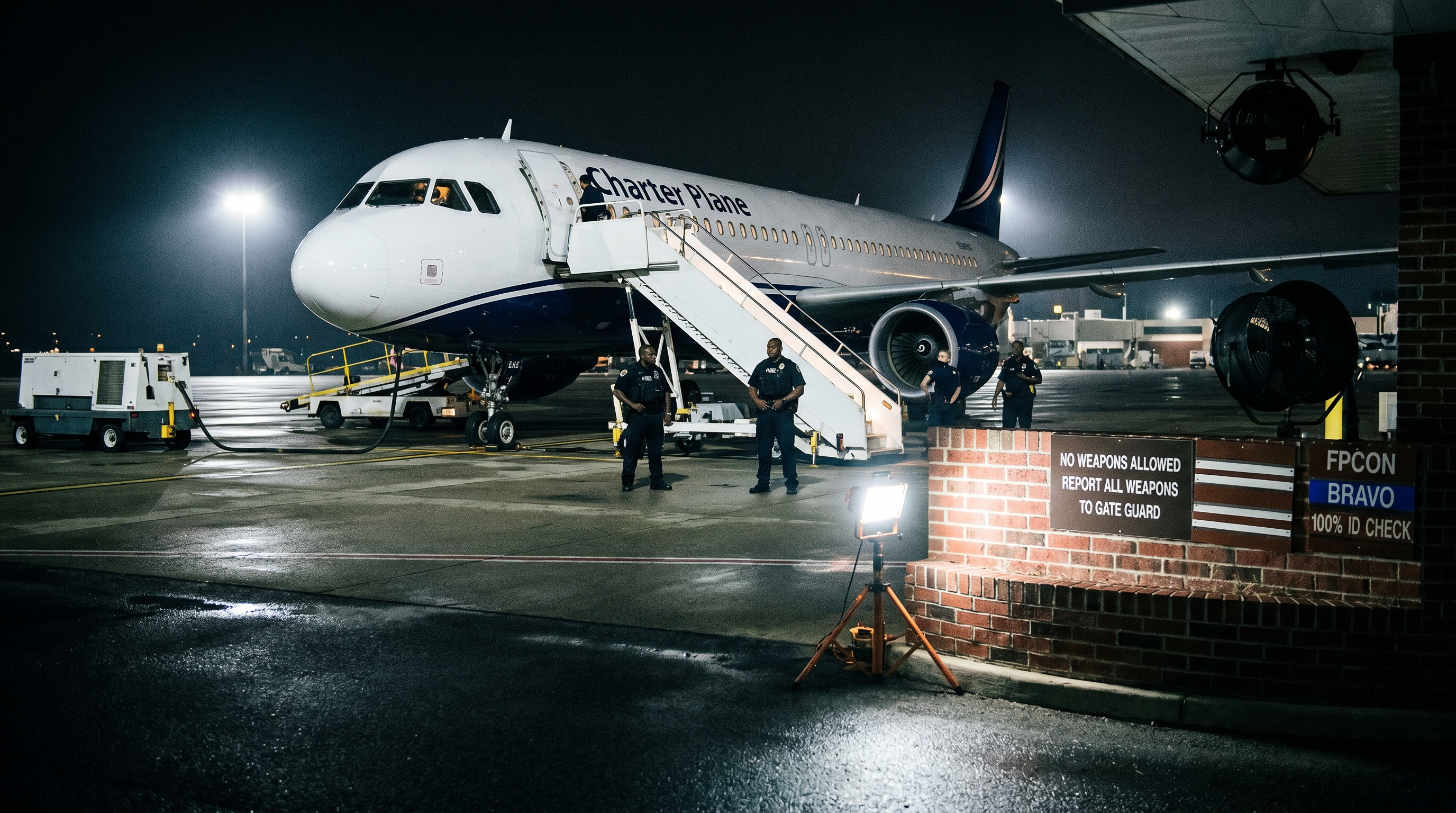
The Trump administration is preparing to deport a group of Iranian asylum-seekers and other migrants to the Central African Republic (CAR) under a newly established third-country agreement. The move represents a significant escalation in the government's strategy to remove migrants who have been ordered deported but cannot legally be repatriated to their native countries. The deportation deal was reportedly finalized in May during a US delegation visit to Bangui, the capital of the CAR. Under the arrangement, the African nation has agreed to accept so-called third-country deportees from the United States, establishing a new pipeline for individuals caught in diplomatic and legal limbo. The first flight under this new framework is expected to depart as early as Thursday, carrying a diverse group of individuals facing removal.[1][2]
That initial flight is slated to carry approximately 20 people. Alongside the Iranian nationals, the passenger list reportedly includes migrants from Syria and Afghanistan, as well as a Turkish national who fled political persecution. The inclusion of migrants from multiple conflict zones highlights the broad application of the third-country policy, which is not limited to a single nationality but rather targets individuals whose direct repatriation is blocked by legal or diplomatic hurdles. The inclusion of two Iranian women on the flight manifest has drawn intense legal and humanitarian scrutiny, bringing the stakes of the policy into sharp relief. Both women arrived in the United States in November 2024 and were subsequently detained by immigration authorities.[1][2][5]
During their legal proceedings, the two women applied for asylum and a US immigration judge granted them "withholding of removal." This is a specific and high-bar legal protection issued only when a judge determines there is a greater than 50 percent chance an individual will face torture or persecution if returned to their home country. According to their attorney, Emily Trostle, returning the women to Iran would put their lives in immediate and severe danger. One of the women is a baptized Christian convert, while the other is a pro-democracy activist—both profiles that are heavily targeted by Iranian state security. Because US law explicitly prohibits deporting them back to Iran under these circumstances, the administration is utilizing the CAR agreement to remove them from American soil.[1][2][4][6]

By sending them to a third country, the government avoids technically violating the international non-refoulement principle, which forbids returning refugees to a place where they face severe threats. However, the destination itself has raised profound concerns among human rights observers and legal advocates. The Central African Republic is a chronically unstable nation that has been racked by sectarian violence, armed rebellions, and deep poverty since gaining independence from France in 1960. The country has struggled to maintain basic security outside its capital, making it a highly precarious environment for vulnerable migrants who do not speak the local languages and have no community ties. Sending political dissidents and religious minorities to a nation grappling with its own internal conflicts has sparked outrage among immigration defenders.[1][2][3]
However, the destination itself has raised profound concerns among human rights observers and legal advocates.
Upon arrival, the deportees are not expected to be immediately repatriated to their home countries or left entirely to their own devices on the streets. Instead, officials briefed on the matter indicate they will initially be held in apartments in Bangui. Ultimately, the agreement could see hundreds of migrants relocated to the country over the coming months. To manage the influx, the International Organization for Migration has reportedly been allocated an $85 million fund to offer post-arrival assistance to migrants landing in the CAR. Despite this funding, the long-term legal status, employment rights, and integration prospects for these individuals remain highly uncertain, leaving them in a precarious state of permanent displacement.[3][4]
The Department of Homeland Security has defended the practice, stating last week that all deportees receive full due process before being placed on a flight. The administration views these third-country agreements as a lawful and necessary mechanism to enforce immigration orders. From the government's perspective, when individuals are ordered removed but diplomatic ties are severed or direct flights are impossible, third-country deals provide the only viable alternative to indefinite detention or releasing the individuals into the US interior. The CAR agreement is not an isolated policy, but rather part of a growing network of transactional deportation deals across the African continent.[2][4]

The US has previously reached similar agreements with nations including Eswatini, Ghana, Sierra Leone, and the Democratic Republic of the Congo. The DRC deal has drawn particular criticism, as the country is currently battling an Ebola outbreak alongside ongoing armed conflict in its eastern provinces. These arrangements typically involve the US providing financial, logistical, or security support to the host nations in exchange for their willingness to absorb the deportees. Immigration defense lawyers and human rights organizations have strongly condemned the deals, describing the agreements as opaque and fundamentally dangerous. Advocates argue that transferring vulnerable dissidents to active conflict zones effectively circumvents the spirit of asylum protections.[1][4]
They contend that while the US may be adhering to the strict letter of the law by not returning migrants to their persecutors, stranding them in impoverished and violent environments is a dereliction of the country's humanitarian obligations. The deportations are unfolding against a highly volatile geopolitical backdrop that has severely limited the administration's options. A three-month-old war between the US, Israel, and Iran has made any direct diplomatic coordination regarding Iranian nationals impossible. With the conflict escalating, the administration's reliance on third-party nations to handle its deportation caseload has accelerated. As the first flight prepares for departure, legal challenges are expected to mount, testing the boundaries of how the US manages asylum-seekers it refuses to keep but legally cannot send home.[2][3][4]

How we got here
November 2024
Two Iranian women arrive in the US and are detained, later securing 'withholding of removal' status from an immigration judge.
May 2026
A US delegation visits Bangui to finalize a third-country deportation agreement with the Central African Republic.
June 2026
Reports emerge that the Trump administration is preparing the first deportation flight to the CAR, carrying roughly 20 migrants.
Viewpoints in depth
The Administration's View
Third-country agreements are a lawful tool to enforce immigration policy when direct repatriation is impossible.
Federal authorities argue that third-country deportation deals are a necessary and legally sound mechanism for managing migrants who have been ordered removed but cannot be sent back to their native countries. Because individuals with 'withholding of removal' status cannot be deported to nations where they face torture, the administration has sought alternative destinations willing to accept them, often in exchange for financial or logistical support. The Department of Homeland Security maintains that all individuals subject to these transfers receive full due process under US law.
Immigration Advocates' View
Deporting asylum-seekers to unstable nations circumvents humanitarian protections and endangers vulnerable people.
Human rights organizations and immigration attorneys view the CAR agreement as a dangerous loophole that violates the spirit of international asylum norms. Advocates point out that the Central African Republic is a chronically unstable country grappling with poverty and sectarian violence, making it an unsafe destination for anyone, let alone targeted dissidents. Lawyers representing the Iranian women emphasize that their clients—a Christian convert and a pro-democracy activist—already proved to a US judge that they face a high likelihood of persecution, and argue that stranding them in a conflict zone is a dereliction of the United States' humanitarian obligations.
Geopolitical Context
The policy reflects the broader complexities of the ongoing US-Iran conflict and the expansion of transactional diplomacy.
Beyond the immediate immigration debate, the deportations highlight the severe diplomatic fallout of the ongoing three-month war between the US, Israel, and Iran. With direct flights and diplomatic channels severed, the US has increasingly relied on transactional agreements with African nations—including the Democratic Republic of the Congo, Eswatini, and Ghana—to absorb deportees. Observers note that these deals often involve opaque financial incentives and raise questions about the long-term legal status and integration prospects of the migrants once they arrive in the host countries.
What we don't know
- It remains unclear what specific legal status or employment rights the deportees will hold once they arrive in the Central African Republic.
- The exact financial or logistical incentives provided by the US to the CAR government to secure the agreement have not been fully disclosed.
- It is unknown how pending legal challenges from immigration defense attorneys might delay or alter the scheduled flights.
Key terms
- Withholding of Removal
- A special legal protection granted by a US immigration judge that prevents the government from deporting a person to a country where their life or freedom would be threatened, requiring a greater than 50% probability of persecution.
- Third-Country Deportation Deal
- An agreement where a country agrees to accept deported migrants from the US who are not citizens of that accepting country, often in exchange for financial or logistical support.
- Non-refoulement
- A fundamental principle of international law that forbids a country receiving asylum seekers from returning them to a country in which they would be in likely danger of persecution.
Frequently asked
Why is the US deporting people to the Central African Republic?
The US has struck a 'third-country' agreement with the CAR to take in migrants who have been ordered removed but cannot legally be sent back to their home countries due to the risk of torture or lack of diplomatic ties.
Who is on the first deportation flight?
The initial flight is expected to carry about 20 people, including Iranians, Syrians, Afghans, and a Turkish national.
Why can't the Iranian migrants be sent back to Iran?
A US immigration judge granted them 'withholding of removal' after determining they face a greater than 50% chance of torture or persecution in Iran. One is a Christian convert and the other is a pro-democracy activist.
Is this the only country the US has this deal with?
No. The US has established similar third-country deportation agreements with several other African nations, including the Democratic Republic of the Congo, Eswatini, Ghana, and Sierra Leone.
Sources
Source coverage
6 outlets
3 viewpoints surfaced






[1]Fox NewsUS Administration
Trump plans to deport Iranians to violence-plagued central African nation in new deal
Read on Fox News →[2]ReutersImmigration Advocates
US plans to deport Iranians to Central African Republic, sources say
Read on Reuters →[3]The Straits TimesInternational Observers
US plans to deport Iranians to Central African Republic, sources say
Read on The Straits Times →[4]InternazionaleImmigration Advocates
US plans to deport Iranians to Central African Republic, sources say
Read on Internazionale →[5]News.AzUS Administration
US reportedly plans Iran deportations to Central African Republic
Read on News.Az →[6]Iran InternationalInternational Observers
US plans to deport Iranians to Central African Republic
Read on Iran International →

More in news politics
See all 61 stories →Diplomatic Settlement
US Cancels Strikes on Iran as Trump Announces 'Great Settlement' to End War
8 sources

Media Verification
Evidence Pack: The Science of Verifying Political Media in 2026
7 sources

US-Iran Conflict
Trump Announces 'Great Settlement' to End US-Iran War, Canceling Planned Strikes
8 sources

US-Iran Relations
US and Iran Reach 'Great Settlement' as Trump Cancels Military Strikes
8 sources

Every angle. Every day.
Get news politics stories with full source coverage and perspective breakdowns delivered to your inbox.