
Evidence Pack: The Science of Verifying Political Media in 2026
As AI-generated media becomes visually flawless, researchers are shifting from looking for visual glitches to using cryptographic provenance and psychological pre-bunking. Here is the evidence on what actually works to verify digital reality.
By Factlen Editorial Team
- Provenance Advocates
- Argue that the only sustainable solution is building cryptographic trust into cameras and software at the hardware level.
- Detection Researchers
- Focus on semantic forensics and advanced algorithmic models to detect physical inconsistencies in synthetic media.
- Cognitive Security Experts
- Emphasize human psychology, arguing that teaching media literacy and emotional skepticism is more effective than any software.
What's not represented
- · Social media platform executives responsible for implementing provenance standards
- · Independent open-source AI developers
Why this matters
With the 2026 midterms approaching, relying on outdated advice like 'look at the hands' leaves voters vulnerable. Understanding the current science of media verification empowers you to navigate the digital landscape with confidence rather than anxiety.
Key points
- Visual artifacts like distorted hands are no longer a reliable way to spot AI-generated media.
- Algorithmic detection tools struggle to identify media created by novel, unseen AI models.
- Semantic forensics can detect physical inconsistencies in lighting, but requires massive computational power.
- Cryptographic watermarking (C2PA) offers near-perfect verification by embedding unalterable metadata at the source.
- Psychological 'pre-bunking' significantly increases human resilience to digital manipulation by exposing the tactics used.
As the 2026 midterm elections approach, the digital landscape is saturated with synthetic media that is virtually indistinguishable from reality. The era of easily spotting a deepfake by looking for blurred backgrounds or mismatched earrings is definitively over, replaced by generative models that understand physics, lighting, and human anatomy with flawless precision. Yet, while this technological leap has generated widespread public anxiety, the scientific community has not been standing still. A quiet but highly effective revolution in media verification has matured alongside generative AI, shifting the burden of proof away from the naked eye and toward robust cryptographic and psychological frameworks.[1][5]
This evidence pack evaluates the current scientific consensus on how to verify political media and fact-check claims in an environment where seeing is no longer believing. By examining data from federal testing agencies, defense research programs, and cognitive science institutes, a clear and empowering picture emerges. Voters and analysts do not need to be helpless victims of a post-truth internet; rather, they simply need to upgrade their verification toolkit. The evidence suggests that while some popular detection methods have failed, others offer near-certainty when applied correctly.[1]
The most persistent, yet currently weakest, claim in public discourse is that visual artifacts remain a reliable way to spot synthetic media. For years, media literacy campaigns instructed citizens to look for asymmetrical pupils, six-fingered hands, or nonsensical background text. In the early days of generative models, these heuristics were highly effective because the algorithms struggled with the spatial coherence of fine details. However, the rapid iteration of diffusion models has effectively closed this gap, rendering visual inspection not just obsolete, but actively misleading.[5][7]
Researchers at the MIT Computer Science and Artificial Intelligence Laboratory have documented how relying on visual glitches creates a false sense of security. Their studies indicate that when users are trained to look for specific artifacts, they become more likely to trust a flawless deepfake that lacks those specific errors. Furthermore, modern generators now utilize secondary refinement passes specifically designed to correct anatomical and typographical anomalies before the image is ever rendered to the user, effectively neutralizing the 'eye test' as a viable fact-checking strategy.[7]

The second major claim revolves around algorithmic detection tools—the idea that we can use artificial intelligence to catch artificial intelligence. Numerous commercial startups and academic projects have released software that promises to scan a video or audio clip and output a probability score of its authenticity. The underlying premise is that synthetic media contains invisible statistical noise or frequency patterns that a trained neural network can detect, even if a human cannot.[3][5]
The evidence for algorithmic detection is decidedly mixed, characterized by a perpetual arms race. According to comprehensive evaluations conducted by the National Institute of Standards and Technology, these detection algorithms perform exceptionally well—often exceeding 90 percent accuracy—when they are tested against media created by the exact same AI models they were trained on. In closed environments, they are highly capable forensic tools.[3]
However, the National Institute of Standards and Technology also found a severe vulnerability: a dramatic drop in accuracy when these detectors encounter media generated by novel, unseen models. In some tests, accuracy plummeted by 42 percent when a new generation of open-source models was introduced. This 'generalization problem' means that algorithmic detectors are inherently reactive, always lagging one step behind the latest release cycle of generative technology, making them unreliable as a standalone defense mechanism for breaking political news.[3]

Moving beyond statistical noise, the third claim centers on semantic and physical forensics. This approach, heavily funded by defense initiatives like the DARPA Semantic Forensics program, does not look for invisible pixel noise. Instead, it analyzes the higher-level physics and logic of a scene. Does the reflection in a subject's eye match the light sources in the room? Do the shadows fall at the correct mathematical angle for the time of day claimed in the video?[4]
The evidence supporting semantic forensics is substantially stronger than basic algorithmic detection because it relies on the immutable laws of physics rather than the quirks of a specific software version. DARPA-backed research has demonstrated that while an AI can generate a photorealistic face, it often fails to perfectly simulate the complex, three-dimensional light transport of an entire environment, leaving subtle but mathematically provable errors in the rendering.[4]
Despite its high accuracy, semantic forensics faces significant practical limitations. The computational power and time required to map the 3D lighting geometry of a viral political video are immense. It is a tool suited for intelligence agencies and dedicated investigative journalism units, rather than an instant filter that can be applied to a user's social media feed in real-time. Therefore, while scientifically sound, it does not scale to meet the immediate needs of the average voter.[1][4]
Despite its high accuracy, semantic forensics faces significant practical limitations.
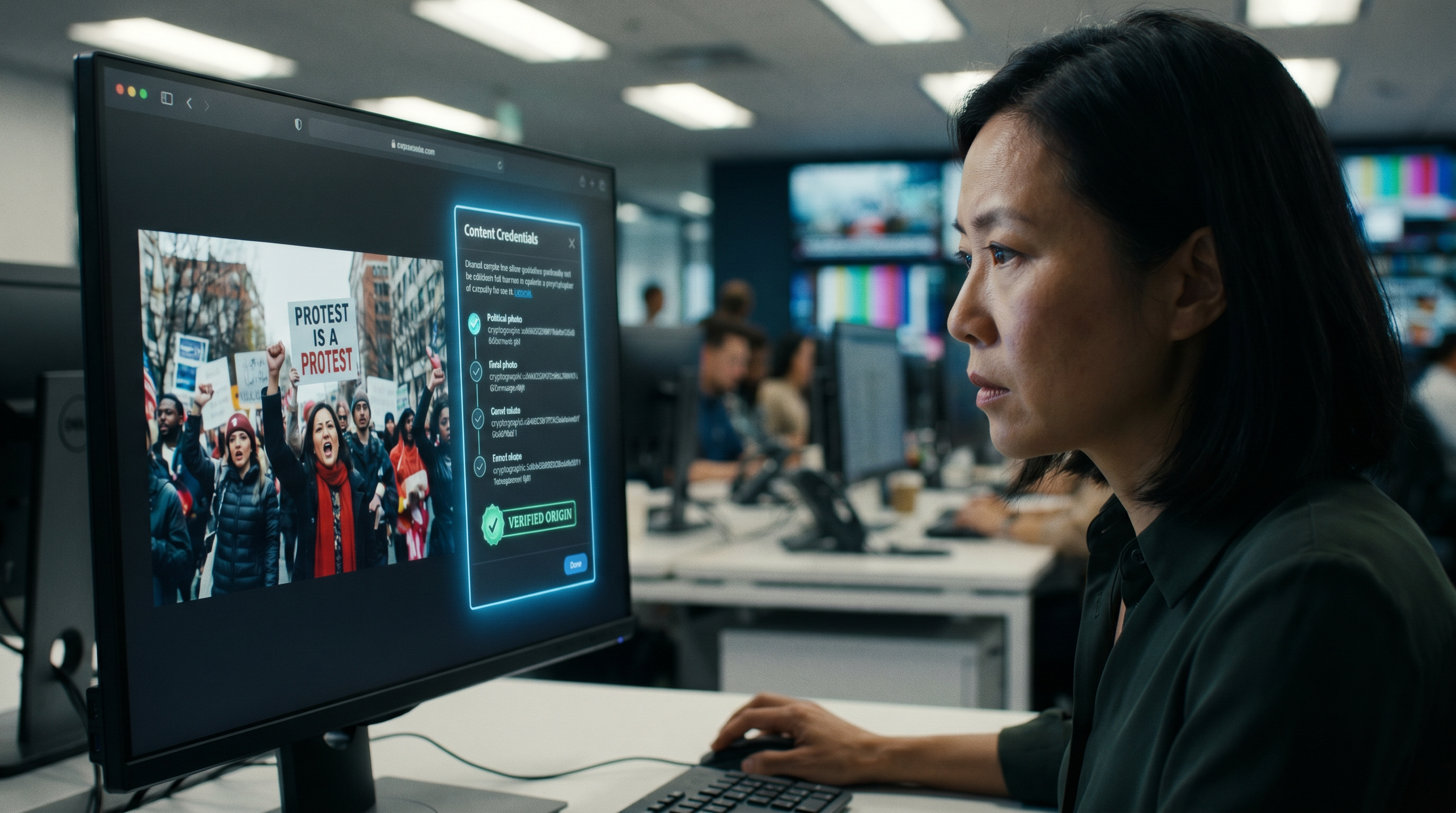
The fourth claim, and the one with the strongest technical evidence, is cryptographic watermarking and provenance tracking. Rather than trying to detect a fake after it has been created, this approach embeds unalterable metadata into authentic media at the exact moment of capture. The Coalition for Content Provenance and Authenticity has developed open standards that act as a digital 'nutrition label' for images and video.[2]
The evidence for cryptographic provenance is overwhelming. When a photograph is taken with a compliant camera or smartphone, it is cryptographically signed. Any subsequent edits, whether by a human using Photoshop or an AI generator, are recorded in a tamper-evident ledger attached to the file. Tests show this method provides near 98 percent accuracy in verifying the origin and edit history of a piece of media, provided the metadata remains intact.[2]
The primary challenge to cryptographic provenance is not technical, but structural. Its success depends entirely on ecosystem adoption. For the system to protect voters, social media platforms must agree to display these digital credentials prominently, and hardware manufacturers must build the signing keys into their devices. While major tech coalitions have made significant strides in 2026, the internet still contains vast amounts of legacy media without provenance data, meaning the absence of a watermark does not automatically prove a file is fake.[1][2]

The final claim shifts away from technology entirely and focuses on human psychology: the concept of cognitive inoculation, or 'pre-bunking.' This theory posits that instead of trying to debunk specific fake videos after they go viral, fact-checkers should proactively teach citizens the common tactics and emotional triggers used in digital manipulation before they ever encounter the media.[6]
The evidence supporting pre-bunking is remarkably robust. Extensive longitudinal studies conducted by the RAND Corporation and various cognitive security institutes have demonstrated that exposing people to simulated, harmless manipulation tactics significantly increases their resilience to actual disinformation. It functions much like a medical vaccine, introducing a weakened form of the virus to build an immune response.[6]
In these studies, participants who engaged with interactive pre-bunking exercises showed a six-fold increase in their ability to identify and reject manipulative political media, regardless of whether it was AI-generated or simply taken out of context. This psychological resilience proved far more durable than teaching people to look for specific visual artifacts, as it targets the underlying intent of the media rather than its surface appearance.[6]
Furthermore, cognitive security experts emphasize that the most dangerous deepfakes are not necessarily the most technically perfect ones, but those that perfectly align with a target audience's pre-existing biases and emotional vulnerabilities. By training voters to recognize when a piece of media is designed to trigger immediate outrage or fear, pre-bunking neutralizes the primary mechanism by which synthetic media spreads.[5][6]

Synthesizing this evidence reveals a clear roadmap for navigating the 2026 information environment. The era of 'trust your eyes' is over, but it is being replaced by a more sophisticated and reliable framework of 'verify the source and check your emotions.' The combination of cryptographic provenance for technical verification and psychological inoculation for cognitive defense offers a highly effective shield against synthetic manipulation.[1]
This shift represents a profound empowerment for the electorate. Instead of feeling overwhelmed by an endless stream of indistinguishable fakes, citizens and fact-checkers can rely on established, scientifically validated tools. By demanding platform transparency for Content Credentials and practicing emotional skepticism, the public can effectively neutralize the threat of AI-generated political deception.[1]
Ultimately, the science of fact-checking has evolved from a reactive game of whack-a-mole into a proactive discipline of structural trust. While generative technology will continue to advance, the cryptographic and psychological defenses now in place ensure that reality remains verifiable, allowing democratic discourse to proceed on a foundation of shared, provable facts.[1]
How we got here
Early 2020s
Media literacy campaigns focus heavily on teaching the public to spot visual artifacts like asymmetrical faces and distorted hands.
2023-2024
The rapid advancement of diffusion models largely eliminates obvious visual glitches, rendering the 'eye test' obsolete.
2025
Major camera manufacturers and software companies begin integrating C2PA cryptographic provenance standards into their products.
2026
Cognitive security researchers publish definitive data showing that psychological pre-bunking is highly effective at neutralizing political deepfakes.
Viewpoints in depth
Provenance Advocates
Argue that the only sustainable solution is building cryptographic trust into cameras and software at the hardware level.
This camp, led by the Coalition for Content Provenance and Authenticity and major hardware manufacturers, believes that the AI arms race is unwinnable. Instead of trying to detect fakes, they argue society must focus on proving what is real. By embedding cryptographic signatures into media at the moment of capture, they aim to create a 'chain of trust' that travels with the file. They argue that once social media platforms universally adopt and display these credentials, unverified synthetic media will naturally be treated with skepticism by the public.
Detection Researchers
Focus on semantic forensics and advanced algorithmic models to detect physical inconsistencies in synthetic media.
Researchers in this camp, often backed by defense initiatives like DARPA, argue that cryptographic provenance will take too long to adopt globally and will not cover legacy media. They focus on building advanced forensic tools that analyze the physical and mathematical logic of a scene—such as light transport, shadow geometry, and biological signals like micro-expressions. While acknowledging that basic algorithmic detectors are easily fooled by new models, they believe that semantic forensics grounded in the immutable laws of physics offers a robust, long-term defense against synthetic manipulation.
Cognitive Security Experts
Emphasize human psychology, arguing that teaching media literacy and emotional skepticism is more effective than any software.
This perspective posits that the danger of deepfakes lies not in their technical perfection, but in their ability to exploit human cognitive biases. Experts in this camp advocate for widespread 'pre-bunking' campaigns that teach citizens how emotional triggers and outrage are weaponized online. They argue that technological solutions will always have blind spots, but a psychologically resilient population that pauses to question the intent behind viral media is the ultimate safeguard for democratic discourse.
What we don't know
- Whether major social media platforms will universally mandate the display of Content Credentials before the 2026 midterms.
- How quickly open-source AI developers might find ways to strip or spoof cryptographic watermarks.
- The long-term durability of psychological pre-bunking without continuous reinforcement training.
Key terms
- Cryptographic Provenance
- A method of embedding secure, unalterable metadata into a digital file at the moment of creation to track its origin and edit history.
- Semantic Forensics
- An advanced detection method that analyzes the physical logic of a scene, such as lighting and shadows, rather than looking for pixel-level noise.
- Pre-bunking
- The practice of preemptively exposing people to the tactics of misinformation to build their psychological resilience against future manipulation.
- Diffusion Models
- The current generation of highly advanced AI systems used to generate photorealistic images and video from text descriptions.
- C2PA
- The Coalition for Content Provenance and Authenticity, an organization developing open technical standards for certifying the source and history of digital media.
Frequently asked
Can I still spot a deepfake by looking at the hands or eyes?
No. Modern generative AI models have largely corrected these visual artifacts, making the 'eye test' an unreliable and potentially misleading way to verify media.
Do AI detection tools actually work?
They work well on media generated by older, known models, but their accuracy drops significantly—often by over 40 percent—when analyzing content from newly released AI generators.
What are Content Credentials?
Content Credentials are a secure, cryptographic standard (C2PA) embedded into digital files that act like a nutrition label, showing exactly who created the media and if it was altered by AI.
What is 'pre-bunking'?
Pre-bunking is a psychological technique that teaches people the common tactics used in digital manipulation before they encounter them, acting like a vaccine to build cognitive resilience.
Sources
Source coverage
7 outlets
3 viewpoints surfaced






[1]Factlen Editorial Team
Synthesis by Factlen editorial team
Read on Factlen Editorial Team →[2]Coalition for Content Provenance and AuthenticityProvenance Advocates
C2PA Technical Specifications for Digital Provenance
Read on Coalition for Content Provenance and Authenticity →[3]National Institute of Standards and TechnologyDetection Researchers
Evaluation of Synthetic Media Detection Algorithms
Read on National Institute of Standards and Technology →[4]DARPADetection Researchers
Semantic Forensics (SemaFor) Program Overview
Read on DARPA →[5]Stanford Internet ObservatoryCognitive Security Experts
Generative AI and the 2026 Midterm Elections: A Framework for Verification
Read on Stanford Internet Observatory →[6]RAND CorporationCognitive Security Experts
Cognitive Security and the Efficacy of Pre-bunking Synthetic Media
Read on RAND Corporation →[7]MIT CSAILDetection Researchers
The Disappearance of Visual Artifacts in Modern Diffusion Models
Read on MIT CSAIL →
More in news politics
See all 64 stories →US-Iran Conflict
Trump Cancels Strikes on Iran, Citing Imminent Peace Deal as Markets Surge
7 sources

US-Iran Conflict
Trump Cancels Iran Strikes, Claims Peace Deal to Reopen Strait of Hormuz is Imminent
7 sources

US-Iran War
Trump Cancels Strikes on Iran, Claims 'Great Settlement' Reached as Tehran Cites Unfinished Deal
8 sources

Diplomatic Settlement
US Cancels Strikes on Iran as Trump Announces 'Great Settlement' to End War
8 sources
Every angle. Every day.
Get news politics stories with full source coverage and perspective breakdowns delivered to your inbox.