
U.S. to Deport Iranian and Syrian Asylum Seekers to Central African Republic in New Deal
The Trump administration has finalized a third-country deportation agreement to send migrants who cannot be legally returned to their home countries to the Central African Republic. The move bypasses traditional asylum protections by relocating individuals to a nation currently under a Level 4 travel advisory for armed conflict.
By Factlen Editorial Team
- Human Rights & Legal Scrutiny
- Argue the policy illegally endangers migrants by dumping them in conflict zones without ties or support.
- Immigration Enforcement Focus
- Support the deals as a necessary mechanism to remove non-citizens when home countries are unsafe or uncooperative.
- Geopolitical & Diplomatic Observers
- Focus on the diplomatic mechanics and the financial incentives provided to African nations to accept the deportees.
What's not represented
- · Central African Republic Civilians
- · The Deportees Themselves
Why this matters
This policy fundamentally alters the U.S. asylum system by allowing the government to deport individuals who have legally proven they face torture at home to third-party conflict zones. It sets a precedent that could affect thousands of migrants currently protected by U.S. immigration courts.
Key points
- The U.S. has finalized a deal to deport migrants to the Central African Republic.
- The first flight includes Iranian women who legally proved they face torture at home.
- The U.S. is providing $85 million to the IOM to assist with operations in CAR.
- Rights groups argue the policy illegally dumps vulnerable people into an active conflict zone.
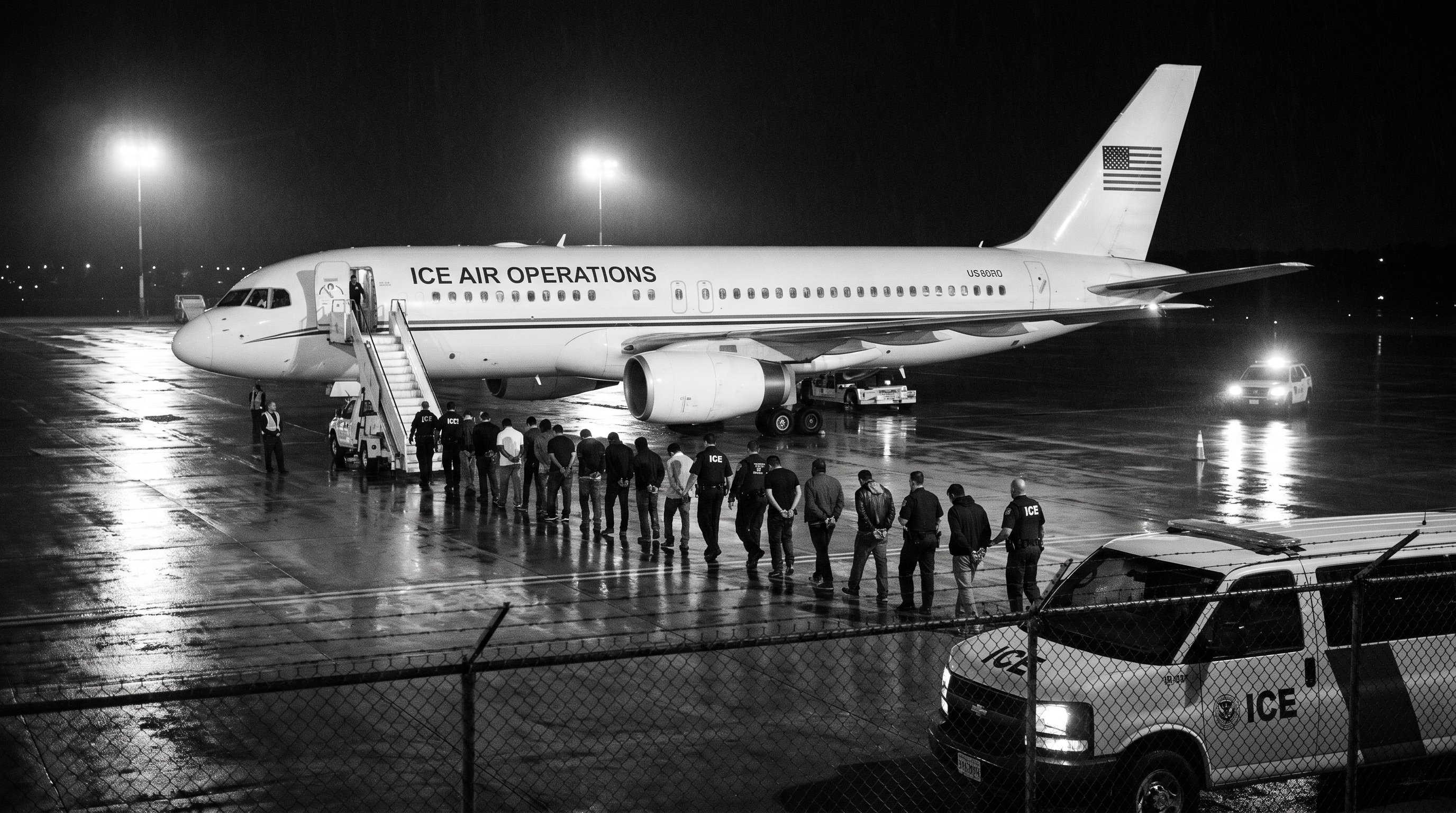
The Trump administration is preparing to deport a group of asylum seekers—including Iranian, Syrian, and Afghan nationals—to the Central African Republic (CAR) under a newly finalized third-country deportation agreement. The policy marks a significant escalation in the government's efforts to remove migrants who cannot be legally or logistically returned to their countries of origin. By utilizing bilateral agreements with alternate nations, the administration is bypassing traditional repatriation routes and relocating individuals to countries where they possess no prior legal, cultural, or personal ties.[1][2][3]
The initial flight under the new framework could depart as early as this week and is expected to carry approximately 20 individuals. Among the passengers slated for removal are two Iranian women who had previously secured legal protection from being returned to Iran. According to their legal representation, one of the women is a Christian convert and the other is a pro-democracy activist. Both were detained upon arriving in the United States in late 2024 and subsequently applied for asylum, navigating a complex legal system to prove the dangers they faced at home.[3]
The mechanism driving this policy is the "third-country deportation" framework, a strategy that has gained traction as diplomatic and legal hurdles complicate direct deportations. When the U.S. government is barred from sending migrants back to their home countries—either due to active conflicts, lack of diplomatic relations, or specific legal injunctions—it negotiates financial and logistical agreements with third-party nations willing to accept the deportees. This approach allows the administration to execute removal orders and clear detention facilities without violating specific bans on returning individuals to hostile environments.[4][5]
To facilitate the arrangement with the Central African Republic, the U.S. government has reportedly allocated $85 million to the International Organization for Migration (IOM) to support operations within the country. The IOM, which has previously assisted with similar transfers in other parts of Africa, will be involved in managing the logistics upon the migrants' arrival. Officials briefed on the matter indicate that the deportees are expected to be housed in apartments in the capital city of Bangui, rather than being immediately repatriated elsewhere or left entirely to their own devices.[2][3][5]

The choice of destination has alarmed international observers and human rights advocates. The Central African Republic is a chronically unstable nation that has endured decades of armed conflict, political upheaval, and extreme poverty. Despite a fragile peace agreement signed in 2019, the state does not have full control over its territory. Violent confrontations between state forces, paramilitary groups, and non-state actors remain a persistent threat to civilian safety, raising severe questions about the viability of sending vulnerable migrants into such a volatile environment.[1][4]
Underscoring the severity of the situation on the ground, the U.S. State Department currently maintains a Level 4 "Do Not Travel" advisory for the Central African Republic. The official government warning cites pervasive insecurity, high levels of unrest, violent crime, kidnapping, and terrorism. The advisory explicitly warns U.S. citizens that traveling to the country could result in death, and the U.S. embassy maintains only a limited diplomatic presence, severely restricting its ability to provide emergency assistance to anyone within the nation's borders.[5]
The deportation policy directly intersects with a specific U.S. legal protection known as "withholding of removal." This status is granted by an immigration judge when a migrant successfully proves there is a greater than 50 percent chance they will face persecution or torture if returned to their country of origin. It is a higher evidentiary bar than standard asylum and serves as a critical legal shield, legally binding the U.S. government from executing a deportation order to that specific dangerous country.[3][4]
Because the two Iranian women on the flight manifest successfully secured this exact protection from a federal judge, the U.S. government is legally barred from deporting them to Tehran. However, the third-country deal allows the administration to bypass this restriction entirely. By removing the women from U.S. soil and transferring them to the Central African Republic, the government achieves its goal of deportation without technically violating the specific judicial ban on returning them to the hands of the Iranian government.[3]
Because the two Iranian women on the flight manifest successfully secured this exact protection from a federal judge, the U.S.
The geopolitical backdrop of the ongoing U.S.-Israel war with Iran, which escalated sharply in late February 2026, has further complicated the status of Iranian nationals within the U.S. immigration system. Repatriation to a hostile state during an active, multi-front conflict is virtually impossible, leaving Iranian asylum seekers in a state of legal limbo. As the conflict continues to whipsaw between fears of broader escalation and hopes for a diplomatic resolution, the administration has increasingly turned to third-country alternatives to manage the backlog of removal orders.[3][6]
The agreement with the Central African Republic is not an isolated incident, but rather part of a broader expansion of third-country deportation deals struck between Washington and several African nations over the past two years. The administration has systematically sought out international partners willing to accept non-citizens, utilizing a combination of diplomatic pressure, financial incentives, and funding promises to secure cooperation from governments that might otherwise have no stake in U.S. domestic immigration enforcement. This global approach represents a fundamental shift in how the United States manages its borders and its deportation pipelines.[2][4]

Similar opaque arrangements have been negotiated and executed with the Democratic Republic of Congo, Ghana, Sierra Leone, and Equatorial Guinea. The implementation of these deals has often proceeded regardless of the humanitarian conditions in the receiving countries. In the case of the Democratic Republic of Congo, the U.S. moved forward with deportations despite the country battling an active Ebola outbreak and ongoing regional violence, signaling to international observers that domestic removal priorities take precedence over the stability or safety of the destination state.[2][3]
The U.S. Department of Homeland Security and the broader administration have consistently defended these agreements as entirely lawful and necessary. Officials argue that the deals are a vital tool to enforce immigration laws and prevent the asylum system from being paralyzed by diplomatic dead ends. The government maintains that all deportees receive full due process before their transfer and that utilizing third countries is a legitimate exercise of executive authority when direct repatriation is blocked by legal or geopolitical realities.[2][3]
According to a Central African government official who spoke on the condition of anonymity, the specifics of the CAR deal were hammered out during a May 18 meeting in Bangui. The negotiations were reportedly led by a U.S. delegation from the State Department's Bureau of Population, Refugees and Migration. The official confirmed that the Central African Republic had formally agreed to take in immigrants deported by American authorities within the framework of these bilateral discussions, though the exact contractual terms remain shielded from public view.[2]
Human rights organizations have fiercely condemned the strategy. Groups like Human Rights First and Refugees International argue that the policy effectively dumps vulnerable people into active conflict zones, stripping them of due process and access to basic essential services. They contend that sending individuals to a country with a fragile economy and severely limited healthcare infrastructure exacerbates the risks faced by migrants, many of whom have already survived severe trauma in their home countries. Advocates view the financial incentives provided to these nations as a dangerous commodification of human lives.[4][5]
Legal advocates warn that the executive branch is utilizing these agreements to circumvent the foundational spirit of the U.S. asylum system. By transferring migrants to third countries, the administration renders the hard-won protections granted by immigration judges effectively meaningless. Lawyers argue that if a judge determines an individual faces a high likelihood of torture, sending them to a different, equally dangerous environment violates the core tenets of international non-refoulement principles, which prohibit returning refugees to places where their lives or freedoms are threatened.[2][4]

The legal foundation of these third-country removals remains highly contested and is currently winding its way through federal courts. In February 2026, a federal court in Massachusetts invalidated a Department of Homeland Security third-country removal policy, ruling that it was illegal to remove people without meaningful notice or the opportunity to request protection in the destination country. The court found that the government's approach bypassed critical statutory safeguards designed to protect asylum seekers from arbitrary expulsion, setting up a high-stakes judicial showdown over executive power.[4]
However, the legal victory for advocates was short-lived. The First Circuit Court of Appeals subsequently stayed the district court's order at the government's request while it considers the broader appeal. This procedural maneuver has allowed the administration to proceed with the deportations in the interim, effectively utilizing the window of legal uncertainty to execute the transfers to the Central African Republic and other African nations before a final, binding appellate decision is handed down by higher courts.[4]
As the legal battles work their way toward the Supreme Court, the administration shows no signs of slowing down its third-country deportation pipeline. Officials briefed on the matter indicate that hundreds of migrants could ultimately be deported to the Central African Republic under the current framework. For the Iranian, Syrian, and Afghan nationals currently awaiting their fate on the initial flight manifest, the geopolitical maneuvering represents a terrifying reality: escaping persecution at home only to be sent to a conflict zone thousands of miles away.[3]
How we got here
2019
The U.S. initiates early third-country asylum agreements with Central American nations.
2024-2025
The administration expands the strategy to African nations, striking deals with the DRC, Ghana, and Sierra Leone.
February 2026
A federal court in Massachusetts invalidates a DHS third-country removal policy, though the ruling is stayed pending appeal.
May 18, 2026
U.S. and CAR officials meet in Bangui to discuss the deportation agreement.
June 2026
The first flight carrying Iranians, Syrians, and Afghans to CAR is scheduled.
Viewpoints in depth
The U.S. Administration's View
Third-country deals are a lawful and necessary tool to enforce immigration laws.
The administration argues that when individuals cannot be repatriated due to diplomatic dead ends or conflict, the U.S. must have alternative mechanisms for removal. Without third-country agreements, officials contend the immigration system would be paralyzed, forcing the government to release individuals with final removal orders into the U.S. interior. They maintain that all deportees receive full due process before transfer.
Human Rights Organizations
Sending vulnerable asylum seekers to a fragile state violates international human rights norms.
Advocacy groups emphasize that the Central African Republic is grappling with severe armed conflict and extreme poverty, making it an inherently unsafe destination. They argue that dumping migrants in a Level 4 'Do Not Travel' zone without personal ties or access to basic services is unconscionable and circumvents the fundamental spirit of asylum protections.
Immigration Legal Advocates
The policy undermines the legal authority of U.S. immigration courts.
Lawyers point out that many of the targeted migrants have already won 'withholding of removal' cases, meaning a federal judge agreed they face a high likelihood of torture or death at home. By utilizing third-country transfers, advocates warn the executive branch is finding a loophole to deport protected individuals, rendering the judicial system's safeguards effectively meaningless.
What we don't know
- How the Central African Republic will guarantee the safety of the deportees amid ongoing armed conflict.
- Whether the Supreme Court will ultimately uphold or strike down the legality of third-country removals.
- The exact contractual terms and long-term financial commitments between the U.S. and CAR.
Key terms
- Third-country deportation
- The practice of expelling a migrant to a nation where they have no citizenship, legal ties, or personal history, usually facilitated by a bilateral agreement.
- Withholding of removal
- A legal protection granted by a U.S. immigration judge when a migrant proves there is a greater than 50% chance they will be persecuted or tortured if returned home.
- International Organization for Migration (IOM)
- A UN-related intergovernmental organization that provides services concerning migration, which is reportedly assisting deportees arriving in CAR.
Frequently asked
Why can't the U.S. deport these individuals to their home countries?
Many of the migrants have legally proven they face a high risk of torture at home, or their home countries are active conflict zones—such as Iran during the ongoing war—making repatriation impossible.
What is the Central African Republic's role?
CAR has agreed to accept the deportees in exchange for U.S. financial support. The migrants are expected to be housed in apartments in the capital, Bangui.
Is this legal under U.S. law?
The administration maintains the deals are lawful, though federal courts are currently litigating whether bypassing immigration court protections via third-country transfers violates due process.
Sources
Source coverage
6 outlets
3 viewpoints surfaced






[1]Fox NewsImmigration Enforcement Focus
Trump plans to deport Iranians to violence-plagued central African nation in new deal
Read on Fox News →[2]ReutersGeopolitical & Diplomatic Observers
Central African Republic to accept third-country deportees from US, sources say
Read on Reuters →[3]The Straits TimesGeopolitical & Diplomatic Observers
US plans to deport Iranians to Central African Republic, sources say
Read on The Straits Times →[4]Just SecurityHuman Rights & Legal Scrutiny
The U.S. Government’s Dangerous Expansion of Third-Country Deportations
Read on Just Security →[5]Third Country Deportation WatchHuman Rights & Legal Scrutiny
Central African Republic Agreement Overview
Read on Third Country Deportation Watch →[6]The New York TimesGeopolitical & Diplomatic Observers
Whipsawed Between Fear and Relief, Iranians Hope for War’s End
Read on The New York Times →

More in news politics
See all 61 stories →Diplomatic Settlement
US Cancels Strikes on Iran as Trump Announces 'Great Settlement' to End War
8 sources

Media Verification
Evidence Pack: The Science of Verifying Political Media in 2026
7 sources

US-Iran Conflict
Trump Announces 'Great Settlement' to End US-Iran War, Canceling Planned Strikes
8 sources

US-Iran Relations
US and Iran Reach 'Great Settlement' as Trump Cancels Military Strikes
8 sources

Every angle. Every day.
Get news politics stories with full source coverage and perspective breakdowns delivered to your inbox.