
‘Toy Story 5’ Hailed as a Masterpiece for Its Nuanced Take on the Screen-Time Epidemic
Early reactions to Pixar's fifth 'Toy Story' installment praise the film's emotional depth as Woody and the gang face their most modern existential threat yet: a child's glowing tablet.
By Factlen Editorial Team
- Film Critics & Audiences
- Reviewers who praise the film's emotional depth and successful continuation of the franchise.
- Child Development Advocates
- Voices focused on the film's message regarding screen time and physical play.
- Franchise Skeptics
- Commentators who feel the series is repeating its themes and unfairly demonizing modern childhood.
What's not represented
- · Tech industry designers who create children's digital interfaces
- · Educators utilizing tablets for early childhood learning
Why this matters
By tackling the universal modern struggle of childhood screen addiction, Pixar is using its most beloved franchise to spark a cross-generational conversation about the value of physical play and human connection.
Key points
- Toy Story 5 premiered in Los Angeles to overwhelmingly positive reviews, with critics calling it a 'masterpiece.'
- The plot centers on Woody, Buzz, and Jessie confronting a new smart tablet named Lilypad that has captivated their owner.
- Reviewers praised the film for its nuanced take on the screen-time epidemic and the importance of physical play.
- Jessie the Cowgirl takes on a central leadership role, providing the film's emotional core.
- Taylor Swift contributed an original song, 'I Knew It, I Knew You,' performing it live at the premiere.
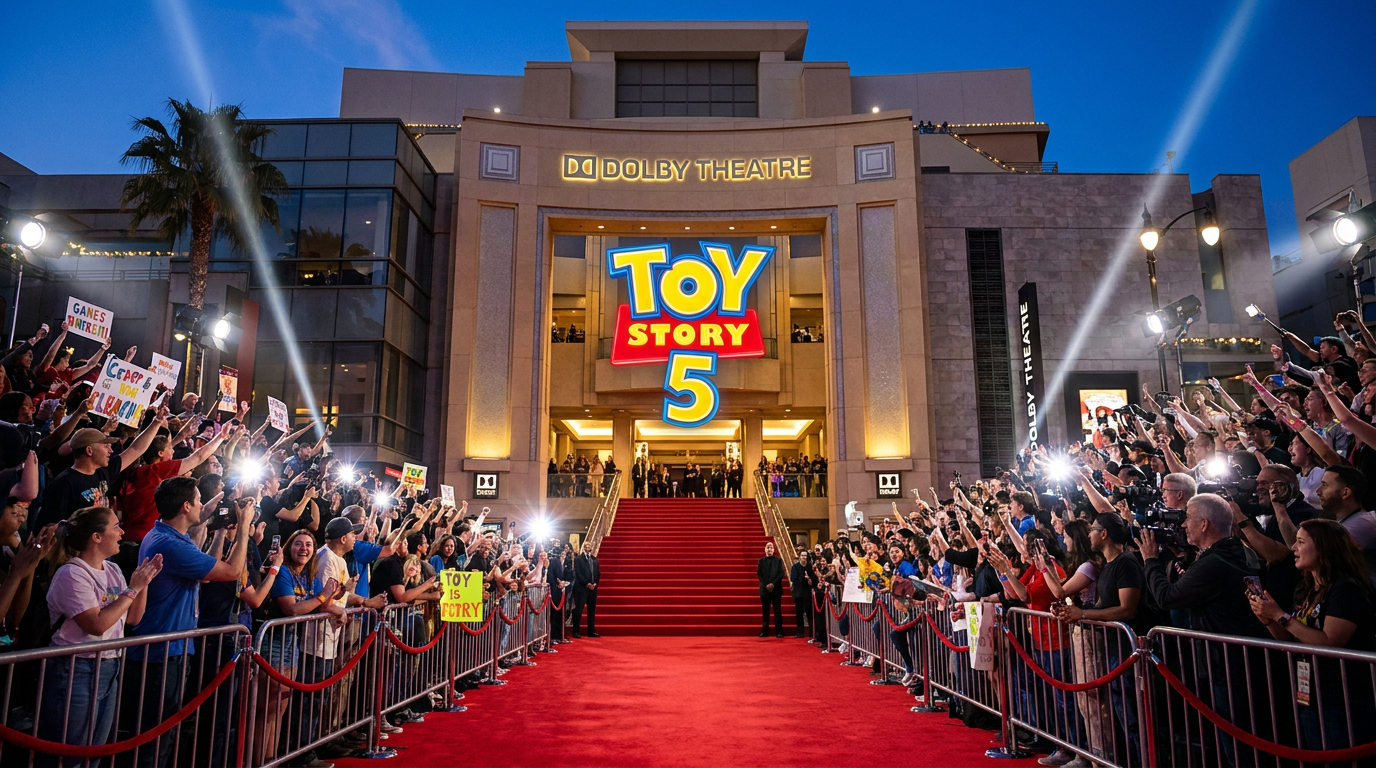
When Disney and Pixar announced they were opening the toy box for a fifth time, a collective wave of skepticism rippled through the cinematic universe. After all, 2010's Toy Story 3 provided what many considered a perfect emotional farewell, and 2019's Toy Story 4 already pushed the boundaries of extending a completed narrative. But following its star-studded world premiere at the Dolby Theatre in Los Angeles, the first reactions to Toy Story 5 are washing away the doubts, with critics hailing the film as a triumphant return to form.[1][5]
Directed by Pixar veteran Andrew Stanton and co-director Kenna Harris, the new installment tackles the ultimate modern existential threat to traditional playtime: the screen-time epidemic. The story follows Woody, Buzz Lightyear, and Jessie as they face off against a sleek, frog-shaped smart tablet named Lilypad, voiced by Greta Lee. The tablet has completely captivated their eight-year-old owner, Bonnie, leaving the classic toys to wonder if they have finally been rendered obsolete by the dopamine loop of the digital age.[4][7]
Early reviews suggest the film handles this "Toy meets Tech" premise with profound emotional intelligence. Critics who attended the Los Angeles premiere have called the movie an "absolute home run" and "pure perfection." Rather than delivering a heavy-handed lecture about the evils of technology, the narrative reportedly takes a nuanced look at the vital importance of one-on-one human connection. Reviewers noted that the film acknowledges how devices like Lilypad are designed with the best intentions—to help kids connect—but ultimately champions the irreplaceable value of physical, imaginative play.[1][2]

The emotional anchor of the film belongs to Jessie the Cowgirl, voiced once again by Joan Cusack. With Woody having previously left to join Bo Peep's toy-rescue squad, Jessie has stepped up as the leader of Bonnie's room. Critics have singled out her storyline as the movie's beating heart, noting that she finally gets the rich, complex narrative arc she deserves as she battles her own anxieties about losing Bonnie to a glowing screen. One reviewer admitted the film left them in a "puddle of tears," a hallmark of Pixar's best work.[2][5]
The voice cast itself has been vocal about the film's striking thematic depth. Tim Allen, returning as Buzz Lightyear, compared the movie's honest exploration of childhood and loss to the works of Dostoevsky, noting that the film captures the somber reality of a toy—or a parent—realizing they are no longer the center of a child's universe. Tom Hanks, who voices Woody, highlighted a specific scene where Bonnie's feelings are hurt by a digital interaction on her tablet, pointing out the profound difference between the safety of a physical toy and the unpredictable perils of online socialization.[4]
The voice cast itself has been vocal about the film's striking thematic depth.
Greta Lee's performance as the tablet Lilypad is also drawing praise for avoiding standard villain tropes. Lee approached the character not as a cold, computerized antagonist, but as a highly assertive, "Type A" personality who genuinely believes her worldwide web connectivity makes her the best companion for Bonnie. This framing allows the film to explore the boundaries of screen time without entirely demonizing the digital world, reflecting the real-life balancing act modern parents face every day.[4][7]

Not everyone was initially sold on the premise. When the first trailers dropped, some cultural commentators expressed frustration, arguing that the franchise was returning to the well simply to deliver a "technology is bad" boomer-esque complaint. Skeptics worried that framing an iPad as the villain ignored the natural progression of kids growing up, a theme that had already been masterfully handled in previous installments. However, the overwhelmingly positive premiere reactions suggest the final film subverts these fears, delivering a story about insecurity and sharing space in a changing world rather than a simple anti-tech manifesto.[6]
Adding to the cultural footprint of the release is a surprise contribution from Taylor Swift, who wrote and performed an original song for the film titled "I Knew It, I Knew You." Swift, who attended the premiere and performed the track live alongside Pixar legend Randy Newman, called the film a "masterpiece" and her favorite entry in the franchise. Critics are already predicting the song will be a frontrunner for Best Original Song during the upcoming awards season.[1][5]

Visually, Pixar reportedly exercised immense restraint to ensure the film still feels like the Toy Story audiences fell in love with in 1995. While the studio developed new animation tools to render complex elements like the coiled hair of a new human character named Blaze, they intentionally held back on hyper-realistic upgrades to the classic toys. The result is a visual style that preserves the nostalgic warmth of the franchise while introducing stunning, watercolor-like sequences when diving into Bonnie's imagination.[7]
As Toy Story 5 heads into its wide theatrical release on June 19, it carries the weight of both a beloved legacy and a highly relevant social message. By confronting the reality of the screen-time epidemic through the eyes of Woody and Buzz, Pixar is betting that audiences are ready for one more adventure—one that reminds both kids and parents that sometimes, the best way to connect is to power down and play.[4][7]
How we got here
February 2023
Disney CEO Bob Iger officially announces that a fifth Toy Story film is in development.
August 2024
Andrew Stanton is confirmed as the director, bringing his veteran Pixar experience to the project.
November 2025
The first teaser trailer drops, revealing the 'Toy meets Tech' premise and sparking online debate.
June 9, 2026
The film holds its world premiere at the Dolby Theatre in Los Angeles, generating rave reviews.
June 19, 2026
Toy Story 5 is scheduled for wide theatrical release across the United States.
Viewpoints in depth
Film Critics & Audiences
Reviewers who praise the film's emotional depth and successful continuation of the franchise.
For many critics, the announcement of a fifth film felt like a corporate cash-grab that risked tarnishing a perfect trilogy (and a well-regarded fourth entry). However, the premiere has completely flipped the narrative. Critics are celebrating the film's decision to elevate Jessie to the lead role, noting that her struggle with obsolescence provides a fresh emotional anchor. They argue that the film successfully balances its legacy characters with a highly relevant modern conflict, proving that Pixar's flagship franchise still has profound emotional territory left to explore.
Child Development Advocates
Voices focused on the film's message regarding screen time and physical play.
Parents and child psychologists have long debated the impact of tablets on early childhood development, and many are thrilled to see a cultural juggernaut like Pixar tackle the issue. By framing the tablet not as an evil machine but as a device that hijacks a child's dopamine loop and isolates them from physical play, the film provides a digestible metaphor for families. Advocates appreciate that the movie emphasizes the emotional safety of traditional toys—which never 'hurt your feelings'—compared to the unpredictable nature of online socialization.
Franchise Skeptics
Commentators who feel the series is repeating its themes and unfairly demonizing modern childhood.
A vocal minority of cultural commentators remain skeptical of the film's core premise. They argue that the franchise has already thoroughly explored the themes of obsolescence, abandonment, and changing play habits. To these critics, making an iPad the antagonist feels like a repetitive, 'boomer-esque' complaint about how kids today grow up. They caution that framing technology as the enemy oversimplifies the reality of modern childhood, where digital connection is a valid and necessary part of how kids interact with the world.
What we don't know
- Whether the film's massive critical acclaim will translate to box office dominance in a crowded summer movie season.
- How general audiences and younger, tech-native children will react to the film's message about screen time.
Key terms
- Dopamine loop
- A neurological cycle where the brain is rewarded with a hit of dopamine for interacting with a stimulus, commonly used to describe the addictive nature of scrolling on smart devices.
- Type A personality
- A temperament characterized by ambition, high energy, and a strong desire for control and achievement, used to describe the tablet character Lilypad.
Frequently asked
When does Toy Story 5 come out?
The film is scheduled to be released exclusively in theaters on June 19, 2026.
Who is the villain in Toy Story 5?
The primary conflict revolves around Lilypad, a frog-shaped smart tablet voiced by Greta Lee, though early reviews note she is portrayed more as an assertive device than a traditional villain.
Did Taylor Swift write a song for the movie?
Yes, Taylor Swift wrote and performed an original end-credits song for the film titled 'I Knew It, I Knew You.'
Are Woody and Buzz in the new movie?
Yes, Tom Hanks and Tim Allen reprise their iconic roles, though Joan Cusack's Jessie reportedly takes on a much larger leadership role in this installment.
Sources
Source coverage
7 outlets
3 viewpoints surfaced







[1]TheWrapFilm Critics & Audiences
‘Toy Story 5’ First Reactions Praise New Installment as an ‘Absolute Home Run’
Read on TheWrap →[2]VarietyFilm Critics & Audiences
Toy Story 5 Premiere: Critics Call Pixar Sequel 'Magical and Pure Perfection'
Read on Variety →[3]GizmodoFilm Critics & Audiences
The First Reactions to 'Toy Story 5' Are Here
Read on Gizmodo →[4]The GuardianChild Development Advocates
‘This is honest art. Like Dostoevsky’: Tim Allen and Tom Hanks on Toy Story 5, tech peril and the joy of rusty nails
Read on The Guardian →[5]Screen RantFilm Critics & Audiences
Toy Story 5 First Reactions Are In
Read on Screen Rant →[6]CrackedFranchise Skeptics
‘Toy Story 5’ And The Problem With Blaming Kids For Growing Up
Read on Cracked →[7]Pixar Animation StudiosChild Development Advocates
Toy Story 5 - Official Movie Page
Read on Pixar Animation Studios →

Every angle. Every day.
Get entertainment stories with full source coverage and perspective breakdowns delivered to your inbox.