
The Rise of the 'Plyscraper': How Mass Timber is Rewriting the Rules of High-Rise Construction
Engineered wood is replacing concrete and steel in a new generation of skyscrapers, offering a radical solution to the construction industry's massive carbon footprint.
By Factlen Editorial Team
- Sustainable Architects & Builders
- Advocates for mass timber as a critical tool to decarbonize construction and build faster.
- Fire Safety & Code Regulators
- Prioritizes rigorous physical testing to ensure engineered wood meets or exceeds the safety of steel and concrete.
- Forestry & Resource Managers
- Focuses on the sustainable harvesting of small-diameter trees and the lifecycle carbon math of timber.
What's not represented
- · Traditional steel and concrete manufacturers facing market disruption
- · Local conservation groups monitoring regional forest health
Why this matters
The built environment generates nearly 40% of global carbon emissions. Shifting from concrete to engineered wood transforms skyscrapers from massive climate liabilities into long-term carbon sinks, fundamentally altering the ecological footprint of modern cities.
Key points
- Mass timber uses cross-laminated layers of wood to achieve the structural strength of steel and concrete.
- Trees sequester carbon as they grow, meaning timber buildings act as long-term carbon sinks.
- In a fire, thick timber beams char on the outside, insulating and protecting the structural core.
- Prefabricated timber components allow for faster, quieter construction with less neighborhood disruption.
- Sydney's 39-story Atlassian Central recently became the world's tallest hybrid timber tower.
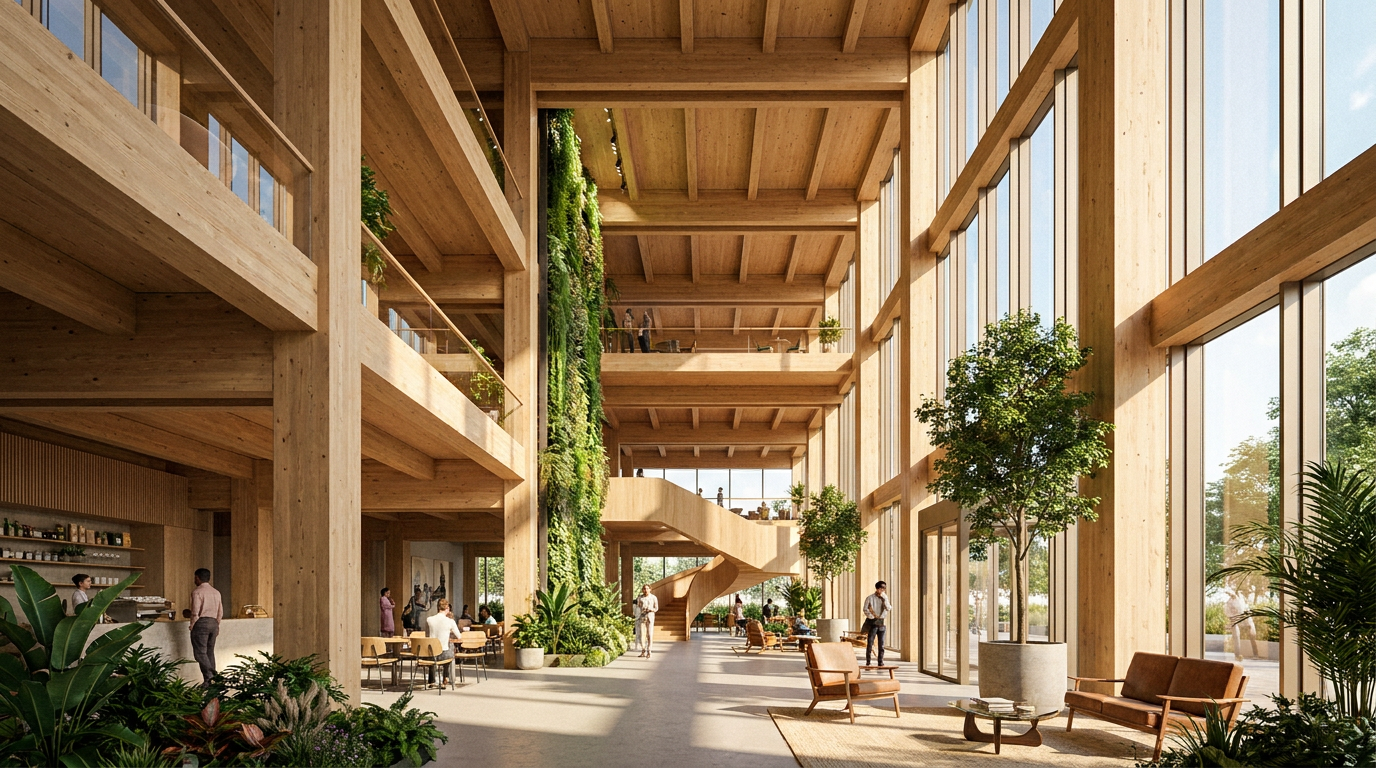
For more than a century, the silhouette of the modern city has been defined by two materials: concrete and steel. These industrial pillars built the modern world, pushing skylines higher and enabling unprecedented urban density. But a quiet revolution is taking root in architecture, driven by the urgent need to address the climate crisis. A new generation of high-rises is rising across the globe, constructed not from energy-intensive metals or poured cement, but from wood. The "plyscraper" is no longer a speculative architectural concept; it is a rapidly scaling reality that promises to fundamentally rewrite the rules of commercial construction.[2][7]
The core problem with traditional building materials lies in their invisible environmental toll. The built environment is responsible for nearly 40 percent of global greenhouse gas emissions. A massive portion of this comes from "embodied carbon"—the sheer amount of energy required to mine iron ore, heat kilns to extreme temperatures for cement, and transport heavy materials to construction sites. Concrete and steel are extractive, carbon-heavy industries. To meet global climate targets while continuing to build housing and infrastructure for a growing population, the construction industry requires a structural material that doesn't cost the earth.[6][7]
Enter mass timber. It is crucial to distinguish this material from the traditional "stick-frame" lumber used to build suburban houses. Mass timber is a highly engineered, technologically advanced product. The most common form, Cross-Laminated Timber (CLT), is manufactured by taking standard dimensional lumber and gluing it together in layers. Crucially, each layer is oriented perpendicularly to the one below it, and the entire stack is pressed together under immense pressure with structural adhesives.[4][5]

This perpendicular cross-lamination process gives the resulting wood panels extraordinary strength in two directions, effectively neutralizing wood's natural tendency to warp or split along its grain. The resulting material boasts a strength-to-weight ratio that rivals steel and concrete, yet it weighs significantly less. Because mass timber is an engineered composite, it does not require the harvesting of massive, old-growth trees; it can be manufactured using small-diameter timber, making it highly adaptable to modern, sustainable forestry practices.[2][4]
The carbon math is the primary driver of this architectural shift. Trees are nature's original carbon capture technology, naturally sequestering carbon dioxide from the atmosphere during their growth phase through photosynthesis. When these trees are harvested and locked into a building's structure, that carbon remains trapped for decades or even centuries. Instead of emitting massive amounts of carbon to build a skyscraper, a mass timber building effectively acts as a massive, long-term carbon sink.[5][7]

Beyond the environmental benefits, mass timber fundamentally changes the logistics of how buildings are constructed. Traditional concrete construction is messy, loud, and highly dependent on weather conditions. Mass timber, by contrast, relies heavily on factory prefabrication. Using precise 3D models, computer-numerical-control (CNC) machines cut the massive wooden beams and panels to exact millimeter specifications in a controlled factory environment, complete with pre-cut holes for plumbing and electrical wiring.[5][7]
These giant wooden puzzle pieces are then shipped to the construction site, where a smaller crew can assemble them with remarkable speed. This prefabrication drastically reduces on-site noise, minimizes neighborhood disruption, and requires significantly fewer truck deliveries. For dense urban environments where construction logistics are a nightmare, the ability to quietly and quickly bolt together a high-rise offers a massive economic and practical advantage for developers and city planners alike.[4][6]

These giant wooden puzzle pieces are then shipped to the construction site, where a smaller crew can assemble them with remarkable speed.
However, whenever timber skyscrapers are proposed, the most persistent question from the public and regulators is inevitable: What happens when it catches fire? The intuitive, visceral fear of burning wood has historically restricted timber buildings to just a few stories, and overcoming this psychological and regulatory hurdle has been the mass timber industry's greatest challenge.[5][8]
The reality is that mass timber behaves fundamentally differently than standard light-frame lumber in a fire. When exposed to extreme heat, the outer layer of a massive wooden beam chars, turning to charcoal. This char layer acts as an intense, natural thermal insulator. It protects the unburned wood inside from the heat, preventing the core from losing its structural integrity. While a steel beam might warp and buckle under extreme temperatures, causing a sudden collapse, a mass timber beam burns at a slow, predictable rate.[4][5]
Recent breakthroughs have codified this safety into law. In early 2026, developers completed a world-first three-hour fire-resistance test on a fully loaded mass timber assembly at the Southwest Research Institute in Texas. The rigorous test evaluated the performance of CLT floor decks and glulam beams under extreme, sustained fire conditions while bearing heavy structural loads.[3]
The assemblies successfully exceeded the three-hour threshold required for International Building Code (IBC) Type I-A buildings. This is a strict safety classification that has traditionally been reserved exclusively for non-combustible steel and concrete high-rises. By proving that engineered wood can withstand severe fires just as well as—if not better than—traditional materials, these tests are rapidly dismantling the final regulatory barriers to tall timber construction.[3]

With safety codes adapting, the race for the sky is accelerating globally. In April 2026, Sydney’s $1.45 billion Atlassian Central Tower officially surpassed Milwaukee’s 25-story Ascent building to become the world’s tallest hybrid timber tower. The 39-story Australian project utilizes a massive steel exoskeleton that supports internal cross-laminated timber habitats, demonstrating how hybrid models can push wood to unprecedented heights while maintaining absolute structural rigidity.[1][2]
Timber is also proving its mettle against natural disasters. In earthquake-prone regions, mass timber's lighter weight and inherent flexibility offer distinct advantages over rigid concrete. Vancouver recently completed a 10-story timber structure known as the Hive, which utilizes advanced seismic dampers. The building is designed to shrug off major tremors, absorbing the seismic energy so that the structure remains safe and does not require total demolition after an earthquake.[2]
Despite the immense momentum, the industry still faces significant hurdles, particularly from the insurance sector. While fire risk is now well-understood by engineers, water damage during the construction phase remains a costly vulnerability. If exposed timber gets soaked by heavy rain before the building's exterior is fully sealed, it can lead to warping, staining, and rot. Insurers are demanding rigorous water-management strategies before underwriting these novel projects.[8]
To scale mass timber globally, the construction industry must also ensure that the forestry practices supplying the wood remain strictly sustainable. Over-harvesting or clear-cutting would completely negate the climate benefits of the material. Consequently, certified, responsibly managed forests—where new trees are continually planted to replace those harvested—are a non-negotiable prerequisite for the plyscraper revolution to succeed on a planetary scale.[4][7]
For the people living and working inside these buildings, the appeal goes far beyond carbon math and structural engineering. "Biophilic design"—the integration of natural materials and light into the built environment—has been shown in numerous studies to reduce stress, lower heart rates, and improve overall mental health. The warm, tactile presence of exposed wood offers a fundamentally more human alternative to the sterile drywall and cold concrete that define most modern offices.[4][6]

As building codes continue to evolve and global supply chains mature, mass timber is poised to move from a niche architectural statement to a standard, everyday construction method. By transforming the very fabric of our cities, the plyscraper offers a rare, tangible solution to the climate crisis—one that we can actually walk inside, live within, and build our future upon.[2][8]
How we got here
1990s
Cross-Laminated Timber (CLT) is first researched and developed in Austria.
2009
The first modern 9-story mass timber residential building is completed.
2022
The 25-story Ascent building opens in Milwaukee, setting a new global height record for timber.
Jan 2026
Mass timber assemblies pass a world-first 3-hour fire test, meeting strict high-rise safety codes.
Apr 2026
Sydney's Atlassian Central tops out at 39 stories, becoming the tallest hybrid timber tower.
Viewpoints in depth
Sustainable Architects & Builders
Advocates for mass timber as a critical tool to decarbonize construction and build faster.
For the architectural and engineering communities, mass timber represents the first genuine structural innovation in a century. By replacing carbon-intensive concrete and steel with a renewable resource that actively sequesters carbon, architects argue that the built environment can transition from being a major climate liability to a climate solution. Furthermore, the precision of factory prefabrication allows for faster construction timelines, less waste, and significantly reduced noise pollution in dense urban environments.
Fire Safety & Code Regulators
Prioritizes rigorous physical testing to ensure engineered wood meets or exceeds the safety of steel and concrete.
Building regulators and fire marshals approach timber with historical caution, prioritizing life safety above environmental benefits. Their focus is on the predictable 'charring effect' of mass timber, where the outer layer burns and insulates the structural core. Regulators rely on exhaustive, full-scale fire testing—such as the recent three-hour endurance tests—to justify updating conservative building codes. They emphasize that while the material is combustible, its engineered density prevents the sudden structural failures often seen in heated steel.
Insurance & Risk Assessors
Concerned with water damage during construction and long-term durability.
The insurance industry remains the most significant bottleneck for mass timber adoption. While fire risks are increasingly mitigated by engineering, insurers are highly focused on the construction phase, where exposed timber is vulnerable to water damage from rain. If moisture penetrates the wood before the building is sealed, it can lead to costly delays, warping, and rot. Risk assessors are demanding stringent, tech-enabled water management protocols and new underwriting models before fully embracing the plyscraper revolution.
What we don't know
- How insurance markets will price long-term premiums for mass timber high-rises in hurricane-prone regions.
- Whether global sustainable forestry supply chains can scale fast enough to meet surging architectural demand without causing deforestation.
Key terms
- Mass Timber
- A category of engineered wood products made by binding smaller pieces of wood together to form large, structurally strong panels and beams.
- Cross-Laminated Timber (CLT)
- A wood panel made by gluing layers of lumber together at perpendicular right angles, giving it immense strength in two directions.
- Embodied Carbon
- The total greenhouse gas emissions generated during the extraction, manufacturing, and transportation of building materials.
- Charring Effect
- The process where the outer layer of a thick wooden beam burns and turns to charcoal, creating a thermal barrier that protects the unburned wood inside.
- Biophilic Design
- An architectural approach that seeks to connect building occupants more closely to nature, often by using exposed natural materials like wood.
Frequently asked
Is mass timber safe in a fire?
Yes. Unlike light-frame wood used in houses, massive timber beams char on the outside when exposed to fire. This char layer insulates the core, allowing the building to maintain its structural integrity for hours.
Does building with wood cause deforestation?
When sourced responsibly, mass timber relies on sustainably managed forests and can utilize small-diameter trees, which actually helps thin forests and reduce the risk of catastrophic wildfires.
Is mass timber as strong as concrete?
Yes. The cross-lamination process gives engineered wood an exceptional strength-to-weight ratio, allowing it to support high-rise structures and resist seismic forces.
What is the tallest timber building in the world?
As of early 2026, Sydney's Atlassian Central Tower is the tallest hybrid timber building at 39 stories, surpassing Milwaukee's 25-story Ascent building.
Sources
Source coverage
8 outlets
3 viewpoints surfaced







[1]Wood CentralSustainable Architects & Builders
Atlassian Tops Ascent — World's Tallest Plyscraper Towers Over Sydney
Read on Wood Central →[2]Mother JonesSustainable Architects & Builders
Tomorrow's Skylines Will be Made of Wood
Read on Mother Jones →[3]WoodScannerFire Safety & Code Regulators
World First 3-Hour Fire Test Means Timber is Safe for High-Rises
Read on WoodScanner →[4]Natural Resources CanadaForestry & Resource Managers
Mass timber buildings are sustainable, safe and healthy
Read on Natural Resources Canada →[5]J.S. HeldFire Safety & Code Regulators
Mass Timber Fire Resistance: Sustainability, Code Compliance, and Fire Safety in Tall Buildings
Read on J.S. Held →[6]Architecture 2030Sustainable Architects & Builders
Mass Timber Tipping Point
Read on Architecture 2030 →[7]The Skyscraper MuseumSustainable Architects & Builders
Tall Timber: The Future of Cities in Wood
Read on The Skyscraper Museum →[8]Factlen Editorial TeamSustainable Architects & Builders
Synthesis by Factlen editorial team
Read on Factlen Editorial Team →

Every angle. Every day.
Get culture stories with full source coverage and perspective breakdowns delivered to your inbox.