
How Indigenous Communities Are Using AI to Save Endangered Languages
Faced with a global language extinction crisis, indigenous groups and linguists are building bespoke AI models to revitalize endangered tongues. By prioritizing data sovereignty, these communities are ensuring their linguistic heritage survives the digital age on their own terms.
By Factlen Editorial Team
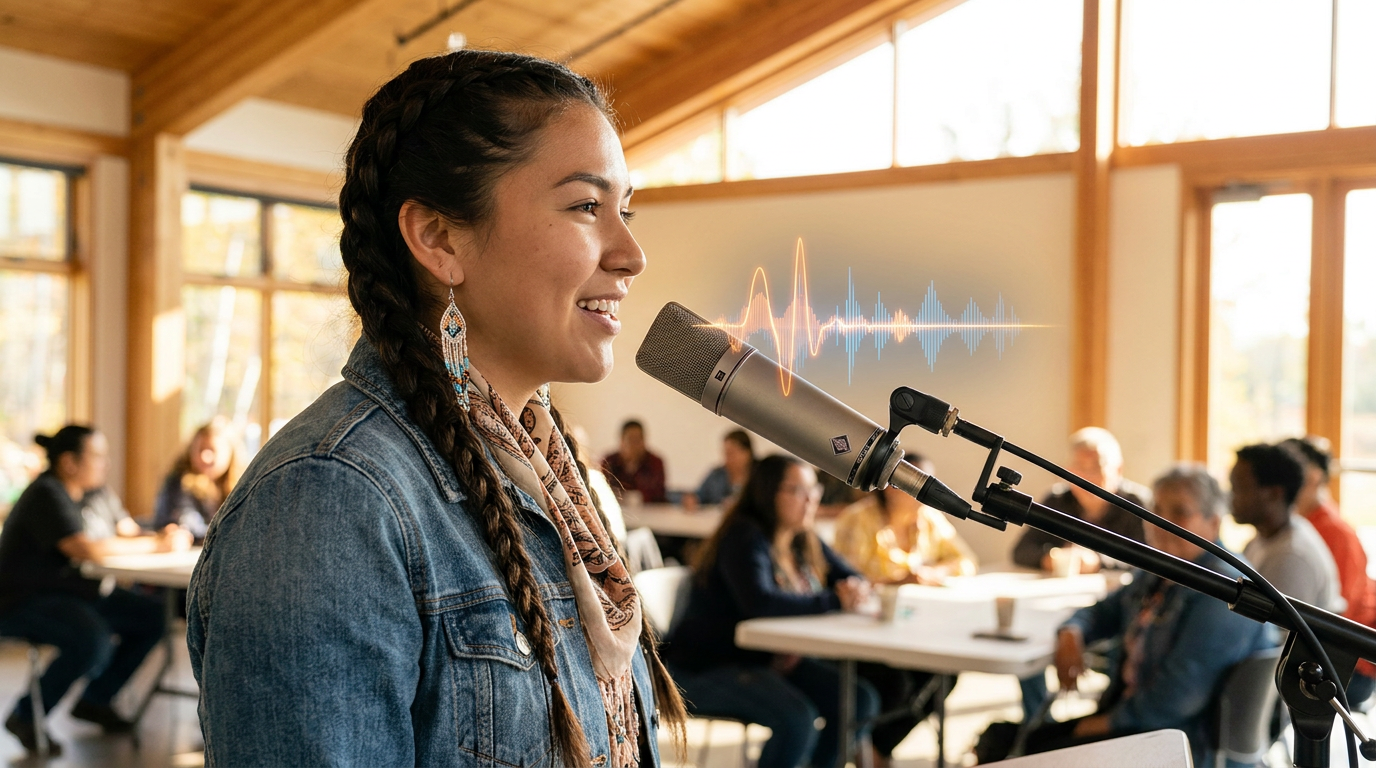
- Indigenous Data Sovereignty Advocates
- Argue that communities must own the algorithms and data processing their languages to prevent digital colonization.
- Computational Linguists
- Focus on the technical breakthroughs required to train AI on low-resource and polysynthetic languages with minimal data.
- Cultural Preservationists
- View AI primarily as a tool for intergenerational knowledge transfer and reducing the information access gap.
What's not represented
- · Commercial AI developers seeking to license indigenous datasets
- · Elder speakers who may be skeptical of digitizing sacred oral traditions
Why this matters
Language is the vessel for cultural identity, history, and ecological knowledge. As artificial intelligence reshapes global communication, these indigenous-led initiatives prove that technology can be harnessed to reverse historical erasure rather than accelerate it.
Key points
- Approximately half of the world's 7,000 languages are projected to face extinction by 2100.
- Indigenous communities are building bespoke AI models to document and teach their languages, bypassing commercial tech giants.
- New Zealand's Te Hiku Media developed a Māori speech recognition model with 92% accuracy, outperforming standard corporate baselines.
- Researchers are pioneering 'few-shot' learning to train AI on low-resource languages that lack massive digital datasets.
- The movement heavily emphasizes 'data sovereignty,' ensuring that indigenous groups retain ownership of their linguistic algorithms.
With approximately 7,000 languages spoken worldwide, linguists are sounding an urgent alarm: nearly half are projected to face extinction by the end of the century. For indigenous communities, the loss of a language is not merely a linguistic footnote; it represents the erasure of ecological knowledge, cultural identity, and unique worldviews. Historically, technology has accelerated this decline by enforcing dominant languages like English and Spanish across digital platforms. However, a new wave of indigenous-led initiatives is flipping the script, harnessing artificial intelligence to document, revitalize, and teach endangered languages before they fall silent.[5][7]
The intersection of AI and language preservation is moving away from the extractive models of Silicon Valley and toward community-owned innovation. Rather than waiting for multinational tech giants to build translation tools, indigenous broadcasters, tribal leaders, and computational linguists are developing bespoke algorithms. These localized models are designed to respect cultural protocols while leveraging cutting-edge natural language processing to bridge the gap between fluent elders and younger, digitally native generations.[1][7]
Training an AI model to understand a language typically requires massive datasets—billions of words scraped from the internet. This presents a severe bottleneck for "low-resource" languages, which have minimal digital footprints. When users ask mainstream large language models to translate phrases into endangered tongues, the systems often hallucinate, confidently outputting complete gibberish. To solve this, researchers are pioneering specialized machine learning techniques that can generate accurate linguistic resources from incredibly small seed datasets.[3][4]

At Dartmouth College, researchers recently demonstrated the viability of these low-data techniques through an AI framework called NüshuRescue. The project focuses on Nüshu, a highly endangered script used exclusively by Yao women in China. By feeding a generative AI model a tiny corpus of verified texts, the system learned to accurately translate unseen examples, effectively expanding the digital library of the language without requiring thousands of hours of human annotation. Similar lightweight, decentralized models are now being applied to Native Alaskan languages, achieving near-perfect identification accuracy where commercial tools previously failed.[4]
The NüshuRescue project exemplifies how "few-shot prompting" can bypass the need for massive datasets. By providing a large language model with just a handful of highly accurate, culturally contextualized examples, the AI learns the underlying grammatical rules and stylistic nuances of the endangered script. This approach drastically lowers the barrier to entry, allowing linguists to rapidly produce valuable educational resources from fragments of historical texts, rather than waiting decades to manually compile a comprehensive dictionary.[4]
The technical hurdles extend beyond mere data scarcity. Many indigenous languages, such as Cherokee, are polysynthetic. In these linguistic systems, complex words are constructed by snapping together smaller units of meaning, much like Lego blocks. A single Cherokee word can convey the exact meaning of a long, complex English sentence. This structural density breaks the standard tokenization methods used by commercial AI, which are optimized for the rigid, linear word-order of English.[3]
At Tennessee Tech University, computer scientists are collaborating with the Cherokee Nation to build AI systems capable of parsing this polysynthetic complexity. The stakes are incredibly high: fewer than 140 first-language Cherokee speakers remain alive today, most of whom are over the age of 60. The project aims to move beyond static digital archives, working toward interactive AI tutors that can facilitate meaningful, real-time conversations in Cherokee, thereby relieving the teaching burden on the few remaining fluent elders.[3]
At Tennessee Tech University, computer scientists are collaborating with the Cherokee Nation to build AI systems capable of parsing this polysynthetic complexity.
Perhaps the most striking success story in indigenous AI comes from Aotearoa New Zealand. Te Hiku Media, a Māori broadcasting collective, spent decades gathering archival recordings and inviting elders into their studios to read phrases aloud. This painstaking, community-driven effort built a robust, culturally verified audio corpus. In 2021, Te Hiku leveraged this data to release a bespoke automatic speech recognition model for Te Reo Māori.[1][2]

The results were unprecedented. Te Hiku's AI model achieved a 92% transcription accuracy rate, outperforming the generalized models deployed by international tech conglomerates. The technology now powers a transcription service called Papa Reo, which is used to digitize historical broadcasts and create accessible learning materials for the Māori diaspora. Crucially, the model was trained to recognize authentic native pronunciation, a process the developers describe as "decolonising the sound" of the language by actively filtering out the phonetic influence of English.[1][2]
This model of localized, purpose-built AI is rapidly spreading across the Global South. In India, a consortium of research institutes recently launched Adi Vaani, a suite of AI-powered tools designed specifically for marginalized tribal languages such as Santali, Mundari, and Bhili. By offering text-to-speech, translation, and optical character recognition, the initiative allows speakers of these historically overlooked languages to access education, healthcare, and public services in their mother tongues.[1]
A similar open-source revolution is unfolding in Latin America. Researchers at the Chilean National Center for Artificial Intelligence have unveiled Latam-GPT, a large language model trained not only on Spanish and Portuguese but also on indigenous languages like Mapuche, Rapanui, Guaraní, Nahuatl, and Quechua. Meanwhile, in Peru, digital tools are utilizing AI to produce verified journalistic content in Quechua, Aimara, and Awajún, directly combating misinformation while simultaneously preserving the cultural values embedded in the languages.[1][6]
As these technologies mature, a fierce debate has emerged around indigenous data sovereignty. Historically, indigenous knowledge—from sacred songs to botanical remedies—has been extracted, commodified, and patented by outside entities without community consent. Tribal leaders argue that the digital realm must not become the next frontier for colonial extraction. If multinational tech companies scrape indigenous languages to train commercial AI models, they effectively privatize a community's cultural heritage.[1][5]

"Data is like land," explains Peter-Lucas Jones, CEO of Te Hiku Media. "If we do not have control, governance, and ongoing guardianship of our data as indigenous people, we will be landless in the digital world, too." This philosophy dictates that the algorithms processing native languages must be owned and governed by the communities themselves, ensuring that the technology serves their specific educational and cultural needs rather than corporate profit margins.[1][2]
The United Nations has formally recognized these concerns, emphasizing that AI systems must respect indigenous rights and fundamental freedoms. The UN Permanent Forum on Indigenous Issues recently highlighted the necessity of meaningful inclusion, warning that AI trained on dominant datasets can reinforce harmful biases and accelerate cultural appropriation if safeguards are not implemented. Ethical AI frameworks are now being drafted to ensure that language revitalization efforts remain firmly in the hands of the people who speak them.[5][7]
Beyond the technical achievements, the integration of indigenous languages into advanced AI carries profound psychological weight. For generations, many native speakers were actively punished for using their mother tongues in schools, leading to a stigma that accelerated language decline. Seeing these same languages power cutting-edge neural networks and interactive applications sends a powerful message to indigenous youth: their heritage is not a relic of the past, but a dynamic, evolving framework perfectly capable of navigating the future.[2][7]

Ultimately, artificial intelligence cannot replace the profound human connection of a grandparent speaking to a grandchild in their native tongue. However, it can serve as a powerful bridge. By automating the transcription of fragile archives, generating interactive educational tools, and proving that low-resource languages can thrive in the digital age, AI is buying crucial time for communities fighting to keep their ancestral voices alive.[3][7]
How we got here
2002
The Rosetta Project launches, representing an early digital effort to archive thousands of endangered languages.
2021
Te Hiku Media releases an automatic speech recognition model for Te Reo Māori, achieving 92% accuracy.
2024
The UN General Assembly adopts a resolution emphasizing that AI development must respect indigenous data sovereignty.
2025
Researchers demonstrate AI's ability to translate the endangered Nüshu script and Native Alaskan languages using minimal seed data.
Viewpoints in depth
Indigenous Broadcasters & Advocates
Prioritizing data sovereignty and cultural ownership over raw technological speed.
For indigenous media collectives like Te Hiku, the development of AI is inseparable from the historical trauma of language suppression. They argue that allowing multinational tech companies to scrape native languages for commercial large language models is a modern form of digital land theft. By building their own algorithms, these advocates ensure that the phonetic nuances of their languages are preserved authentically, rather than being assimilated into English-centric speech patterns. Their ultimate goal is to create closed-loop systems where the data generated by the community directly serves the community's educational needs.
Computational Linguists
Solving the mathematical puzzle of low-resource and polysynthetic languages.
Researchers in natural language processing view endangered languages as one of the field's most pressing technical challenges. Mainstream AI relies on brute-force data consumption, which fails entirely when applied to languages with fewer than a thousand living speakers. Linguists are pioneering 'few-shot' learning and decentralized models that can deduce complex grammatical rules from tiny datasets. For polysynthetic languages like Cherokee, this requires fundamentally rewriting how AI tokenizes words, moving away from English sentence structures to understand how single, densely packed words convey entire concepts.
Global Policymakers
Establishing ethical frameworks to protect indigenous intellectual property in the AI era.
International bodies, including the United Nations, approach the intersection of AI and indigenous culture through the lens of human rights. They warn that AI systems trained without community consent can perpetuate harmful biases and commodify sacred knowledge. Policymakers are advocating for strict ethical guidelines that mandate indigenous inclusion at every stage of AI development. They argue that technological innovation must be balanced with robust legal protections, ensuring that the digital revitalization of a language does not inadvertently strip a community of its intellectual property.
What we don't know
- Whether bespoke AI models can be scaled affordably for the thousands of endangered languages that currently lack institutional funding.
- How international intellectual property laws will adapt to protect indigenous data sovereignty from being scraped by commercial AI.
- The long-term efficacy of AI tutors in producing truly fluent, conversational speakers compared to traditional human-led immersion.
Key terms
- Polysynthetic Language
- A language where complex words are created by combining many smaller linguistic units, often expressing an entire sentence's meaning in a single word.
- Data Sovereignty
- The principle that indigenous communities have the right to own, control, and govern the digital data generated from their languages and cultures.
- Low-Resource Language
- A language that lacks large digital datasets, making it difficult to train standard artificial intelligence models.
- Automatic Speech Recognition (ASR)
- Technology that converts spoken language into written text, crucial for documenting oral traditions and historical broadcasts.
- Corpus
- A large, structured collection of texts or spoken audio used to train machine learning models and analyze linguistic patterns.
Frequently asked
Can AI actually teach someone an endangered language?
While AI cannot replace human interaction, it can create interactive tutors, translate historical documents, and provide accessible practice tools for learners who lack access to fluent elders.
Why do standard AI models struggle with indigenous languages?
Mainstream AI relies on massive amounts of internet data. Endangered languages have a minimal digital footprint, causing models to hallucinate or generate incorrect translations.
What is 'decolonising the sound' of a language?
It involves training AI models exclusively on the voices of native speakers to recognize and preserve authentic pronunciation, stripping away the phonetic influence of dominant languages like English.
What makes the Cherokee language difficult for AI?
Cherokee is a polysynthetic language, meaning complex words are built by combining smaller linguistic units. This structure breaks the standard tokenization methods AI uses for English.
Sources
Source coverage
7 outlets
3 viewpoints surfaced







[1]IC MagazineIndigenous Data Sovereignty Advocates
Indigenous communities are leveraging AI to preserve and revitalize their languages
Read on IC Magazine →[2]National Indigenous Radio ServiceIndigenous Data Sovereignty Advocates
Maori-led media company is using Artificial Intelligence to preserve the Maori Language
Read on National Indigenous Radio Service →[3]Tennessee Tech UniversityComputational Linguists
Computer science professor uses AI to help preserve Cherokee language
Read on Tennessee Tech University →[4]Dartmouth CollegeComputational Linguists
Tech tools to aid language preservation
Read on Dartmouth College →[5]United NationsIndigenous Data Sovereignty Advocates
Indigenous Peoples and AI: Defending Rights, Shaping Futures
Read on United Nations →[6]Emerald InsightCultural Preservationists
Artificial intelligence for the preservation of native languages
Read on Emerald Insight →[7]Factlen Editorial TeamCultural Preservationists
Synthesis by Factlen editorial team
Read on Factlen Editorial Team →

Every angle. Every day.
Get culture stories with full source coverage and perspective breakdowns delivered to your inbox.