
OLED vs. Mini-LED: Which TV Technology Wins in 2026?
As Mini-LED panels close the gap on black levels and OLEDs push new brightness boundaries, choosing the right TV in 2026 comes down to your room's lighting and viewing habits.
By Factlen Editorial Team
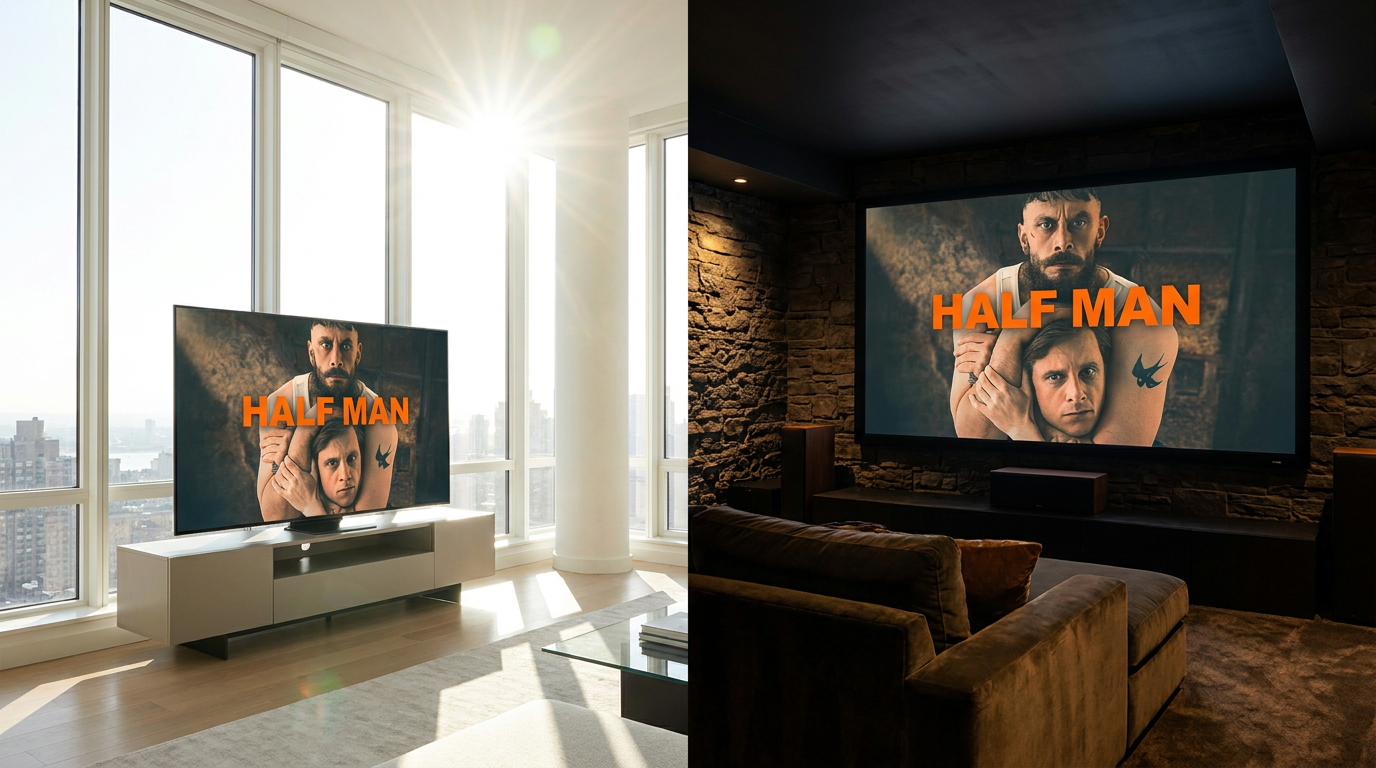
- Cinematic Purists
- Advocates for OLED technology who prioritize perfect contrast and pixel-level precision.
- Bright-Room Pragmatists
- Viewers who prioritize peak brightness and versatility for everyday living spaces.
- Large-Format Value Seekers
- Market analysts focused on the cost-to-size ratio of massive displays.
What's not represented
- · Environmental Advocates (focusing on power consumption differences)
Why this matters
A premium television is a multi-year investment that dictates how you experience entertainment, gaming, and daily news. Choosing the wrong panel technology for your room's lighting can result in washed-out daytime viewing or distracting light-bleed during cinematic movie nights.
Key points
- OLED TVs deliver perfect black levels and infinite contrast, making them the undisputed choice for dark-room home theaters.
- Mini-LED TVs can reach over 2,000 nits of brightness, offering superior performance in sunlit living rooms.
- Modern OLEDs have mitigated burn-in risks, but Mini-LED remains the safest option for heavy static-image viewing.
- Mini-LED provides significantly better value for buyers seeking ultra-large screens of 75 inches or more.
The 2026 television landscape is defined by a fierce technological convergence between OLED and Mini-LED. While both deliver stunning 4K and 8K visuals, they achieve them through fundamentally different engineering philosophies, forcing buyers to weigh distinct trade-offs based on their viewing environments and daily habits.[4]
The core mechanical difference dictates these trade-offs. OLED (Organic Light-Emitting Diode) panels feature self-illuminating pixels that can turn off completely, generating perfect blacks without a backlight. Mini-LED, conversely, relies on a traditional LCD panel illuminated by thousands of microscopic backlight zones that dim or brighten in localized clusters.[1][3]
When evaluating contrast and dark-room performance, the evidence heavily favors OLED. Because Mini-LEDs must illuminate zones rather than individual pixels, they suffer from "haloing" or "blooming"—a faint glow around bright objects on dark backgrounds, such as white subtitles over a black cinematic letterbox. OLED's pixel-level precision eliminates this entirely.[1][6]

Conversely, the argument for Mini-LED dominates when measuring peak brightness and daylight viewing. Premium 2026 Mini-LED panels routinely push past 2,000 nits of peak brightness, easily overpowering glare in sun-drenched living rooms and delivering incredibly punchy HDR highlights that make daytime sports and vibrant games pop.[3][5]
While OLED manufacturers have introduced Micro Lens Array (MLA) and QD-OLED technologies to boost brightness closer to 1,200 nits, they still cannot match the sheer full-screen luminance of a Mini-LED display without risking panel degradation or triggering aggressive auto-dimming limiters.[2][5]
The burn-in debate remains a critical dividing line. Mini-LED advocates point to the technology's complete immunity to permanent image retention, making it the undisputed choice for viewers who leave news networks, sports tickers, or static video game HUDs on screen for hours at a time.[1][5]
OLED defenders counter that 2026 panels feature aggressive pixel-shifting and localized dimming algorithms that make burn-in a non-issue for varied viewing, but they concede that Mini-LED offers total peace of mind for heavy, static usage in multi-purpose family rooms.[5][6]
For competitive gaming, the trade-offs become highly specific. OLED holds the advantage in motion clarity, boasting near-instantaneous pixel response times of roughly 0.1 milliseconds, which eliminates motion blur in fast-paced shooters and racing simulators.[1][5]

For competitive gaming, the trade-offs become highly specific.
However, Mini-LED counters with superior value at massive screen sizes. As buyers increasingly demand 75-inch, 85-inch, and even 100-inch displays, Mini-LED scales far more cost-effectively, often pricing thousands of dollars below a comparably sized OLED panel.[3][4]
The 2026 market is also seeing new innovations blur the lines. Manufacturers are rolling out RGB Mini-LEDs that ditch white backlights for individual red, green, and blue LEDs, closing the color-accuracy gap and approaching OLED-level precision without sacrificing brightness.[2][4]
Ultimately, neither technology claims an unconditional victory; the right choice depends entirely on environmental conditions, budget, and viewing habits.[6]

How we got here
2013
LG releases the first commercially viable large-screen OLED TVs, establishing a new benchmark for contrast.
2019
TCL introduces the first Mini-LED TV, offering a brighter alternative to OLED with improved local dimming.
2022
QD-OLED technology debuts, combining quantum dots with OLED to boost color brightness and challenge premium LEDs.
2026
RGB Mini-LED and Tandem OLED panels hit the consumer market, closing the performance gap between the two technologies.
Viewpoints in depth
Cinematic Purists
Advocates for OLED technology who prioritize perfect contrast and pixel-level precision.
For home theater enthusiasts and cinephiles, the television's ability to render true black is the most critical metric of picture quality. Because OLED pixels emit their own light and can turn off completely, they eliminate the 'haloing' effect that plagues backlit TVs. This camp argues that the infinite contrast ratio of OLED provides a three-dimensional depth to movies that no amount of Mini-LED brightness can replicate, making it the only acceptable choice for light-controlled rooms.
Bright-Room Pragmatists
Viewers who prioritize peak brightness and versatility for everyday, multi-use living spaces.
This perspective focuses on the reality of modern open-concept homes, which often feature massive windows and uncontrolled ambient light. Pragmatists argue that OLED's perfect blacks are useless if the screen is covered in daytime glare. By pushing past 2,000 nits of peak brightness, Mini-LEDs cut through sunlight and deliver punchy, vibrant HDR highlights. Furthermore, this camp values the zero-burn-in guarantee of Mini-LED, allowing families to leave news tickers or video games on all day without anxiety.
Large-Format Value Seekers
Market analysts and budget-conscious buyers focused on the cost-to-size ratio of modern displays.
As consumer demand shifts toward massive 85-inch and 100-inch screens, the manufacturing realities of the two technologies become impossible to ignore. Producing flawless organic OLED panels at massive sizes remains incredibly expensive, resulting in exponential price jumps. Value seekers point out that Mini-LED scales far more efficiently, allowing buyers to secure a premium 85-inch Mini-LED for the same price as a 65-inch OLED, arguing that sheer size often provides a more immersive upgrade than perfect black levels.
What we don't know
- Whether the new RGB Tandem OLED panels releasing in 2026 will suffer from accelerated degradation when pushed to their maximum brightness limits.
- How quickly the manufacturing costs for 85-inch and 100-inch OLED panels will drop to compete with the aggressive pricing of massive Mini-LEDs.
Key terms
- Blooming / Haloing
- A visual artifact where light bleeds into dark areas of the screen, commonly seen around white text on a black background on backlit TVs.
- Nits
- A unit of measurement for brightness; higher numbers mean the screen can get brighter to combat glare or display HDR highlights.
- Burn-in
- Permanent image retention on a screen caused by leaving static elements (like news tickers or logos) displayed for thousands of hours.
- Dimming Zones
- Clusters of backlights in a Mini-LED TV that can independently brighten or darken to improve contrast.
Frequently asked
Will an OLED TV get burn-in from video games?
Modern OLEDs have built-in protections like pixel shifting to prevent burn-in, but leaving static game HUDs on screen for thousands of hours still carries a slight risk compared to Mini-LED.
Which TV is better for a bright living room?
Mini-LED is the superior choice for bright rooms because it can reach peak brightness levels of over 2,000 nits, easily cutting through daytime glare.
Why are Mini-LED TVs cheaper at larger sizes?
Manufacturing large LCD panels with Mini-LED backlights is significantly easier and yields fewer defects than producing massive 85-inch or 100-inch organic OLED panels.
Sources
Source coverage
6 outlets
3 viewpoints surfaced






[1]RTINGSCinematic Purists
OLED vs Mini LED: Which is better?
Read on RTINGS →[2]CNETLarge-Format Value Seekers
The Best TVs of CES 2026
Read on CNET →[3]CurrysBright-Room Pragmatists
OLED vs Mini LED: What's the difference?
Read on Currys →[4]Persistence Market ResearchLarge-Format Value Seekers
OLED vs Mini LED TV: 2026 Market Insights and Product Trends
Read on Persistence Market Research →[5]Pixel PrimeBright-Room Pragmatists
LED vs QLED vs OLED vs Mini LED - The REAL Winner in 2026
Read on Pixel Prime →[6]Jeff RauseoCinematic Purists
OLED vs. Mini-LED vs. QLED: What's the Best TV for You?
Read on Jeff Rauseo →

Every angle. Every day.
Get shopping stories with full source coverage and perspective breakdowns delivered to your inbox.