
The End of Forever Chemicals on the Slopes: How Skiing is Replacing Toxic Wax
As the 2026 Winter Olympics approach, the ski industry is enforcing a strict ban on fluorinated waxes, driving a boom in eco-friendly, permanent base treatments.
By Factlen Editorial Team
- Environmental Advocates
- Focuses on the urgent need to eliminate PFAS from mountain watersheds and protect the health of ski technicians.
- Elite Ski Technicians
- Prioritizes absolute speed and performance, navigating the challenge of replacing the sport's gold standard for glide.
- Ski Tech Innovators
- Champions new material sciences and permanent base treatments as a superior, low-maintenance alternative to traditional waxing.
What's not represented
- · Small-scale traditional wax manufacturers struggling to adapt to the new regulations
Why this matters
The transition away from toxic 'forever chemicals' in ski wax protects mountain watersheds and drinking water supplies, while new permanent base treatments are saving recreational skiers hours of maintenance time.
Key points
- The 2026 Winter Olympics will be the first to strictly enforce a ban on fluorinated ski waxes.
- Traditional fluoro waxes contain PFAS, which contaminate mountain watersheds and harm technicians.
- Eco-friendly hot waxes and permanent base treatments are rapidly replacing toxic chemicals.
- Permanent treatments use UV light to bond polymers directly into the ski base, eliminating the need for re-waxing.
The familiar scent of melting wax in a poorly ventilated garage has long been a staple of ski culture. For decades, recreational skiers and Olympic technicians alike relied on a specific chemical cocktail to achieve the perfect glide down a snow-covered mountain. But as the 2026 Milan Cortina Winter Games approach, the sport is undergoing a quiet, high-tech revolution. The era of fluorinated ski wax is officially over.[4]
At the heart of this transition is a sweeping ban on per- and polyfluoroalkyl substances (PFAS), commonly known as "forever chemicals." Since the 1980s, elite skiers and snowboarders chased podium finishes with the help of these highly stable compounds. PFAS repel water and reduce friction with unparalleled efficiency, allowing skis to glide effortlessly, particularly in wet or slushy snow.[2]
"There's nothing in the chemical world that I'm aware of that can replicate their hydrophobic and dirt-repelling properties," noted Tim Baucom, a wax technician for the United States cross-country ski team. When technicians first introduced fluorocarbons to ski bases, athletes reported feeling as though they were floating over the snow. The compounds quickly became the gold standard for competitive racing.[4]
However, the performance benefits came with a steep environmental and biological cost. Because PFAS are not biodegradable, the wax shavings scraped off in tuning rooms and the microscopic layers worn away on the slopes accumulate in the ecosystem. As the snow melts each spring, these forever chemicals wash into mountain watersheds, persisting in the environment and eventually entering the food chain.[1][2]

The health risks are equally severe for the technicians who spend hours melting and scraping these waxes. When heated with a waxing iron, fluorinated waxes release toxic vapors. Prolonged exposure to PFAS has been linked to a range of severe health issues, prompting regulatory bodies to intervene to protect both the environment and the workers who prepare the equipment.[3]
The International Ski and Snowboard Federation (FIS) and the International Biathlon Union (IBU) officially banned fluorinated waxes from competition starting in the 2023–2024 season. Enforcing the ban required the development of reliable testing protocols at the starting gate to detect fluorine on race skis—a technical hurdle that took several seasons to perfect. Now, mandatory testing is a standard feature at World Cup events.[1][2]
Government regulators have also stepped in. The U.S. Environmental Protection Agency (EPA) recently cracked down on the importation of noncompliant ski wax products. In a landmark settlement, the wax manufacturer Swix agreed to pay a civil penalty and fund a $1 million Responsible Waxing Project aimed at educating the ski community and phasing out PFAS-containing waxes.[3]
Environmental Protection Agency (EPA) recently cracked down on the importation of noncompliant ski wax products.
The ban has forced a massive paradigm shift in how skis are prepared, sparking a wave of innovation in eco-friendly alternatives. Initially, technicians worried that the loss of fluoros would drastically slow down race times. Instead, the industry has responded with advanced, non-toxic formulations that rival the performance of their chemical predecessors without the environmental footprint.[4]

Companies like Colorado-based mountainFLOW have pioneered high-performance, plant-based waxes that eliminate petroleum and toxic chemicals entirely. These eco-friendly hot waxes require the traditional iron-and-scrape application but offer a biodegradable solution for purists who still enjoy the ritual of tuning their own gear.[2][6]
But the most disruptive innovation in the post-fluoro era isn't a wax at all—it's a permanent base treatment. Products like Phantom Glide, developed by a Salt Lake City-based company, are fundamentally changing the mechanics of ski maintenance. Rather than applying a temporary topical layer that inevitably wears off into the snow, these treatments alter the ski base itself.[5][7]
Traditional ski wax functions by coating the top layer of the polyethylene base. Because wax molecules are relatively large, they sit on the surface, much like a layer of frosting on a cake. After a few hours of aggressive skiing, the friction of the snow strips this layer away, diminishing glide and leaving the base unprotected.[5]
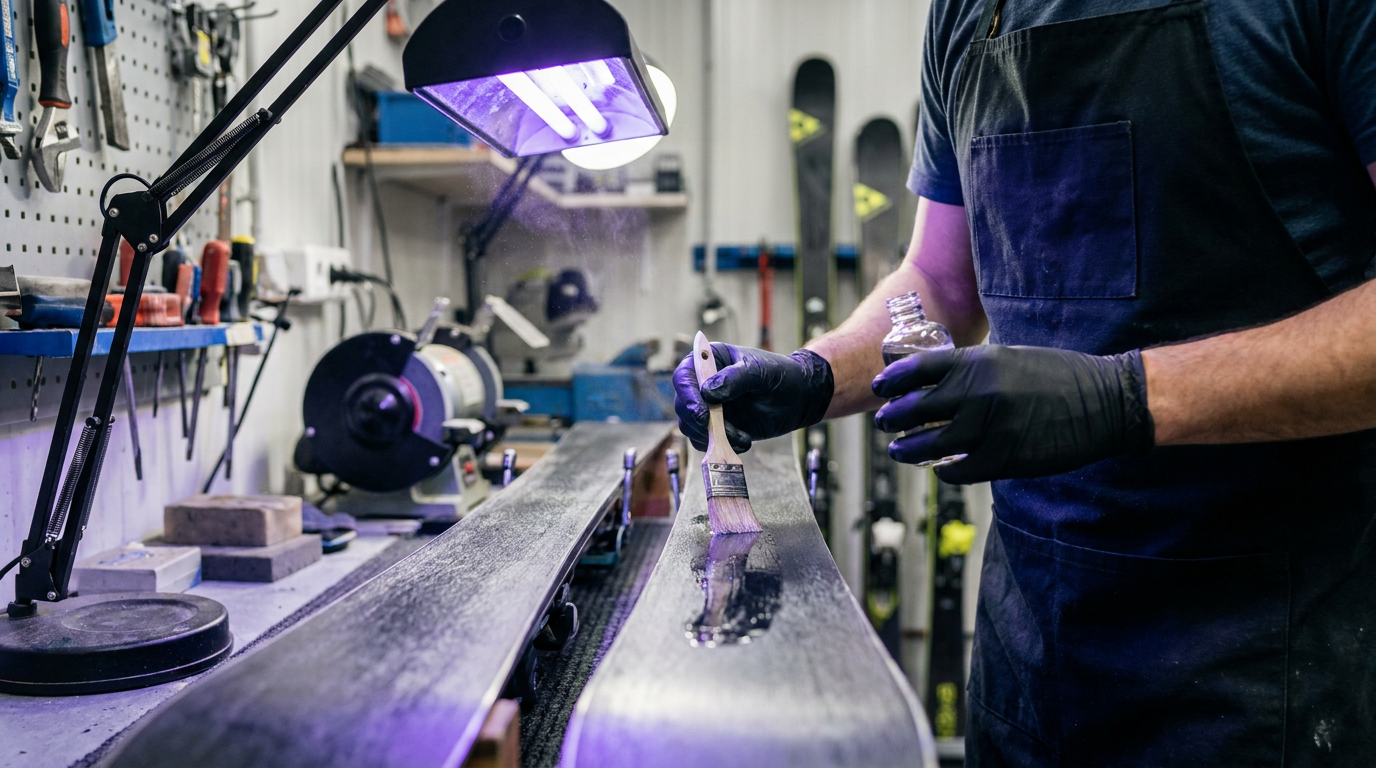
Permanent treatments operate on a molecular level. The formula consists of microscopic short-chain compounds that penetrate deep into the unstructured sections of the ski or snowboard base. Once the liquid is absorbed, it is exposed to ultraviolet (UV) light—either via a specialized curing station or natural sunlight. The UV light activates a chemical bonding process, permanently fusing the treatment to the base material.[5]

Because the treatment is cured into the base itself, it never wears off and does not shed chemicals into the watershed. Skiers report that the glide remains consistent across a wide range of temperatures and snow conditions, mirroring the performance of a premium all-temperature wax without the need for constant reapplication.[5][6]
While permanent treatments offer unmatched convenience for recreational skiers, the elite racing community remains divided. Some technicians argue that while permanent treatments provide an excellent baseline, the micro-adjustments required for Olympic-level racing—where a hundredth of a second dictates a medal—still demand specialized, temperature-specific topical applications on race day.[4][7]

Regardless of the specific method chosen, the transition away from forever chemicals is a monumental victory for mountain ecosystems. Ski towns are actively participating in the cleanup; Park City, Utah, collected over 600 pounds of polluting fluoro wax during the first year of its local ban. As the 2026 Winter Games prepare to showcase a fully fluoro-free Olympics, the sport has proven that high performance does not have to come at the expense of the environment.[4][7]
How we got here
1980s
Fluorinated waxes are introduced to competitive skiing, becoming the gold standard for speed.
2019
The International Ski and Snowboard Federation (FIS) announces its intention to ban fluoro waxes.
2023
The FIS and IBU officially implement the ban across all top-tier competitions.
2026
The Milan Cortina Winter Games become the first Olympics to be completely fluoro-free.
Viewpoints in depth
Environmental Advocates & Regulators
Focuses on the urgent need to eliminate PFAS from mountain watersheds and protect the health of ski technicians.
For environmental groups and government regulators, the ban on fluorinated wax is a critical step in combating the spread of 'forever chemicals.' They point to studies showing that PFAS from ski wax directly contaminates snowmelt, which then flows into local drinking water supplies. Regulators like the EPA emphasize that the health risks are not just environmental; wax technicians who melt these compounds in poorly ventilated rooms face severe occupational hazards from toxic vapors. Their primary goal is strict enforcement and public education to ensure these chemicals are permanently removed from the sport.
Elite Ski Technicians
Prioritizes absolute speed and performance, navigating the challenge of replacing the sport's gold standard for glide.
At the Olympic level, where a fraction of a second determines a medal, technicians view the fluoro ban as a monumental engineering challenge. While they acknowledge the environmental necessity of the ban, they argue that nothing in the chemical world perfectly replicates the hydrophobic properties of fluorocarbons. This camp is intensely focused on testing new plant-based and synthetic alternatives, often combining permanent base treatments with highly specific, temperature-calibrated eco-waxes on race day to claw back the lost milliseconds.
Recreational Skiers
Focuses on convenience, cost, and the end of the hot-waxing chore.
For the average skier or snowboarder, the shift away from traditional wax is largely seen as a massive upgrade in convenience. Rather than spending hours in a garage melting, scraping, and brushing wax—or paying a shop to do it multiple times a season—recreational riders are embracing permanent base treatments. They value the ability to apply a treatment once and enjoy consistent glide for the lifetime of the ski, viewing the environmental benefits as an excellent bonus to a significantly easier maintenance routine.
What we don't know
- Whether the new eco-friendly waxes will completely close the performance gap with fluorocarbons at the elite Olympic level.
- How quickly local ski shops will fully phase out their remaining stockpiles of non-compliant traditional waxes.
Key terms
- PFAS
- Per- and polyfluoroalkyl substances, a class of synthetic chemicals known for their water-resistant properties and inability to break down in the environment.
- Fluorinated Wax
- Traditional high-performance ski wax containing PFAS, prized for its ability to repel water and dirt.
- Polyethylene Base
- The porous plastic material used on the bottom of modern skis and snowboards.
- UV Curing
- A process where ultraviolet light is used to initiate a photochemical reaction, permanently bonding a treatment to a surface.
Frequently asked
Why was traditional ski wax banned?
The International Ski Federation banned fluorinated waxes because they contain PFAS, which accumulate in mountain watersheds and pose severe health risks to wax technicians.
Do I need to throw away my old ski wax?
Many ski towns and resorts offer exchange programs to safely dispose of old fluoro waxes. It is highly recommended to switch to eco-friendly alternatives to protect local ecosystems.
How long does a permanent base treatment last?
Unlike traditional wax that wears off after a few days, UV-cured treatments like Phantom Glide permanently bond to the ski base and last for the lifetime of the equipment.
Sources
Source coverage
7 outlets
3 viewpoints surfaced







[1]International Ski and Snowboard FederationElite Ski Technicians
FIS Fluorinated Wax Ban Implementation
Read on International Ski and Snowboard Federation →[2]Environmental Working GroupEnvironmental Advocates
These Olympics are first to feature a ban on 'forever chemicals' in ski and snowboard wax
Read on Environmental Working Group →[3]U.S. Environmental Protection AgencyEnvironmental Advocates
Swix Sport USA Settlement Regarding PFAS in Ski Wax
Read on U.S. Environmental Protection Agency →[4]GristElite Ski Technicians
The Milan Cortina Games will be the first Olympics without 'fluoro' waxes
Read on Grist →[5]Phantom GlideSki Tech Innovators
How PHANTOM Glide Works: Permanent Base Treatment
Read on Phantom Glide →[6]Propel RCSki Tech Innovators
The 8 Best Ski Wax Alternatives in 2026
Read on Propel RC →[7]Factlen Editorial TeamSki Tech Innovators
Synthesis by Factlen editorial team
Read on Factlen Editorial Team →
Every angle. Every day.
Get sports stories with full source coverage and perspective breakdowns delivered to your inbox.