
How Mass Timber is Rewriting the Rules of High-Rise Architecture
Engineered wood products like cross-laminated timber are replacing concrete and steel in skyscrapers, offering a faster, carbon-negative approach to urban construction.
By Factlen Editorial Team
- Timber Engineering Advocates
- Architects and environmentalists pushing for the rapid adoption of engineered wood to decarbonize construction.
- Risk & Insurance Assessors
- Insurers and fire safety regulators focused on the financial and safety risks of combustible structures.
- Market & Policy Analysts
- Industry researchers tracking the economic growth and regulatory shifts enabling timber adoption.
What's not represented
- · Sustainable Forestry Managers
- · Local Fire Departments
Why this matters
The construction industry is one of the world's largest carbon emitters. Shifting from concrete to engineered wood not only drastically reduces the climate impact of new buildings, but also creates quieter, faster construction sites in dense urban areas.
Key points
- Mass timber uses engineered wood panels to replace concrete and steel in high-rise construction.
- The material can reduce a building's embodied carbon footprint by 20% to 60%.
- Prefabricated timber components allow buildings to be constructed up to 25% faster.
- In a fire, thick timber forms a protective 'char layer' that prevents structural collapse.
- Milwaukee's 31-story 'The Edison' is set to become the world's tallest mass timber building.
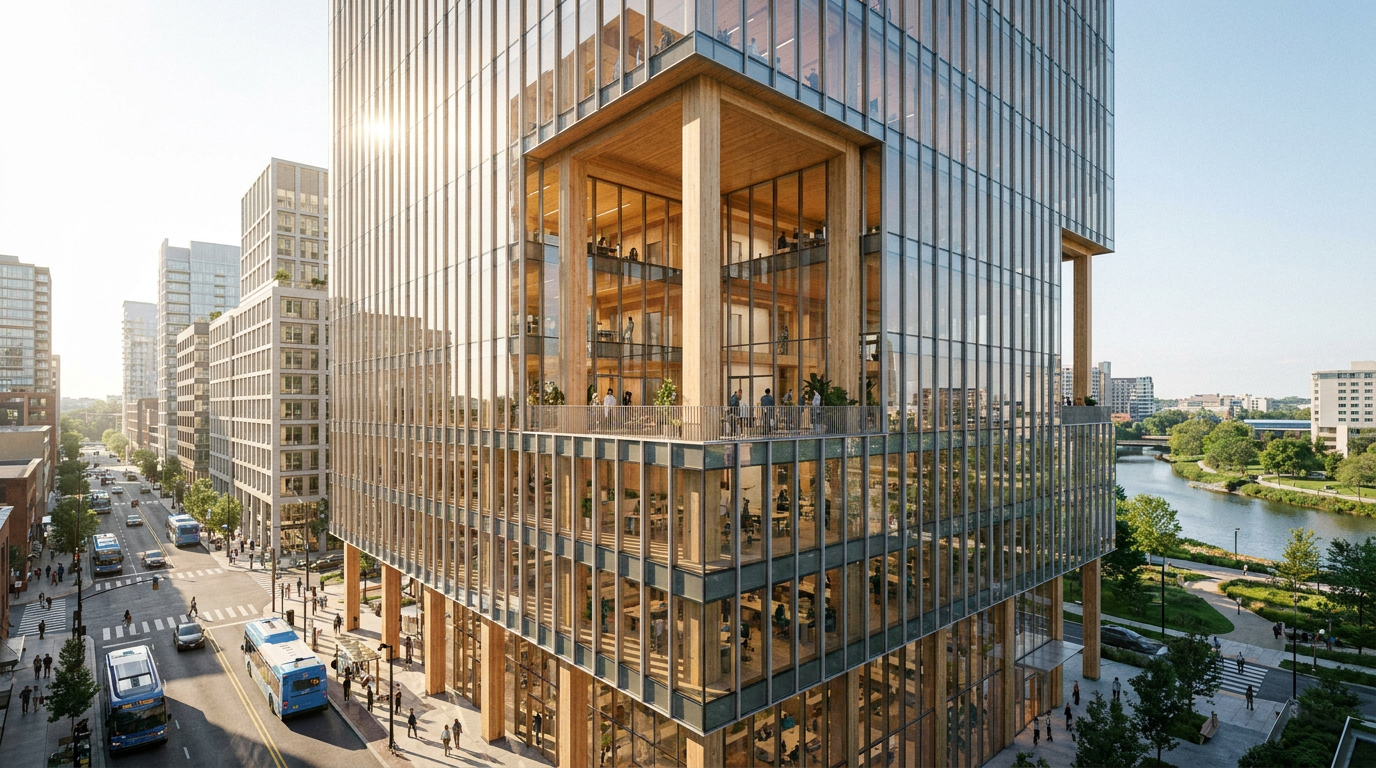
Milwaukee, Wisconsin, is quietly becoming the global capital of a structural revolution. In the city's downtown, construction is underway on "The Edison," a 31-story residential tower that will reach 362 feet into the sky. But unlike the steel and concrete monoliths that defined the 20th-century urban landscape, The Edison is being built primarily out of wood. When completed in 2026 or 2027, it will claim the title of the world's tallest mass timber building, surpassing another Milwaukee tower, the 25-story Ascent, which currently holds the record.[1][5]
The rise of "mass timber" represents one of the most significant shifts in commercial architecture in decades. For over a century, building tall meant pouring concrete and welding steel, while wood was relegated to single-family homes and low-rise framing. But a suite of engineered wood products has fundamentally altered the structural mathematics of high-rise construction. By gluing, nailing, or doweling layers of wood together, engineers have created panels and beams that rival the load-bearing strength of traditional industrial materials.[2][6]
The undisputed workhorse of this architectural movement is Cross-Laminated Timber, or CLT. To manufacture CLT, lumber boards are stacked in alternating, perpendicular layers—usually three, five, or seven layers thick—and bonded with high-strength structural adhesives. This cross-hatching technique eliminates the natural directional weakness of wood grain, resulting in massive, dimensionally stable panels that will not warp or twist. These panels can measure up to 60 feet long and serve as the primary floor slabs and load-bearing walls for skyscrapers.[4][6]
Alongside CLT, builders rely heavily on "glulam," or glue-laminated timber, where the wood grain all runs in the same direction to create massive structural columns and beams. Together, these engineered products boast a strength-to-weight ratio that is roughly 1.5 times that of steel. Because the material is significantly lighter than concrete, mass timber buildings require smaller, less expensive foundations, allowing developers to build taller structures on sites with poor soil conditions.[1][4][5]
The primary catalyst driving the mass timber boom is the urgent need to decarbonize the built environment. The traditional construction sector is a massive climate liability; cement production alone accounts for roughly 8% of global carbon dioxide emissions. Mass timber flips this equation. Trees naturally draw carbon dioxide out of the atmosphere as they grow, and that carbon remains locked inside the wood for the lifespan of the building.[4][6]
By replacing carbon-intensive concrete and steel with engineered wood, mass timber structures can reduce a building's "embodied carbon"—the emissions associated with manufacturing and transporting building materials—by 20% to 60%. For environmentally conscious developers and corporations seeking to meet strict sustainability targets, building with wood has transitioned from a niche aesthetic choice to a core strategic mandate.[4][6]

Beyond environmental benefits, mass timber is transforming the logistics of the construction site. Traditional concrete construction is messy, weather-dependent, and labor-intensive, requiring time to pour and cure on-site. Mass timber, by contrast, relies heavily on prefabrication. The massive wooden panels and beams are manufactured in off-site factories, where advanced computer-numerical-control (CNC) machines cut them to millimeter precision.[4][6]
These prefabricated components are then shipped to the construction site and assembled almost like a giant piece of flat-pack furniture. Because the panels arrive with pre-cut openings for doors, windows, and plumbing, the assembly process is remarkably quiet and efficient. Industry data indicates that mass timber buildings can be constructed up to 25% faster than their concrete counterparts, significantly reducing labor costs and neighborhood disruption.[4]
These prefabricated components are then shipped to the construction site and assembled almost like a giant piece of flat-pack furniture.
This combination of speed and sustainability has ignited a global market. The global cross-laminated timber market is projected to nearly double, growing from roughly $2.3 billion in 2026 to over $4.1 billion by 2032. Europe currently dominates the industry, accounting for over 40% of the global market share, with countries like Austria, Germany, and Sweden serving as the primary manufacturing hubs. In regions like Scandinavia, timber construction is already heavily integrated into public infrastructure and mid-rise housing.[4][6]

North America is rapidly catching up. Recent revisions to the International Building Code (IBC) have explicitly permitted mass timber structures to rise up to 18 stories by default, providing a regulatory green light that has spurred a wave of new development. While record-breaking towers like The Edison require special variances and hybrid designs—often utilizing a concrete central elevator core for lateral wind stability—the broader mid-rise market is adopting timber at an unprecedented pace.[1][4][5]
Yet, the most persistent hurdle facing the mass timber revolution is a primal, intuitive fear: wood burns. Convincing the public, regulators, and insurance companies that a 30-story wooden skyscraper is safe requires overcoming centuries of ingrained caution regarding urban fires. The reality of how engineered timber behaves in a fire, however, is highly counterintuitive and relies on a mechanism known as the "char layer."[2][3]
When exposed to intense heat, large-section mass timber does not ignite and burn through rapidly like the light-frame two-by-fours used in residential housing. Instead, the outer surface of the thick timber panel burns and quickly forms a layer of black char. This char layer acts as a highly effective thermal insulator, starving the fire of oxygen and dramatically slowing the rate at which heat penetrates the interior of the wood.[2][3]
Because the charring rate of engineered timber is highly predictable—typically advancing at a known fraction of an inch per hour—engineers can intentionally oversize the wooden beams and columns. In the event of a severe fire, the outer layer is sacrificed to char, while the protected inner core retains its full structural load-bearing capacity, preventing the building from collapsing.[2]

This mechanism has been proven in rigorous, full-scale testing. In a landmark 2022 test at the Ottawa Fire and Explosives Testing Facility, researchers subjected a two-story mass timber structure to a severe, worst-case-scenario fire without any sprinkler activation or firefighter intervention. Despite the intense exposure, the char layer performed exactly as engineered; the structure remained entirely stable and was safe to enter after the fire burned itself out.[2]
Despite these engineering assurances, the insurance industry and some regulatory bodies remain cautious. While countries like Sweden and France have embraced tall timber, jurisdictions like the United Kingdom have tightened regulations on combustible materials in the wake of the Grenfell Tower tragedy, complicating the approval process for exposed timber facades. Fire safety experts note that while mass timber is not inherently unsafe, it requires a higher level of competency from architects to properly assess the specific hazards of exposed wood.[3]
For insurers, the concern extends beyond structural collapse. Insurance models focus on the "estimated maximum loss" of an event. Even if a mass timber building survives a fire structurally intact, the extensive water damage from firefighting efforts, combined with the difficulty of replacing massive, charred structural panels, can result in total financial write-offs. This financial risk calculation continues to keep insurance premiums for mass timber buildings higher than those for conventional concrete structures.[3]
To bridge this gap, the industry is increasingly turning to hybrid structural systems. Towers like The Edison in Milwaukee and the 42-story Atlassian Central headquarters in Sydney, Australia, utilize a combination of materials to maximize their respective strengths. By pairing a concrete or steel central core with mass timber floors and framing, developers can achieve the aesthetic and carbon benefits of wood while satisfying the strictest seismic and fire safety codes.[1][5]

As the supply chain matures and manufacturing capacity expands, mass timber is poised to transition from an architectural novelty to a standard building practice. The skyline of 2030 will likely look different—not necessarily in its shape, but in its substance. By turning to the forest, architects are discovering that the most advanced technology for building the sustainable cities of the future has been growing from the ground all along.[4][6][7]
How we got here
2014
Early mass timber projects face setbacks, such as a fire at Nottingham University's chemistry building during construction, highlighting the need for strict protocols.
2021
The International Building Code (IBC) is revised to allow mass timber buildings up to 18 stories, sparking a US development boom.
2022
Milwaukee's Ascent tower is completed at 25 stories, setting the record for the world's tallest mass timber building.
2025
Construction begins on The Edison in Milwaukee, designed to reach 31 stories and claim the new global height record.
Viewpoints in depth
Timber Engineering Advocates
Architects and environmentalists pushing for the rapid adoption of engineered wood.
This camp views mass timber as the only viable path to decarbonizing the global construction industry. They point to the material's immense strength-to-weight ratio, the speed of prefabricated assembly, and the proven physics of the char layer as evidence that timber can safely replace concrete and steel in mid-rise and high-rise urban development.
Risk & Insurance Assessors
Insurers and fire safety regulators focused on the financial and safety risks of combustible structures.
While acknowledging that mass timber can be engineered safely, this group emphasizes that wood remains a combustible fuel source. They worry about the lack of long-term, real-world data on high-rise timber fires, the potential for catastrophic water damage during firefighting efforts, and the high cost of replacing charred structural panels even if the building does not collapse.
Hybrid Construction Proponents
Pragmatic developers blending traditional and new materials to satisfy codes.
Rather than pushing for all-wood structures, this camp advocates for hybrid systems. By using concrete for central elevator cores and foundations, and mass timber for floors and framing, they argue developers can achieve the carbon reductions of wood while bypassing the strictest regulatory and insurance hurdles associated with lateral wind stability and fire safety.
What we don't know
- How insurance premiums for mass timber buildings will evolve as the industry gathers more long-term actuarial data.
- Whether global sustainable forestry practices can scale rapidly enough to meet the surging demand for engineered wood without causing ecological strain.
Key terms
- Mass Timber
- A category of engineered wood products made by binding layers of wood together to create structural panels and beams.
- Cross-Laminated Timber (CLT)
- Wood panels made by stacking lumber in alternating, perpendicular layers and gluing them together for immense strength.
- Glulam
- Glue-laminated timber, where the wood grain all runs in the same direction, typically used for load-bearing columns and beams.
- Embodied Carbon
- The total greenhouse gas emissions generated by the manufacturing, transportation, and assembly of building materials.
- Char Layer
- The burnt, blackened outer surface of thick timber that acts as a thermal insulator during a fire, protecting the inner wood.
Frequently asked
Is mass timber safe in a fire?
Yes, when properly engineered. Large-section timber burns predictably, forming an outer char layer that insulates the inner core and prevents structural collapse.
How tall can a mass timber building be?
Current building codes in many regions allow up to 18 stories by default, but hybrid designs using concrete cores are pushing past 30 stories, such as The Edison in Milwaukee.
Does mass timber construction cause deforestation?
No, the industry relies on sustainably managed forests where trees are replanted. Harvesting younger trees and replanting actually increases the forest's overall carbon sequestration rate.
Why is it better for the environment than concrete?
Concrete and steel production release massive amounts of CO2. Trees absorb carbon as they grow, and mass timber locks that carbon inside the building for its entire lifespan.
Sources
Source coverage
7 outlets
3 viewpoints surfaced







[1]Construction BriefingTimber Engineering Advocates
Construction of 'world's tallest' mass timber high-rise underway
Read on Construction Briefing →[2]Cornerstone Timber FramesTimber Engineering Advocates
Mass Timber Fire Safety: How Large-Section Wood Resists Fire
Read on Cornerstone Timber Frames →[3]DezeenRisk & Insurance Assessors
Architects must improve understanding of mass-timber fire safety or "risk disaster"
Read on Dezeen →[4]MarkNtel AdvisorsMarket & Policy Analysts
Global Cross-Laminated Timber Market Geographical Outlook 2026
Read on MarkNtel Advisors →[5]Construction DiveTimber Engineering Advocates
Contractor breaks ground on world’s tallest mass timber building
Read on Construction Dive →[6]EuroditaMarket & Policy Analysts
European Timber Construction Market 2026
Read on Eurodita →[7]Factlen Editorial TeamMarket & Policy Analysts
Synthesis by Factlen editorial team
Read on Factlen Editorial Team →


Every angle. Every day.
Get culture stories with full source coverage and perspective breakdowns delivered to your inbox.