
The Rise of Sleep Tourism: How Hotels Are Engineering the Perfect Night's Rest
Driven by a global epidemic of burnout, the hospitality industry is transforming hotel rooms into high-tech recovery clinics equipped with AI mattresses and circadian lighting.
By Factlen Editorial Team
- Hospitality Industry
- Sees sleep optimization as a highly lucrative market segment that drives bookings and guest loyalty.
- Wellness Travelers
- View sleep tourism as a necessary antidote to chronic burnout and the digital fatigue of modern life.
- Sleep Scientists
- Support the focus on environmental sleep hygiene but warn against obsessive tracking and pseudoscientific internet trends.
- Accessibility Advocates
- Worry that restorative rest is becoming a luxury commodity available only to those who can afford premium interventions.
What's not represented
- · Shift workers who face systemic barriers to circadian alignment
- · Budget travelers seeking affordable sleep solutions
Why this matters
As digital fatigue and chronic stress erode public health, the travel industry is proving that environments can be engineered to restore our biology. Understanding the science behind these sleep-optimized spaces offers a blueprint for how we can build better rest habits in our own homes.
Key points
- Sleep tourism is a rapidly growing travel sector focused entirely on restorative rest.
- The global market for sleep-focused travel is valued at over $75 billion.
- Hotels are installing circadian lighting and AI mattresses to optimize the sleep environment.
- Properties now offer 'dopamine menus' and sleep coaching instead of packed itineraries.
- Experts warn against 'sleepmaxxing' trends that can cause sleep anxiety.
- Advocates caution that high-quality sleep is increasingly becoming a luxury commodity.
The traditional vacation is often exhausting. Travelers pack dense itineraries, fight across multiple time zones, and frequently return home feeling like they need a vacation from their vacation. But in 2026, a radical shift is reshaping the travel industry: people are paying premium rates simply to go to sleep.[1]
The concept of "sleep tourism" has evolved from a niche wellness offering into a dominant force in global hospitality. Rather than treating the hotel room as a mere pit stop between sightseeing tours, travelers are making the bed the primary destination, seeking out environments specifically engineered to induce deep, restorative rest.[5]
The economics behind this shift are staggering. The global sleep tourism market, valued at roughly $75.7 billion in 2024, is expanding at an annual growth rate of over 8%, with industry analysts projecting it could double by the early 2030s.[3][8]
This boom is a direct response to a modern public health crisis. According to the National Sleep Foundation, six in ten American adults fail to get the recommended seven to nine hours of quality sleep each night, while nearly 40% struggle to fall asleep multiple times a week.[5]
Chronic burnout, digital fatigue, and the blurring of work-life boundaries have left populations chronically exhausted. In the United Kingdom, nearly three-quarters of adults report sleeping badly, driving a collective desperation for interventions that actually work.[4]
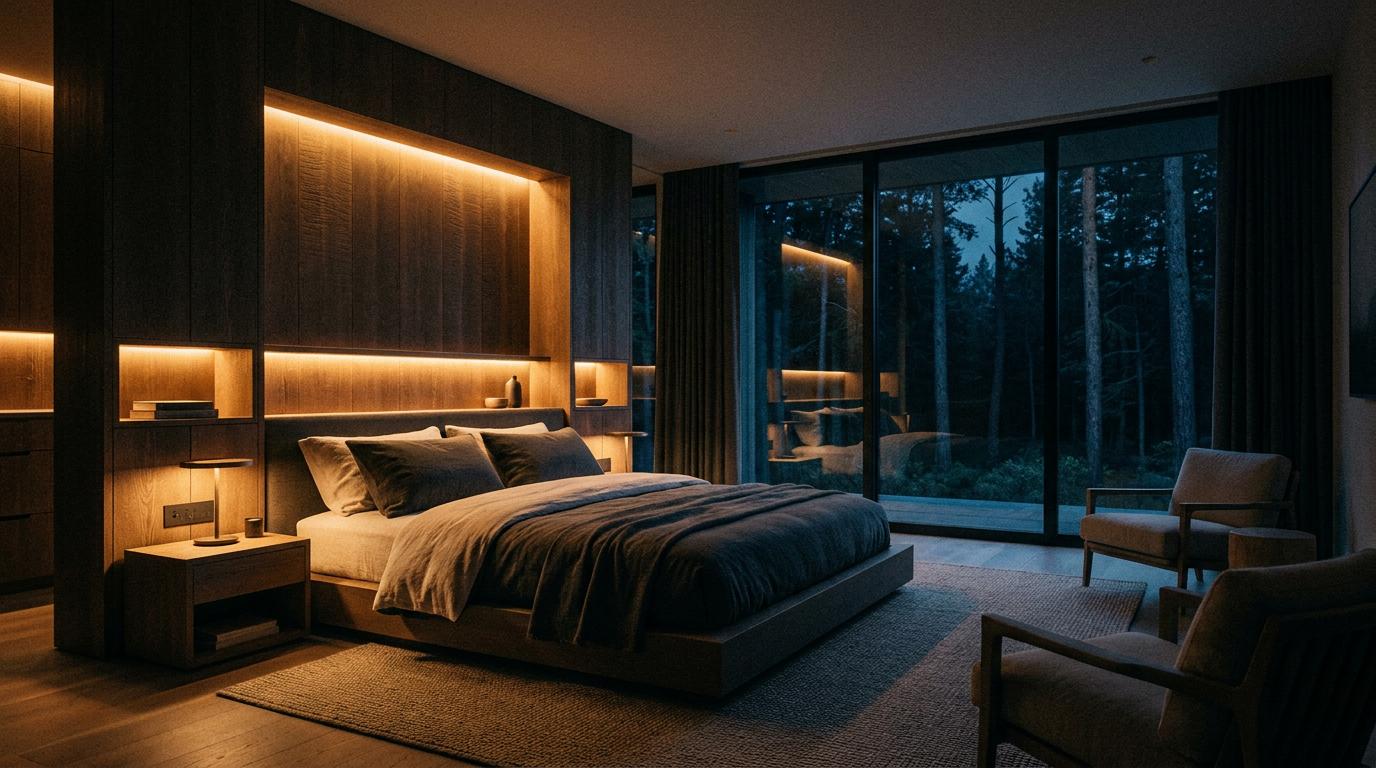
To meet this demand, the hospitality industry is transforming the standard hotel room into a high-tech recovery clinic. The most significant architectural innovation is the widespread adoption of circadian lighting systems in luxury and boutique properties.[2]

These smart lighting networks mimic the natural progression of the sun. They bathe the room in cool, blue-toned light in the morning to suppress melatonin and boost alertness, then automatically transition to warm, amber hues in the evening to signal to the brain that it is time to wind down.[1][2]
These smart lighting networks mimic the natural progression of the sun.
Acoustic engineering has also become a critical selling point. Beyond standard soundproofing, premium properties are installing active noise-cancellation architecture and offering curated ambient soundscapes designed to mask disruptive frequencies and lower guests' resting heart rates.[2]
At the center of the room is the bed itself, which has undergone a technological revolution. High-end resorts, such as the Park Hyatt New York, have moved past high-thread-count sheets to install AI-powered smart mattresses.[8]
These beds are equipped with biometric sensors that track heart rate, respiration, and movement. Throughout the night, the mattress automatically adjusts its firmness to relieve pressure points and actively regulates surface temperature, keeping the sleeper in the optimal thermal zone for deep REM sleep.[4][8]

The optimization extends beyond the physical room into specialized programming. Hotels are partnering with sleep scientists and dream experts to offer personalized consultations, moving far beyond the traditional "pillow menu" offered at check-in.[4]
Guests can now order from "dopamine menus"—curated selections of screen-free, low-stimulation activities designed to replace doomscrolling before bed. Spas have also pivoted, offering evening treatments rich in transdermal magnesium and melatonin to physically prepare the body for rest.[6][7]
However, the rise of sleep tourism has sparked debate among health professionals. While experts applaud the mainstream focus on rest, they warn against the internet-fueled trend of "sleepmaxxing," which treats sleep as a competitive sport.[6]
With over 125 million posts on TikTok, sleepmaxxing often mixes evidence-based habits with extreme, unverified practices, such as mouth taping or obsessive biometric tracking, which can paradoxically induce sleep anxiety and worsen insomnia.[6]

Furthermore, the Global Wellness Institute has raised concerns about a growing "sleep divide." As the most advanced restorative environments become concentrated in luxury resorts, high-quality sleep risks becoming a commodified luxury rather than a fundamental human right accessible to all.[2]
Despite these concerns, the trajectory of travel is clear. As society continues to grapple with the exhausting pace of modern life, the ultimate luxury is no longer an action-packed itinerary, but the simple, profound promise of a good night's sleep.[1]
How we got here
Pre-2020
Hotels focus primarily on premium bedding and pillow menus as their main sleep amenities.
2022–2023
Post-pandemic burnout drives a surge in wellness retreats, with a new emphasis on recovery.
2024
The global sleep tourism market surpasses $75 billion as major hospitality brands launch dedicated sleep programs.
2026
AI-powered mattresses and circadian lighting become standard features in luxury wellness travel.
Viewpoints in depth
Wellness Travelers
View sleep tourism as a necessary antidote to chronic burnout and the digital fatigue of modern life.
For many modern professionals, the traditional vacation has lost its appeal. Wellness travelers argue that the relentless pace of daily life, combined with the constant stimulation of digital devices, has created a baseline of exhaustion that a standard beach holiday cannot fix. They view sleep tourism not as an indulgence, but as a necessary biological reset. By outsourcing their sleep hygiene to experts and engineered environments, they hope to break the cycle of insomnia and return home with sustainable habits.
Hospitality Industry
Sees sleep optimization as a highly lucrative market segment that drives bookings and guest loyalty.
Hotel brands and wellness resorts recognize that sleep is the ultimate untapped amenity. Industry analysts note that guests who report a good night's sleep are significantly more likely to return to a property. By investing in high-tech infrastructure like circadian lighting and AI mattresses, hotels can differentiate themselves in a crowded market and justify premium room rates. The industry views this shift as a long-term evolution of hospitality, moving from merely providing a bed to actively managing a guest's physiological recovery.
Sleep Scientists
Support the focus on environmental sleep hygiene but warn against obsessive tracking and pseudoscientific internet trends.
Medical professionals and sleep researchers are generally thrilled that society is finally taking sleep seriously. They strongly support hotel initiatives that control light, temperature, and noise—the foundational pillars of sleep hygiene. However, they express deep concern over the gamification of rest. Scientists warn that the internet trend of 'sleepmaxxing' and the hyper-fixation on biometric data from smart beds can trigger orthosomnia—an unhealthy obsession with achieving perfect sleep that paradoxically causes anxiety and insomnia.
Accessibility Advocates
Worry that restorative rest is becoming a luxury commodity available only to those who can afford premium interventions.
As the sleep economy booms, sociologists and wellness advocates are pointing out a troubling disparity. They argue that the people who most desperately need restorative rest—shift workers, parents without childcare, and lower-income individuals living in noisy urban environments—are the least likely to afford a $1,000-a-night sleep retreat. These advocates warn of a growing 'sleep divide,' where the biological necessity of a good night's rest is increasingly gated behind luxury paywalls and high-tech consumer goods.
What we don't know
- Whether high-tech interventions like AI mattresses provide significantly better rest than traditional dark, quiet environments.
- How quickly budget and mid-tier hotel chains will adopt advanced sleep technologies.
- The long-term psychological effects of hyper-fixating on biometric sleep data.
Key terms
- Sleep Tourism
- Travel designed specifically to improve and prioritize rest, rather than fitting sleep around a packed vacation itinerary.
- Circadian Lighting
- Artificial lighting systems that mimic the natural progression of sunlight to help regulate the body's internal clock.
- AI Mattress
- A smart bed equipped with sensors to track biometrics and automatically adjust firmness and temperature throughout the night.
- Dopamine Menu
- A curated list of low-stimulation, screen-free activities designed to wind down the brain before bedtime.
- Sleepmaxxing
- An internet trend focused on extreme sleep optimization, which sometimes mixes evidence-based habits with unproven or anxiety-inducing practices.
Frequently asked
What makes a sleep tourism hotel different?
Unlike traditional hotels that serve as a base for sightseeing, sleep hotels engineer the room specifically for rest. They feature circadian lighting, soundproof architecture, AI mattresses, and specialized wind-down programming.
Do AI smart mattresses actually improve sleep?
They can help by actively regulating body temperature and adjusting firmness to relieve pressure points, though sleep scientists note that a dark, quiet room and a consistent schedule remain the most critical factors.
Is sleep tourism only for luxury travelers?
While the trend began in five-star wellness resorts, budget and mid-tier chains are increasingly adopting basic sleep-friendly amenities, such as better blackout curtains and upgraded bedding.
Sources
Source coverage
8 outlets
4 viewpoints surfaced








[1]Factlen Editorial TeamAccessibility Advocates
Synthesis by Factlen editorial team
Read on Factlen Editorial Team →[2]Global Wellness InstituteAccessibility Advocates
2026 Sleep Initiative Trends: Sleep Tourism and the Growing Sleep Divide
Read on Global Wellness Institute →[3]Fortune Business InsightsHospitality Industry
Sleep Tourism Market Size & Future Outlook
Read on Fortune Business Insights →[4]National GeographicSleep Scientists
Why sleep tourism is the travel trend of the year
Read on National Geographic →[5]US MagazineWellness Travelers
Sleep Tourism Is One of 2026's Biggest Travel Trends
Read on US Magazine →[6]Mattress MiracleSleep Scientists
Sleep Trends 2026: Sleep Tourism, Sleepmaxxing, and Dopamine Menus
Read on Mattress Miracle →[7]Luxury LondonWellness Travelers
The rise of sleep tourism: Where to go for a good night's rest
Read on Luxury London →[8]Grand View ResearchHospitality Industry
Sleep Tourism Market Size, Share & Trends Analysis Report
Read on Grand View Research →
Every angle. Every day.
Get travel stories with full source coverage and perspective breakdowns delivered to your inbox.