
The 2026 Smartphone Buyer's Guide to On-Device AI: What You Actually Need
As Apple, Google, and Samsung push 'AI phones,' understanding the difference between on-device and cloud processing is crucial for battery life, privacy, and performance.
By Factlen Editorial Team
- Privacy-First Advocates
- Prioritizes keeping all personal data and AI processing strictly on the local device.
- Agentic AI Proponents
- Values highly capable, proactive AI assistants that execute complex tasks across multiple apps.
- Hardware Realists
- Focuses on the physical limitations of mobile silicon, specifically memory bandwidth and thermal throttling.
What's not represented
- · Environmental Advocates (concerned about the e-waste of upgrading for AI)
- · Budget Consumers (priced out of the 12GB RAM flagship market)
Why this matters
If you buy a phone with insufficient RAM or a weak NPU, the heavily advertised AI features will either drain your battery, lag, or secretly send your personal data to the cloud. Understanding these specs ensures you buy a device that actually empowers your daily life.
Key points
- On-device AI relies on a dedicated Neural Processing Unit (NPU) to process data locally rather than in the cloud.
- A minimum of 12GB of RAM is now required for smartphones to run advanced AI models smoothly in the background.
- Local processing guarantees absolute privacy and works offline, but consumes roughly 20% more battery during sustained use.
- Cloud-based 'agentic' AI offers more complex, multi-step capabilities but requires an internet connection and data sharing.
If you are shopping for a new smartphone in 2026, the spec sheet looks fundamentally different than it did just two years ago. The era of comparing camera megapixels and screen resolutions has quietly ended, replaced by a new battleground: artificial intelligence. Every major manufacturer is heavily marketing their devices as "AI phones," promising features that can rewrite your emails, generate images, and organize your life. But beneath the marketing gloss, a quiet hardware revolution is dictating which phones actually deliver on these promises and which ones merely pretend to.[2][8]
The defining feature of this new generation is "on-device AI." Apple has Apple Intelligence, Google pushes Gemini Nano, and Samsung heavily promotes Galaxy AI. While all three companies use similar buzzwords like "privacy-first" and "local processing," the reality of how these systems operate is deeply nuanced. Understanding the mechanics of on-device AI is no longer just for developers; it is the single most important factor in determining whether your next smartphone will feel like a futuristic assistant or a sluggish, battery-draining frustration.[1]
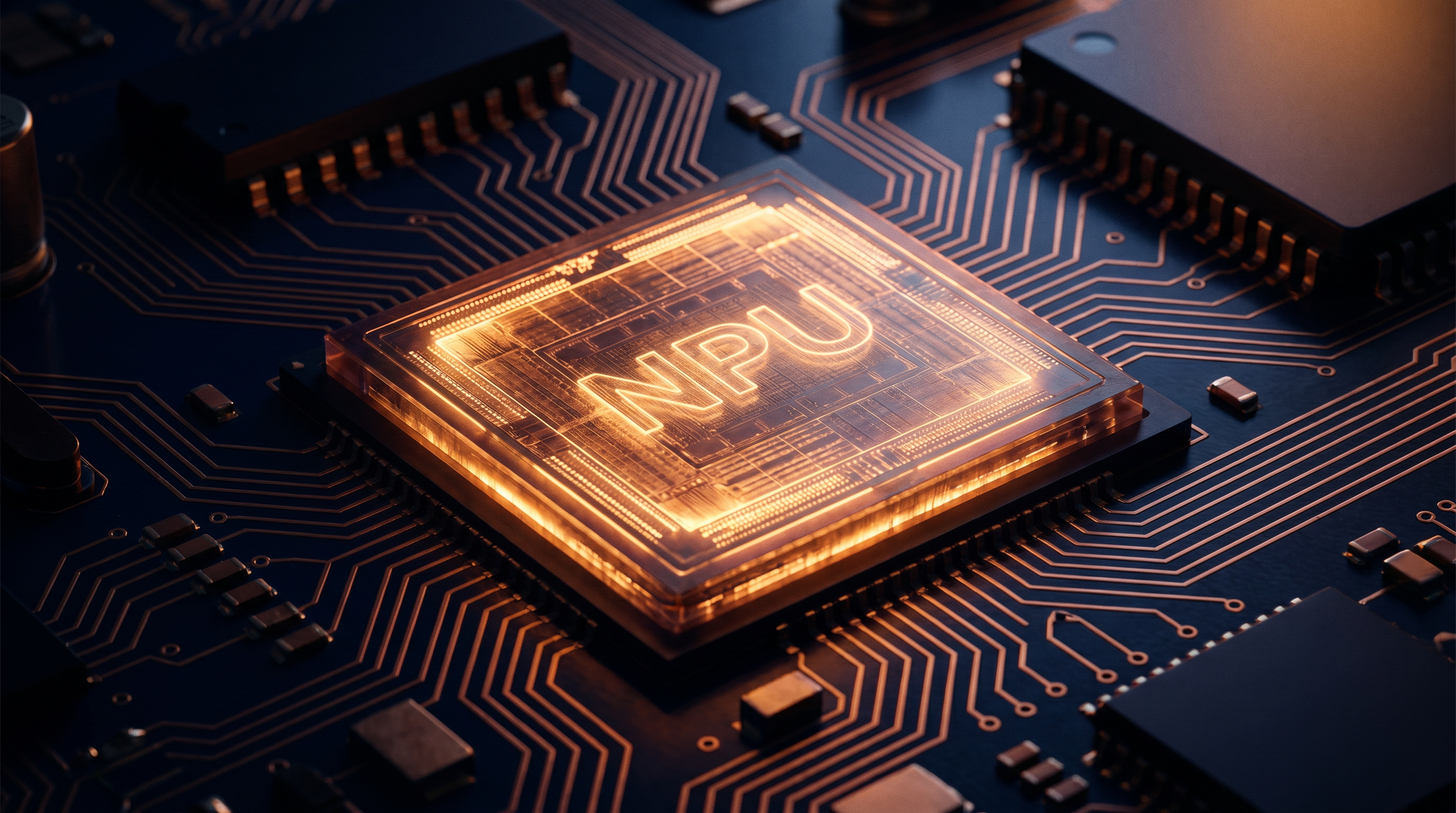
To understand what makes an AI phone work, you have to look past the main processor and focus on the Neural Processing Unit, or NPU. The NPU is a dedicated piece of silicon designed exclusively for the complex mathematics required by neural networks. When you ask your phone to summarize a document or remove a photobomber from a picture, the NPU takes over. Because it is purpose-built for these tasks, it can execute them in milliseconds while using a fraction of the power that the main CPU would require.[2][6]
In 2026, the baseline metric for a capable NPU is measured in TOPS—Trillions of Operations Per Second. For a smartphone to run advanced AI features smoothly without relying on the cloud, industry experts suggest a minimum threshold of 40 TOPS. The latest flagship silicon, such as Qualcomm's Snapdragon 8 Elite Gen 5 and Apple's A18 Pro, comfortably exceed this, hitting between 50 and 65 TOPS. If a phone falls below this mark, it will inevitably struggle with real-time generative tasks.[2][4]

However, raw NPU speed is only half the equation. The quiet, often-ignored bottleneck in mobile AI performance is system memory. To run a local AI model, the device must load the entire neural network into its RAM. If the phone lacks sufficient memory, it is forced to constantly swap data in and out of storage, leading to aggressive app eviction, stuttering performance, and features that feel irritatingly slow.[7]
This memory requirement has fundamentally shifted smartphone design. A 4-bit quantized AI model with 3 billion parameters requires roughly 2 to 3 gigabytes of RAM just to sit idle. When you factor in the operating system and background applications, a phone with 8GB of RAM is barely scraping by. For serious, system-wide AI assistants like Google's Gemini Intelligence, 12GB of RAM has become the new mandatory standard, while ultra-premium devices are pushing toward 16GB and even 24GB to accommodate massive local models.[2][4]
This memory requirement has fundamentally shifted smartphone design.
The distinction between on-device and cloud AI also represents a massive philosophical divide regarding user privacy. Apple has built its architecture around "Invisible AI," prioritizing local processing above all else. When an iPhone needs more computational power than the device can provide, it routes the request to Private Cloud Compute—a verifiable, third-party-auditable server environment designed to immediately destroy the data after processing. For privacy-conscious users, this closed-loop system is a major selling point.[5][9][10]
Conversely, Google and Samsung are leaning heavily into "agentic" AI. These systems are designed to be proactive, executing complex, multi-step workflows like booking rides or cross-referencing your calendar with live traffic data. Because these tasks require vast amounts of real-time data and reasoning capabilities that exceed mobile hardware, they rely heavily on cloud processing. The trade-off is clear: you surrender a degree of absolute privacy in exchange for a significantly more capable, friction-minimizing assistant.[1][5][9]
Beyond privacy, the shift to on-device processing has profound implications for battery life. While NPUs are highly efficient compared to standard processors, running complex generative models locally is still incredibly demanding. Independent testing reveals that sustained use of on-device AI features can consume 18 to 22 percent more battery power than standard smartphone usage. A phone marketed as having "all-day battery" might barely make it past the afternoon if you frequently use it for local image generation or live translation.[3][6]

Thermal management is another critical factor that rarely appears on spec sheets. A smartphone might boast an impressive peak TOPS rating, but neural inference generates significant heat. Under sustained load, such as transcribing a long lecture or running continuous live translation, many devices will thermally throttle after just a few minutes. When this happens, the NPU slows down to prevent overheating, and the AI features degrade in real-time, highlighting the difference between peak marketing claims and sustained real-world performance.[7]
Despite these hardware hurdles, the benefits of true on-device AI are undeniable, particularly for users who travel or work in areas with poor connectivity. Because the models live entirely on the phone's storage, core functions like real-time language translation, smart reply generation, and audio transcription operate flawlessly without an internet connection. This offline capability transforms the smartphone from a cloud-dependent terminal into a genuinely self-sufficient tool.[3][4]
For budget-conscious buyers, the AI revolution presents a tricky landscape. While mid-range chips now include dedicated AI cores, their limited RAM often forces manufacturers to rely on cloud APIs for features that sound identical to their flagship counterparts. This reliance introduces latency—often 1.2 to 2.4 seconds per request—and requires a constant internet connection. A budget phone might advertise "AI photo editing," but the experience will be fundamentally different from a premium device doing the math locally.[3][8]

Ultimately, the decision of which smartphone to buy in 2026 requires looking past the ubiquitous "AI" branding. Shoppers must verify the RAM capacity, check the NPU's TOPS rating, and decide whether they value the absolute privacy of local processing or the expansive capabilities of cloud-connected agents. As the technology matures, the gap between true on-device intelligence and cloud-dependent features will only widen, making informed hardware choices more critical than ever.[8]
How we got here
Late 2023
Early on-device AI models are introduced, but struggle with high memory requirements and battery drain.
Mid 2024
Apple and Google announce foundational shifts toward integrating AI deeply into iOS and Android operating systems.
2025
Model quantization improves dramatically, allowing highly capable 3-billion parameter models to run on mobile silicon.
Spring 2026
12GB of RAM and 40 TOPS NPUs become the established baseline for flagship smartphones to support system-wide AI.
Viewpoints in depth
Privacy-First Advocates
Prioritizes keeping all personal data and AI processing strictly on the local device.
This camp, heavily aligned with Apple's architectural choices, argues that a smartphone contains a user's most intimate data. They believe that sending photos, emails, or location history to a cloud server for AI processing is an unacceptable security risk. For these advocates, the limitations of on-device models—such as smaller parameter counts and slower generation times—are a necessary trade-off to ensure that personal data never leaves the physical hardware.
Agentic AI Proponents
Values highly capable, proactive AI assistants that execute complex tasks across multiple apps.
Driven by Google and Samsung's software philosophies, this viewpoint argues that AI is only useful if it can actually do work for you. They advocate for "agentic" workflows, where the AI can read an email, check a calendar, book a reservation, and draft a reply all in the background. Because these multi-step reasoning tasks require massive computational power that exceeds mobile silicon, this camp embraces cloud processing as the only way to deliver a truly next-generation smartphone experience.
Hardware Realists
Focuses on the physical limitations of mobile silicon, specifically memory bandwidth and thermal throttling.
Composed of benchmarkers, developers, and tech reviewers, this group cuts through the marketing hype to focus on physics. They point out that while a phone might boast a 60 TOPS NPU, the device will inevitably throttle under sustained load due to the lack of active cooling. Furthermore, they highlight that memory bandwidth—not just raw processing power—is the true bottleneck for on-device AI, warning buyers that without sufficient RAM, the heavily advertised AI features will simply drain the battery and lag.
What we don't know
- How quickly current 40 TOPS NPUs will become obsolete as mobile AI models continue to grow in parameter size.
- The long-term impact of sustained high-heat neural inference on the physical lifespan of smartphone batteries.
- Whether mid-range smartphones will eventually receive enough RAM to run flagship-level local models without cloud reliance.
Key terms
- NPU (Neural Processing Unit)
- A specialized hardware chip designed specifically to accelerate the complex mathematical calculations required by artificial intelligence.
- TOPS (Trillions of Operations Per Second)
- A performance metric used to measure the speed and capability of an NPU.
- Quantization
- A compression technique that shrinks the file size and memory requirements of an AI model so it can fit on a mobile device, with minimal loss in accuracy.
- Agentic AI
- Artificial intelligence that doesn't just answer questions, but proactively takes multi-step actions on your behalf, like booking a flight or organizing files.
- On-Device Inference
- The process of running an AI model entirely on the local hardware of a smartphone, rather than sending the data to a remote cloud server.
Frequently asked
Does on-device AI work without an internet connection?
Yes. Because the neural network model is downloaded and stored directly on your phone's memory, core features like real-time translation and text summarization can function entirely offline.
Why do I need 12GB of RAM for a new smartphone?
AI models require a massive amount of memory just to remain active in the background. 12GB ensures the phone can hold the AI model in memory without forcing your other apps to close or slow down.
Will using AI features drain my phone's battery faster?
Yes. While dedicated Neural Processing Units are efficient, sustained use of local AI generation can consume roughly 18 to 22 percent more battery power compared to standard smartphone tasks.
What does 'TOPS' mean on a smartphone spec sheet?
TOPS stands for Trillions of Operations Per Second. It is the standard measurement for how fast a phone's Neural Processing Unit (NPU) can perform the specific math required for artificial intelligence tasks.
Sources
Source coverage
10 outlets
3 viewpoints surfaced









[1]Abhishek GautamPrivacy-First Advocates
Apple Intelligence vs Samsung Galaxy AI vs Gemini Nano: On-Device vs Cloud Privacy Compared (2026)
Read on Abhishek Gautam →[2]LMSAHardware Realists
Best Smartphones & Tablets for Local AI LLMs (May 2026)
Read on LMSA →[3]ElectronicsHubHardware Realists
What to Consider When Buying a New Smartphone in 2026
Read on ElectronicsHub →[4]aiME JournalHardware Realists
Best AI Models for On-Device, Real-Time, and Offline Use
Read on aiME Journal →[5]FindSkillPrivacy-First Advocates
Apple Intelligence vs Gemini Intelligence: 2026 Compare
Read on FindSkill →[6]ArticsledgeHardware Realists
What Is On-Device AI? How It Works in 2026
Read on Articsledge →[7]Vertu InsightsHardware Realists
AI Phone Hardware Features Comparison: What Actually Matters?
Read on Vertu Insights →[8]Mobile VerseAgentic AI Proponents
AI Phones in 2026: Worth Buying or Just Hype?
Read on Mobile Verse →[9]AI Phone WarsAgentic AI Proponents
Galaxy AI vs Apple Intelligence vs Google Gemini: The 2026 AI Phone Wars
Read on AI Phone Wars →[10]LifehackerPrivacy-First Advocates
Here's How Much Gemini Is Actually in Apple Intelligence
Read on Lifehacker →
More in shopping
See all 50 stories →E-Bike Tech
The 2026 E-Bike Buying Guide: Motors, Batteries, and the New Safety Rules
8 sources

Audio Tech
Solid-State MEMS Speakers Are Replacing Traditional Headphone Drivers
7 sources
Nursery Tech
Smart Bassinets vs. Traditional Sleepers: The Complete Trade-Off Analysis
8 sources

Kitchen Upgrades
Induction vs. Gas Cooktops: The 2026 Trade-Off Analysis
8 sources

Every angle. Every day.
Get shopping stories with full source coverage and perspective breakdowns delivered to your inbox.