
How Physical AI is Transforming Robotics from Rigid Machines to Adaptable Workers
The integration of Vision-Language-Action models and biomimetic hardware is allowing robots to perceive, reason, and operate autonomously in unstructured human environments.
By Factlen Editorial Team
- Industrial Automation Operators
- Focuses on the immediate ROI, reliability, and labor-saving potential of deploying adaptable robots in structured environments.
- General-Purpose AI Researchers
- Prioritizes solving the foundational software challenges of embodied intelligence, such as zero-shot learning and the sim-to-real gap.
- Humanoid Hardware Developers
- Emphasizes the necessity of biomimetic design, tactile sensing, and bipedal locomotion for integrating robots into human spaces.
What's not represented
- · Labor Union Representatives
- · Consumer Privacy Advocates
Why this matters
The leap from digital AI to Physical AI means machines can finally take over dangerous, repetitive, and physically demanding tasks in dynamic environments. This shift promises to alleviate severe global labor shortages in logistics and manufacturing while paving the way for eventual robotic assistance in healthcare and homes.
Key points
- Physical AI is shifting artificial intelligence from digital screens into the real world, allowing robots to perceive and adapt to unstructured environments.
- Unlike traditional industrial robots that require rigid programming, AI-native robots can learn on the job and respond to natural language commands.
- Humanoid form factors are becoming the industry standard because they can navigate spaces and use tools originally designed for humans.
- Hardware advancements, such as biomimetic skin with 0.1-newton sensitivity, are making it safe for robots to work directly alongside people.
- Companies are using accelerated digital simulations to train robot software thousands of times faster than real-world testing allows.
- Commercial deployments are already underway in the logistics and manufacturing sectors to combat severe labor shortages.
For the past three years, the artificial intelligence revolution has been largely confined to screens. Large language models can write code, draft legal briefs, and generate photorealistic images in milliseconds, but they exist in a purely digital vacuum. In 2026, the frontier of technology has decisively shifted from the screen to the physical world. This transition is driven by "Physical AI"—artificial intelligence systems that enable machines to autonomously perceive, reason about, and interact with their physical environments in real time. Unlike digital AI, which processes text or pixels, Physical AI must navigate the continuous, noisy, and unforgiving laws of physics, where the consequences of an action are immediate and irreversible.[1][2][4]
Classical robotics solved physical manipulation through rigid, explicit programming. In traditional manufacturing, an engineer writes code that dictates the exact trajectory of a robotic arm, the precise moment a gripper should close, and the specific coordinates of every object. This approach is highly effective for fixed tasks in structured environments, such as automotive assembly lines, where identical motions are repeated millions of times. However, these systems are fundamentally brittle; if a part is dropped or a workstation is slightly misaligned, the traditional robot cannot adapt, requiring human intervention and costly downtime.[3][4]
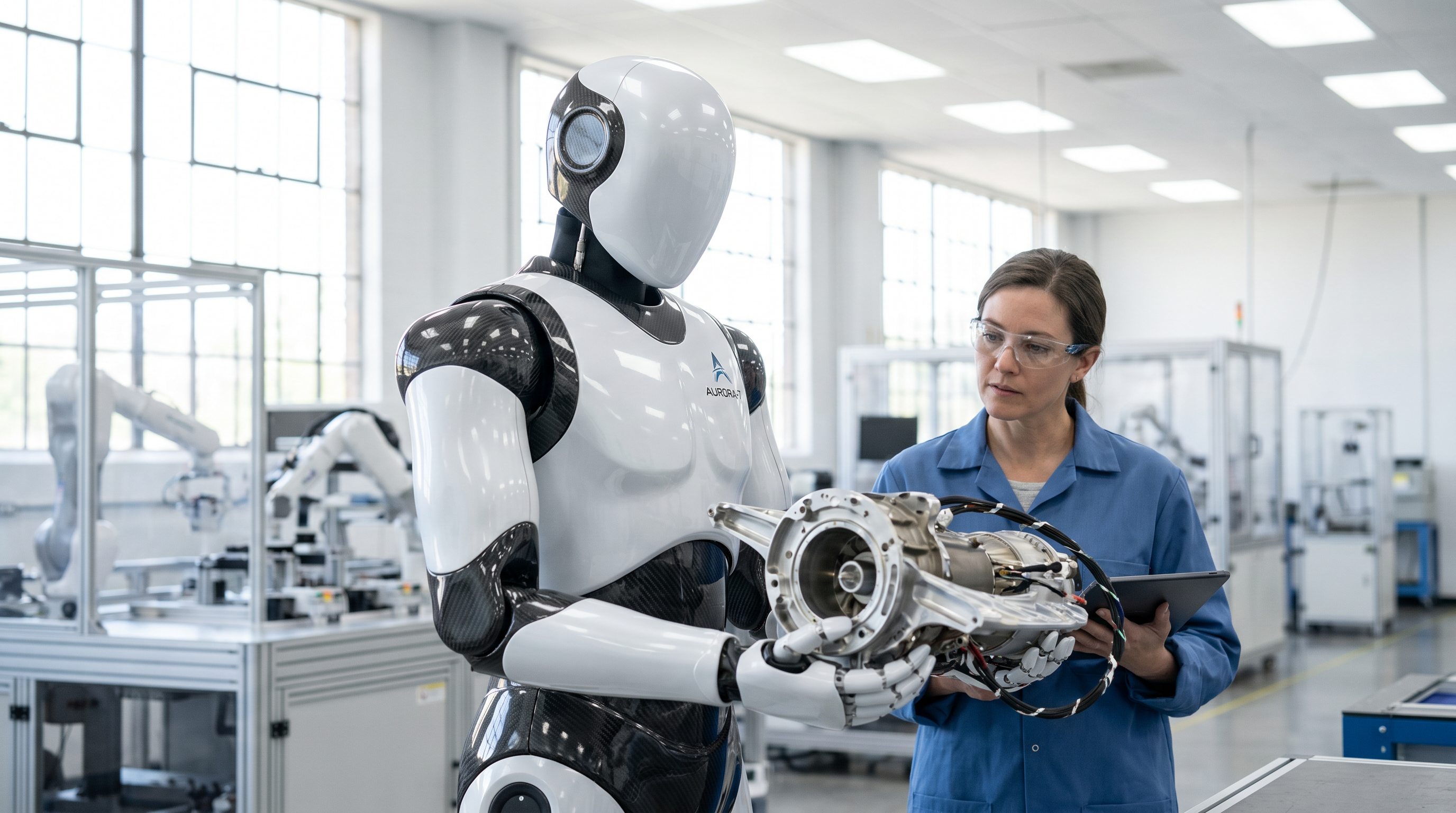
Physical AI dismantles this limitation by replacing rigid scripts with dynamic perception and reasoning. Modern robotic systems are now equipped with Vision-Language-Action (VLA) models, which allow them to interpret their surroundings and select appropriate actions much like the human brain. Instead of following a predetermined path, a robot powered by Physical AI can receive a natural language command, visually locate the target object, calculate the necessary joint angles, and execute the task even if the environment has changed. This capability is transforming robots from isolated, single-task machines into adaptable, general-purpose workers.[1][2][4]
The core technical hurdle that engineers have had to overcome is known as the "grounding problem." A large language model understands the word "grasp" as a statistical pattern of text, but it cannot translate that abstract concept into the precise motor commands required to close a robotic hand around an irregularly shaped object without crushing it or letting it slip. Physical AI solves this by training on embodied data—recordings of actual robots performing tasks in the real world. By processing this physical data, the AI learns what a concept looks like as a trajectory of forces, visual observations, and torque adjustments.[4]

This breakthrough is no longer confined to laboratory demonstrations. In June 2026, the Barcelona-based robotics company THEKER raised $85 million in a Series A funding round to scale its AI-native generalist robots across European industrial environments. Unlike traditional systems that take weeks to program, THEKER’s robots are designed to be deployed in days, continuously learning on the job without manual reprogramming. By adapting in real time to mixed inventory, irregular shapes, and operational variability, these systems are actively addressing persistent labor shortages in logistics and manufacturing.[6]
Similar commercial momentum is visible across the broader robotics sector. Humanoid platforms from companies like Figure AI, Agility Robotics, and Tesla have moved out of the research phase and into active customer pilots at major manufacturing and logistics facilities. Tesla, for instance, has reportedly produced over 50,000 units of its Optimus robot, deploying them internally for repetitive pick-and-place operations and battery cell sorting. Meanwhile, Figure AI has deployed its humanoid units in BMW manufacturing facilities to handle sheet metal and parts placement, proving that the hardware is now capable of sustained industrial labor.[1][7]
Similar commercial momentum is visible across the broader robotics sector.
The convergence on the humanoid form factor is a deliberate engineering choice. While fixed robotic arms are cheaper and wheeled robots are more stable, humanoids offer unparalleled versatility in environments that were originally designed for people. A bipedal robot with dexterous hands can navigate stairs, reach standard shelving, and operate tools without requiring a facility to undergo massive, expensive reconfigurations. This means the same robotic platform can be dynamically reassigned from unloading trucks in the morning to sorting inventory in the afternoon, fundamentally changing the economics of automation.[3][7]
Hardware capabilities are advancing in tandem with software, focusing heavily on safe human-robot interaction. In early 2026, Matrix Robotics launched the MATRIX-3, a third-generation flagship humanoid that integrates biomimetic design with advanced tactile sensing. The robot features a 3D woven biomimetic skin embedded with a distributed sensing network capable of detecting micro-forces as low as 0.1 newtons. This extreme sensitivity allows the robot to handle delicate objects and operate safely alongside human workers, cushioning contact and adjusting its grip in real time.[5]

The MATRIX-3 also features a 27-degree-of-freedom dexterous hand powered by cable-driven actuation, enabling it to perform complex manipulations like tool operation and fabric handling. Coupled with a general motion control model trained on extensive human motion-capture datasets, the robot achieves a fluid, natural gait that closely mimics human biomechanics. These hardware innovations are crucial for moving robots out of caged industrial cells and into dynamic, unstructured environments like retail spaces, hospitals, and eventually, homes.[1][5]
Training these advanced physical systems requires massive amounts of data and computational power. To accelerate this process, companies are leveraging highly realistic digital twins. NVIDIA's Isaac platform and its new Cosmos 3 world foundation model allow developers to train robot policies in simulated environments at 1,000 times real-world speed. By generating edge-case scenarios and evaluating behavior virtually, researchers can rapidly iterate on a robot's software before ever deploying it to physical hardware, drastically reducing development time and costs.[8]
Despite these rapid advancements, the industry still faces a significant challenge known as the "sim-to-real gap." While a robot might perform a task perfectly in a digital simulation, the physical world is full of unpredictable variables—friction, sensor noise, lighting changes, and material wear—that cannot be perfectly modeled. Bridging this gap requires continuous real-world data collection and refinement, ensuring that the AI's physical intuition matches its digital training.[1][2]

As perception and dexterity mature, the economic implications of Physical AI are becoming impossible to ignore. The logistics and warehousing industry, which faces acute labor shortages and high turnover rates, is the primary proving ground for these systems. By automating repetitive, physically demanding tasks, companies can increase throughput and reduce operational bottlenecks without displacing highly skilled human labor. The focus is shifting from whether these robots work to how quickly they can be integrated into existing supply chains.[3][6]
The year 2026 marks the inflection point where Physical AI transitions from a speculative technology into a core operational capability. While general-purpose robots capable of doing laundry and cooking dinner in a typical home remain a few years away, the foundation has been laid. By combining multimodal AI models with sophisticated, biomimetic hardware, the robotics industry is successfully building machines that can finally perceive, understand, and act within the human world.[1][2]
How we got here
2023–2024
Large language models demonstrate advanced reasoning, sparking interest in applying foundation models to physical robotics.
Late 2025
Major tech companies and startups begin integrating Vision-Language-Action models into robotic hardware, achieving basic autonomous manipulation.
January 2026
Matrix Robotics launches the MATRIX-3, introducing biomimetic skin and 0.1N tactile sensitivity for safe human-robot interaction.
June 2026
THEKER raises $85 million to scale AI-native generalist factory robots, signaling the shift from lab prototypes to commercial industrial deployment.
Viewpoints in depth
Industrial Automation Operators
Focuses on the immediate ROI, reliability, and labor-saving potential of deploying adaptable robots in structured environments.
For logistics and manufacturing leaders, the appeal of Physical AI is strictly economic. Traditional automation requires massive upfront capital to build rigid, caged environments that only perform single tasks. By deploying AI-native generalist robots, operators can automate repetitive, high-turnover roles—like tote picking and machine tending—without redesigning their entire facility. Their primary metric for success is not whether a robot can perform a backflip, but whether it can operate for a 16-hour shift with minimal human intervention and a clear return on investment.
General-Purpose AI Researchers
Prioritizes solving the foundational software challenges of embodied intelligence, such as zero-shot learning and the sim-to-real gap.
The academic and software engineering community views Physical AI as the ultimate test of artificial intelligence. While large language models have mastered digital text, researchers argue that true intelligence requires physical grounding—the ability to understand gravity, friction, and spatial reasoning. This camp is heavily focused on Vision-Language-Action (VLA) models and accelerated digital simulations, believing that once the 'brain' is perfected in virtual environments, it can be seamlessly downloaded into any robotic body to perform tasks it has never explicitly seen before.
Humanoid Hardware Developers
Emphasizes the necessity of biomimetic design, tactile sensing, and bipedal locomotion for integrating robots into human spaces.
Hardware engineers argue that software alone cannot solve physical tasks without the right physical vessel. Because the modern world—from staircases to door handles—was built exclusively for the human form, they believe the humanoid robot is the most efficient universal design. This camp is pushing the boundaries of materials science, developing cable-driven dexterous hands and biomimetic skin with micro-force sensitivity. Their goal is to ensure that as robots become more autonomous, they also become inherently safe and physically intuitive when interacting with humans.
What we don't know
- How quickly the 'sim-to-real gap' can be fully closed for highly complex, unstructured tasks like household chores.
- The long-term impact of widespread physical automation on the global manufacturing labor market.
- When the unit economics of humanoid robots will drop low enough to make them accessible for everyday consumer purchase.
Key terms
- Physical AI
- Artificial intelligence systems that enable machines to autonomously perceive, reason about, and interact with the physical world in real time.
- Zero-Shot Generalization
- An AI model's ability to successfully perform a task or recognize an object it has never explicitly been trained on.
- Sim-to-Real Gap
- The discrepancy between how a robot performs in a simulated digital training environment versus how it behaves in the unpredictable physical world.
- Vision-Language-Action (VLA) Models
- AI models that process visual inputs and text commands simultaneously to output direct motor control actions for a robot.
- Degrees of Freedom (DoF)
- The number of independent movements a robotic joint or mechanical system can make.
Frequently asked
What makes Physical AI different from traditional robotics?
Traditional robots follow rigid, pre-programmed scripts and cannot adapt to changes. Physical AI allows robots to perceive their environment, understand natural language, and adjust their movements in real time.
Are humanoid robots available for home use yet?
Not yet. In 2026, leading humanoid platforms are primarily deployed in commercial pilots for manufacturing and logistics. Consumer availability is projected for the late 2020s.
How do these advanced robots learn new tasks?
Instead of manual coding, they use Vision-Language-Action (VLA) models. They learn by watching human demonstrations or training in accelerated digital simulations before transferring those skills to the real world.
Sources
Source coverage
8 outlets
3 viewpoints surfaced







[1]Factlen Editorial TeamHumanoid Hardware Developers
Synthesis by Factlen editorial team
Read on Factlen Editorial Team →[2]DeloitteIndustrial Automation Operators
AI goes physical: navigating the convergence of AI and robotics
Read on Deloitte →[3]BCGIndustrial Automation Operators
How Physical AI Is Reshaping Robotics Today
Read on BCG →[4]SVRC Robotics CenterGeneral-Purpose AI Researchers
Physical AI in 2026: What It Is, Key Models, and How to Build It
Read on SVRC Robotics Center →[5]Matrix RoboticsHumanoid Hardware Developers
MATRIX-3 | Third-generation flagship humanoid robot
Read on Matrix Robotics →[6]Tech.euIndustrial Automation Operators
Barcelona-based AI robotics outfit Theker raises $85M
Read on Tech.eu →[7]VaaSBlockGeneral-Purpose AI Researchers
Humanoid Robotics 2026: Figure, Optimus, 1X Commercial Reality
Read on VaaSBlock →[8]NVIDIAGeneral-Purpose AI Researchers
NVIDIA Enables the Next Era Of Physical AI Research With Agent Skills
Read on NVIDIA →
More in technology
See all 49 stories →Battery Tech
Solid-State Batteries Move From Lab to Road, Promising 1,000-Kilometer EV Ranges
7 sources
Atmospheric Water Harvesting
Engineers Develop a Wearable Jacket That Harvests Drinking Water Directly From the Air
6 sources

AI Scaffolding
Microsoft and Xiaomi Open-Source Breakthroughs in AI Coding Memory and Skills
8 sources

Battery Tech
Silicon-Carbon Batteries Hit the Global Market, Promising Multi-Day Smartphone Lifespans
7 sources
Every angle. Every day.
Get technology stories with full source coverage and perspective breakdowns delivered to your inbox.