
Solid-State Batteries Move From Lab to Road, Promising 1,000-Kilometer EV Ranges
After decades of research, solid-state battery technology is entering real-world production in 2026, offering electric vehicles double the range, faster charging, and eliminated fire risks.
By Factlen Editorial Team
- Aggressive Adopters
- Believe mass commercialization is happening immediately and will rapidly replace lithium-ion.
- Cautious Incumbents
- View the technology as promising but years away from affordable mass-market scale.
- Next-Gen Mobility Developers
- Leveraging solid-state for high-performance applications where cost is less of a barrier.
What's not represented
- · Raw material mining sector
- · Lithium-ion recycling industry
Why this matters
Solid-state batteries eliminate the biggest hurdles to electric vehicle adoption: range anxiety, long charging times, and cold-weather performance drops. By replacing flammable liquids with stable solid materials, this technology paves the way for lighter, safer, and vastly more capable transportation.
Key points
- Solid-state batteries are moving from laboratory testing to mass production and on-road integration in 2026.
- The technology replaces flammable liquid electrolytes with solid materials, eliminating the risk of battery fires.
- Energy density improvements allow vehicles to exceed 1,000 kilometers of range on a single charge.
- Extreme cold-weather testing shows solid-state cells retain over 74% of their charge at -30°C.
- Early production costs remain high, meaning initial rollout will focus on luxury vehicles, motorcycles, and aviation.
For years, the electric vehicle industry has chased a singular, elusive holy grail: the solid-state battery. Promised as the technology that would finally make EVs lighter, safer, and capable of driving from New York to Detroit on a single charge, it has perpetually remained "five years away" in the eyes of skeptical analysts.[4]
But in 2026, the horizon has finally arrived. Across North America, Europe, and Asia, solid-state batteries are graduating from pristine laboratory environments to punishing real-world roads. Automakers and battery startups are hitting critical manufacturing milestones, signaling that the biggest leap in energy storage since the invention of the lithium-ion cell is now underway.[1][2]
To understand why this shift is monumental, one must look inside the battery cell. Traditional lithium-ion batteries rely on a liquid electrolyte—a chemical soup that shuttles lithium ions back and forth between the anode and the cathode during charging and discharging.[7]
While effective, this liquid comes with severe compromises. It is highly flammable, creating the risk of "thermal runaway" and intense fires if the battery is punctured or overheats. Furthermore, liquid electrolytes are susceptible to the formation of dendrites—microscopic, needle-like metallic whiskers that grow over time and can eventually pierce the battery's internal separator, causing a short circuit.[7]

Solid-state technology eliminates these vulnerabilities by replacing the liquid soup with a solid material, typically a specialized polymer, oxide, or sulfide ceramic. Because the solid electrolyte is non-flammable and physically blocks dendrite growth, the battery becomes inherently stable. Engineers can then safely swap out traditional graphite anodes for pure lithium metal, unlocking massive gains in energy storage.[5][7]
The numbers reflect a paradigm shift. Today's best lithium-ion batteries max out at an energy density of roughly 250 to 300 watt-hours per kilogram (Wh/kg). The solid-state cells entering production in 2026 are hitting 350 to 500 Wh/kg.[2][4][6]
For the consumer, this translates directly to freedom. A vehicle equipped with a solid-state pack can either travel twice as far on the same size battery, or travel the same distance with a battery that is half the weight and size.[4]

Chinese automaker Dongfeng Motor recently announced that its solid-state batteries will enter mass production in the second half of 2026. The company claims these cells will enable passenger vehicles to exceed 1,000 kilometers (over 620 miles) of driving range.[2]
Chinese automaker Dongfeng Motor recently announced that its solid-state batteries will enter mass production in the second half of 2026.
Crucially, Dongfeng has proven the technology's resilience in extreme environments. During winter testing in Mohe, China—where temperatures plunge to -30°C (-22°F)—their solid-state prototype retained over 74% of its charge, effectively eliminating the notorious cold-weather range drop that plagues current EVs.[2]

In North America, Massachusetts-based Factorial Energy has begun on-road testing of its solid-state cells in partnership with major automakers. Following successful validations with Stellantis, Factorial's batteries are now being integrated into development vehicles, demonstrating ultra-fast charging capabilities that can replenish a battery from 15% to 90% in just 18 minutes.[1]
The technology is also unlocking new vehicle form factors. Karma Automotive is utilizing Factorial's cells to power a new generation of EV supercars, where the reduced battery volume allows for sleeker aerodynamics and lower vehicle weight—metrics critical for high-performance track driving.[5]
Two-wheeled transport is moving even faster. At CES 2026, Donut Lab introduced the world's first production-ready solid-state battery for motorcycles. Integrated into the 2026 Verge electric motorcycles, the packs deliver 400 Wh/kg and can charge in under 10 minutes, proving that the technology can be packaged into the tight confines of a motorcycle frame.[6]
The aerospace sector is also capitalizing on the breakthrough. In China, solid-state batteries are already powering electric vertical takeoff and landing (eVTOL) aircraft. The high energy density is essential for aviation, where every kilogram of weight drastically impacts flight time; recent tests showed a 60% to 90% increase in flight range compared to traditional cells.[3]
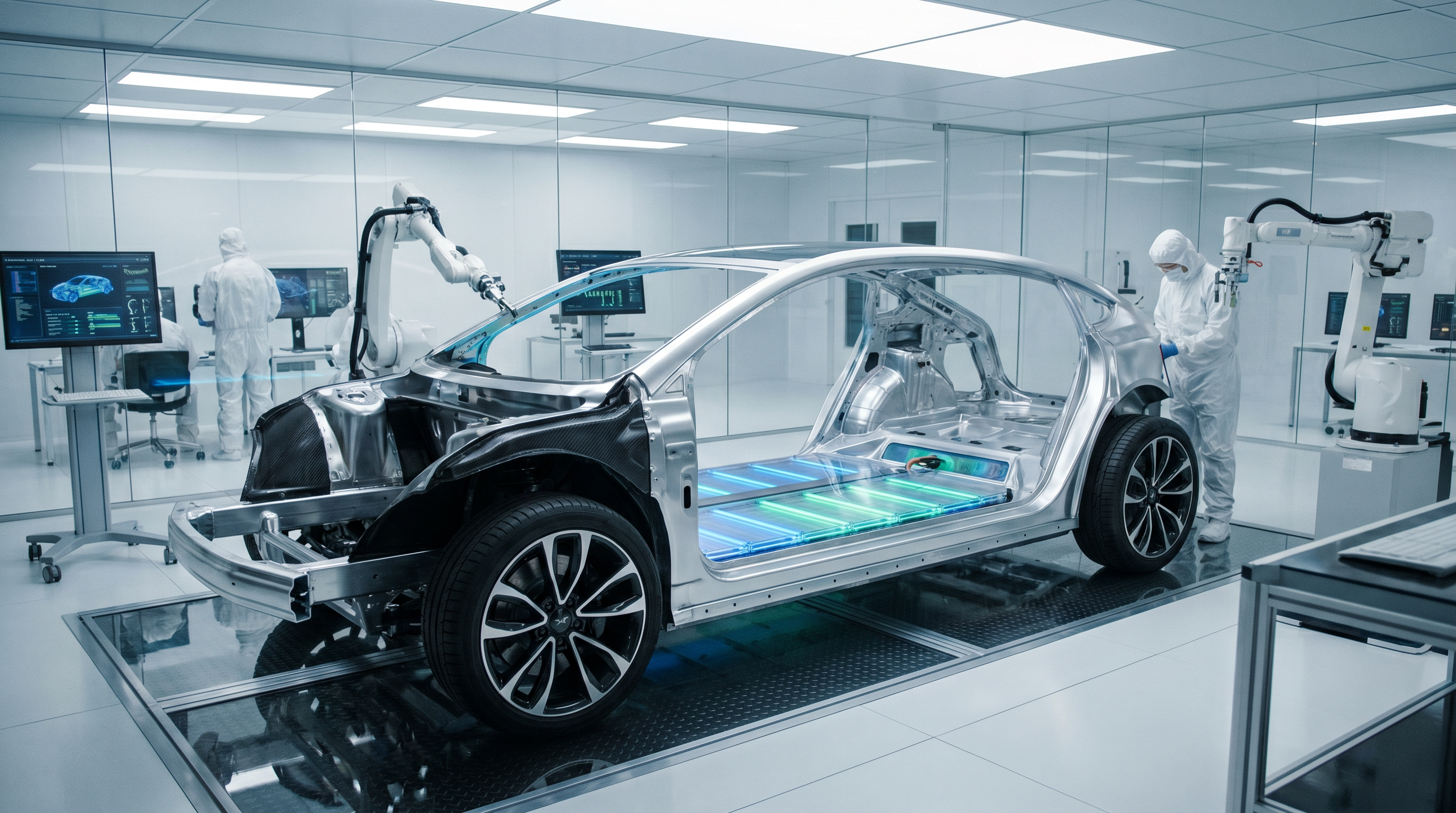
Despite the rapid progress, significant hurdles remain before solid-state batteries become standard in affordable commuter cars. Manufacturing these cells requires entirely new production techniques and highly controlled environments. As a result, early production costs are estimated at $400 to $800 per kilowatt-hour—three to five times more expensive than current lithium-ion packs.[4]

Industry analysts expect that for the next few years, solid-state technology will be reserved for premium luxury vehicles, commercial trucking, and aviation. However, as manufacturing scales and production lines are optimized, costs are projected to plummet by the end of the decade, eventually democratizing the technology and cementing the electric vehicle as the undisputed future of global transportation.[1][4]
How we got here
2010s
Solid-state batteries remain largely confined to laboratory research and small-scale electronics.
2020–2024
Major automakers invest billions into battery startups, achieving breakthroughs in suppressing dendrite growth and stabilizing solid electrolytes.
2025
Mercedes-Benz and Factorial Energy successfully test a solid-state prototype vehicle over 1,200 kilometers on a single charge.
Early 2026
Dongfeng Motor completes extreme cold-weather testing of its solid-state prototype in -30°C conditions.
Mid 2026
Multiple battery manufacturers announce the start of mass production lines, moving the technology from the lab to commercial integration.
Viewpoints in depth
Aggressive Adopters
Believe mass commercialization is happening immediately and will rapidly replace lithium-ion.
Companies like Dongfeng, Greater Bay Technology, and Factorial Energy argue that the fundamental engineering challenges of solid-state batteries have been solved. By moving directly into A-sample production and on-road testing, they believe the industry can scale manufacturing much faster than legacy analysts predict, targeting widespread passenger vehicle integration by 2027.
Cautious Incumbents
View the technology as promising but years away from affordable mass-market scale.
While acknowledging the impressive lab results and prototype tests, cautious voices point to the brutal economics of automotive manufacturing. Analysts note that current solid-state cells cost up to five times more to produce than traditional lithium-ion batteries. They argue that until manufacturing defect rates drop and economies of scale are achieved, solid-state will remain a niche luxury feature rather than a mainstream standard.
Next-Gen Mobility Developers
Leveraging solid-state for high-performance applications where cost is less of a barrier.
For manufacturers of electric aircraft and hypercars, the cost per kilowatt-hour is secondary to energy density and weight. These developers view solid-state batteries as an immediate enabler for products that were previously impossible to build. By acting as early adopters, they are effectively subsidizing the technology's development, paving the way for eventual mass-market automotive use.
What we don't know
- Exactly how quickly manufacturing costs will fall to achieve parity with traditional lithium-ion batteries.
- Whether global supply chains can scale the production of specialized solid electrolytes and pure lithium metal anodes fast enough to meet demand.
- How the batteries will perform over a 15-year lifespan in daily consumer use outside of controlled testing environments.
Key terms
- Solid-state battery
- A type of battery that uses solid electrodes and a solid electrolyte, rather than the liquid or polymer gel electrolytes found in conventional lithium-ion batteries.
- Energy density
- The amount of energy a battery can hold relative to its weight, usually measured in watt-hours per kilogram (Wh/kg). Higher density means more range without adding weight.
- Electrolyte
- The medium inside a battery that allows electrical charge (ions) to flow between the cathode and the anode.
- Dendrites
- Microscopic, needle-like metal structures that can grow inside liquid batteries over time, potentially causing short circuits and fires.
- Thermal runaway
- A dangerous chain reaction in a battery where excess heat causes further heat generation, often leading to fires or explosions.
Frequently asked
What makes a solid-state battery different?
Instead of using a liquid chemical to move energy inside the battery, it uses a solid material like ceramic or specialized glass. This makes it safer and allows it to store much more energy in a smaller space.
Will solid-state batteries catch fire?
They are vastly safer than current lithium-ion batteries. Because they lack flammable liquid electrolytes, they are highly resistant to thermal runaway and will not easily catch fire even if punctured or overheated.
When can I buy a car with a solid-state battery?
The first consumer vehicles featuring solid-state batteries, primarily high-end luxury cars and motorcycles, are hitting the road in 2026 and 2027. Affordable mass-market commuter cars are expected to adopt the technology closer to 2030 as manufacturing costs drop.
Sources
Source coverage
7 outlets
3 viewpoints surfaced







[1]ElectrekNext-Gen Mobility Developers
Solid-state EV batteries are getting real as on-road testing begins in North America
Read on Electrek →[2]CarsGuideAggressive Adopters
Dongfeng solid-state batteries to be mass-produced in 2026 with 1000km-plus of driving range
Read on CarsGuide →[3]CarNewsChinaAggressive Adopters
Solid-state batteries power 22 km cross-strait eVTOL flight
Read on CarNewsChina →[4]Chasing CarsCautious Incumbents
When will solid state batteries arrive for EVs?
Read on Chasing Cars →[5]Factorial EnergyNext-Gen Mobility Developers
Solid-State Batteries Powering Next-Generation EV Supercars
Read on Factorial Energy →[6]PR NewswireAggressive Adopters
Donut Lab Introduces the Future of Electrification at CES Presenting World's First All-Solid-State Battery
Read on PR Newswire →[7]IEEE SpectrumCautious Incumbents
The Chemistry Behind the Solid-State Battery Breakthrough
Read on IEEE Spectrum →
More in technology
See all 50 stories →Algorithmic Choice
The Era of Algorithmic Choice: How User-Controlled Feeds are Rewiring Social Media
8 sources
Atmospheric Water Harvesting
Engineers Develop a Wearable Jacket That Harvests Drinking Water Directly From the Air
6 sources

AI Scaffolding
Microsoft and Xiaomi Open-Source Breakthroughs in AI Coding Memory and Skills
8 sources

Battery Tech
Silicon-Carbon Batteries Hit the Global Market, Promising Multi-Day Smartphone Lifespans
7 sources
Every angle. Every day.
Get technology stories with full source coverage and perspective breakdowns delivered to your inbox.