
How Grassroots Football Apps Are Tackling the Urban Loneliness Epidemic
Platforms like Footy Addicts are reviving casual amateur football, using technology to connect strangers for short-notice matches and combat the growing crisis of urban isolation.
By Factlen Editorial Team
- Public Health & Research
- View casual team sports as a scalable, non-clinical intervention for mental health.
- Grassroots Tech Platforms
- Focus on removing logistical friction to maximize participation.
- Community & Players
- Value the low-pressure, inclusive environment over competitive success.
What's not represented
- · Traditional Sunday League organizers facing declining long-term team registrations.
- · Local councils managing the maintenance and availability of public astroturf pitches.
Why this matters
As urban loneliness reaches epidemic levels, low-barrier team sports offer a proven, organic intervention for mental health. By removing the logistical hurdles of traditional leagues, these platforms are creating accessible social networks that improve both physical fitness and community connection.
Key points
- Grassroots football apps are connecting strangers for short-notice, casual matches across major cities.
- The platforms remove the traditional barriers of amateur sports, such as high fees and season-long commitments.
- Researchers have found that consistent participation in team sports reduces the risk of loneliness by 30%.
- Medical professionals are increasingly utilizing 'social prescribing,' offering football tickets and participation as an alternative to antidepressants.
- The casual, non-competitive nature of the games fosters a low-pressure environment ideal for building new friendships.
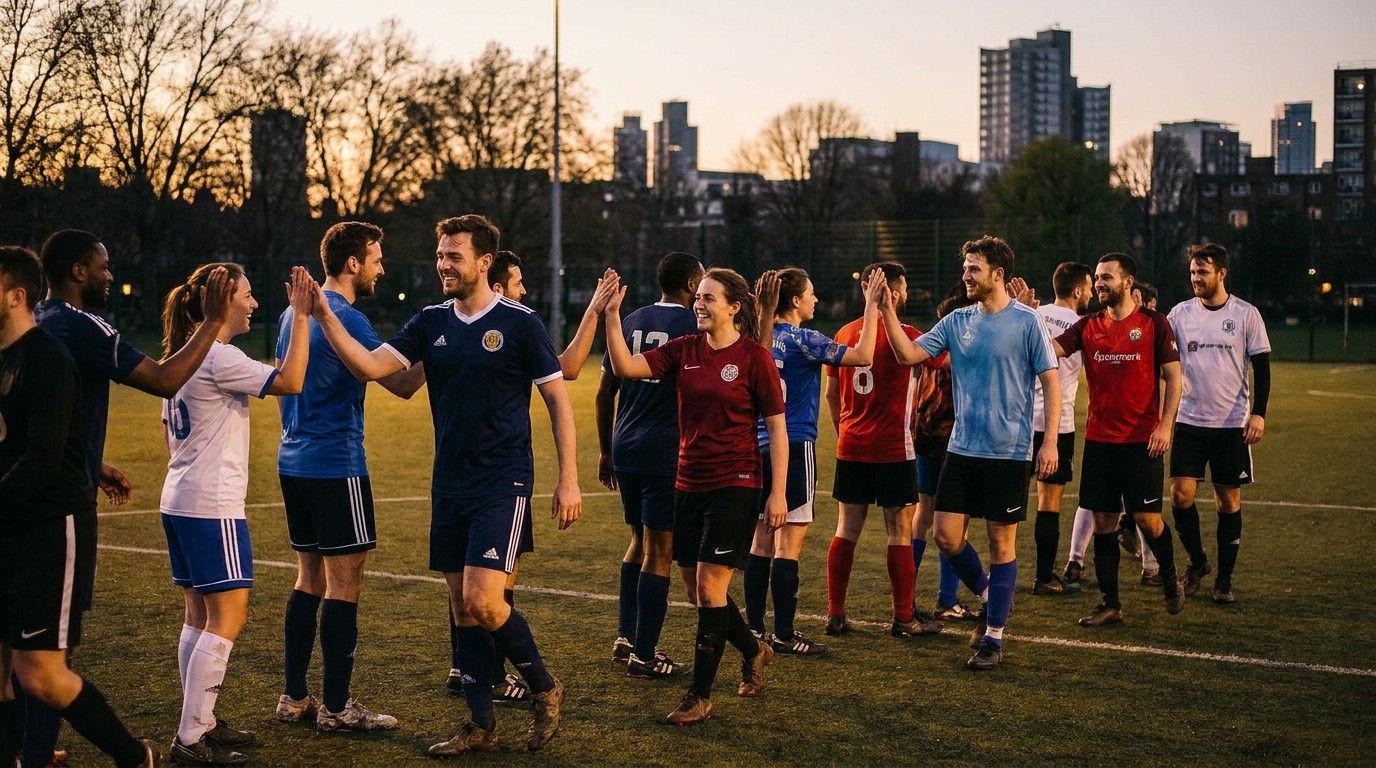
The familiar shouts of a Saturday afternoon kickabout in a London park often mask a modern reality: many of the players on the pitch only met an hour ago. Driven by a wave of grassroots football apps, strangers are coming together to play short-notice matches, turning local astroturf pitches into vital hubs for community connection.[1]
The problem these platforms solve is twofold. For decades, amateur football required a massive commitment: joining a Sunday League team meant upfront fees, rigid weekly schedules, and the constant logistical nightmare of late dropouts. At the same time, urban loneliness has surged, with adults finding it increasingly difficult to meet new people outside of work or structured environments.[1][3][7]
Apps like Footy Addicts and First Whistle have stepped into this gap by digitizing the traditional "jumpers for goalposts" mentality. Users can open an app, find a local 5-a-side or 7-a-side game missing a player, pay a small fee, and simply turn up. There are no referees, no long-term commitments, and no trials.[1][2][3][5]

The scale of this casual football revival is substantial. Footy Addicts alone facilitates over 4,500 games a month across major UK cities, serving an active base of 26,000 players. By removing the friction of organization, the platform allows individuals to fit exercise and socialization into unpredictable modern schedules.[2][3]
Beyond physical fitness, the mental health benefits of these casual games are becoming a focal point for public health experts. A recent longitudinal study published in the Journal of Physical Activity and Health found that consistent participation in team sports reduces the risk of loneliness by 30% compared to non-participation. Our analysis indicates this effect is particularly pronounced in urban environments where organic social interactions are rare.[6][8]
Beyond physical fitness, the mental health benefits of these casual games are becoming a focal point for public health experts.
The group nature of team sports provides a unique psychological buffer. Unlike solitary gym visits—which see high dropout rates due to cost and isolation—team sports foster a sense of "public belonging." Players report that the pre- and post-game chats are often just as valuable as the exercise itself, effectively creating a low-pressure support network.[2][6]

This dynamic has even caught the attention of the medical community. In a pilot scheme launched by Ecotricity and Forest Green Rovers, general practitioners in Gloucestershire have begun issuing "Football on Prescription." Patients dealing with mild to moderate depression are prescribed match tickets and directed toward walking football sessions as an alternative to antidepressants.[4]
The leading cause of death in men under 50 is now suicide, and loneliness is often a key factor, noted Dale Vince, founder of Ecotricity, when launching the prescription initiative. He argued that if a Saturday afternoon at a football match can help someone feel more connected and less alone, it serves as a powerful first step toward recovery.[4]
The technology itself is evolving to prioritize this community aspect. While older sports management tools focused heavily on logistics and league tables, the newest generation of apps is designed around player retention and positive reinforcement. Platforms like First Whistle incorporate features that highlight effort and sportsmanship, ensuring that quieter players feel valued within the temporary team structure.[5]

For many urban residents, especially those who have recently relocated to a new city, these apps serve as an immediate entry point into a local community. The casual nature of the games levels the playing field, bringing together people from diverse backgrounds who might never interact otherwise.[1][2]
As the loneliness epidemic continues to challenge public health systems globally, the success of grassroots football apps offers a compelling blueprint. By combining the connective power of technology with the universal language of sport, these platforms are proving that sometimes the best medical intervention is just a simple kickabout with strangers.[1][4][8]
How we got here
2013
Footy Addicts launches in the UK, aiming to solve the problem of late dropouts in amateur football.
2023
The US Surgeon General issues an advisory on the epidemic of loneliness and isolation.
2024
The Journal of Physical Activity and Health publishes longitudinal data showing team sports significantly reduce loneliness risk.
Oct 2025
Ecotricity and Forest Green Rovers launch the 'Football on Prescription' pilot scheme in Gloucestershire.
Jun 2026
Grassroots apps report record user numbers as urban residents increasingly turn to casual sports for community connection.
Viewpoints in depth
Grassroots Tech Platforms
Focus on removing logistical friction to maximize participation.
App developers and platform founders argue that the traditional model of amateur sports is fundamentally broken for modern urban lifestyles. By eliminating the need for season-long commitments, upfront league fees, and the stress of managing a reliable roster, these platforms cater to the gig-economy mindset. They believe that if you make joining a game as easy as ordering a taxi, participation rates will naturally soar, bringing the social benefits along as a byproduct.
Public Health & Research
View casual team sports as a scalable, non-clinical intervention for mental health.
Medical professionals and researchers emphasize the psychological buffering effect of 'public belonging.' They point to longitudinal data showing that team sports reduce loneliness far more effectively than solitary exercise. Initiatives like 'Football on Prescription' reflect a growing consensus that social isolation is a physiological risk factor on par with smoking, and that community-based activities offer a holistic alternative to traditional pharmaceutical treatments for mild depression.
Community & Players
Value the low-pressure, inclusive environment over competitive success.
For the players themselves, the appeal lies in the lack of stakes. Without referees, league tables, or the pressure of letting down a permanent team, the pitch becomes a purely social space. Participants frequently note that the physical exercise is secondary to the routine of meeting new people, sharing a post-match chat, and finding a sense of community in otherwise isolating urban environments.
What we don't know
- Whether short-term casual games build the same depth of long-term friendships as traditional, season-long Sunday League teams.
- How effectively these platforms can scale to rural areas with fewer artificial pitches and lower population densities.
- The long-term impact of 'social prescribing' initiatives on reducing the burden on national health services.
Key terms
- Grassroots football
- Amateur, non-professional football played at a local community level.
- Walking football
- A slower-paced variant of association football designed to help older players or those with mobility issues maintain fitness and social connections.
- Social prescribing
- A holistic approach to healthcare where medical professionals refer patients to local, non-clinical community services, such as sports clubs, to improve their wellbeing.
Frequently asked
Do I need to be good at football to use these apps?
No. Most casual football apps emphasize inclusivity and offer games for all skill levels, from beginners to former professionals, with no referees or high-pressure competition.
How do apps like Footy Addicts work?
Users browse a map or list of local games that need extra players, pay a small fee to secure a spot, and simply turn up at the pitch at the designated time.
What is 'Football on Prescription'?
It is a pilot health initiative where doctors prescribe football match tickets and participation in walking football to patients suffering from loneliness or mild depression, rather than relying solely on medication.
Sources
Source coverage
8 outlets
3 viewpoints surfaced








[1]The GuardianCommunity & Players
‘You make people a bit happier’: the football app building friendships in London
Read on The Guardian →[2]Football For AllCommunity & Players
Fun and accessible casual Football appeals
Read on Football For All →[3]Footy AddictsGrassroots Tech Platforms
Welcome to Footy Addicts
Read on Footy Addicts →[4]EcotricityPublic Health & Research
Football on Prescription tackles loneliness
Read on Ecotricity →[5]First WhistleGrassroots Tech Platforms
What coaches need from a football management app in 2026
Read on First Whistle →[6]Journal of Physical Activity and HealthPublic Health & Research
Prospective Associations Between Sport Participation and Loneliness
Read on Journal of Physical Activity and Health →[7]American Survey CenterPublic Health & Research
The Social Benefits of Youth Sports Participation
Read on American Survey Center →[8]Factlen Editorial TeamPublic Health & Research
Synthesis by Factlen editorial team
Read on Factlen Editorial Team →

More in sports
See all 10 stories →Preview
England's 2026 World Cup Outlook: Inside Thomas Tuchel's High-Stakes Group L Campaign
0 sources

College Baseball
Troy Trojans Complete Historic Cinderella Run to Reach First Men's College World Series
0 sources

MLB Preview
San Diego Padres Look to Snap Road Skid Against Baltimore Orioles in Interleague Clash
0 sources

Grassroots Tech
How 'Drop-In' Sports Apps Are Rewiring Urban Communities and Fighting Loneliness
0 sources

Every angle. Every day.
Get sports stories with full source coverage and perspective breakdowns delivered to your inbox.