
What Is an NPU? The 2026 Guide to Copilot+ PCs and the Laptop Battery Revolution
The addition of Neural Processing Units (NPUs) has transformed the Windows laptop market, delivering unprecedented battery life and local AI capabilities.
By Factlen Editorial Team
- Efficiency & Portability Advocates
- Prioritizing battery life and thermal efficiency over legacy software support.
- Compatibility Traditionalists
- Valuing guaranteed software execution and burst performance over absolute battery longevity.
- On-Device AI Proponents
- Focusing on the privacy and speed benefits of local neural processing.
What's not represented
- · Budget Consumers
- · Linux Users
Why this matters
The addition of the NPU has effectively doubled the battery life of standard Windows laptops, meaning buyers in 2026 can finally get Apple-level efficiency without leaving the Windows ecosystem.
Key points
- An NPU is a dedicated chip that handles AI tasks locally, saving massive amounts of battery power.
- Copilot+ PCs require an NPU capable of at least 40 TOPS, plus 16GB of RAM.
- Qualcomm's ARM-based Snapdragon chips offer maximum battery life but face minor software compatibility hurdles.
- Intel's x86-based Lunar Lake chips offer maximum compatibility and burst performance with slightly less battery longevity.
- Even if you never use AI features, the battery life improvements make these laptops a major upgrade.
For decades, buying a Windows laptop involved a painful compromise: you could have high performance, or you could have all-day battery life, but you rarely got both. That binary choice has officially shattered. Over the past two years, the introduction of "Copilot+ PCs" has fundamentally rewritten the rules of mobile computing, bringing Windows laptops to parity with Apple's highly efficient MacBooks.[3]
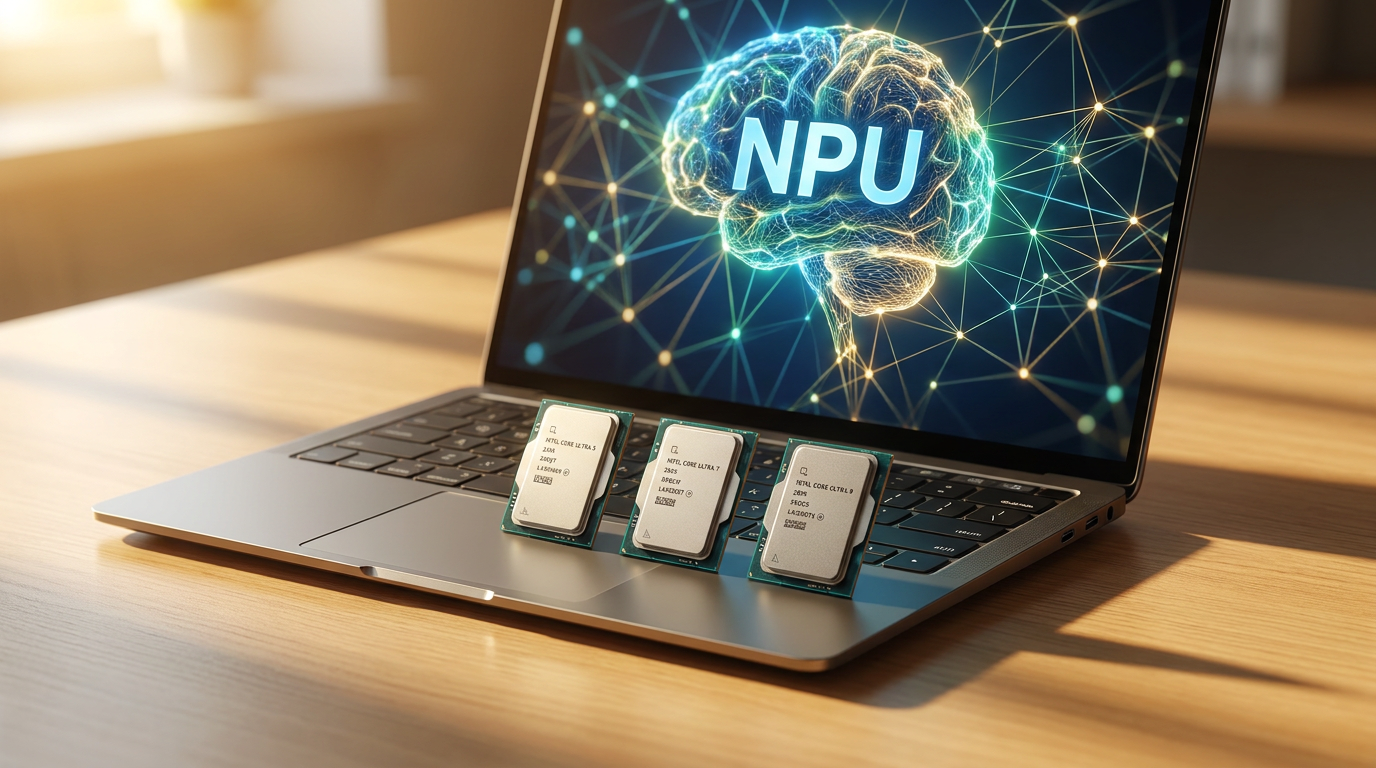
The catalyst for this shift isn't just a slightly larger battery or a more efficient screen. It is the introduction of a completely new piece of silicon onto the laptop motherboard: the Neural Processing Unit, or NPU. While marketing campaigns focus heavily on the "AI" aspect of these chips, the practical reality for everyday shoppers is much more grounded in daily usability.[6]
To understand why the NPU matters, it helps to look at how computers traditionally divide labor. The Central Processing Unit (CPU) is the generalist—the manager that handles everyday tasks, opens applications, and keeps the operating system running. The Graphics Processing Unit (GPU) is the specialist, designed to handle thousands of parallel calculations required to render video games or encode high-resolution video.

But artificial intelligence tasks—like blurring your background on a video call, generating images, or transcribing audio in real-time—rely on continuous, heavy mathematical matrix multiplications. When forced to run these tasks, a traditional CPU or GPU consumes massive amounts of power, spinning up the laptop's fans and draining the battery in a matter of hours.
Enter the NPU. Designed specifically for the mathematical operations used by machine learning models, the NPU handles these workloads at a fraction of the power cost. By offloading AI tasks to this dedicated chip, the rest of the system can power down or focus on other work. The result is a laptop that remains cool, quiet, and incredibly power-efficient, even during heavy multitasking.[1][2]
Microsoft recognized this hardware shift and established a new baseline for the industry: the "Copilot+ PC." To earn this certification, a laptop must meet strict hardware requirements. It needs a minimum of 16 gigabytes of RAM to hold AI models in memory, a 256-gigabyte solid-state drive, and, crucially, an NPU capable of at least 40 TOPS.[3]
TOPS, or Trillions of Operations Per Second, is the new benchmark metric of the AI era. It measures how many math calculations the NPU can perform in one second. While early AI PCs in 2023 hovered around 10 to 15 TOPS, the 2026 generation of chips from Qualcomm, Intel, and AMD easily clear the 40 TOPS hurdle, with most landing between 45 and 60 TOPS.[1][2]

TOPS, or Trillions of Operations Per Second, is the new benchmark metric of the AI era.
This hardware unlocks a suite of localized features that previously required an internet connection and a cloud server. "Live Captions," for example, can instantly transcribe and translate any audio playing on the device into English, entirely offline. "Windows Studio Effects" uses the NPU to maintain eye contact, frame the user, and cancel background noise during video calls without taxing the main battery.[6]
Perhaps the most debated feature is "Recall," a semantic search engine that takes periodic snapshots of the screen, allowing users to search their past activity using natural language. Because the NPU processes these snapshots locally, the data never leaves the device, addressing significant privacy concerns that would arise if the processing happened in the cloud.[3][7]
But the most profound impact of the NPU era has nothing to do with AI features at all. It is the underlying architecture shift that accompanied it. To meet the efficiency demands of Copilot+ PCs, chipmakers had to rethink their designs from the ground up, sparking a fierce architectural war between two distinct philosophies.
In one corner is Qualcomm with its Snapdragon X Elite processors. Built on the ARM architecture—the same foundation used in smartphones and Apple Silicon—Snapdragon chips prioritize marathon-like efficiency. Independent testing consistently shows Snapdragon-powered laptops achieving 15 to 22 hours of real-world battery life, alongside near-instant wake times and cool, fanless operation.[1][5]

In the other corner is Intel with its "Lunar Lake" processors. Intel relies on the traditional x86 architecture that has powered Windows PCs for decades, but heavily optimized for efficiency. While Lunar Lake laptops might trail Snapdragon slightly in absolute battery longevity, they offer a massive advantage in compatibility and burst performance, particularly for gaming and legacy creative applications.[2][4]
This architectural divide introduces a new layer of complexity for shoppers. Windows on ARM (Snapdragon) uses an emulation layer called Prism to run traditional x86 applications. While Prism has improved dramatically, some niche software, specialized hardware drivers, and anti-cheat systems for video games still struggle or fail to run on ARM-based machines.[4]

For the everyday consumer, the choice comes down to priorities. If absolute maximum battery life, cool operation, and portability are the primary goals, the ARM-based Snapdragon laptops are a revelation. If the user relies on specific legacy software, heavy video editing plugins, or PC gaming, the x86-based Intel Lunar Lake or AMD Ryzen AI chips offer the safest route without sacrificing the Copilot+ benefits.[7]
Ultimately, the "AI PC" marketing may feel overwhelming, but the underlying hardware evolution is a clear win for consumers. The mandate for 16GB of RAM as a baseline eliminates the underpowered budget machines that used to frustrate buyers. And whether a user ever generates an AI image or uses live translation, the battery life revolution driven by the NPU makes the 2026 generation of laptops the most significant upgrade cycle in over a decade.[7]
How we got here
Late 2023
Early 'AI PCs' launch with basic NPUs offering 10-15 TOPS, insufficient for heavy local processing.
May 2024
Microsoft announces the Copilot+ PC standard, requiring 40 TOPS, 16GB RAM, and local AI processing.
June 2024
Qualcomm launches the Snapdragon X Elite, bringing ARM architecture and massive battery gains to Windows.
Late 2024
Intel responds with Lunar Lake (Core Ultra Series 2), optimizing the x86 architecture for extreme efficiency.
2026
The 40+ TOPS NPU becomes the standard baseline for mid-range and premium Windows laptops.
Viewpoints in depth
Efficiency & Portability Advocates
Prioritizing battery life and thermal efficiency over legacy software support.
This camp, championed by Qualcomm and ARM enthusiasts, argues that the future of mobile computing is fanless and untethered. They point to the 15-to-22-hour battery life of Snapdragon laptops as a paradigm shift that fundamentally changes how people work. For these users, the occasional software incompatibility is a minor speed bump compared to the massive daily benefit of never needing to carry a charger.
Compatibility Traditionalists
Valuing guaranteed software execution and burst performance over absolute battery longevity.
Intel and x86 loyalists argue that a laptop is only useful if it can run the software you need without friction. They highlight that while emulation layers like Prism have improved, professionals relying on niche plugins, specialized hardware drivers, or PC gaming still face unpredictable roadblocks on ARM. This camp prefers the Lunar Lake approach: massive efficiency gains over previous generations, but with the ironclad guarantee that every Windows application will simply work.
On-Device AI Proponents
Focusing on the privacy and speed benefits of local neural processing.
Microsoft and hardware vendors emphasize that the NPU's real value lies in decoupling AI from the cloud. By processing audio transcription, image generation, and screen semantic search entirely on the local silicon, users avoid subscription fees, eliminate latency, and ensure their personal data never touches an external server. For this camp, the 40 TOPS requirement is about establishing a secure, private baseline for the next decade of software.
What we don't know
- How quickly third-party software developers will fully optimize their applications to utilize the NPU.
- Whether ARM architecture will eventually overcome its remaining compatibility issues with legacy PC games.
Key terms
- NPU (Neural Processing Unit)
- A specialized chip designed specifically to handle the mathematical calculations required by artificial intelligence, using very little power.
- TOPS (Trillions of Operations Per Second)
- A metric used to measure the speed and capability of an NPU; Microsoft requires 40 TOPS for Copilot+ PCs.
- ARM Architecture
- A highly efficient processor design historically used in smartphones and Apple MacBooks, now powering Snapdragon Windows laptops.
- x86 Architecture
- The traditional processor design used by Intel and AMD, known for broad software compatibility and high burst performance.
- Prism
- Microsoft's emulation software that allows traditional x86 Windows applications to run on newer ARM-based laptops.
Frequently asked
Do I need an NPU if I don't care about AI?
Yes, because the NPU is packaged with highly efficient processors that double the battery life of the laptop compared to older models.
Will my old software work on a Snapdragon laptop?
Most everyday software works perfectly through emulation, but specialized tools, heavy plugins, and many video games may struggle on ARM architecture.
What is the difference between an AI PC and a Copilot+ PC?
An 'AI PC' simply has an NPU, while a 'Copilot+ PC' meets strict Microsoft requirements (40+ TOPS, 16GB RAM) to run advanced features locally.
Does local AI processing drain the battery?
No. Because the NPU is purpose-built for these tasks, it uses a fraction of the power a standard CPU would use, preserving battery life.
Sources
Source coverage
7 outlets
3 viewpoints surfaced







[1]QualcommEfficiency & Portability Advocates
Snapdragon X Elite Platform Specifications
Read on Qualcomm →[2]IntelCompatibility Traditionalists
Intel Core Ultra Series 2 (Lunar Lake) Architecture
Read on Intel →[3]MicrosoftOn-Device AI Proponents
Copilot+ PCs: A new era of Windows
Read on Microsoft →[4]PCWorldCompatibility Traditionalists
Intel's Lunar Lake vs. Snapdragon X Elite: The AI PC showdown
Read on PCWorld →[5]Tom's HardwareEfficiency & Portability Advocates
Snapdragon X Elite laptops last 15+ hours on our battery test
Read on Tom's Hardware →[6]HPOn-Device AI Proponents
HP OmniBook AI Features Explained: How Copilot+ PCs Boost Daily Productivity
Read on HP →[7]Factlen Editorial TeamOn-Device AI Proponents
Synthesis by Factlen editorial team
Read on Factlen Editorial Team →

Every angle. Every day.
Get shopping stories with full source coverage and perspective breakdowns delivered to your inbox.