
Travel Backpack vs. Roller Bag: The Ultimate Carry-On Trade-Off Analysis
Choosing the right carry-on luggage comes down to a strict trade-off between mobility and physical comfort. We analyze the ergonomics, capacity limits, and situational advantages of travel backpacks versus rolling suitcases to help you optimize your next trip.
By Factlen Editorial Team
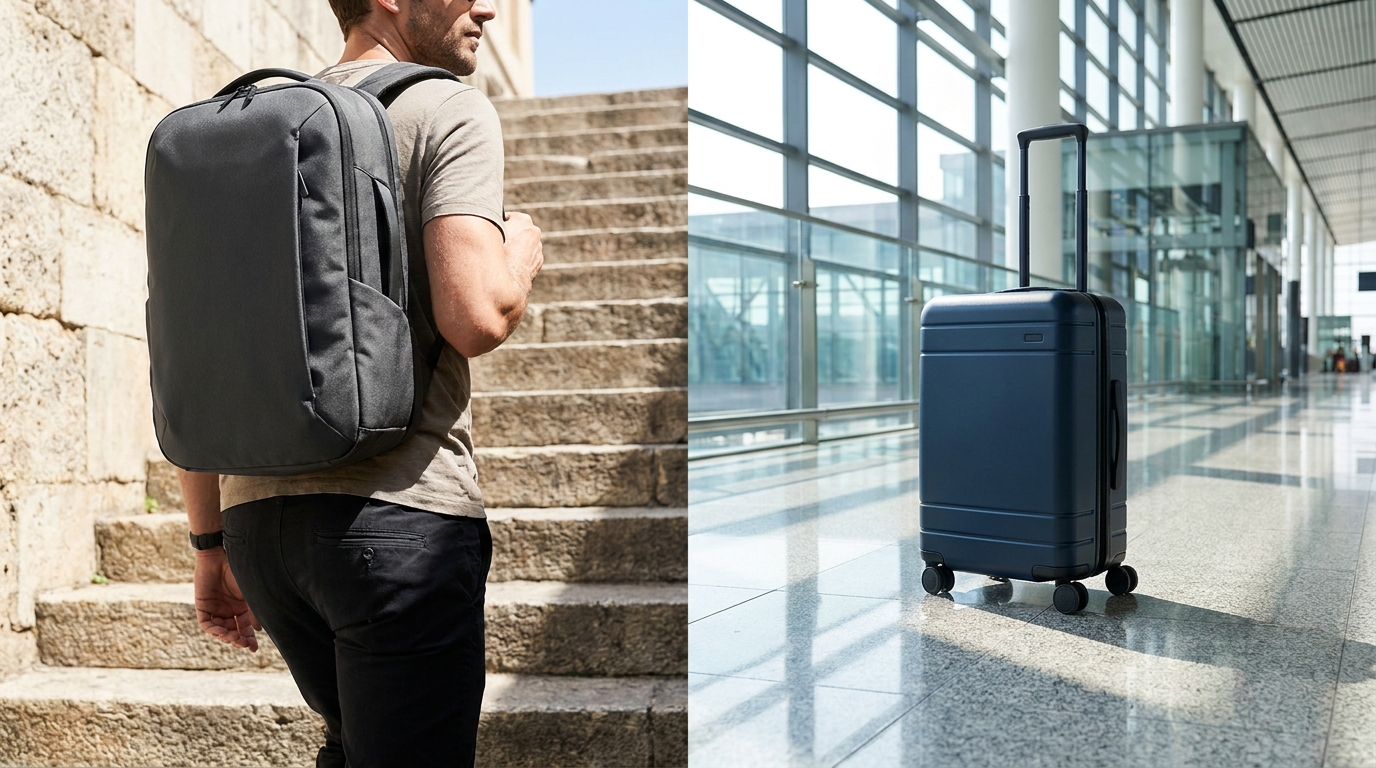
- Mobility Maximizers
- Prioritize speed, hands-free agility, and the ability to navigate unpredictable terrain without friction.
- Comfort & Structure Seekers
- Prioritize physical relief, maximum packing capacity, and the protection of structured luggage.
- Hybrid Pragmatists
- Choose luggage dynamically based on the specific logistics and terrain of each individual trip.
What's not represented
- · Accessibility Advocates
- · Aviation Ergonomists
Why this matters
Luggage dictates how you move through the world. Selecting the wrong bag for your itinerary introduces daily friction, physical strain, and transit delays, while the right choice transforms travel into a seamless, hands-free experience.
Key points
- Travel backpacks offer superior mobility, hands-free convenience, and excel on stairs, cobblestones, and public transit.
- Rolling suitcases provide maximum physical relief, protect fragile items, and utilize every inch of airline size limits.
- Backpack comfort sharply declines when packed beyond 15 to 20 pounds, requiring strict packing discipline.
- Two-wheeled and four-wheeled suitcases struggle significantly on uneven terrain, creating awkward, unbalanced loads.
- The optimal choice depends entirely on the itinerary: backpacks for dynamic, multi-stop trips, and rollers for linear, point-to-point travel.
The debate between traveling with a carry-on backpack versus a rolling suitcase is one of the most enduring discussions in the modern travel gear community. As airlines continue to tighten checked baggage allowances and travelers increasingly embrace the minimalist philosophy, the receptacle you choose to carry your life in becomes a critical ergonomic and logistical decision. This is not merely a question of aesthetic preference; it is a strict trade-off analysis between absolute mobility and physical relief. Every trip presents a unique set of environmental variables—from the polished floors of international airport terminals to the unforgiving cobblestones of historic European districts. Understanding how each luggage type interacts with these environments is the key to eliminating travel friction.[7]
The case for the travel backpack centers entirely on mobility and the distinct advantage of remaining hands-free. When your luggage is strapped to your back, you retain full use of both hands to check digital boarding passes, hold a coffee, navigate transit maps, or assist traveling companions. Backpacks excel in environments where the ground is unpredictable. They allow travelers to seamlessly bypass broken escalators, sprint onto departing trains, and navigate narrow hostel staircases without breaking stride. Furthermore, because backpacks are soft-sided and compressible, they can often be squeezed into tight overhead bins or under seats that would flatly reject a rigid roller bag of similar volume.[4][6]
The case against the travel backpack is rooted in physical fatigue and capacity limitations. Wearing your luggage means your shoulders, spine, and hips bear the entirety of your packing choices. Even with advanced ergonomic suspension systems, sternum straps, and padded hip belts, carrying twenty pounds of gear for several hours will induce sweat, wrinkle professional clothing, and cause muscular fatigue. Additionally, the soft structure of a backpack means that overpacking can cause the bag to bulge outward, shifting its center of gravity away from the body and exacerbating back strain.[2][5]
The evidence regarding travel backpacks highlights a clear threshold for comfort. Gear analysts and frequent travelers consistently note that a travel backpack becomes a liability once the total weight exceeds fifteen to twenty pounds, depending on the wearer's frame. Reviews from industry experts demonstrate that while modern bags offer excellent internal organization, they cannot defy gravity. The consensus across solo travel communities is that backpacks require strict packing discipline; if you are prone to packing "just in case" items, the physical toll of a backpack will quickly outweigh its mobility benefits.[1][2][6]

The case for the rolling suitcase is built on structural protection, maximum capacity, and complete physical relief. By transferring the weight of your belongings from your spine to a set of polyurethane wheels, a roller bag allows you to move heavy loads with minimal physical exertion. The rigid, rectangular bucket shape of a suitcase perfectly maximizes the dimensional allowances of airline baggage sizers, often providing forty to forty-five liters of packing space compared to the thirty-five liters typical of a streamlined backpack. This hard-sided structure also provides superior protection for fragile souvenirs, electronics, and formal wear that must remain unwrinkled.[1][3]
The case against the rolling suitcase becomes apparent the moment you leave smooth, paved surfaces. Wheels are fundamentally incompatible with cobblestone streets, gravel paths, dirt roads, and the steep, narrow staircases common in boutique hotels or older apartment buildings. When a roller bag cannot be rolled, it must be carried by a single side handle, creating an awkward, unbalanced load that is far more difficult to manage than a backpack. Furthermore, a suitcase permanently occupies one of your hands, reducing your ability to interact with your environment and making crowded public transit commutes significantly more cumbersome.[4][6]
The case against the rolling suitcase becomes apparent the moment you leave smooth, paved surfaces.
The evidence on rolling luggage points to a clear divide between transit-heavy itineraries and point-to-point vacations. Discussions on travel forums and insights from long-term digital nomads reveal that while four-wheeled spinners glide effortlessly down airplane aisles, they struggle immensely on uneven European streets. Conversely, two-wheeled rollaboards handle rough terrain slightly better but still transmit vibration and noise up the handle. The data shows that travelers who rely on taxis and elevators rarely regret a suitcase, while those who utilize subways, ferries, and walking commutes frequently curse their wheeled bags.[3][5]
When comparing the trade-offs directly, capacity and dimensions present a quantifiable difference. A standard maximum-size carry-on suitcase utilizes every available cubic inch of the airline's sizing box, offering a highly efficient packing void. Travel backpacks, by necessity, feature rounded corners, tapered profiles, and thick padding that eat into internal volume. If you are traveling with bulky winter clothing, specialized camera gear, or multiple pairs of shoes, the sheer volumetric advantage of a rolling suitcase is undeniable. However, this extra space often tempts travelers into packing more weight than they actually need.[1][7]

Analyzing the health and ergonomic trade-offs reveals that neither option is universally superior for the human body. A backpack distributes weight symmetrically across the shoulders and hips, which is optimal for short bursts of movement but can compress the spine over long durations. A rolling suitcase eliminates spinal compression but introduces asymmetrical twisting. Pulling a heavy two-wheeled bag behind you forces the shoulder and wrist into an unnatural extension, which can aggravate rotator cuffs and elbow joints over time. Pushing a four-wheeled spinner beside you is ergonomically safer, provided the ground is perfectly flat.[2][5]
A travel backpack fits well when your itinerary is highly dynamic and involves multiple modes of transportation. If your trip requires navigating subway turnstiles, boarding ferries, walking several blocks from a train station to an accommodation, or climbing multiple flights of stairs, the backpack is the undisputed champion. It is the optimal choice for travelers who prioritize speed, agility, and the ability to adapt to changing environments without being anchored by a heavy, dragging box.[4][6]
A travel backpack does not fit well when you are traveling for formal business, carrying heavy specialized equipment, or suffering from pre-existing back or shoulder injuries. Arriving at a corporate meeting with a sweat-stained shirt and wrinkled blazer is a distinct professional disadvantage. Similarly, if your packing list pushes the bag beyond the twenty-pound threshold, the resulting physical discomfort will quickly erase any joy derived from the bag's mobility.[2][7]

A rolling suitcase fits well when your journey is linear and point-to-point. If your travel consists of a car ride to the airport, a smooth roll to the gate, and a taxi directly to a hotel with an elevator, the suitcase provides an effortless, sweat-free experience. It is the superior choice for resort vacations, business trips requiring formal attire, and travelers who simply want to pack their maximum allowance without having to physically bear the burden of their choices.[3][5]
A rolling suitcase does not fit well when your trip involves complex logistics, rough terrain, or constant relocation. Dragging a suitcase over ancient cobblestones is not only physically jarring but also incredibly noisy, often drawing unwanted attention. If you plan to hop between multiple cities by train, navigate crowded pedestrian zones, or stay in budget accommodations lacking modern accessibility features, a wheeled bag will act as a constant anchor, slowing you down and increasing travel friction.[1][6]
Ultimately, the choice between a travel backpack and a rolling suitcase requires situational loyalty rather than ideological purity. There is no single winner without conditions. The most experienced travelers do not rigidly commit to one form factor; instead, they audit their upcoming itinerary, assess the terrain, and select the tool that best mitigates the specific frictions of that journey. By matching your luggage to your travel style, you ensure that your energy is spent enjoying the destination rather than fighting your gear.[4][7]
Viewpoints in depth
Mobility Maximizers
Travelers who prioritize speed, agility, and hands-free movement across unpredictable terrain.
This camp argues that the world is rarely flat and paved. They view rolling luggage as a liability that anchors a traveler to the ground, making stairs, crowded trains, and cobblestones a miserable experience. By keeping their gear on their backs, Mobility Maximizers maintain the use of both hands and can seamlessly transition between different modes of transit. They willingly accept the physical burden of carrying their belongings in exchange for the freedom to move quickly and efficiently through any environment.
Comfort & Structure Seekers
Travelers who prioritize physical relief, maximum packing capacity, and organized, wrinkle-free clothing.
This perspective emphasizes that travel is exhausting enough without adding a twenty-pound weight to your spine. Comfort Seekers argue that modern airports and hotels are designed for wheels, making the physical strain of a backpack entirely unnecessary for most point-to-point trips. They value the rigid structure of a suitcase, which protects fragile items, keeps business attire crisp, and maximizes the allowable dimensions of airline sizers. For this camp, the occasional inconvenience of a staircase is a small price to pay for hours of sweat-free, effortless transit.
Hybrid Pragmatists
Travelers who reject strict loyalty to one bag type, choosing their luggage based on the specific itinerary.
Hybrid Pragmatists argue that the 'backpack vs. suitcase' debate presents a false dichotomy. They maintain a gear closet with both options and audit each trip's logistics before packing. If an itinerary involves multiple train transfers and walking commutes, they deploy the backpack. If the trip is a direct flight to a resort or a formal business conference, they pack the roller. This camp relies heavily on data—assessing the destination's infrastructure, the trip's pace, and their own physical condition—to select the tool that introduces the least friction.
What we don't know
- How future airline crackdowns on carry-on weight limits might disproportionately affect heavier rolling suitcases.
- Whether emerging hybrid designs (roller-backpacks) can overcome their historical bulkiness to offer a true zero-compromise solution.
- How the increasing pedestrianization of major global cities will shift the long-term preference toward backpack mobility.
Key terms
- One-Bag Travel
- A minimalist travel philosophy where a person packs all their belongings into a single carry-on bag to avoid checked luggage fees and save time.
- Spinner Luggage
- A type of rolling suitcase equipped with four multidirectional wheels, allowing it to be pushed upright alongside the traveler.
- Rollaboard
- A traditional two-wheeled suitcase that must be tilted and pulled behind the traveler.
- Liters (Capacity)
- The standard metric used by the outdoor and travel industry to measure the internal volume and packing space of a bag.
Frequently asked
Can a travel backpack fit as much as a rolling suitcase?
Generally, no. Because backpacks require rounded corners, thick padding, and ergonomic tapering, they offer less usable internal volume than the rigid, rectangular box shape of a maximum-size carry-on suitcase.
Is a backpack or a roller bag better for my back?
It depends on the usage. A backpack distributes weight symmetrically but compresses the spine over time. A roller bag relieves the spine but can cause asymmetrical shoulder and wrist strain from pulling.
Do airlines weigh carry-on backpacks?
While U.S. domestic airlines rarely weigh carry-on bags, many international and budget carriers strictly enforce carry-on weight limits (often 7kg to 10kg), which can be challenging to meet with heavy rolling luggage.
Sources
Source coverage
7 outlets
3 viewpoints surfaced







[1]Pack HackerComfort & Structure Seekers
Best Carry On Luggage: Backpacks vs. Rollers
Read on Pack Hacker →[2]CarryologyHybrid Pragmatists
Backpack vs Luggage: Which is Better for Travel?
Read on Carryology →[3]The Professional HoboComfort & Structure Seekers
Rolling Luggage vs Backpacks for Long-Term Travel
Read on The Professional Hobo →[4]Boundary SupplyMobility Maximizers
Carry-On Backpack vs Suitcase for Travel
Read on Boundary Supply →[5]Rick StevesHybrid Pragmatists
Backpack vs Wheeled Suitcase Travel Forum
Read on Rick Steves →[6]Reddit r/OneBagMobility Maximizers
One Bag Travel Backpack vs Roller Bag Debate
Read on Reddit r/OneBag →[7]Factlen Editorial TeamHybrid Pragmatists
Synthesis by Factlen editorial team
Read on Factlen Editorial Team →

Every angle. Every day.
Get shopping stories with full source coverage and perspective breakdowns delivered to your inbox.