
The Science of the Sear: How to Master the Maillard Reaction at Home
Understanding the chemistry behind the Maillard reaction is the secret to achieving restaurant-quality browning, crusts, and complex flavors in your own kitchen.
By Factlen Editorial Team
- Culinary Scientists
- Focusing on the molecular pathways and thermodynamic thresholds of cooking.
- Professional Chefs
- Prioritizing practical techniques, heat management, and consistent results.
- Home Cooks
- Seeking accessible hacks and reliable methods to elevate weeknight dinners.
What's not represented
- · Vegetarian/Vegan Cooks (applying Maillard to plant-based proteins)
- · Cookware Manufacturers (designing pans for optimal heat retention)
Why this matters
By understanding the thermodynamics of cooking, you can stop ruining expensive cuts of meat and start unlocking the hundreds of savory flavor compounds that make restaurant food taste so good.
Key points
- The Maillard reaction is a chemical process that creates hundreds of savory flavor compounds when amino acids and sugars are heated.
- Surface moisture prevents browning because water cannot exceed 212°F, trapping the food's temperature below the 285°F Maillard threshold.
- Patting food completely dry and avoiding an overcrowded pan are essential steps for achieving a restaurant-quality sear.
- Raising the pH of food with a tiny pinch of baking soda can artificially accelerate the browning process.
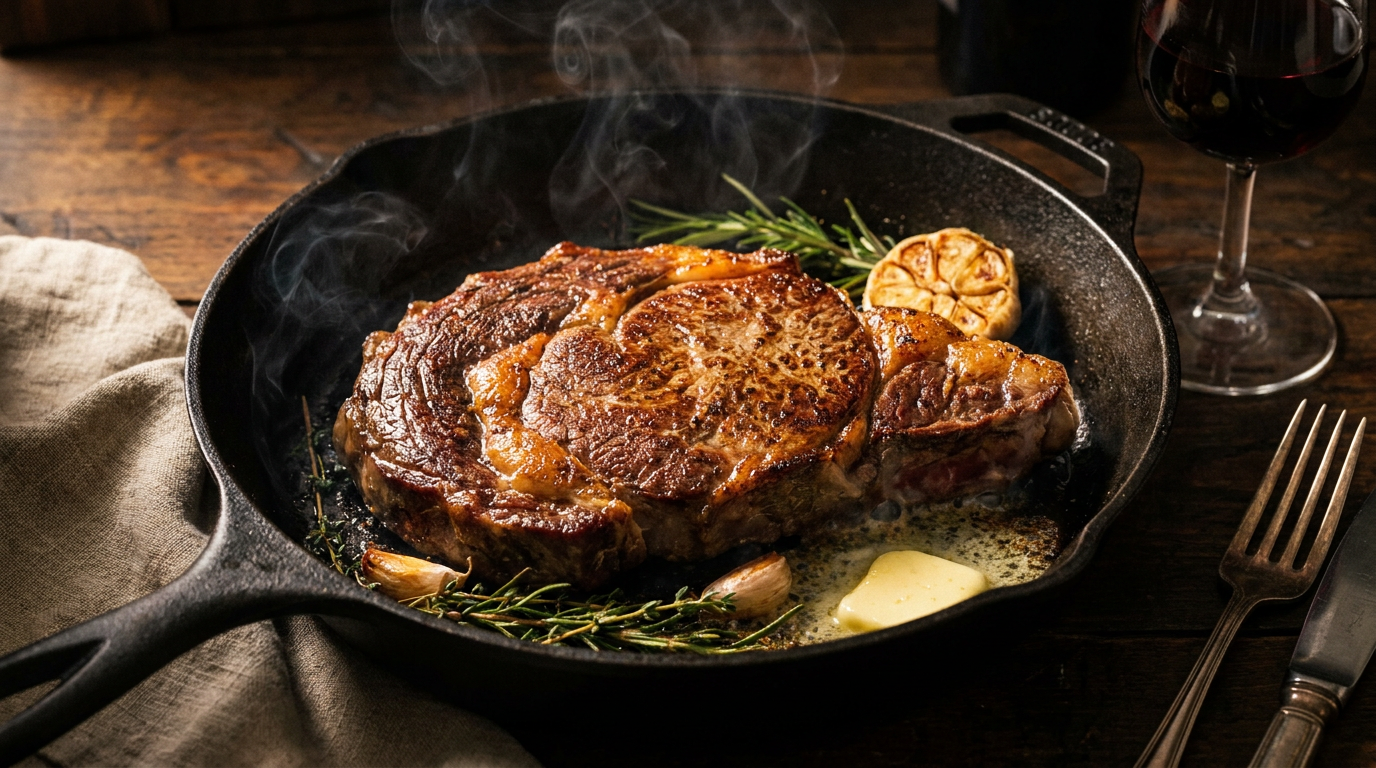
Every home cook has experienced the disappointment of a grey, uninspiring piece of meat. You place a steak or a batch of ground beef into a hot pan, hoping for a rich, golden-brown crust, but instead, the meat releases a pool of liquid and gently simmers. The result is a meal that tastes flat and looks entirely unappetizing. The difference between that grey disappointment and a restaurant-quality sear isn't the price of the pan or the cut of the meat—it is a matter of applied chemistry.[6]
The secret to that savory, complex crust is the Maillard reaction. First described in 1912 by French chemist Louis Camille Maillard, this non-enzymatic process occurs when amino acids (the building blocks of proteins) and reducing sugars (like glucose and fructose) are subjected to heat. When these compounds collide under the right thermal conditions, they fuse and break apart in a cascading chain reaction, fundamentally transforming the structure of the food.[2][4]
While we visually recognize the Maillard reaction as "browning," its true magic lies in flavor development. This chemical cascade generates over 600 new volatile flavor compounds, including pyrazines, furans, and thiophenes. These are the microscopic molecules responsible for the savory, roasted, and earthy aromas that make toasted bread, roasted coffee, and seared steaks so universally appealing. Without the Maillard reaction, a cooked steak would taste essentially like boiled beef.[1][4][5]
However, the Maillard reaction is notoriously demanding. It operates on a strict thermodynamic threshold, only kicking into high gear when the surface temperature of the food reaches approximately 285°F (140°C). It peaks in efficiency between 310°F and 330°F. If the temperature is too low, the reaction stalls, and the complex flavor compounds never form. This strict temperature requirement is where most home cooks inadvertently sabotage their own dinners.[1][3]

The ultimate enemy of the Maillard reaction is water. Water physically cannot exceed 212°F (100°C) at standard atmospheric pressure; any additional heat energy simply converts the liquid into steam. If a piece of meat goes into a pan with moisture on its surface, the temperature of that surface is mathematically capped at 212°F until every last drop of water has evaporated. By the time the water is gone and the surface can finally reach the 285°F Maillard threshold, the interior of the meat is often hopelessly overcooked.[1][3][5]
This thermodynamic reality makes moisture control the single most important step in cooking. Culinary scientists and professional chefs universally mandate patting meat completely dry with paper towels before it ever touches a pan. Removing that surface water eliminates the 212°F temperature trap, allowing the exterior of the food to immediately rocket past the 285°F threshold the moment it hits the hot oil.[5][6]
This thermodynamic reality makes moisture control the single most important step in cooking.
Another common pitfall that disrupts this delicate temperature balance is pan overcrowding. When a large volume of cold, moisture-rich food is dropped into a skillet, the temperature of the metal plummets instantly. The crowded pan traps the escaping steam, creating a humid microclimate that blocks the Maillard reaction. Cooking in smaller batches ensures the pan retains enough thermal mass to vaporize moisture instantly and maintain the high heat required for browning.[3][5]

While high heat is essential, there is a dangerous cliff at the top of the temperature scale. If the surface of the food exceeds 355°F (180°C), the Maillard reaction ceases and a different chemical process takes over: pyrolysis. Pyrolysis is the literal thermal decomposition of the food—commonly known as burning. This destroys the delicate flavor compounds created by the Maillard reaction, replacing them with bitter, acrid, and potentially carcinogenic black char.[1][2][4]
Managing the heat source is therefore a balancing act. Cooks must use fats with high smoke points—like avocado oil, refined grapeseed oil, or clarified butter (ghee)—to safely reach the 310°F sweet spot. Standard whole butter contains milk solids that will burn and undergo pyrolysis at just 302°F, ruining the flavor of the dish before the meat has a chance to properly brown.[5][6]
For cooks looking to cheat the system, science offers a fascinating shortcut: pH manipulation. The Maillard reaction is highly sensitive to the acidity or alkalinity of its environment. Acidic environments slow the reaction down, while alkaline (basic) environments aggressively accelerate it. By slightly raising the pH of the food's surface, cooks can trigger browning at lower temperatures and in less time.[1][2]

This principle is famously applied to ground beef and caramelized onions. Tossing raw ground beef with a tiny pinch of baking soda (a strong base) about fifteen minutes before cooking raises its surface pH. When the meat hits the pan, it browns rapidly and evenly, developing a rich crust before the interior proteins tighten and squeeze out their juices. The result is deeply savory meat that remains incredibly tender.[4][6]
The same baking soda trick works wonders on onions, reducing the time required for deep caramelization and Maillard browning from an hour down to mere minutes. However, precision is required; too much baking soda will leave a soapy, metallic chemical taste that ruins the dish. A mere quarter-teaspoon is usually enough to alter the chemistry of an entire pan.[1][6]

Ultimately, mastering the kitchen requires viewing recipes not as rigid instructions, but as applied physics and chemistry. Once a cook understands that browning is a chemical reaction requiring high heat, zero moisture, and the right pH, the mystery of the grey steak vanishes. By controlling these variables, anyone can transform raw ingredients into culinary masterpieces, unlocking the hundreds of flavor compounds waiting just beneath the surface.[4][5][6]
How we got here
1912
French chemist Louis Camille Maillard first describes the reaction between amino acids and sugars.
1953
Scientist John E. Hodge publishes the definitive mechanism of the Maillard reaction, establishing its phases.
2011
The publication of 'Modernist Cuisine' brings advanced thermodynamic cooking concepts to the mainstream culinary world.
Today
Home cooks increasingly use science-backed techniques, like pH manipulation and moisture control, to achieve restaurant-quality results.
Viewpoints in depth
Culinary Scientists
Focusing on the molecular pathways and thermodynamic thresholds of cooking.
For food scientists, the kitchen is simply a laboratory. They view the Maillard reaction not as a cooking technique, but as a complex cascade of non-enzymatic browning where amino acids and reducing sugars form hundreds of volatile compounds. Their research emphasizes strict temperature control, noting that the reaction requires a minimum of 285°F (140°C) and is completely halted by the presence of water, which caps surface temperatures at 212°F (100°C).
Professional Chefs
Prioritizing practical techniques, heat management, and consistent results.
Professional chefs translate thermodynamic principles into actionable kitchen habits. They emphasize the importance of heavy cookware, like cast iron or carbon steel, which retains enough thermal mass to prevent temperature drops when cold food is added. For chefs, mastering the Maillard reaction means ruthlessly eliminating surface moisture, cooking in small batches to avoid trapped steam, and knowing exactly when to pull food off the heat before bitter pyrolysis sets in.
Home Cooks
Seeking accessible hacks and reliable methods to elevate weeknight dinners.
For the everyday cook, the science of browning is about practical problem-solving. Home cooks often struggle with grey, steamed ground beef or soggy vegetables. By adopting simple, science-backed hacks—like thoroughly patting meat dry with paper towels or adding a pinch of baking soda to raise the pH level—they can bypass common pitfalls. These accessible techniques allow home cooks to achieve deep, savory flavors without needing professional equipment or culinary degrees.
What we don't know
- While over 600 flavor compounds have been identified from the Maillard reaction, scientists are still mapping the exact chemical pathways that produce many of them.
- The precise long-term health impacts of consuming high levels of Maillard-derived compounds versus pyrolysis-derived char remain a subject of ongoing nutritional study.
Key terms
- Maillard reaction
- A non-enzymatic chemical reaction between amino acids and reducing sugars that gives browned food its distinctive flavor.
- Pyrolysis
- The thermal decomposition of food at high temperatures (above 355°F), resulting in bitter, charred, and potentially carcinogenic compounds.
- Water activity
- A measure of the free moisture in a food product, which directly dictates whether a surface will steam or sear.
- Alkaline environment
- A condition with a pH higher than 7, which can be artificially created with baking soda to accelerate browning.
Frequently asked
Why does my meat turn grey instead of brown?
Excess surface moisture traps the temperature at 212°F (the boiling point of water), causing the meat to steam rather than sear.
Does the Maillard reaction only happen with meat?
No. It occurs in roasted coffee, toasted bread, caramelized onions, and even baked cookies.
Can I speed up the browning process?
Yes. Adding a tiny pinch of baking soda raises the pH level, creating an alkaline environment that accelerates the Maillard reaction.
Is burnt food the same as browned food?
No. Browning is the Maillard reaction, while burning is pyrolysis, which destroys flavor compounds and creates bitter, acrid tastes.
Sources
Source coverage
6 outlets
3 viewpoints surfaced





[1]Modernist CuisineCulinary Scientists
The Maillard Reaction: A Culinary Superpower
Read on Modernist Cuisine →[2]AlimentariumHome Cooks
The Maillard reaction
Read on Alimentarium →[3]Journal of Food EngineeringCulinary Scientists
Thermal dynamics of non-enzymatic browning and water activity
Read on Journal of Food Engineering →[4]Institute of Food TechnologistsCulinary Scientists
Understanding the Maillard Reaction
Read on Institute of Food Technologists →[5]America's Test KitchenProfessional Chefs
The Science of Searing and Browning
Read on America's Test Kitchen →[6]Factlen Editorial TeamHome Cooks
Synthesis by Factlen editorial team
Read on Factlen Editorial Team →

Every angle. Every day.
Get food drink stories with full source coverage and perspective breakdowns delivered to your inbox.