
The Science of Tangzhong: How Starch Gelatinization Transforms Home Baking
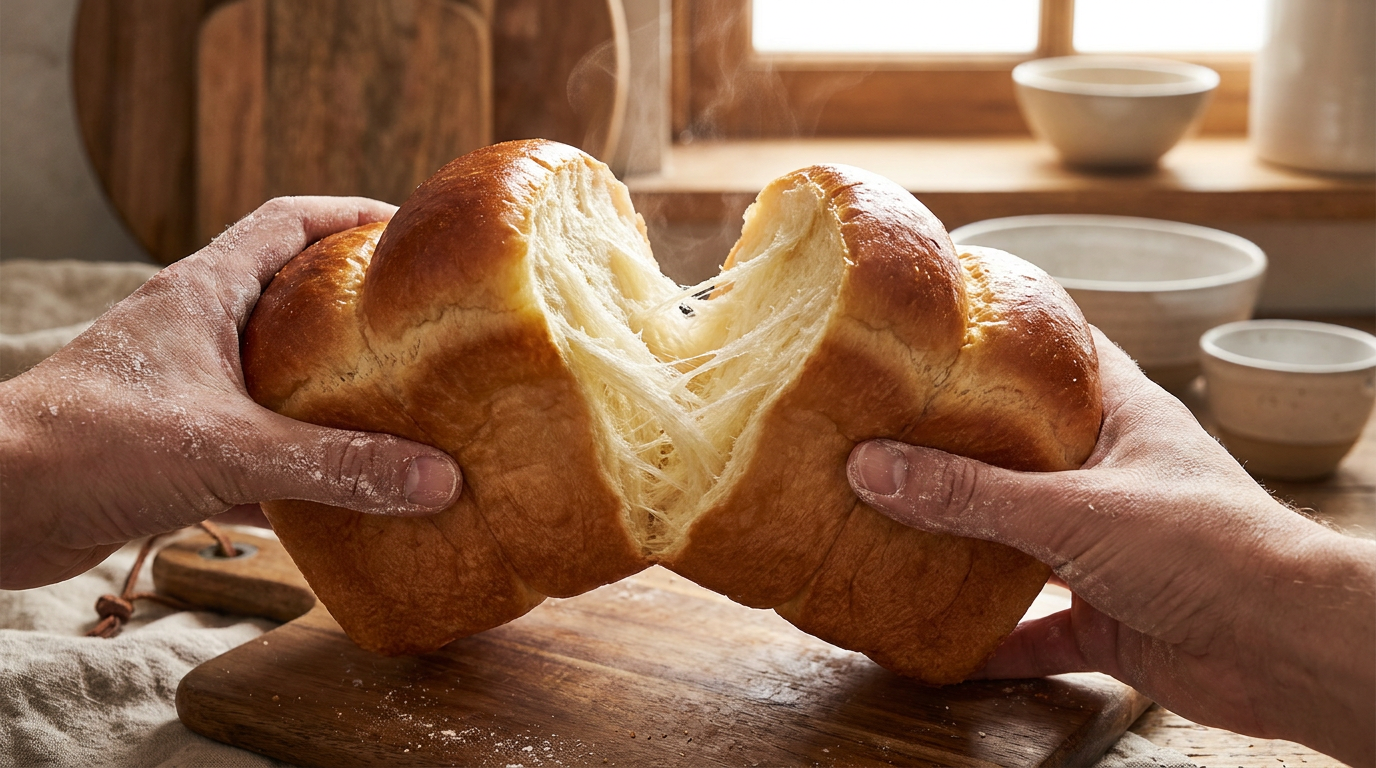
By pre-cooking a small portion of flour and water, bakers can fundamentally alter the molecular structure of dough. This simple technique traps moisture to create ultra-soft, longer-lasting bread without chemical additives.
By Factlen Editorial Team
- Home Bakers & Recipe Developers
- Value the accessible, natural method to achieve professional-level softness and extended freshness without commercial additives.
- Food Scientists & Commercial Bakers
- Focus on the rheological benefits, increased water retention, and the ability to reduce fat and chemical preservatives in mass production.
- Traditional Artisan Bakers
- Prefer crusty, lean doughs and view the ultra-soft, gelatinized texture as a specific stylistic choice rather than a universal upgrade.
What's not represented
- · Gluten-free bakers adapting the method for alternative flours
- · Industrial dough conditioner manufacturers
Why this matters
For home bakers and commercial producers alike, mastering starch gelatinization offers a natural way to extend shelf life, increase dough hydration, and achieve bakery-level fluffiness without relying on extra fats, eggs, or commercial dough conditioners.
Key points
- Tangzhong and yudane are techniques that pre-cook a portion of flour to gelatinize its starches.
- Gelatinized starch can hold up to twice as much water as raw flour, increasing dough hydration.
- The trapped moisture creates a feathery, ultra-soft crumb and significantly delays staling.
- Tangzhong uses a 1:5 flour-to-liquid ratio cooked to a paste, while yudane uses a 1:1 ratio with boiling water.
- These natural methods allow bakers to achieve rich textures without relying on heavy fats or chemical conditioners.
The holy grail for many bakers is a loaf of bread that manages to be impossibly soft, feathery light, and capable of staying fresh for days on the counter. While traditional European baking prizes a crackling crust and a chewy, open crumb, the global rise of Asian-style milk breads has introduced a completely different standard of perfection.[7]
The secret to this pillowy texture lies not in chemical dough conditioners or excessive amounts of butter, but in a simple, elegant manipulation of heat and water. Known primarily as the tangzhong or yudane method, this technique fundamentally alters the molecular structure of the dough before the mixing even begins.[7]
The origins of this approach trace back to post-World War II Japan. Facing severe rice shortages, the nation saw a dramatic 50% drop in rice consumption, prompting a massive shift toward wheat. However, local bakers needed to adapt bread to Asian palates that favored the soft, milky, and slightly sweet textures of traditional steamed buns, often without the benefit of high-heat commercial ovens.[3]
This necessity led to the development of the Japanese yudane method, and later the Chinese and Taiwanese adaptation known as tangzhong. The latter was widely popularized across Asia—and eventually the West—by Taiwanese cookbook author Yvonne Chen in her seminal 2007 book, "65°C Bread Doctor."[2]

At the heart of both techniques is a fundamental chemical transformation known as starch gelatinization. To understand why it works, one must look closely at the composition of flour, which is roughly 70% starch.[5][6]
In its raw state, starch granules are hard, highly organized crystalline structures. Under a microscope, they resemble tiny, rigid river stones scattered among the protein strands that will eventually form gluten.[5]
When cold or room-temperature water is added to raw flour, the starch granules absorb very little of it. They remain intact, which limits how much hydration a dough can handle before it turns into an unworkable, sticky puddle.[2]
But when heat is introduced, the physical properties of the starch change entirely. Between 55°C and 65°C (131°F and 149°F), the rigid surfaces of the starch granules begin to crack and swell, pulling in massive amounts of surrounding water.[5]
As the heating continues, these swollen granules eventually burst. They spill out long amylose molecules that tangle together, forming a thick, interconnected, and highly viscous gel. This is the exact same chemical process that thickens a gravy, a roux, or a stovetop pudding.[5]

As the heating continues, these swollen granules eventually burst.
By pre-cooking a small percentage of a bread recipe's total flour—usually between 4% and 10%—bakers intentionally trigger this gelatinization early. They create a water-trapping gel paste that is then cooled and incorporated into the main dough.[1][2]
This pre-gelatinization is a structural cheat code. It allows the flour to hold up to twice as much liquid as it normally would. The result is a high-hydration dough that feels strong, cohesive, and easy to handle, rather than slack and sticky.[1][2]
The benefits of this increased hydration translate directly into the oven. As the bread bakes and the internal temperature rises, the gluten network naturally begins to weaken. The pre-gelatinized starch, however, increases in viscosity, providing a crucial secondary support structure.[6]
This viscous gel stabilizes the expanding gas bubbles (alveoli) produced by the yeast, preventing them from collapsing. The result is a dramatically higher "oven spring" and a finished crumb structure that is exceptionally light and resilient.[1][3]
Beyond the immediate texture, the most significant benefit of starch gelatinization is its impact on shelf life. Bread goes stale due to a natural process called retrogradation, where gelatinized starches slowly recrystallize as they cool, pushing water out of the crumb and rendering it dry and brittle.[5]
Because the tangzhong and yudane methods trap water so effectively within their pre-cooked gel matrix, they significantly delay this retrogradation process. Breads baked with these methods retain their moisture and stay soft for days longer than standard loaves.[3][4]
While both methods achieve similar results, they differ slightly in execution. Tangzhong uses a 1:5 ratio of flour to liquid by weight, cooked gently on a stovetop until it forms a thick, pudding-like paste.[2][4]

Yudane, originating in Japan, uses a 1:1 ratio of flour to liquid. Instead of cooking the mixture on a stove, boiling water is poured directly over the flour to scald it. This creates a stiffer, dough-like starter that is typically wrapped and rested overnight to fully hydrate.[2][4]
Bakers often choose between the two based on the desired final texture. Tangzhong tends to yield a slightly fluffier, more delicate crumb, while yudane produces a chewier, almost mochi-like resilience that tears beautifully.[4]
The implications of these techniques extend far beyond the home kitchen. Food scientists note that the moisture-retaining properties of pre-gelatinized starch allow commercial bakers to reduce the fat and sugar content in their recipes while still maintaining a luxurious, rich mouthfeel.[3]

For the modern baker, mastering starch gelatinization is a revelation. It is a purely scientific, entirely natural dough improver that transforms basic pantry staples into bakery-tier perfection, proving that sometimes the most profound culinary upgrades happen at the microscopic level.[7]
How we got here
1940s
Post-WWII rice shortages in Japan lead to a dramatic increase in wheat consumption and the adaptation of bread to local palates.
2007
Taiwanese author Yvonne Chen publishes '65°C Bread Doctor,' popularizing the tangzhong method across Asia.
2020s
The technique sees a massive surge in Western baking communities as home bakers seek natural ways to achieve bakery-quality softness.
Viewpoints in depth
Home Bakers & Recipe Developers
Value the accessible, natural method to achieve professional-level softness and extended freshness without commercial additives.
For home baking enthusiasts, tangzhong and yudane represent a democratization of bakery-level quality. Historically, achieving the feathery texture of commercial sandwich bread at home required either chemical dough conditioners or heavy enrichments like butter and egg yolks, which can weigh down the dough. By simply pre-cooking a fraction of the flour, recipe developers can push hydration levels higher without making the dough impossible to knead by hand. This natural 'dough improver' has become a staple technique in modern recipes for everything from cinnamon rolls to whole wheat sandwich loaves.
Food Scientists & Commercial Bakers
Focus on the rheological benefits, increased water retention, and the ability to reduce fat and chemical preservatives in mass production.
In the commercial sector, the benefits of starch gelatinization are measured in rheology and profit margins. Food scientists note that because the pre-gelatinized paste holds water so effectively, it increases the overall yield of the dough. More importantly, the delayed retrogradation means bread stays softer on supermarket shelves for days longer without the need for artificial preservatives. Additionally, the luxurious mouthfeel provided by the water-trapping gel allows manufacturers to reduce the amount of expensive fats and sugars in their formulations, improving the nutritional profile while cutting costs.
Traditional Artisan Bakers
Prefer crusty, lean doughs and view the ultra-soft, gelatinized texture as a specific stylistic choice rather than a universal upgrade.
While the tangzhong method is universally praised for creating soft bread, traditional European-style artisan bakers view it as a specialized tool rather than a replacement for classic techniques. For bakers focused on rustic sourdoughs, baguettes, and ciabattas, the goal is a crackling, robust crust and an open, chewy crumb—qualities that are fundamentally at odds with the uniform, feathery softness produced by high starch gelatinization. In these circles, the technique is respected for its specific application in enriched doughs and milk breads, but is intentionally avoided when crafting lean, hearth-baked loaves.
What we don't know
- The exact mathematical formula to predict evaporation rates across different stovetops when cooking tangzhong.
- How emerging alternative flours (like green banana or cassava) respond to the yudane method at a commercial scale.
Key terms
- Starch Gelatinization
- The process where starch granules absorb water and swell when heated, eventually bursting to form a thick, moisture-trapping gel.
- Retrogradation
- The recrystallization of starch molecules after baking, which pushes water out of the crumb and causes bread to go stale.
- Alveoli
- The gas bubbles or air pockets within the crumb of baked bread, created by yeast and stabilized by gluten and starch.
- Rheology
- The study of the flow and deformation of matter, used in baking science to describe dough strength, elasticity, and viscosity.
- Amylose
- A type of long-chain starch molecule that seeps out of swollen starch granules during gelatinization to form an interconnected gel network.
Frequently asked
Can I use tangzhong for whole wheat bread?
Yes. The pre-gelatinized paste helps soften the bran in whole wheat flour, resulting in a much lighter and less dense loaf.
Do I add extra liquid to my recipe for the tangzhong?
No. The flour and liquid used to make the tangzhong must be subtracted from the recipe's total ingredient amounts to maintain the correct overall hydration.
Can I make tangzhong in the microwave?
Yes. Heating the flour and water mixture in short 20-second bursts and stirring in between works just as effectively as stovetop cooking.
What is the main difference between tangzhong and yudane?
Tangzhong is cooked on a stove at a 1:5 flour-to-liquid ratio, while yudane uses boiling water poured over flour at a 1:1 ratio and is left to rest.
Sources
Source coverage
7 outlets
3 viewpoints surfaced







[1]BakerpediaFood Scientists & Commercial Bakers
Tangzhong Method
Read on Bakerpedia →[2]King Arthur BakingHome Bakers & Recipe Developers
Introduction to tangzhong
Read on King Arthur Baking →[3]Institute of Culinary EducationFood Scientists & Commercial Bakers
Pre-Gelatinization of Starches in Bread Making
Read on Institute of Culinary Education →[4]The Perfect LoafHome Bakers & Recipe Developers
What is Yudane (and How is it Different From Tangzhong)?
Read on The Perfect Loaf →[5]Modernist CuisineFood Scientists & Commercial Bakers
The Science of Baking Bread
Read on Modernist Cuisine →[6]KPM AnalyticsFood Scientists & Commercial Bakers
Why Starch Gelatinization Matters
Read on KPM Analytics →[7]Factlen Editorial TeamTraditional Artisan Bakers
Synthesis by Factlen editorial team
Read on Factlen Editorial Team →
Every angle. Every day.
Get food drink stories with full source coverage and perspective breakdowns delivered to your inbox.