
How 90,000 Empty Office Units Are Being Converted Into Apartments
Driven by high vacancy rates and maturing commercial loans, the U.S. office-to-residential conversion pipeline has hit a record 90,300 units in 2026. While structural challenges remain, targeted tax incentives are helping cities transform vacant corporate towers into much-needed housing.
By Factlen Editorial Team
- Commercial Real Estate Owners
- Focuses on the financial necessity of conversions to salvage distressed assets and survive maturing loans.
- Urban Planners & Architects
- Views conversions as a design opportunity to transform single-use business districts into vibrant 24/7 neighborhoods.
- Housing Advocates & Policymakers
- Prioritizes adding housing supply and ensuring that tax-subsidized conversions include affordable unit mandates.
What's not represented
- · Local small businesses in business districts
- · Construction labor unions
Why this matters
The hollowing out of downtown office districts threatens city tax bases and local businesses. Converting these empty towers into apartments not only rescues distressed real estate but also adds crucial housing supply to the country's most expensive urban cores.
Key points
- The U.S. office-to-residential conversion pipeline reached a record 90,300 units in early 2026, up 28% from the previous year.
- High office vacancy rates and $213 billion in maturing commercial loans are forcing property owners to repurpose distressed assets.
- Structural challenges, such as deep, windowless floorplates and centralized plumbing, make conversions nearly as expensive as new construction.
- Cities like New York, Washington D.C., and Chicago are offering aggressive tax abatements and zoning reforms to subsidize the transition.
The contradiction of the modern American city is visible on almost any downtown skyline: soaring housing costs and fierce competition for apartments, set against millions of square feet of half-empty office towers. For years, the idea of turning vacant cubicles into living rooms was treated as a niche architectural novelty. But as remote and hybrid work patterns have solidified, the sheer volume of unused commercial space has forced a reckoning. What was once a boutique sustainability concept has rapidly evolved into a scalable, multi-billion-dollar real estate strategy.[6]
The momentum behind this shift is accelerating at an unprecedented pace. At the start of 2026, the United States had 90,300 apartments in the active office-to-residential conversion pipeline. This represents a 28 percent year-over-year increase from 2025, and the figure is nearly four times higher than the conversion volume recorded just four years ago in 2022. Across the country, developers are looking at aging, underperforming commercial assets and deciding that their highest and best use is no longer corporate tenancy, but residential living.[1][2]
The data underscores how dominant this specific strategy has become within the broader construction industry. Office conversions now account for 47 percent of all future adaptive reuse projects nationwide, comfortably surpassing the repurposing of hotels, industrial warehouses, and schools. This surge is not merely a creative choice by developers; it is a structural response to a commercial real estate market that has fundamentally changed.[1][6]
The primary catalyst for this transformation is the persistent emptiness of the American office. National office vacancy rates have hovered near 20 percent through early 2025 and into 2026, with physical daily occupancy in many buildings stagnating around 50 to 55 percent of pre-pandemic levels. Companies have downsized their footprints, leaving older, less desirable "Class B" and "Class C" buildings struggling to attract tenants.[1][2]

Compounding the vacancy crisis is a looming financial cliff. Roughly one-third of all U.S. office loans—totaling more than $213 billion—are scheduled to mature by the end of 2027. Property owners facing these maturities find themselves in a precarious position: they cannot refinance empty buildings at favorable rates, and selling them in the current market often means taking a massive loss. For many distressed asset holders, converting the property to residential use is the only viable path to salvage their investment.[3][6]
The scale of this transition has reached a historic tipping point. According to real estate services firm CBRE, the amount of U.S. office space poised to disappear—either through demolition or residential conversion—now exceeds the amount of new office space coming online. This marks a stark reversal from the pre-pandemic era, signaling that the commercial market is actively shrinking its footprint to stabilize itself.[2]
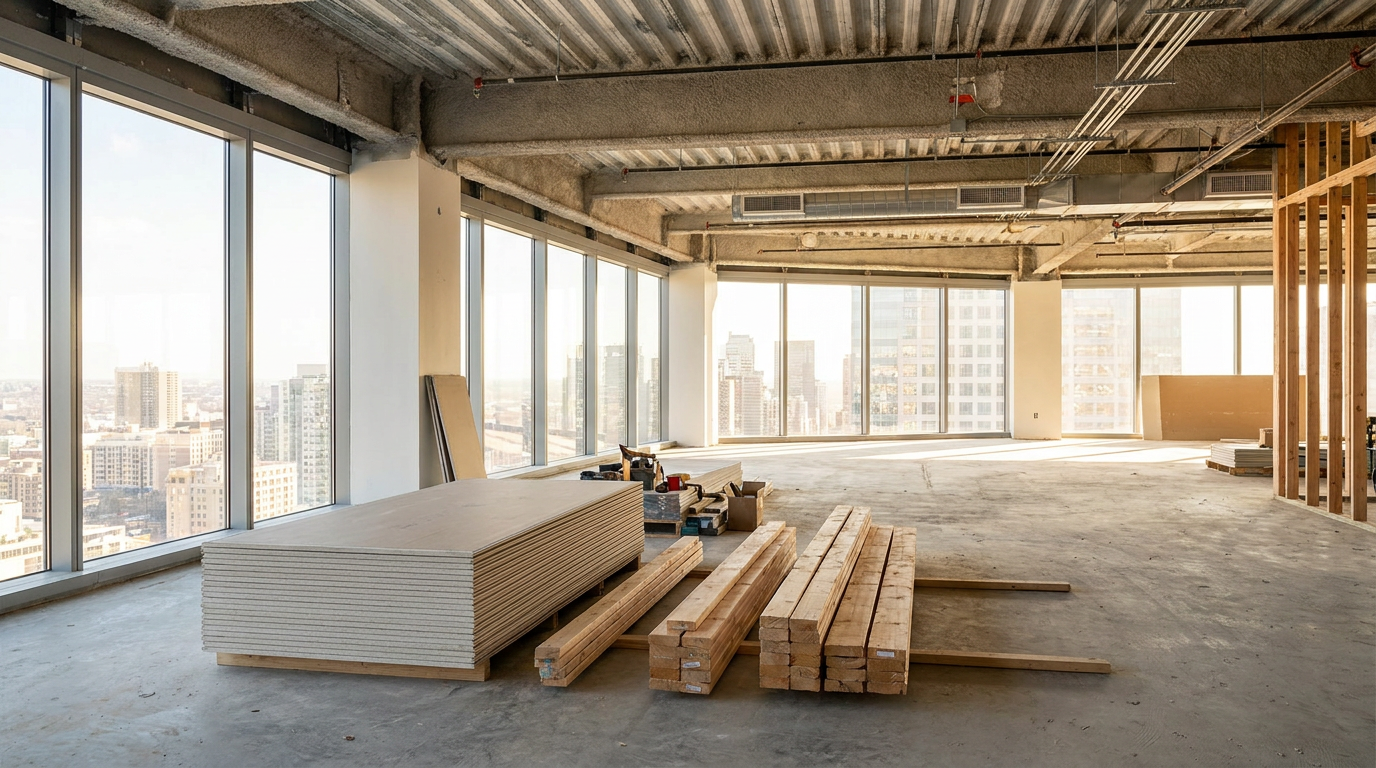
Yet, transforming a 1980s corporate tower into a modern apartment building is far more complex than simply erecting drywall. The most significant hurdle is what architects call the "floorplate problem." Modern office buildings were designed with massive, deep floorplates to maximize desk space, relying heavily on artificial fluorescent lighting and centralized air conditioning.[4][6]
Yet, transforming a 1980s corporate tower into a modern apartment building is far more complex than simply erecting drywall.
Residential building codes, however, strictly require bedrooms and living spaces to have access to natural light and operable windows. When developers attempt to carve an apartment layout into a deep office floorplate, they are left with a massive, windowless core in the center of the building that cannot legally or practically be used for bedrooms.[4][6]
Architects have had to engineer creative solutions to this geometric puzzle. In some high-end conversions, developers physically core out the center of the building, creating a massive open-air atrium that brings sunlight into inward-facing units. A more common and cost-effective approach is to push all the apartments to the perimeter of the building and dedicate the dark, windowless core to resident amenities, such as fitness centers, movie theaters, coworking lounges, and self-storage.[4]

Beyond the floorplate, the mechanical infrastructure of an office building requires a total overhaul. Offices are designed with centralized bathrooms and HVAC systems concentrated near the elevators. Apartments require decentralized plumbing, with individual kitchens, bathrooms, and climate control in every unit. Retrofitting this infrastructure means drilling hundreds of new holes through reinforced concrete floors to run water and sewer lines, a labor-intensive and highly expensive process.[6]
Because of these structural and mechanical hurdles, the cost of an office-to-residential conversion can sometimes rival the price of ground-up new construction. The free market alone cannot sustain the volume of conversions needed to revitalize downtowns, prompting local governments to step in with aggressive policy interventions. Cities have realized that subsidizing these projects is often cheaper than dealing with the blighted, empty towers and lost property tax revenue of a hollowed-out commercial district.[5][6]
New York City has emerged as the undisputed national leader in this space, boasting 16,358 units in its conversion pipeline. This boom is largely driven by the city's proactive policy environment, including the "City of Yes" zoning reforms that expanded the pool of eligible buildings, and a state-level tax abatement program that offers significant property tax relief for developers who designate at least 25 percent of their new units as affordable housing.[1][3][5]
Other major metros are following suit with their own tailored incentives. Washington, D.C., which holds the second-largest pipeline with 8,479 units, launched an "Office to Anything" program offering up to 15 years of tax abatements for adaptive reuse. Chicago, ranking third, has utilized millions of dollars in Tax Increment Financing (TIF) to subsidize downtown conversions, specifically targeting projects that include affordable units for lower-income residents.[1][3][5]

Despite the record-breaking numbers and enthusiastic policy support, industry experts caution that conversions are not a silver bullet for the national housing shortage. Real estate analysts estimate that only 15 to 20 percent of existing office buildings possess the right combination of floorplate depth, structural integrity, and acquisition price to make a conversion economically feasible. The 90,300 units currently in the pipeline represent a massive achievement in adaptive reuse, but they are only a fraction of the millions of homes needed to balance the U.S. housing market.[1][6]
Nevertheless, the impact of these projects extends far beyond the raw unit count. For urban planners, the true value of the conversion wave lies in its ability to fundamentally rewire the DNA of the American downtown. By replacing single-use corporate monoliths with residential communities, cities are slowly transitioning their central business districts from 9-to-5 commuter hubs into vibrant, 24-hour neighborhoods. As the pipeline continues to deliver new homes through 2026 and beyond, the legacy of the remote work era may ultimately be the rebirth of the city center.[2][4][6]

How we got here
Early 2020s
The shift to remote and hybrid work drastically reduces daily office occupancy across major U.S. cities.
2022
The office-to-residential conversion pipeline sits at a modest 23,100 units nationwide.
2024
New York City introduces the 'City of Yes' zoning reforms to streamline the conversion of outdated commercial buildings.
2025
For the first time, the amount of U.S. office space removed for conversion or demolition exceeds new office construction.
Early 2026
The national conversion pipeline hits a record 90,300 units, accounting for nearly half of all adaptive reuse projects.
Viewpoints in depth
Commercial Real Estate Owners
For property owners, the conversion wave is less about architectural innovation and more about financial survival.
With over $213 billion in office loans maturing by 2027 and national vacancy rates stuck near 20 percent, holding onto empty Class B and C office space is a losing proposition. Owners argue that without significant tax incentives and streamlined permitting, the sheer cost of retrofitting plumbing and HVAC systems makes conversions financially impossible, leaving them with stranded assets.
Urban Planners & Architects
Design professionals see the collapse of the traditional office market as a once-in-a-generation opportunity to correct the urban planning mistakes of the 20th century.
By solving the 'floorplate problem'—often by coring out buildings or placing amenities in windowless centers—architects argue they can transform sterile, 9-to-5 central business districts into dynamic, 24-hour mixed-use neighborhoods that are more resilient to economic shocks.
Housing Advocates & Policymakers
City officials and housing advocates welcome the influx of new residential units but are highly focused on who gets to live in them.
Because developers frequently request public subsidies or tax abatements to make the math work, advocates argue that a strict percentage of the resulting apartments must be deed-restricted as affordable housing. They view these public-private partnerships as a critical lever to ensure downtowns don't become exclusive enclaves for the wealthy.
What we don't know
- How many of the 90,300 planned units will actually reach completion, given the high costs of construction labor and financing.
- Whether the influx of residential units will be enough to offset the lost commercial property tax revenue that cities rely on.
- How the next generation of zoning laws will adapt if office vacancies remain permanently elevated above 20%.
Key terms
- Adaptive Reuse
- The process of repurposing an existing building for a use other than what it was originally designed for.
- Floorplate
- The total leasable square footage of a single floor in a commercial building, which dictates how much natural light reaches the center.
- Class B and C Offices
- Older, less modern commercial buildings that lack premium amenities and are currently suffering the highest vacancy rates.
- Tax Increment Financing (TIF)
- A public financing method used by cities to subsidize redevelopment and infrastructure projects by borrowing against future property tax gains.
Frequently asked
Are all empty office buildings suitable for conversion?
No. Real estate analysts estimate that only 15% to 20% of existing office buildings have the right structural dimensions and acquisition price to make conversion economically viable.
Why are office conversions so expensive?
Offices have deep, windowless cores and centralized utilities. Converting them requires drilling through concrete to install decentralized plumbing and HVAC for every individual apartment.
Will this solve the national housing shortage?
While conversions provide crucial new supply in dense urban cores, the 90,300 units in the pipeline are only a fraction of the millions of homes needed nationwide.
Which U.S. cities are converting the most offices?
New York City leads the nation with over 16,000 units in the pipeline, followed closely by Washington D.C. and Chicago.
Sources
Source coverage
6 outlets
3 viewpoints surfaced






[1]RentCafeHousing Advocates & Policymakers
Office-to-Apartment Conversions Surge as Pipeline Nears 100,000 Units
Read on RentCafe →[2]CBRECommercial Real Estate Owners
Office Conversions and Demolitions Will Exceed New Construction in 2025
Read on CBRE →[3]BisnowCommercial Real Estate Owners
Office-To-Resi Conversions Up 28% From Last Year's Record Levels
Read on Bisnow →[4]GenslerUrban Planners & Architects
Trends to Watch: What Other Cities Can Learn From New York City's Conversion Boom
Read on Gensler →[5]J.P. MorganHousing Advocates & Policymakers
Adaptive reuse can turn aging offices into much-needed housing
Read on J.P. Morgan →[6]Factlen Editorial Team
Synthesis by Factlen editorial team
Read on Factlen Editorial Team →
Every angle. Every day.
Get real estate stories with full source coverage and perspective breakdowns delivered to your inbox.