
Fact-Checking Ranked-Choice Voting: Does It Actually Fix Toxic Politics?
As alternative voting methods expand across municipalities and states, advocates promise a cure for extreme polarization. We break down the peer-reviewed evidence on whether ranked-choice voting truly changes campaign behavior, voter turnout, and election outcomes.
By Factlen Editorial Team
- Election Reform Advocates
- Argue that RCV is essential for reducing toxic polarization, eliminating the spoiler effect, and ensuring winners have true majority support.
- Political Scientists
- Focus on the empirical data, noting that while RCV improves civility and diversity, it does not inherently break the two-party system.
- Electoral Traditionalists
- Express concern over administrative complexity, the potential for voter confusion, and the phenomenon of exhausted ballots altering outcomes.
What's not represented
- · Local Election Administrators
- · Third-Party Candidates
Why this matters
Understanding the actual data behind election reform allows voters to make informed decisions about how their own local and state governments should be structured, moving beyond partisan talking points to measurable results.
Key points
- Ranked-Choice Voting requires candidates to win a true majority, altering campaign incentives.
- Data shows RCV measurably reduces negative campaigning and attack ads in local elections.
- Initial voter confusion is common but drops significantly by the second RCV election.
- RCV has been proven to increase the electoral success of women and minority candidates.
- While it eliminates the spoiler effect, RCV rarely results in third-party candidates winning major office.
In the landscape of modern politics, polarization is frequently cited as an intractable problem, but a structural reform is quietly spreading across the country with the promise of changing the incentive structures of elections: Ranked-Choice Voting (RCV).[1]
The core premise of RCV is fundamentally behavioral. By requiring candidates to win a true majority of votes rather than a simple plurality, the system theoretically forces politicians to appeal to a broader swath of the electorate, including the supporters of their opponents.[3]
But does the reality match the rhetoric? With over 50 municipalities and several states now utilizing the system for primary or general elections, political scientists and data analysts finally have enough longitudinal data to test the claims made by both advocates and critics.[2][8]
The most prominent claim is that RCV reduces negative campaigning. The strategic logic is straightforward: if a candidate needs the second-choice votes of their opponent's supporters to cross the 50 percent threshold, viciously attacking that opponent becomes a strategic liability rather than an advantage.[5]

The empirical evidence here is robust and largely positive. Surveys of voters in cities that use RCV consistently show that residents perceive significantly less vitriol in their local campaigns compared to demographically similar voters in plurality-rule cities.[3][7]
Furthermore, linguistic analysis of campaign mailers, debate transcripts, and television advertisements in RCV jurisdictions reveals a measurable drop in direct attack ads. Candidates are statistically more likely to spend time defining their own platforms and highlighting shared community values than tearing down their rivals.[8]
However, researchers note an important caveat to this data: the civility effect is strongest in multi-candidate primaries and local races where ideological differences are narrower. In highly polarized, two-candidate general elections, the mathematical incentive to go negative often returns, as second-choice votes matter less.[2]
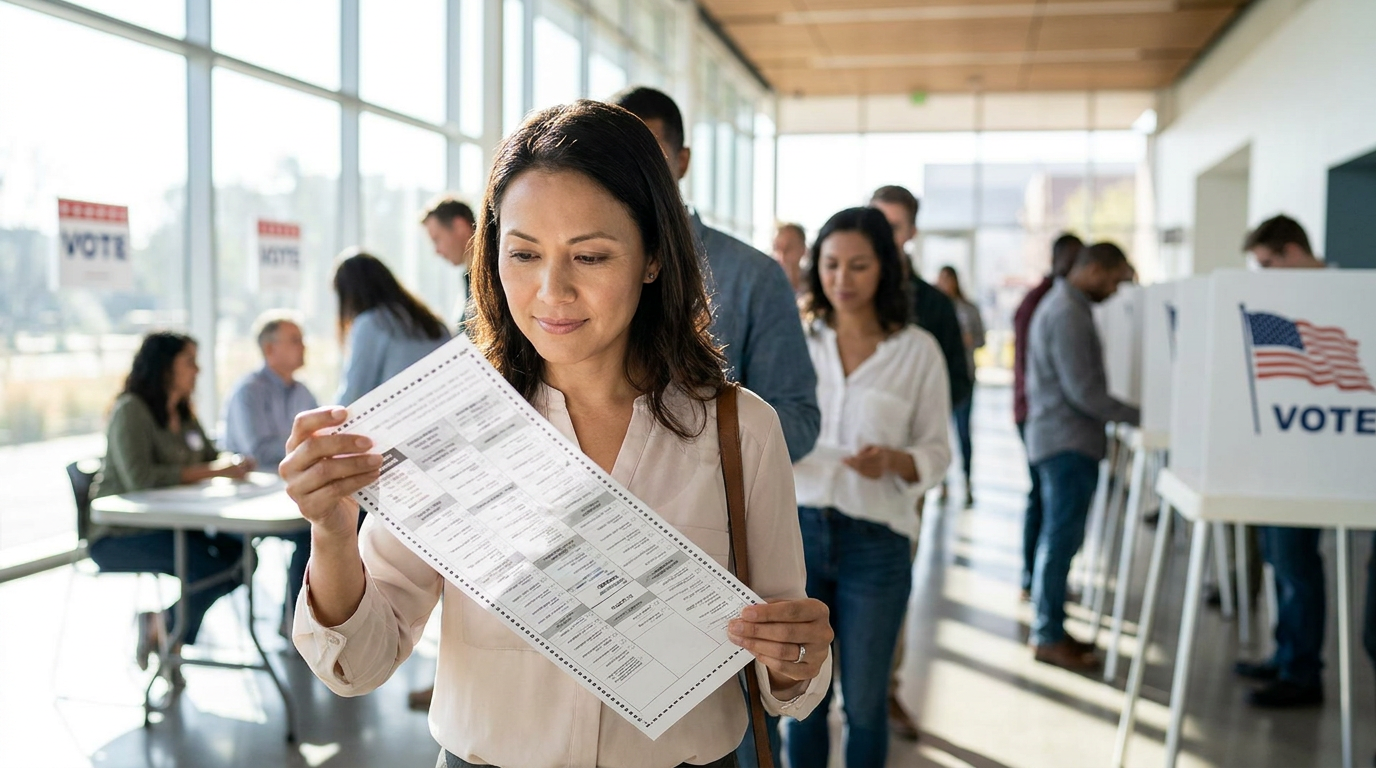
A frequent counter-claim from critics is that RCV confuses voters and inadvertently suppresses turnout. Opponents argue that the grid-style ballots are overly complex, leading to errors, spoiled ballots, and disenfranchisement, particularly among older voters or those with lower educational attainment.[4]

A frequent counter-claim from critics is that RCV confuses voters and inadvertently suppresses turnout.
The administrative data presents a nuanced picture of this concern. Initial rollouts of RCV in a new jurisdiction do typically see a slight uptick in overvotes, which occurs when a voter mistakenly selects multiple candidates for the first-place position, invalidating the ballot.[2][6]
Yet, this confusion appears to be a temporary learning curve rather than a permanent flaw. Polling indicates that by the second or third RCV election in a jurisdiction, over 85 percent of voters report finding the ballot instructions easy to understand, and error rates drop to baseline levels.[7]
A more persistent structural issue is the phenomenon of the exhausted ballot. This occurs when a voter only ranks one or two candidates, and those specific candidates are eliminated in early rounds, leaving the voter with no active preference in the final, deciding round of tabulation.[4]
Studies show ballot exhaustion rates generally hover around 5 to 8 percent in competitive races. While this means a small fraction of voters do not weigh in on the final pairing, election administrators point out that this drop-off is mathematically much lower than the severe voter attrition typically seen in traditional runoff elections held on separate days.[2][8]

Another major claim is that RCV levels the playing field for women and minority candidates. Proponents argue that by eliminating the spoiler effect, RCV encourages a wider, more diverse array of candidates to run without the traditional party establishment pressuring them to drop out for the sake of a frontrunner.[3]
Empirical evidence strongly supports this demographic claim. Municipalities that have adopted RCV have seen statistically significant increases in the election of women and candidates of color to city councils and mayoral offices, as diverse coalitions can pool their voting power across multiple rounds.[5][8]
Many voters support RCV hoping it will break the two-party system and allow third-party candidates to win major offices. They believe that if voters are free to rank their true favorite first without fear of wasting their vote, independent candidates will surge to victory.[1]
Here, the evidence is sobering for third-party optimists. While third-party candidates do receive a higher percentage of first-choice votes under RCV, they still rarely accumulate the broad 50 percent consensus needed to actually win the office in the final round.[2][5]

Instead, the primary effect on the party system appears to be internal. RCV allows different factions within a dominant political party to compete vigorously against one another without handing the election to the opposing party, ensuring the eventual winner represents the median voter of that district.[6]
Ultimately, the aggregated data suggests that Ranked-Choice Voting is not a magic bullet for all democratic ailments. It does not instantly create a multi-party utopia, nor does it completely erase deep-seated ideological divides within the electorate.[4][8]
However, as an evidence-based structural intervention, it consistently delivers on its more modest promises: it reduces campaign vitriol, diversifies candidate pools, eliminates the spoiler effect, and ensures that winning candidates have broader consensus support than those elected under traditional plurality rules.[1][3][5]
How we got here
2004
San Francisco implements Ranked-Choice Voting for municipal elections, providing early longitudinal data.
2018
Maine becomes the first state to use Ranked-Choice Voting for federal congressional elections.
2020
Alaska voters approve a ballot measure establishing a top-four open primary followed by an RCV general election.
2024-2026
RCV sees rapid expansion, being adopted by over 50 municipalities across the United States.
Viewpoints in depth
Election Reform Advocates
Organizations pushing for RCV emphasize its ability to build consensus and reduce vitriol.
Advocacy groups point to the structural incentives of RCV as the key to fixing toxic politics. They argue that when politicians are forced to court second-choice votes, they can no longer rely on firing up a narrow, extreme base. Instead, candidates must engage constructively with the entire electorate. These advocates heavily cite the increases in candidate diversity and the elimination of the 'spoiler effect' as proof that the system creates a more representative democracy.
Electoral Traditionalists
Critics focus on the administrative burden and the potential for voter disenfranchisement.
Traditionalists and skeptical administrators argue that the complexity of RCV asks too much of the average voter. They point to the phenomenon of 'exhausted ballots'—where voters who only rank one or two candidates effectively drop out of the final tally—as a form of silent disenfranchisement. Furthermore, they argue that the delayed tabulation process, which can take days or weeks as rounds are calculated, undermines public trust in the immediacy and transparency of election results.
Political Scientists
Researchers provide a measured view, validating some claims while debunking others.
Academic researchers emphasize that while RCV is a positive reform, it is not a panacea. Their data validates that RCV improves campaign civility and helps diverse candidates, but they push back on the idea that it breaks the two-party duopoly. Political scientists note that third-party candidates still struggle to build the 50 percent consensus required to win. They view RCV primarily as a tool for better intra-party competition and consensus-building, rather than a system that will radically overhaul the partisan makeup of government.
What we don't know
- Whether the civility effects of RCV will persist as highly funded national campaigns adapt their strategies to the system.
- How RCV impacts long-term legislative behavior and bipartisanship once candidates are actually in office.
Key terms
- Ranked-Choice Voting (RCV)
- An electoral system where voters rank candidates by preference on their ballots; if no candidate wins a majority of first-preference votes, the lowest-polling candidate is eliminated and their votes are redistributed to the voters' next choices.
- Plurality Voting
- The traditional electoral system where the candidate with the most votes wins, even if they receive less than 50 percent of the total vote.
- Spoiler Effect
- A phenomenon in plurality voting where a third-party or independent candidate draws votes away from a major candidate with similar ideology, inadvertently helping a candidate with opposing views to win.
- Overvote
- A ballot error where a voter selects more candidates for a single position than is allowed, such as marking two candidates as their first choice, which invalidates that section of the ballot.
Frequently asked
What is an exhausted ballot?
An exhausted ballot occurs when a voter ranks only a few candidates, and all of their chosen candidates are eliminated in early rounds. Because they did not rank the candidates who made it to the final round, their ballot does not count toward the final tally.
Does RCV favor one political party over another?
Extensive data shows RCV does not inherently favor Democrats or Republicans. It tends to favor consensus candidates who can appeal to the median voter in their specific district, regardless of party affiliation.
How are ties handled in Ranked-Choice Voting?
If candidates tie for the lowest number of votes during an elimination round, election officials use a predetermined random method, such as drawing lots, to decide which candidate is eliminated, mirroring traditional election tie-breaking rules.
Sources
Source coverage
8 outlets
3 viewpoints surfaced








[1]Factlen Editorial Team
Synthesis by Factlen editorial team
Read on Factlen Editorial Team →[2]MIT Election Data and Science LabPolitical Scientists
Evaluating the Empirical Effects of Ranked Choice Voting
Read on MIT Election Data and Science Lab →[3]FairVoteElection Reform Advocates
Ranked Choice Voting: Data and Research
Read on FairVote →[4]Bipartisan Policy CenterElectoral Traditionalists
An Assessment of Ranked Choice Voting Administration
Read on Bipartisan Policy Center →[5]Stanford Center on DemocracyPolitical Scientists
Electoral System Design and Democratic Representation
Read on Stanford Center on Democracy →[6]Alaska Division of Elections
Official Election Results and Voter Turnout Data
Read on Alaska Division of Elections →[7]Pew Research Center
Voter Attitudes Toward Alternative Voting Systems
Read on Pew Research Center →[8]American Political Science AssociationPolitical Scientists
Campaign Civility and Strategy Under Ranked Choice Voting
Read on American Political Science Association →

More in news politics
See all 7 stories →US-Iran Ceasefire
US and Iran Reach Tentative Agreement to End War and Reopen Strait of Hormuz
0 sources

Digital Provenance
The End of the Deepfake Arms Race: How C2PA and Cryptographic Provenance Are Rebuilding Digital Trust
0 sources

Strait of Hormuz
Potential End to U.S.-Iran War Tests Trump's Economic Promises as Dispute Over Strait of Hormuz Tolls Emerges
0 sources

US-Iran Relations
CIA Director Doubts Iran's Intentions in Peace Deal as White House Seeks Economic Rebound
0 sources
Every angle. Every day.
Get news politics stories with full source coverage and perspective breakdowns delivered to your inbox.