
SpaceX Raises Record $85.7 Billion in Historic IPO, Reaching $2.1 Trillion Valuation
SpaceX executed the largest stock market debut in history, raising $85.7 billion and vaulting to a $2.1 trillion valuation after underwriters exercised their over-allotment option. The blockbuster listing officially made CEO Elon Musk the world's first trillionaire while testing Wall Street's appetite for mega-cap AI infrastructure.
By Factlen Editorial Team
- Growth Investors & Tech Bulls
- Believe the premium valuation is justified by SpaceX's monopoly in space launch and its massive AI potential.
- Value Analysts & Skeptics
- Caution that the company's current revenue and recent unprofitability do not support its multi-trillion-dollar price tag.
- Market Historians & Institutional Observers
- Focus on the structural impact of the IPO on global capital markets and future mega-cap listings.
What's not represented
- · Retail investors who were priced out of the initial allocation
- · Competitors in the AI space facing a newly capitalized rival
Why this matters
This record-shattering IPO not only reshapes the hierarchy of the world's most valuable companies but also proves that public markets have an immense appetite for massive AI and space infrastructure investments. The successful debut clears the runway for other highly anticipated tech listings, potentially unlocking a new era of mega-cap public offerings.
Key points
- SpaceX raised $85.7 billion after underwriters exercised their greenshoe option, shattering the global IPO record.
- Shares closed at $160.95 on their first day of trading, giving the company a $2.1 trillion market capitalization.
- The newly public entity includes the core space business, Starlink, xAI, and the social media platform X.
- The massive surge in valuation officially made CEO Elon Musk the world's first trillionaire.
- Analysts are divided on the valuation, with bulls citing a $28.5 trillion AI market and bears pointing to recent unprofitability.
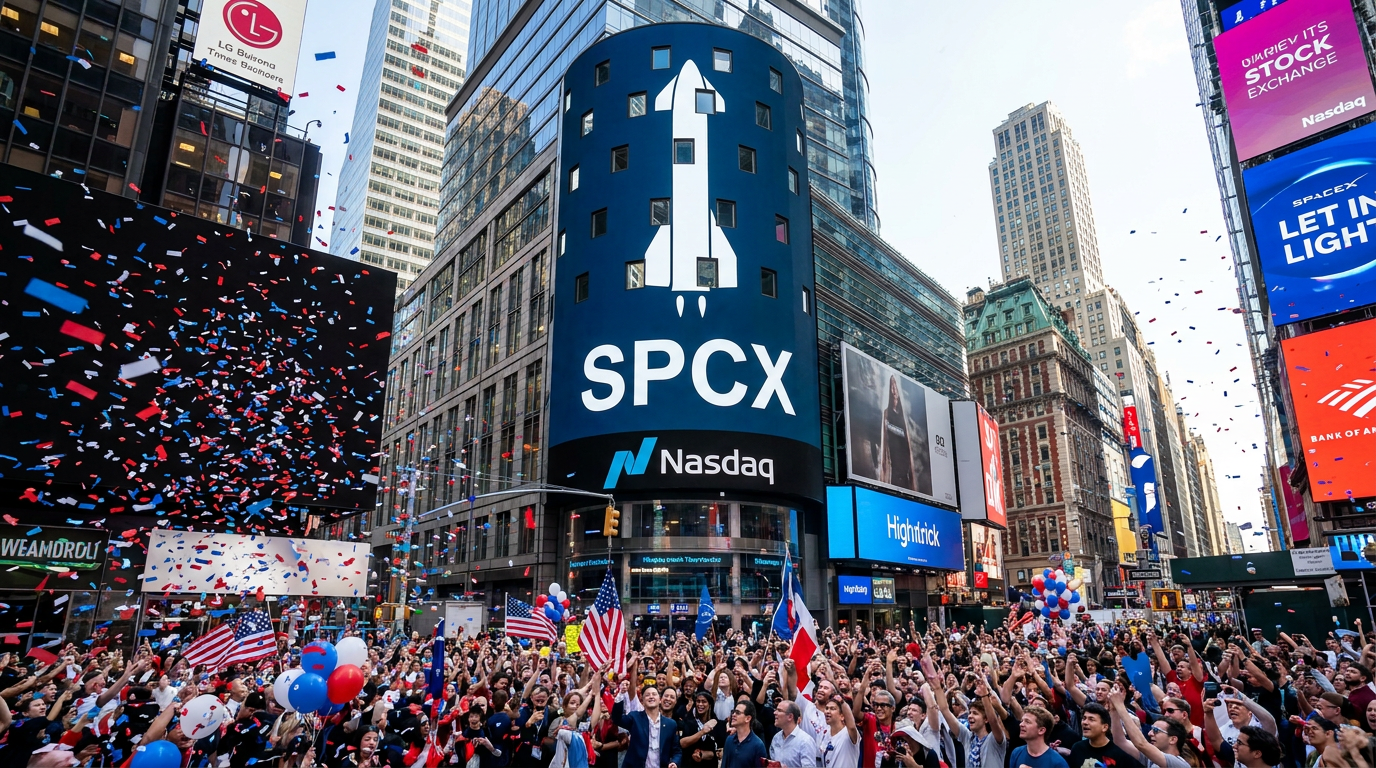
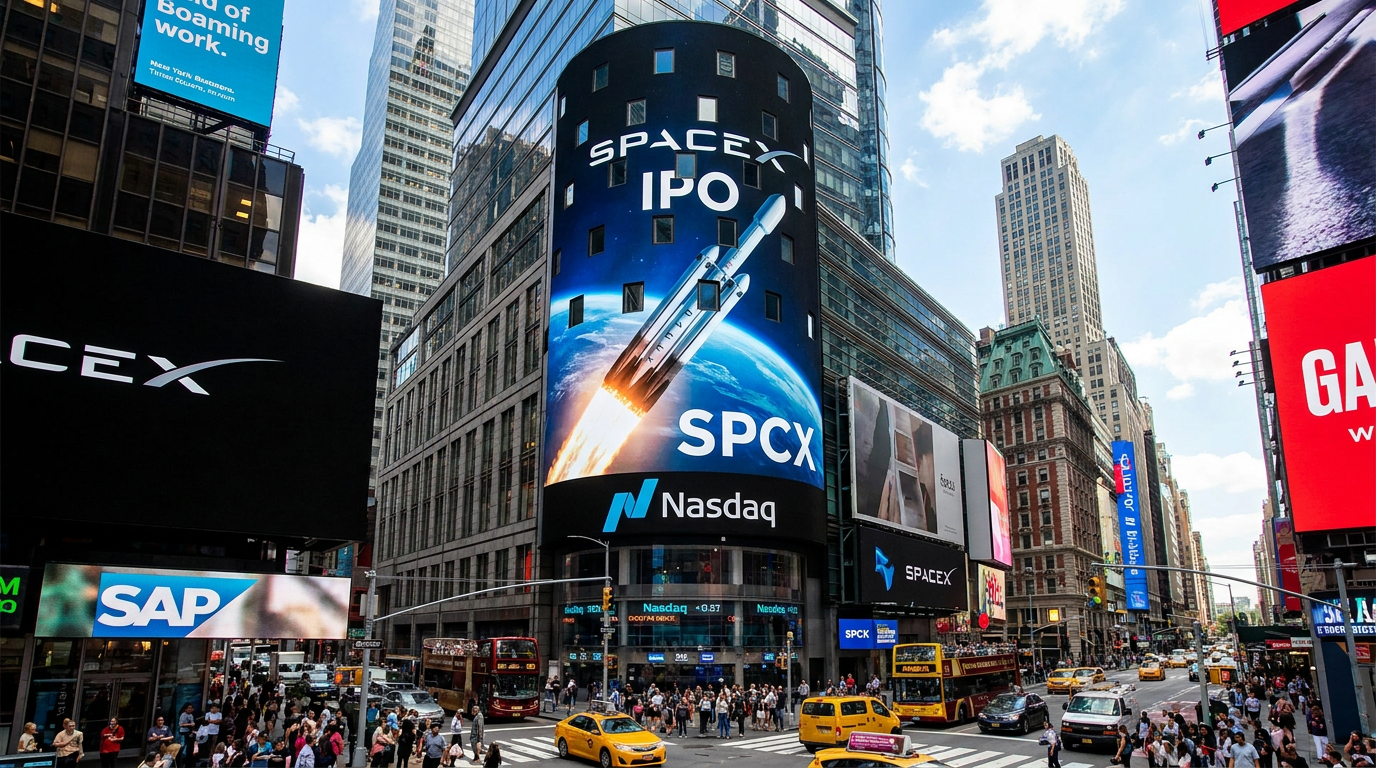
SpaceX has officially executed the largest stock market debut in global history, shattering previous records and instantly vaulting into the upper echelon of the world's most valuable companies. After a frenzied first day of trading on the Nasdaq under the ticker symbol SPCX, the aerospace and technology conglomerate reached a staggering market capitalization of $2.1 trillion. The public listing not only cemented the company's dominance in the commercial space sector but also officially made its chief executive, Elon Musk, the world's first trillionaire.[2][3][4]
The sheer scale of the capital raise has redefined Wall Street benchmarks. While the initial offering was priced to raise $75 billion, the company revealed on Monday that underwriters fully exercised their "greenshoe" over-allotment option. This maneuver allowed bankers to purchase an additional 83.3 million shares, injecting another $10.7 billion into the offering and bringing the total proceeds to $85.7 billion. For context, the previous record for an initial public offering was held by Saudi Arabia's state-owned oil giant, Saudi Aramco, which raised $29.4 billion in 2019. SpaceX eclipsed that mark by more than two and a half times.[1][4][6]
Investor appetite proved insatiable despite the company's unconventional approach to the listing. SpaceX offered shares at a fixed price of $135 rather than a traditional range, and demand from institutional and retail buyers quickly outstripped supply. When public trading commenced on Friday, the stock opened at $150 and surged throughout the session, closing at $160.95—a 19 percent premium over the offering price. The momentum carried into Monday, with shares climbing an additional 10 percent in early trading and pushing the company's valuation past $2.3 trillion.[2][3][4][7][8]

Crucially, the entity that debuted on the Nasdaq is vastly different from the rocket manufacturer of the past decade. Following a sweeping corporate consolidation in February 2026, the newly public SpaceX encompasses the core launch business, the Starlink satellite internet network, the artificial intelligence startup xAI, and the social media platform X. This integration was designed to provide a financial lifeline to xAI's capital-intensive development while presenting Wall Street with a unified infrastructure narrative.[3][7]
Crucially, the entity that debuted on the Nasdaq is vastly different from the rocket manufacturer of the past decade.
That narrative is the primary engine driving the company's premium valuation. In its prospectus, SpaceX outlined a total addressable market of $28.5 trillion, with a massive $26.5 trillion of that opportunity attributed to artificial intelligence. The company is already leveraging its enormous data centers to train its own models, like Grok, while simultaneously renting spare computing capacity to external tech giants. Active deals to provide AI compute to Anthropic and Alphabet are expected to generate billions in annualized revenue, transforming SpaceX into a formidable player in the cloud infrastructure space.[5][7]
However, the astronomical valuation has drawn sharp warnings from value analysts and skeptical market watchers. Critics point out that SpaceX is currently generating very little revenue relative to its $2.1 trillion price tag. The company's core space launch segment, while technologically revolutionary thanks to reusable rockets, operates in a market worth only about $10 billion annually. Furthermore, financial disclosures revealed that the company lost $4.9 billion last year—a sharp reversal from a $791 million profit the prior year—driven almost entirely by massive expenditures on AI hardware.[3][5][7]

"We think the market is assigning too much value to future optionality and too little discount to execution risk," noted one analyst, highlighting the fierce competition SpaceX faces in the AI sector from established incumbents. Skeptics argue that while Starlink provides a solid, growing revenue stream, the company's growth story is now dangerously tilted toward an AI market where it still trails industry leaders. Despite these concerns, the stock's performance suggests that a largely loyal investor base is willing to pay an "Elon Musk premium" based on his track record of disrupting legacy industries.[1][5][8]
Beyond the immediate financial windfall for SpaceX, the blockbuster IPO is being viewed as a critical bellwether for the broader technology sector. The flawless execution and massive retail participation have assuaged fears that the market might struggle to absorb such a colossal listing. Wall Street strategists now believe the successful debut paves the way for other highly anticipated mega-listings, with AI heavyweights like OpenAI and Anthropic expected to test the public markets later this year.[3][8]
For now, SpaceX sits comfortably as the sixth-largest company in the United States by market capitalization, trailing only the likes of Nvidia, Apple, Alphabet, Amazon, and Microsoft. As the initial euphoria settles, the company faces the daunting task of executing on its multi-front ambitions—from landing the Starship rocket on Mars to scaling its AI data centers—to justify a valuation that has already left the stratosphere.[4][5]
How we got here
February 2026
SpaceX merges with xAI and the social media platform X to form a unified technology conglomerate.
June 11, 2026
SpaceX prices its initial public offering at a fixed $135 per share.
June 12, 2026
Shares debut on the Nasdaq, opening at $150 and closing at $160.95, pushing the valuation to $2.1 trillion.
June 15, 2026
Underwriters exercise the greenshoe option, bringing total IPO proceeds to a record-breaking $85.7 billion.
Viewpoints in depth
Growth Investors & Tech Bulls
Investors who believe the premium valuation is justified by SpaceX's monopoly in space launch and its massive AI potential.
Proponents argue that SpaceX is uniquely positioned to dominate the infrastructure of the future. By combining the world's only fully reusable rocket fleet, the Starlink global internet monopoly, and xAI's massive compute clusters, they view the $2.1 trillion valuation as a fair price for a company targeting a $28.5 trillion total addressable market. For these investors, the near-term unprofitability is a necessary stepping stone to building an insurmountable technological moat.
Value Analysts & Skeptics
Financial analysts who caution that the company's current revenue does not support its multi-trillion-dollar price tag.
Skeptics point out a stark disconnect between SpaceX's current financials and its astronomical market cap. They note that the company lost $4.9 billion last year, largely due to heavy AI spending, and that the core space launch market is only worth about $10 billion annually. From this perspective, the stock's price relies entirely on unproven projections in the highly competitive artificial intelligence sector, making it vulnerable to severe corrections if execution falters.
Market Historians & Institutional Observers
Market watchers focused on the structural impact of the IPO on global capital markets.
Institutional observers view the SpaceX listing as a watershed moment that redefines what is possible in public markets. By successfully raising $85.7 billion—more than double the previous record held by Saudi Aramco—the offering proves that public exchanges can absorb unprecedented liquidity events. This camp believes the flawless execution of the SpaceX debut will act as a catalyst, encouraging other massive private tech decacorns like OpenAI and Anthropic to accelerate their own IPO timelines.
What we don't know
- Whether SpaceX can successfully capture the massive $26.5 trillion artificial intelligence market it outlined in its prospectus.
- How the newly integrated conglomerate will balance the capital-intensive demands of Starship development with its massive AI data center buildout.
- If the stock's premium valuation will hold once the initial retail euphoria subsides and quarterly earnings reports begin.
Key terms
- Initial Public Offering (IPO)
- The process of offering shares of a private corporation to the public in a new stock issuance, allowing the company to raise capital from public investors.
- Greenshoe Option
- A provision in an underwriting agreement that allows the underwriters to sell more shares than originally planned if demand is higher than expected.
- Market Capitalization
- The total value of a publicly traded company's outstanding common shares, calculated by multiplying the current share price by the total number of shares.
- Total Addressable Market (TAM)
- The overall revenue opportunity that is available to a product or service if 100% market share is achieved.
Frequently asked
How much did SpaceX raise in its IPO?
SpaceX raised a total of $85.7 billion after underwriters exercised their over-allotment option, making it the largest IPO in history.
What is SpaceX's ticker symbol?
SpaceX trades on the Nasdaq stock exchange under the ticker symbol SPCX.
What companies are included in the public SpaceX entity?
Following a February 2026 merger, the public entity includes the core SpaceX rocket business, the Starlink satellite network, the artificial intelligence startup xAI, and the social media platform X.
Did the IPO make Elon Musk a trillionaire?
Yes, the surge in SpaceX's valuation pushed Elon Musk's personal net worth past the $1 trillion mark, making him the world's first trillionaire.
Sources
Source coverage
8 outlets
3 viewpoints surfaced








[1]MarketWatchGrowth Investors & Tech Bulls
SpaceX’s stock jumps as the company reveals its IPO has raised another $10.7 billion
Read on MarketWatch →[2]The GuardianGrowth Investors & Tech Bulls
SpaceX makes largest ever stock market debut, making Elon Musk world's first trillionaire
Read on The Guardian →[3]The New York TimesGrowth Investors & Tech Bulls
SpaceX's Stock Surges on First Full Day of Trading
Read on The New York Times →[4]Los Angeles TimesMarket Historians & Institutional Observers
SpaceX shares rise 19% in stock market debut after historic IPO
Read on Los Angeles Times →[5]Seeking AlphaValue Analysts & Skeptics
SpaceX: The $2 Trillion Stock That Already Left Earth (NASDAQ:SPCX)
Read on Seeking Alpha →[6]ReutersMarket Historians & Institutional Observers
SpaceX IPO raises US$85.7 billion as underwriters exercise greenshoe option
Read on Reuters →[7]The Motley FoolValue Analysts & Skeptics
SpaceX Stock Soared 19% on Its Market Debut. Here's Why I'm Not Buying It.
Read on The Motley Fool →[8]BloombergGrowth Investors & Tech Bulls
SpaceX Shares Jump in Second Day of Trading After Record IPO
Read on Bloomberg →

Every angle. Every day.
Get finance stories with full source coverage and perspective breakdowns delivered to your inbox.