
How Hydrogen Trains Are Replacing Diesel on the World's Railways
As rail networks push to decarbonize, hydrogen fuel cell trains are emerging as a zero-emission alternative for long-haul routes where overhead electrification is too expensive.
By Factlen Editorial Team
- Hydrogen Advocates
- Manufacturers and operators who see hydrogen as the only viable replacement for diesel on long-haul routes.
- Battery-First Proponents
- Industry voices arguing that battery-electric trains are more efficient and cost-effective for most regional networks.
- Environmental Planners
- Policymakers focused on the lifecycle emissions and the source of the hydrogen fuel.
What's not represented
- · Fossil fuel industry representatives
- · Local transit union workers
Why this matters
Nearly half of Europe's railway network remains un-electrified, relying on polluting diesel locomotives. Hydrogen technology offers a way to clean up these hard-to-reach routes, improving local air quality and advancing global climate goals without requiring billions in new infrastructure.
Key points
- Hydrogen trains use onboard fuel cells to generate electricity, emitting only water vapor.
- They are designed to replace diesel locomotives on rural and regional lines where overhead electrification is too expensive.
- Most modern hydrogen trains operate as hybrids, using lithium-ion batteries to handle peak acceleration and capture braking energy.
- While battery trains dominate short routes, hydrogen offers superior range (up to 1,000 km) and faster refueling for long-haul journeys.
For decades, rail travel has been celebrated as the poster child for clean, mass-scale transportation, yet a surprisingly large share of the world's regional networks remains stubbornly tethered to fossil fuels. In the European Union, for example, only 57 percent of the railway network is currently electrified, with countries like Italy falling below one-third. The reality is that thousands of miles of track across the globe still rely on heavy, polluting diesel locomotives to move passengers and freight, presenting a massive hurdle for governments attempting to meet strict net-zero emissions targets by the middle of the century.[6]
On these non-electrified routes, diesel locomotives have long been considered the only practical and economically viable option, quietly contributing a significant share to the transport sector's overall carbon footprint. Upgrading these legacy lines with continuous overhead electric wires is often prohibitively expensive and logistically challenging, especially in rural, mountainous, or sparsely populated regions where the low frequency of train services cannot justify the massive upfront infrastructure investment. Consequently, transit authorities have been trapped in a difficult position, forced to choose between running dirty trains or abandoning vital regional connectivity altogether.[4][6]
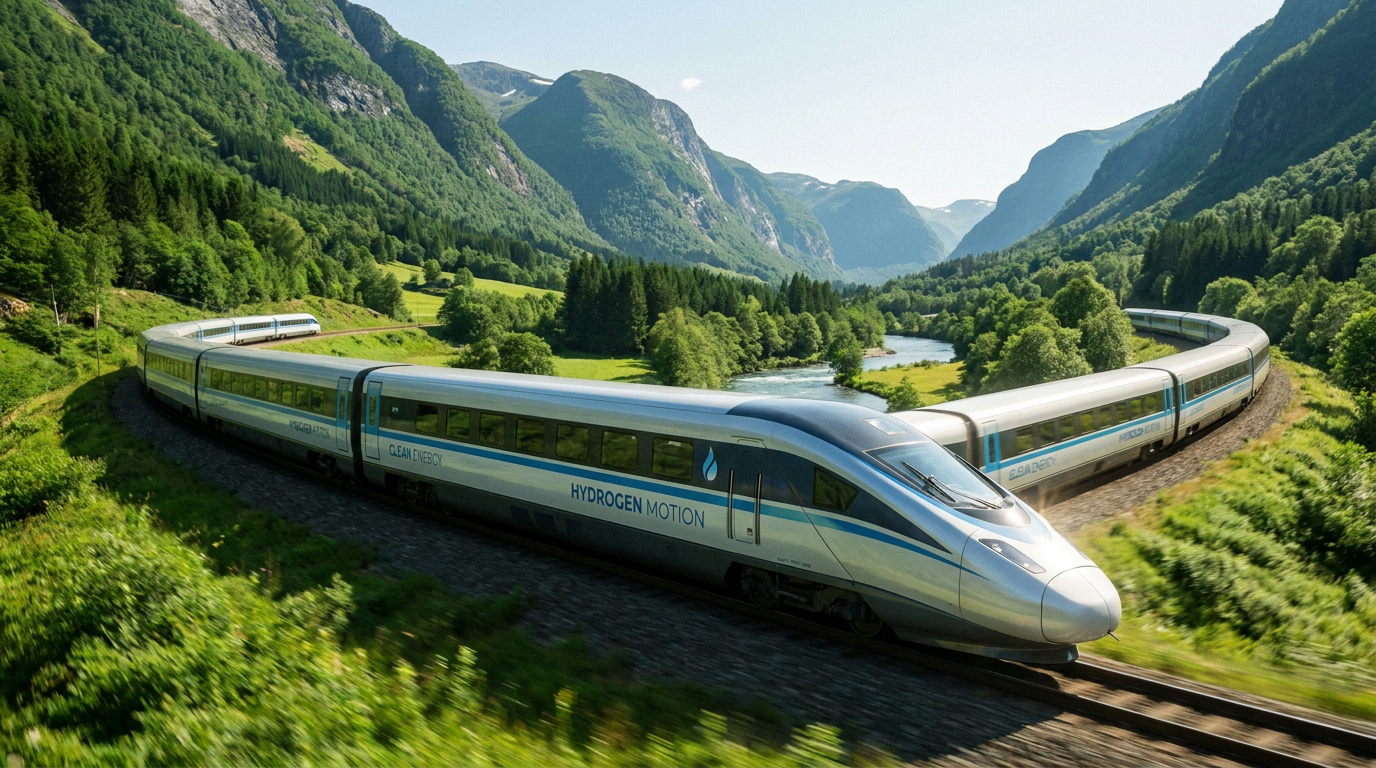
Enter the hydrogen-powered train, frequently referred to in the industry as "hydrail." Designed specifically to bridge the difficult gap between dirty diesel operations and costly full-line electrification, these innovative trains offer the smooth, quiet, and efficient performance of a modern electric multiple unit without the need for overhead catenary wires. By carrying their own clean power plant on board, hydrogen trains promise to seamlessly replace diesel units on existing tracks, allowing railways to decarbonize their most remote and challenging routes without laying a single mile of new electrical cable.[4]
The mechanism driving these next-generation trains is fundamentally different from a traditional combustion engine. While some experimental designs have attempted to burn hydrogen gas directly in modified internal combustion engines, the vast majority of modern hydrogen trains do not burn anything at all. Instead, they rely on highly advanced onboard fuel cells to generate electricity through a controlled, continuous chemical reaction. This approach avoids the inefficiencies and thermal losses associated with combustion, providing a direct and elegant pathway from stored chemical energy to usable electrical power.[4]

Inside the roof-mounted fuel cell stack, the magic of hydrail takes place. Hydrogen gas, which is stored safely in high-pressure tanks on top of the train cars, is carefully fed into the fuel cell where it is combined with oxygen drawn directly from the ambient air outside. This electrochemical reaction strips electrons from the hydrogen molecules, creating a steady flow of electrical current that is then routed down to drive the train's heavy-duty electric traction motors, propelling the massive vehicle forward with remarkable silence and smooth acceleration.[1][4]
The most celebrated aspect of this chemical process is its complete lack of harmful emissions. The only direct by-products generated by the hydrogen fuel cell are heat and pure water vapor, which is harmlessly vented into the atmosphere as a light trail of steam. This zero-emission profile makes hydrogen an incredibly attractive alternative for regional transit authorities looking to meet aggressive climate targets, as it entirely eliminates the nitrogen oxides, particulate matter, and carbon dioxide that have historically plagued diesel-operated railway corridors and the communities they pass through.[4][5]
However, a modern hydrogen train is rarely powered by fuel cells alone. In practice, almost all current hydrail designs operate as highly sophisticated hybrid vehicles, pairing the hydrogen fuel cell system with a substantial lithium-ion battery pack located beneath the passenger cabin. This dual-source architecture is not a redundancy, but a critical engineering necessity designed to handle the unique physical demands of moving hundreds of tons of steel and passengers from a dead stop to highway speeds repeatedly throughout a daily transit schedule.[4][6]
This hybrid architecture is crucial because rail traction is highly dynamic by nature. The hydrogen fuel cell operates most efficiently and enjoys a longer lifespan when it is tasked with providing a steady, continuous baseline of power for cruising. Meanwhile, the onboard lithium-ion battery is perfectly suited to handle the sudden, massive peaks in electrical demand required for initial acceleration out of a station or for climbing steep mountain gradients, stepping in instantly to provide the necessary torque that the fuel cell alone cannot rapidly supply.[4]
Furthermore, the inclusion of a high-capacity battery allows the train to capture and store kinetic energy during regenerative braking. When the train slows down to approach a station, the electric traction motors run in reverse, acting as generators that convert the vehicle's forward momentum back into electricity. By recycling this energy—which would otherwise be wasted as heat dissipating off traditional mechanical brake pads—the hybrid system significantly improves the train's overall energy efficiency, reduces wear and tear on physical components, and substantially extends its operational range between refueling stops.[4]
Furthermore, the inclusion of a high-capacity battery allows the train to capture and store kinetic energy during regenerative braking.
Despite the elegant engineering and the pristine water vapor exhaust, the actual climate benefits of hydrail depend entirely on how the hydrogen fuel is sourced. It is vital to understand that hydrogen is an energy carrier, much like a battery, rather than a primary energy source that can be mined or pumped from the earth. Because hydrogen rarely exists in its pure form in nature, it must be manufactured, and the various production pathways available today vary wildly in their environmental impact and overall carbon footprint.[4]
If the hydrogen is produced via electrolysis—a process that uses electricity to split water into hydrogen and oxygen—and that electricity is sourced from renewable wind, solar, or hydroelectric power, the resulting fuel is known as "green hydrogen." In this scenario, the entire lifecycle of the train is genuinely low-carbon. However, if the hydrogen is derived from natural gas using steam methane reforming, the carbon emissions are simply shifted away from the train's tailpipe and relocated to the industrial production facility, undermining the core environmental promise of the technology.[4]

As the technology matures and moves from prototype to production, hydrogen trains are finding themselves in a fierce competition not just with legacy diesel locomotives, but with rapidly advancing battery-electric trains. Over the past decade, the energy density of lithium-ion batteries has improved dramatically, allowing manufacturers to build trains that run entirely on battery power without the need for complex fuel cells or high-pressure gas storage, setting up a fascinating technological rivalry for the future of non-electrified rail corridors.[4][8]
Battery-electric trains offer a highly compelling operational model: they can charge their batteries while running under existing overhead wires on main lines, and then seamlessly switch to battery power to traverse the non-electrified gaps on regional branch lines. For routes under 80 kilometers, battery-electric models are increasingly viewed by transit operators as the simpler and more cost-effective solution. They boast fewer moving parts, require less specialized maintenance, and completely avoid the need to build expensive, highly regulated hydrogen refueling stations along the route.[3][4]
Executives at Swiss trainmaker Stadler have publicly noted that in technology-neutral tenders for short German branch lines, battery trains almost always emerge victorious over their hydrogen counterparts. They point out that hydrogen fuel cells require more intensive and costly maintenance, with some critical components requiring complete replacement every three years. Because of this added complexity, and the inherent energy losses involved in converting electricity to hydrogen and back again, many industry analysts believe battery trains will dominate the market for short, predictable commuter routes.[3]

Where hydrogen technology truly shines, however, is on long-haul routes and intensive, round-the-clock timetables where batteries simply cannot keep up. A modern hydrogen train can be completely refueled in roughly 15 minutes and can travel up to 1,000 kilometers on a single tank of pressurized gas. This vastly outperforms current battery ranges, which often require lengthy recharging stops that can disrupt tightly scheduled transit networks. For vast countries with long distances between rural stations, hydrogen remains the only viable zero-emission alternative to diesel.[3][8]
This long-range capability has driven significant commercial adoption and proven the technology's viability in the real world. Alstom's Coradia iLint, celebrated as the world's first hydrogen passenger train, entered commercial service in Germany in 2018 and has since logged hundreds of thousands of kilometers. The platform recently demonstrated its flexibility by completing a highly successful pilot program in Quebec, Canada, where it transported over 10,000 passengers and proved that hydrail can operate seamlessly even in harsh North American climates.[1]
Other major global manufacturers are quickly following suit, eager to capture a share of the burgeoning green transit market. Siemens Mobility is currently producing the Mireo Plus H, a state-of-the-art two-car hydrogen train set to replace aging diesel units on non-electrified routes in Bavaria by 2026. To ensure the project meets its environmental goals, the regional transit authority is supporting the rollout with a dedicated green hydrogen electrolysis plant, ensuring the fuel supply is as clean as the trains themselves.[2]
The momentum for hydrogen rail is accelerating across Europe as national governments mandate the phase-out of fossil fuels. In France, the national railway company SNCF has aggressively pursued the technology, ordering 12 dual-mode hydrogen trains dubbed the Régiolis H2. These innovative trainsets are currently undergoing rigorous validation testing and are slated to begin commercial passenger service in mid-2027, marking a major milestone in France's broader strategy to eliminate diesel from its regional transport networks entirely.[5]

Meanwhile, the Italian government has recognized that the transition requires massive structural support, recently allocating 300 million euros to replace diesel trains with hydrogen alternatives across six different regions by 2026. Crucially, Italian policymakers have dedicated the vast bulk of this funding not just to purchasing the rolling stock, but to building out the necessary renewable production, storage, and refueling infrastructure, acknowledging that a hydrogen train is useless without a reliable, green ecosystem to support it.[7]
Ultimately, the future of decarbonized rail will not be a winner-take-all battle between hydrogen fuel cells and lithium-ion batteries. Instead, transit networks around the world will likely deploy a highly complementary mix of technologies tailored to specific geographic needs: battery-electric trains will handle the short, frequent commuter hops near urban centers, while hydrogen fuel cells will take on the long, quiet, heavy-duty journeys through the countryside, working together to finally relegate the diesel locomotive to the history books.[4][8]
How we got here
2016
Alstom unveils the Coradia iLint, the world's first hydrogen passenger train, at the InnoTrans trade fair.
2018
The Coradia iLint enters commercial passenger service in Germany.
2023
North America's first hydrogen train demonstration takes place in Quebec, Canada.
2026
Siemens Mireo Plus H trains are scheduled to replace diesel units in Bavaria, Germany.
2027
SNCF plans to launch its first dual-mode hydrogen trains in France.
Viewpoints in depth
Hydrogen Advocates
Manufacturers and operators who see hydrogen as the only viable replacement for diesel on long-haul routes.
This camp, led by manufacturers like Alstom and Siemens, argues that hydrogen is essential for routes where electrification is too expensive. They emphasize that hydrogen trains offer a 1,000-kilometer range and 15-minute refueling times, matching the operational profile of legacy diesel trains without requiring a complete overhaul of timetables. They view the high initial costs of refueling infrastructure as a necessary long-term investment for total decarbonization.
Battery-First Proponents
Industry voices arguing that battery-electric trains are more efficient and cost-effective for most regional networks.
Proponents of battery technology, including executives at trainmaker Stadler, point out that most regional non-electrified routes are relatively short—often under 80 kilometers. They argue that battery trains, which can charge under existing overhead wires and run on battery power for the gaps, are cheaper to buy and maintain. They frequently highlight that hydrogen fuel cells require complex high-pressure gas logistics and more frequent component replacements.
Environmental Planners
Policymakers focused on the lifecycle emissions and the source of the hydrogen fuel.
For energy agencies and environmental planners, the train itself is only half the equation. They stress that hydrogen trains only deliver true climate benefits if the fuel is 'green hydrogen' produced via renewable electrolysis. This camp advocates for holistic investments, such as Italy's €300 million initiative, which dedicates the vast majority of funding not to the trains themselves, but to building out renewable production and storage infrastructure.
What we don't know
- How quickly the cost of producing 'green hydrogen' will fall to achieve price parity with diesel fuel.
- Whether the long-term maintenance costs of hydrogen fuel cells will prove prohibitive compared to battery-electric alternatives.
Key terms
- Hydrail
- A portmanteau of 'hydrogen' and 'rail,' referring to any railway vehicle powered by hydrogen fuel cells.
- Fuel Cell
- A device that generates electricity through an electrochemical reaction, combining hydrogen and oxygen without combustion.
- Green Hydrogen
- Hydrogen fuel produced by using renewable electricity (like wind or solar) to split water into hydrogen and oxygen, resulting in zero carbon emissions.
- Regenerative Braking
- A mechanism that captures the kinetic energy normally lost as heat during braking and converts it into electricity to recharge the train's battery.
- Electrolysis
- The process of using electricity to separate water into hydrogen and oxygen gases.
Frequently asked
Do hydrogen trains burn fuel like diesel engines?
No. Hydrogen trains use fuel cells to combine hydrogen gas with oxygen from the air. This electrochemical reaction generates electricity to power the train, without any combustion.
What comes out of the exhaust of a hydrogen train?
The only direct by-products of a hydrogen fuel cell are heat and water vapor. The train emits harmless steam into the atmosphere.
Why not just use battery-powered trains everywhere?
While battery trains are excellent for short routes, they currently lack the range for long-haul journeys and require lengthy recharging times. Hydrogen trains can travel up to 1,000 kilometers and refuel in about 15 minutes.
Are hydrogen trains completely carbon-free?
The trains themselves produce zero emissions. However, their overall climate impact depends on how the hydrogen is made. They are only truly carbon-free if powered by 'green hydrogen' produced using renewable energy.
Sources
Source coverage
8 outlets
3 viewpoints surfaced








[1]AlstomHydrogen Advocates
Coradia iLint: the world's 1st hydrogen powered passenger train
Read on Alstom →[2]Hydrogen EuropeHydrogen Advocates
German rail network to introduce Siemens hydrogen-powered trains
Read on Hydrogen Europe →[3]WirtschaftsWocheBattery-First Proponents
Battery trains prevail over hydrogen
Read on WirtschaftsWoche →[4]IlluminemBattery-First Proponents
Hydrogen trains vs battery electric trains
Read on Illuminem →[5]SNCFEnvironmental Planners
First hydrogen TERs arriving in stations in 2027
Read on SNCF →[6]Global Energy AssociationEnvironmental Planners
Hydrogen trains to replace diesel locomotives?
Read on Global Energy Association →[7]International Energy AgencyEnvironmental Planners
Diesel trains replacement with hydrogen trains
Read on International Energy Agency →[8]Rail ExpressBattery-First Proponents
Hydrogen vs. battery-powered trains
Read on Rail Express →
Every angle. Every day.
Get transportation stories with full source coverage and perspective breakdowns delivered to your inbox.