
SpaceX Valuation Eclipses $2.1 Trillion After Record-Breaking IPO Raises Additional $10.7 Billion
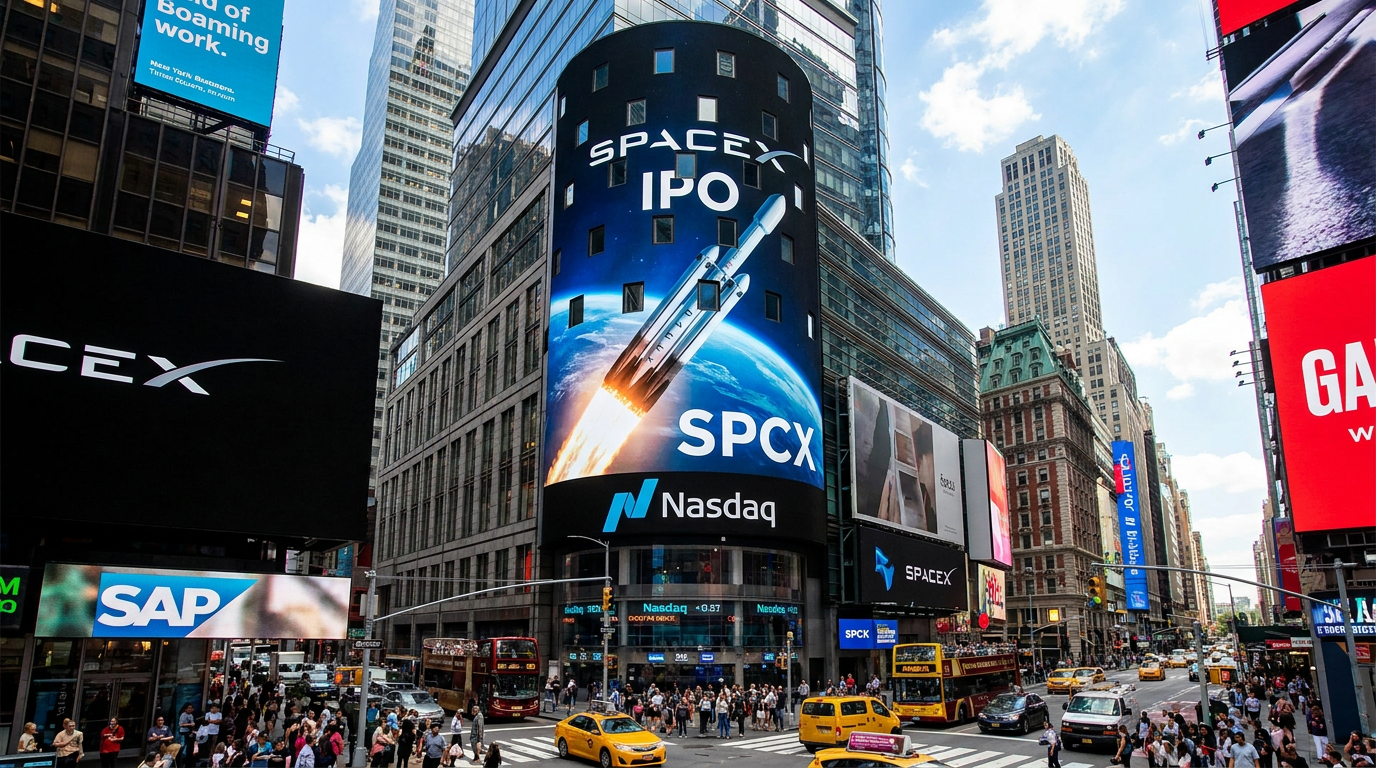
SpaceX's historic public market debut has expanded further after underwriters exercised options to purchase an additional 83 million shares. The move cements the aerospace and AI giant's valuation above $2.1 trillion, though some analysts warn the sheer size of the listing could drain liquidity from the broader market.
By Factlen Editorial Team
- Growth Investors & Underwriters
- Views SpaceX as a generational asset with an uncapped total addressable market across space and AI.
- Value Analysts & Pension Funds
- Argues the $2.1 trillion valuation leaves no margin of safety and prices in decades of flawless execution.
- Macro Market Observers
- Warns that the sheer size of the IPO could drain liquidity from other sectors and increase market volatility.
What's not represented
- · Retail investors who were priced out of the initial allocation
- · Competitors in the terrestrial cloud computing sector
Why this matters
The successful listing of the world's most valuable private company reshapes the technology sector, creating a new heavyweight that combines space infrastructure, satellite internet, and AI compute. For retail and institutional investors, SpaceX's sheer scale means it will heavily influence major index funds and tech portfolios for years to come.
Key points
- SpaceX raised an additional $10.7 billion after underwriters exercised their greenshoe option, bringing the total IPO raise to $85.7 billion.
- The massive capital influx pushes the company's valuation to $2.1 trillion, making it one of the most valuable public entities globally.
- SEC filings reveal a major pivot toward AI infrastructure, including a $920 million monthly cloud computing deal with Google.
- The Starlink broadband network remains the company's primary revenue engine, serving over 4 million global subscribers.
- Some analysts and pension fund managers warn that the $2.1 trillion valuation leaves little room for upside and could drain liquidity from the broader market.
SpaceX’s historic public market debut has expanded its record-breaking footprint. Following a blockbuster initial public offering that saw shares price at $135, underwriters have fully exercised their overallotment option, snapping up an additional 83 million shares. The maneuver raises another $10.7 billion for Elon Musk’s aerospace and technology conglomerate, pushing the total capital raised to roughly $85.7 billion. The massive influx of capital cements the company’s valuation at a staggering $2.1 trillion, making it one of the most valuable publicly traded entities on the planet and capping off a multi-year journey from private unicorn to public heavyweight.[1][2]
The sheer scale of the offering—officially the largest in stock market history—has captivated Wall Street and retail investors alike. Demand for the shares approached four times the planned offering size, with institutional order books swelling past $250 billion before the final pricing was locked in. Trading under the ticker SPCX on the Nasdaq, the stock’s early performance has validated the intense pre-listing hype. Long-only funds and retail traders have aggressively accumulated shares, driven by a fear of missing out on a generational asset that dominates the commercial space sector.[3][4][12]
While SpaceX is universally recognized for its reusable Falcon rockets and the Starship program, the company’s detailed SEC filings revealed a surprising pivot that fundamentally alters its investment thesis. The S-1 prospectus disclosed that SpaceX is no longer just an aerospace company; it is rapidly transforming into an artificial intelligence infrastructure juggernaut. The company plans to deploy data centers in space, leveraging the vacuum and cold of orbit to overcome the thermal and capacity limitations of ground-based infrastructure, effectively positioning itself to fill the widening U.S. computing power gap.[5][7]

The financial mechanics of this AI pivot are already in motion. A recently disclosed cloud service agreement with Google commits SpaceX to providing access to a massive cluster of 110,000 NVIDIA GPUs, alongside associated CPUs and memory. Under the terms of the deal, the customer has agreed to pay SpaceX $920 million per month from October 2026 through June 2029. This contracted revenue stream provides a massive, predictable cash flow that helps justify the company's premium valuation and signals a direct challenge to terrestrial cloud providers.[6]
Despite the flashy AI contracts, the Starlink satellite internet constellation remains the foundational financial engine of the company. The broadband network now serves over 4 million subscribers globally, providing high-speed internet to remote regions, maritime vessels, and commercial airlines. According to the prospectus, the connectivity segment accounted for nearly 70% of the company’s revenue in the first quarter of 2026. This recurring, subscription-based revenue has been critical in offsetting the massive research and development costs associated with the company's more experimental divisions.[5][7]

Despite the flashy AI contracts, the Starlink satellite internet constellation remains the foundational financial engine of the company.
However, the astronomical $2.1 trillion valuation has sparked intense debate among financial analysts and value-oriented investors. Critics point out that the company reported a $4.94 billion loss last year on $18.7 billion of revenue, and had previously lowered its internal valuation targets before the massive public demand drove the price back up. The North Carolina State Treasurer publicly dropped the state's pension fund investment in the company, noting that while the technology is awe-inspiring, a valuation approaching $2 trillion leaves virtually no room for upside. For funds targeting predictable high-single-digit returns, the stock is viewed as fully priced, if not severely overvalued.[4][8][9]
Beyond individual portfolio concerns, macroeconomic observers worry about the structural impact of such a massive listing. Prominent financial commentators have warned that the speculative frenzy surrounding SpaceX could be actively "destructive" to the broader market. The core concern is that the sheer gravitational pull of the SPCX listing is sucking capital away from established, income-generating equities. As institutional managers rebalance their portfolios to ensure adequate exposure to the new mega-cap stock, they are forced to liquidate positions in other sectors, potentially exacerbating volatility across the technology and industrial landscapes.[10][11]
Corporate governance has also emerged as a friction point for some institutional backers. The company's dual-class share structure ensures that Elon Musk retains an overwhelming 85.1% of the voting power, despite holding a smaller percentage of the total economic interest. This concentration of control means that public shareholders have virtually no say in the strategic direction of the company. While Musk's track record of execution has earned him immense leeway with growth investors, traditional governance watchdogs warn that the structure introduces significant key-man risk.[5][7]

Looking ahead, the market is bracing for further turbulence as SpaceX fully integrates into the public trading ecosystem. Options trading for SPCX is set to begin shortly, which analysts expect will drive heavy, volatile activity given the stock's high profile and retail popularity. If the stock behaves similarly to other Musk-led ventures, the options market could create massive gamma squeezes, amplifying both upward and downward price movements in the coming weeks.[11]
Adding to the complex trading dynamics is the company's unconventional lockup expiration schedule. Unlike traditional IPOs that enforce a strict six-month restriction period for insiders, SpaceX has implemented a staged system linked to the company's performance. This means that a large portion of shares held by early employees and private backers could become eligible for resale much sooner than anticipated. The market will have to absorb these additional shares, which could introduce sudden downward pressure on the stock price if early investors decide to cash out their massive paper gains.[11]

For now, SpaceX is flush with capital to fund its most ambitious roadmap to date. The newly raised $85.7 billion is explicitly earmarked for expanding AI compute infrastructure, scaling launch facilities in Texas and Florida, and accelerating the deployment of next-generation satellite constellations. The company's ability to execute on these capital-intensive projects will determine whether it can grow into its historic valuation.[1][5]
As the dust settles on the largest public offering in history, the implications extend far beyond Wall Street. SpaceX has effectively merged the aerospace, telecommunications, and artificial intelligence sectors into a single, publicly traded monolith. Whether the stock proves to be a generational wealth creator or a cautionary tale of speculative excess, its performance will serve as the ultimate bellwether for the global technology industry for the remainder of the decade.[2][10]
How we got here
April 2026
SpaceX confidentially files its draft registration statement with the SEC.
May 20, 2026
The company publicly files its S-1 prospectus, revealing its financials and AI pivot for the first time.
June 4, 2026
SpaceX launches its investor roadshow, meeting with over 300 institutional investors.
June 11, 2026
Shares price at $135, raising an initial $75 billion.
June 12, 2026
SPCX begins trading on the Nasdaq.
June 15, 2026
Underwriters fully exercise the greenshoe option, raising an additional $10.7 billion and pushing the valuation to $2.1 trillion.
Viewpoints in depth
Growth Investors' View
A Generational Asset with Uncapped Potential.
Growth funds view SpaceX not just as a rocket company, but as the foundational infrastructure for the next century of technology. By combining global satellite broadband with space-based AI data centers, they argue SpaceX is building a monopoly in low-Earth orbit. They justify the $2.1 trillion valuation by pointing to the $920 million monthly Google contract and Starlink's rapid subscriber growth, asserting that the company's total addressable market is effectively uncapped.
Value Analysts' View
Priced for Absolute Perfection.
Skeptics and traditional pension fund managers argue that the IPO price leaves zero margin of safety. At $2.1 trillion, SpaceX is valued higher than almost every established, highly profitable tech giant, despite posting a net loss in the previous fiscal year. They caution that the valuation assumes flawless execution of highly experimental projects, like space-based data centers, and warn that any delays or launch failures could trigger a severe correction.
Macro Strategists' View
A Liquidity Black Hole.
Market strategists are focused less on the company's fundamentals and more on the mechanics of the listing itself. They warn that an $85.7 billion capital raise acts as a vacuum, pulling investment dollars away from mid-cap tech stocks and established blue chips. Furthermore, they anticipate that the upcoming options trading and early lockup expirations will inject significant volatility into the Nasdaq, potentially destabilizing the broader market in the short term.
What we don't know
- How quickly SpaceX can scale its space-based data centers to meet the massive computing demands of its AI partners.
- Whether the upcoming expiration of early-investor lockup periods will trigger a significant sell-off in the stock.
- How the broader technology sector will react to the liquidity drain caused by the largest capital raise in stock market history.
Key terms
- Greenshoe Option
- A provision in an underwriting agreement that allows the underwriters to sell more shares than originally planned if demand is higher than expected.
- S-1 Prospectus
- The initial registration form required by the SEC for U.S. companies planning to go public, detailing their business model and financials.
- Dual-Class Share Structure
- A system where a company issues two types of shares with different voting rights, often used to keep control in the hands of founders.
- Gamma Squeeze
- A rapid increase in a stock's price caused by options market makers buying the underlying stock to hedge their positions as call options are purchased.
- Lockup Period
- A predetermined window of time after an IPO during which early investors and insiders are restricted from selling their shares.
Frequently asked
What is SpaceX's stock ticker symbol?
SpaceX trades on the Nasdaq exchange under the ticker symbol SPCX.
How much is SpaceX worth after the IPO?
Following the exercise of the underwriters' overallotment option, SpaceX is valued at approximately $2.1 trillion.
Is SpaceX currently profitable?
While its Starlink division generates significant recurring revenue, the overall company reported a net loss of $4.94 billion last year due to massive research and development costs.
Why is SpaceX building data centers in space?
SpaceX plans to use the natural vacuum and cold temperatures of orbit to cool massive AI server farms, overcoming the thermal and power constraints faced by ground-based data centers.
Sources
Source coverage
12 outlets
3 viewpoints surfaced








[1]MarketWatchGrowth Investors & Underwriters
SpaceX’s stock jumps as the company reveals its IPO has raised another $10.7 billion
Read on MarketWatch →SpaceX’s massive $2.1 trillion valuation may soon become its own worst enemy
Read on MarketWatch →[3]ReutersGrowth Investors & Underwriters
SpaceX IPO demand is approaching four times oversubscribed
Read on Reuters →[4]BloombergValue Analysts & Pension Funds
SpaceX cuts target valuation for IPO to $1.8 trillion
Read on Bloomberg →[5]SECGrowth Investors & Underwriters
Space Exploration Technologies Corp. Form S-1 Registration Statement
Read on SEC →Space Exploration Technologies Corp. Free Writing Prospectus
Read on SEC →[7]TradingKeyGrowth Investors & Underwriters
SpaceX Officially Files With SEC. Breakdown of the Largest IPO Prospectus in History
Read on TradingKey →[8]CNBCMacro Market Observers
North Carolina Treasurer Drops SpaceX Investment, Citing Expensive Valuation
Read on CNBC →[9]Seeking AlphaValue Analysts & Pension Funds
SpaceX IPO: The Valuation Rocket That Flew Too High
Read on Seeking Alpha →Jim Cramer Warns SpaceX IPO Could Be 'Destructive' for Broader Market
Read on CNBC →[11]Investing.comMacro Market Observers
What's next for SpaceX stock after IPO blastoff
Read on Investing.com →SpaceX plans to set IPO price at $135 per share, targeting record $75 billion raise
Read on Reuters →

Every angle. Every day.
Get finance stories with full source coverage and perspective breakdowns delivered to your inbox.